Showing posts with label New Hampshire History. Show all posts

Friday, March 20, 2026

The Road to Redemption

Engraving of Daniel Clark

On a Tuesday in May of 1831, President Nathan Lord of Dartmouth sat down at his writing desk to pen an awkward letter to Reverend Jacob Cummings, a member of Dartmouth's class of 1819 who was a friend of Lord's and the minister of a small congregation in Stratham, New Hampshire. Cummings had written to Lord to inquire about a recent incident involving Daniel Clark, a member of the class of 1834 and a Stratham boy. Lord began by telling Cummings that although he was "unwilling to give pain", he felt "obliged to correct [Cummings'] impressions" about the story that Clark had told him.

The facts of the case, as per a faculty investigation, were as follows: that several nights earlier, a sizable group of pious and concerned young students had gathered at 1am before the front door of local resident Mr. Holton, whose home was known to be a den of ill repute; that they had peaceably gained access with the intention of relocating the ladies of the night from the establishment; that Mr. Holton had drawn a knife and threatened them when they tried to enter a back room; and that when they had finally been able to enter said room, they had discovered Mr. Clark hiding within. The investigation resulted in Clark's suspension from the college for a year.

First page of Lord Letter to Cummings

Apparently, soon after being dismissed from the college and returning home, Clark had entreated Cummings to intercede with Lord on his behalf; the young man claimed that he was merely out for an evening walk to get some exercise and stopped for a rest at Holton's without realizing the nature of the dwelling. Lord's incredulity is palpable as his letter lays out Clark's story in detail: a casual stroll down the darkest road in Hanover at one in the morning followed by a random visit to an unknown residence? Nearly two hundred years later, one can almost feel the force from Lord's eyes rolling. The president ends the letter by openly acknowledging Clark's intellectual gifts and his potential, expressing his hope that Clark will repent of his sins, and praying that the young man will return to Dartmouth to finish his studies after a year's suspension so that he may "yet become a blessing".

Lord's prayers were ultimately answered, though perhaps not quite in the way that he would have hoped. Clark did repent and return to Dartmouth to finish his studies. Several decades later, he was elected to represent New Hampshire in the United States Senate where he served from 1857 until 1866. In contrast to Lord, who was well-known for his support of slavery, Clark was a staunch abolitionist who gave eloquent speeches denouncing slavery as well as supporting suffrage for all men regardless of race. His colleagues in the Senate held him in such high regard that they elected him president pro tempore for the Thirty-Eighth Congress (1865-1866).

To read Nathan Lord's frank assessment of a youthful Daniel Clark's indiscretions, request MSS 831317.1 online and then come to Rauner.

Friday, February 27, 2026

Sammelband Sociology

Image of the sammelband fore-edge showing all of the bound-in pamphletsIn our opinion, sammelbands are one of the most curious books to be found in Special Collections libraries the world over. Derived from the German word "Sammelbänd" meaning "collected group", these texts can be comprised of any number of smaller discrete publications that have been bound together to form a single volume. What makes these books intriguing is that the selection and organization of the individual publications within the sammelband has almost always been done by a private individual and not, for instance, by a publishing house seeking to divest itself of lingering back stock by putting an unpopular text together with a more saleable one (something referred to as a "bound-with" in the book world). Unlike "bound-withs", each sammelband is a unique object whose unifying concept was born out of the mind of its creator and whose purpose and value is therefore intextricably bound up Image of the Sovereigns of Industry pamphlet coverwith the values and interests of that person.

Recently, while conducting research for a religion class on the Essene community, we came across a sammelband consisting of the rules and regulations of no less than twenty-eight different civic-minded fraternal organizations in Dover, New Hampshire. These publications span the years from 1838 to 1887 and provide a fascinating window into the life of town-dwellers in 19th-century New England. Dover during this period grew from a town of around 6,000 people into a city that was a leading national textile producer and had doubled in population by the end of the 1800s.

The small society pamphlets in the sammelband reflect the needs and concerns of the growing city. The bylaws of seven private firefighting companies are included, along with two documents that standardize the protocol for medical treatment and regulate the fees associated with different medical services by physicians in the area. The book includes the bylaws of organizations established to better the lives of mill laborers, such as the Sovereigns of Industry (1874) and the Knights of Labor (1887). There are rules for the Sons of Temperance (1863), St. Thomas Episcopal Church's parish (1877), and the Dover Public Library (1885). And there are booklets related to a wide variety of fraternal organizations both well-known and somewhat obscure, including the Masons and the Knights of Pythias, among others.

The booklets by themselves are valuable ephemera, shedding light on communal self-governance during the rise of mill towns and city-based industrialism in 19th-century New England. Bound together, as a sammelband, they also provide a clue into the interests and mindset of someone living in Dover at the time.

To explore the twenty-eight books in one, request NH Dover 1838b via the online catalog and then come to Rauner.


Friday, November 7, 2025

Body-Snatching and Bad Luck

First page of Nathan Smith letterIn the winter of 1810, Doctor Nathan Smith wrote from Hanover to a fellow physician in Philadelphia. Smith apologized for not writing sooner to his friend and colleague, blaming the delay on a "little bad luck" back in December that had given him "great inquietude." As the founder of Dartmouth's medical school in 1797 and its only professor of medicine at the time, Smith was also the instructor of anatomy. The bad luck, it turned out, was that Smith had contracted with an untrustworthy individual to procure a fresh cadaver for the school's anatomy lectures. Instead of going to Boston and purchasing a body there as instructed, the independent contractor instead snatched a newly deceased corpse from the Enfield graveyard only a few miles to the east of campus. It wasn't long before a local officer of the peace appeared in the middle of an anatomy lab dissection and reclaimed the cadaver. At the time of the letter, Smith expressed confidence that "we shall survive the accident without material injury either personal or to the Institution."

President John Wheelock was less optimistic a few months earlier when writing to Benjamin J. Gilbert, a local lawyer and influential member of the community. In his letter to Gilbert, dated December 18th, 1809, Wheelock suggests that it was Dartmouth medical students who had stolen the body. Speaking for the College administration, he affirmed that "We cannot express the detestation and abhorence [sic] which we feel on account of this inhuman & barbarous act, nor our ardent desire that the perpetrator or perpetrators may be found and brought to justice, as an example to deter others from the perpetration of such an infamous crime." As evidence of the college's commitment to re-establishing the "public confidence" in Dartmouth, he included with his letter a resolution that granted Gilbert and other prominent leaders of the Upper Valley community permission to inspect the rooms of the students whenever they wished. In the resolution, Wheelock acknowledges that the reputation of the medical school is inextricably linked to that of the college, and that "recent events" have damaged the entire institution's reputation among the community.

Excerpt from John Wheelock's resolution

Despite the earnest and swift response by Wheelock, body-snatching continued to be a problem for at least the next century, not just at Dartmouth but nationwide. To read Nathan Smith's letter, request MSS 810163 online. To read Wheelock's letter to Gilbert and the entirety of the resolution, request MSS 809668 and MSS 809668.1.

Friday, September 19, 2025

Exhibit: "From Vision to Reality: The Appalachian Trail from Then to Now"

Poster of the ATC 100th Anniversary exhibitOne hundred years ago, the first Appalachian Trail Conference was convened by the Federated Societies on Planning and Parks in Washington DC. According to the proceedings, the goal was to organize a "body of workers" to complete the construction of the Appalachian Trail. During the meeting, the Appalachian Trail Conference, later known as the Appalachian Trail Conservancy (ATC), was made a permanent body. Its purpose? To guide the completion and continuing care of the Appalachian Trail, an idealistic dream of Benton MacKaye in 1921 that had now become an improbable reality: 2,000 miles of nature trail that stretched across fourteen states as it hugged the Appalachian mountain range from Georgia to Maine. Over the last century, the ATC has provided stable leadership and a rallying point for those who agreed and still agree with MacKaye's long-held conviction that time spent in the outdoors could serve as a "sanctuary and a refuge from the scramble of everyday worldly commercial life".

"From Vision to Reality: The Appalachian Trail from Then to Now" looks back at the beginnings of both the AT and the ATC, explores the growth and change that have occurred along the Trail over the last one hundred years, and highlights the commitment and accomplishments of the Dartmouth Outing Club, one of many volunteer organizations that continue to keep the dream of a shared outdoors alive by protecting their portion of the Trail.

The exhibit will be on display in Rauner Special Collections Library's Class of 1965 Galleries in Webster Hall from September 15th through December 12th, 2025. It was curated by Dakota Jackson, Senior Director of Visitor Engagement at the Appalachian Trail Conservancy, and Morgan Swan, Special Collections Librarian for Teaching and Scholarly Engagement at Dartmouth Libraries, with help from Kim Wheeler, Research & Learning Librarian at Dartmouth Libraries. The poster was designed by Max Seidman, Exhibits and Graphic Arts Designer at Dartmouth Libraries.

Friday, September 5, 2025

Will that be Cash or Beef?

Broadside describing payment options for town meeting-house
When Hanover decided to erect a new meeting-house in 1794 it needed to find a way to pay for it. The meeting-house would serve many uses: a church, a place for important speakers visiting town, a venue for political debate. It was to be the focal point for the life of the town separate from the College that had come to dominate. In classic New England fashion, they allowed select pews to be claimed for a set amount of money or goods. Pledging to purchase a pew would let you assert your family's status at every church service and every town event.

What struck us were the options for how to express your support. Cash was always welcome but, if you were a person with forested land, you could also pay with lumber or, if you were without means, each day's labor on the building went into your account. And, well naturally, there was the option to pay with commodities: beef, pork, and grain were welcome payment. This broadside issued in 1794 by Dartmouth's first librarian, Bezaleel Woodward (who was on the select board at the time) spells out the payment options so Hanover's citizens could pledge their resources. And a select few could claim their pews of distinction.

To see it, ask for Broadside 001501.

Monday, June 5, 2023

An Almanac for America

Almanacs have been in existence since at least the second millennium BCE; their annual predictions of weather and other calendar-related natural phenomena were vital tools used by numerous professions, including farmers, sailors, and astronomers. When Europeans began to settle on the American continent in large numbers, the colonists needed almanacs that were aligned for to their particular area of the world.

The first American almanac for New England was printed in 1639 in Cambridge, Massachusetts, and was the second document printed in the English colonies in America. In the mid-1700s, an almanac published by Nathaniel Ames became the the most popular brand for nearly fifty years. A medical doctor by trade, Ames was known as a bit of a renaissance man as well as an eccentric. In 1725, when Ames was just seventeen, he published the first edition of his almanac; after his death in 1764, his son continued publishing the almanac for another ten years.

One of the utilitarian modifications that 18th-century colonists made to their almanacs was to interleave blank pages between the printed pages. On those sheets, they would record all sorts of information that was relevant not only to the weather but also to their immediate lived experience, including deaths, births, marriages, and other community occurrences. Here in Special Collections, we have a run of Ames almanacs from 1741 until 1762. Nearly every single printed page is interleaved with a previously blank one that now contains copious notes about the actual weather, deaths, births, and other goings-ons. We don't know who the original owner was, but he was clearly a resident of Portsmouth, NH: he mentions among other things the death of the minister of Portsmouth's South Church, Rev. William Shurtleff III, on May 9, 1747.

To journey back in time and space through the eyes of a colonial New Englander, come to Rauner and ask to see Rare AY53 .A8.

Friday, December 9, 2022

Maxfield Parrish's Palette

Earlier this week, or perhaps it was last week, we had the good fortune to witness a beautiful sunset while walking out onto the Green. The radiant pink and purple clouds were stunning with the blue sky behind them, and it brought to mind the color palette of a certain painter and illustrator who lived and died in Plainfield, New Hampshire, only a dozen miles or so from the Dartmouth campus. Maxfield Parrish was born in Philadelphia, Pennsylvania, in 1870; he was raised in a Quaker society and attended Haverford College, like any good Pennsylvania Quaker should. He then attended the Pennsylvania Academy of the Fine Arts and studied under Howard Pyle at the Drexel Institute of Art, Science, & Industry.

In 1898, Parrish and his wife moved to Plainfield, where he became an
important member of the Cornish Art Colony. Famous sculptor Augustus Saint-Gaudens was at the center of this gathering of artists and other creatives, which at times swelled to nearly one hundred people in size. After Saint-Gaudens died in 1907, the colony slowly dissolved. However, the Upper Valley had clearly made an impression on Parrish. He continued on in New Hampshire until 1966 when he died here at the ripe old age of 95.


Parrish was a wildly successful illustrator for over fifty years and the Upper Valley was his muse. Whenever we step outside and behold the glory of another New Hampshire/Vermont sunset, we always feel a kinship with him and, perhaps, that same sense of awe that he first felt upon settling here. Come to Rauner if you want to stumble upon even more stunning vistas within the Maxfield Parrish papers (ML-62).

Friday, November 4, 2022

What in the Blazes?

First page of the statutes of the Society of Self-WatchersIn my work I often come across curious or odd organizations. They are usually created by men who are trying to exclude and/or control other members of society. The one I came across today, however, was created so that its members could police their own behavior. Let’s hear it for the "Society of Self-Watchers". What are they watching themselves for, you may ask? Profane swearing, which is defined as "swearing that constitutes sin and shows a lack of respect for all things held sacred".

There is actually a long history in the West of legalistic attempts to protect society from blasphemous utterings. Laws were put in place beginning with the Profane Swearing Act in England in 1694, and followed by the Profane Oath Act in 1745, which was not repealed until 1967. The United States had similar laws that fined people for profane swearing in public. The state of Virginia, for example, did not repeal its profanity law of 1792 until 2020.

The Society of Self-Watchers was founded in Hanover, New Hampshire on February 16, 1856. The group created a preamble and resolutions that declared that "the sin of profane swearing is a vice so mean and so low that every person of sense and character will detest and despise it".

In addition, they resolved to:
...acknowledge the higher authority of him who has commanded “Thou shall not take the name of the Lord thy god in vain for the Lord will not hold him guiltless that take his name in vain.”and feeling the need of every possible restrained and protection against and unmanly and sinful habit so sadly formed, we do together agree to form ourselves into an Association of principle and practice opposed to the sin of profane swearing and do take for our watchword and motto, the precept of Christ our Savior, “Swear not at all”.

Ten specific resolutions follow this preamble that advise the members to be vigilant of their own behavior, including:

Resolved, that should we ever hear of one of our company using deliberately or hastily a profane word we will kindly remind him of our agreement by repeating to him our watchword "Swear not at all".

Resolved, that we will receive kindly any similar report from our companions or from any other persons if we ourselves in any matter violate the principles we hear profess.

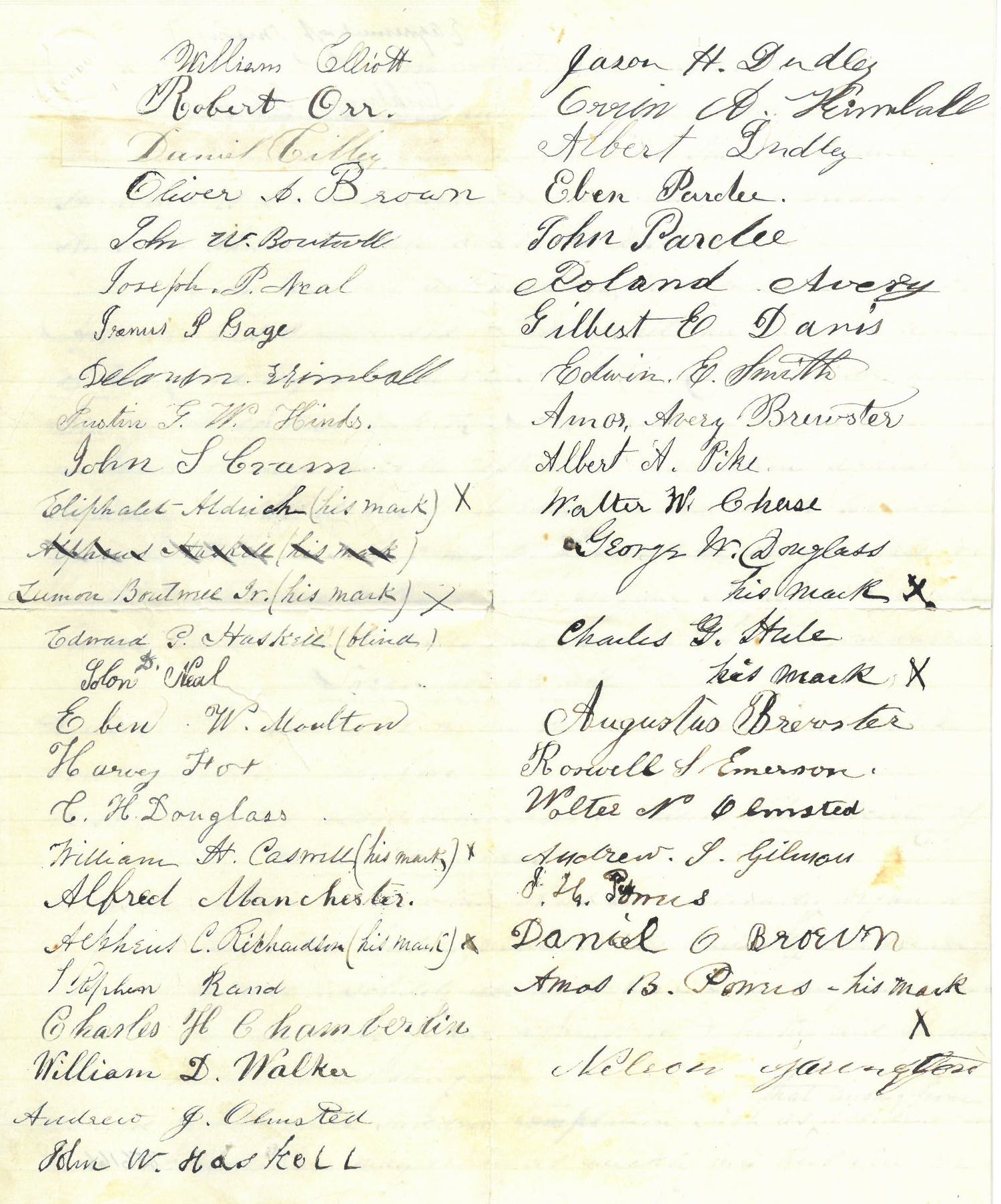
The members of the Society of Self-Watchers vowed to hold steady in their conviction with God’s help even when ridiculed. The agreement was signed by forty-six Hanover men.

Signatures of the members of the Society

To read their resolutions, come to Special Collections and ask for MSS 856166.

Friday, July 15, 2022

A Game of Planchette

paper with ouija board notesRauner Special Collections Library is home to a wide assortment of papers related to the Cornish Colony, a New Hampshire artists' collective active through the end of World War I. Typically, we focus on the big names associated with the colony, like Augustus Saint-Gaudens and Maxfield Parrish. Today however, we're looking at an instance in the lives of the children in residence.

In some papers belonging to Lucia Fairchild Fuller (1870-1924), a painter and member of the colony, there is a set of notes from a ouija board session she conducted with her daughter Clara and other children. Most of the answers provided by the game are next to nonsense, but one particular piece sticks out. When asked to name a set of kittens, the planchette spells out "Drown it, darn it, drat it, and damn it." It's a perfect little piece of creepiness, and apparently it stuck around. According to a note from Clara's own daughter:

'Planchette' - (or the 'Oija [sic] Board' as we call it now-) was a game loved by the children of Cornish... Lucia Fuller joined the game and the saucer rapidly named the kittens 'DROWN IT; DRAT IT; DARN IT; DAMN IT' - an event my mother (CBT) spoke of until the end of her life.

The Fairchild-Fuller family papers are full of artwork, diaries, gossipy letters, and other interesting odds and ends. To read the full notes from this game of Planchette, ask for MS-152, Box 10, Folder 41.

Thursday, March 31, 2022

A Subway for Hanover?

Photo of the broadside, "A Subway for Hanover?"Recently, I found this gem in our “Transportation II” vertical file, entitled “A Subway for Hanover?” Dated 1976, it lays out plans for a rural subway system that would transport Hanover denizens on such lines as the “WART,” the “CHORT,” and the “BOPFAFA-LOOP.” Between these silly names and suggestions like holding discos in the subway stations for revenue, it seemed too good to be true. But it also seemed too detailed to be fake: it includes a New York Times article, a proposed map, and even the name of the planning group. I had to know how much, if any of it, was real.

The supposed New York Times article lists various obstacles to the subway project, including that New Hampshire governor Meldrim Thomson wanted to block funding for it, and speculated to the Union Leader newspaper that “ex-convicts” could be involved. This article appears nowhere in the real New York Times archive, but I suspected that these details were satirizing something else. It turns out that in 1975, just a year before the “Subway for Hanover,” the liberal Franconia College requested a federal grant for an experimental education plan, and Thomson and the conservative Union Leader attacked the college for this plan as well as for its alleged support of “ex-convicts.”

Also according to the “NYT” article, the subway project originated at Brown University, and the broadside credits the plans to the “Carberry Research and Planning Group.” A Brown tradition, beginning with a fake lecture announcement in 1929, claimed that “Josiah Carberry” was a professor who never appeared for his speaking engagements. For decades after, Carberry’s name frequently appeared attached to joke news items. If there was still any doubt that this was intentional, the date on the bottom of the broadside fell on Friday the 13th, which would have been observed at Brown as “Carberry Day.”

But this still doesn’t answer the question: who would put so much effort into these fake Hanover subway plans? Clues are scarce, but there is one interesting coincidence. When the (legitimate) New York Times reported on the Franconia College situation, it mentioned that Arthur E. Jensen, a former professor and dean at Dartmouth College, had criticized Governor Thomson’s actions and endorsed Franconia’s plan. Even though it wasn’t much of a lead, I decided to check Jensen’s affiliate file. Imagine my shock when I opened the file to find it full of articles about the mythical Professor Carberry—because Jensen himself had made the fake posting that started it all in 1929.

Does this prove Jensen is behind the “Subway for Hanover”? Not really. And there’s a long list of other questions that remain tragically unanswered. To those who were here in 1976, we implore you to contact us with any tips you have about this mysterious broadside. In the meantime, we can rest easy knowing no one seriously planned a subway line called the CHORT.

If you want to see everything for yourself, come to Rauner and ask for the “Transportation II” vertical file or Arthur E. Jensen’s affiliate file. Or if you just want to spend a few hours solving a mystery like this one, there are plenty to be found here.

Friday, September 10, 2021

A Decade Undercover as a Communist

Carol Foster's subpoena to the Committee on Un-American Activities
At a Cub Scout meeting in 1945, suburban New Hampshire housewife Carol Foster asked another parent, an FBI agent, “Don’t you have a job in the FBI for someone like me?” So began her thirteen-year career as a counterspy for the FBI, undercover in the Communist Party in New Hampshire, which only ended in 1958 when the House Un-American Activities Committee called her to testify about what she had learned. Foster kept a large scrapbook with mostly clippings of newspapers mentioning her, which include transcripts of the hearing where she appeared.

Front page story about Foster in the Nashua TelegraphReading through these news articles, it’s easy to understand how normalized the “Red Scare” mindset was at the time. Even Foster was asked whether she had any “sympathy with the Communist ideology,” and when she had finished testifying, Congressman Bernard Kearney advised her to ignore the insults of people he dismissed as “Fifth Amendment Americans”—referring to the fifth amendment protection against self-incrimination, which suspected communists relied on in these hearings. This attitude did not bother Foster, though; she believed the FBI had been “sticking to constitutional methods,” and she had no problem with encouraging civilians to call the FBI to report “anything which might seem subversive.” While she felt guilty about revealing people’s personal information herself, she also felt that it was “bigger than [her].”

Part of a newspaper clipping with a transcript of Foster's hearing
It is also apparent in Foster’s scrapbook how much her gender influenced news coverage of the events. Although Foster was celebrated as a hero, headlines pigeonholed her as a “mother,” a “housewife,” and even “pretty” before anything else. When the papers did mention her life outside her FBI career and family, they revealed that she had a home photography studio, and that she enjoyed skiing, hunting, fishing, and flying. Somehow, Foster still found the time to carry out what she felt was her patriotic duty, as a secret from everyone but her husband, for over a decade.

To see Foster’s scrapbook (or her impressive collection of communist publications), come to Rauner and ask for MS-1441.

Friday, May 21, 2021

Fiasco at Fredericksburg

First page of Sargent's letter to Maria, 17 Dec 1862This week we had the opportunity to visit a local 5th-grade classroom via Zoom to talk with them about the American Civil War. The students looked at and analyzed an image from Gardner's Sketch Book of the Civil War, read a military map that provided information about Corinth, Mississippi, and interpreted a personal letter written by a Union soldier, Ransom F. Sargent, to his wife Maria.

Sargent was a Fife Major of the 11th New Hampshire regiment, Company F, and was in his mid-twenties when he joined the army. His letters home to Maria are a wonderful firsthand account of several important battles that Sargent witnessed, including the disastrous Battle of Fredricksburg, the Siege of Vicksburg, and the Siege of Petersburg. Despite the seriousness of his situation, Sargent also discussed smaller and more personal issues in his letter, including news about other New Hampshire men that he knew and comments about what was going on back in New London, New Hampshire, where Maria awaited his return.

For the 5th-grade class, we both transcribed and provided color scans of a letter he wrote outside Fredericksburg, Virginia, on December 17, 1862. In the letter, Sargent reflects on the recent loss by the Union, saying to Maria: "I long to know what the papers say about this battle. Believe me if they call it anything but a terrible slaughter and defeat into the bargain they very much misrepresent the matter. If ever the works behind Fredricksburg are taken it must be done by some strategy. It never can be taken by storm as last Saturday’s battle proves which cost New Hampshire the lives of more brave and true men than the whole of theaccursed South is worth in my opinion."

Soon after the loss at Fredricksburg, Burnside was relieved of his command by President Abraham Lincoln and replaced by Joseph Hooker. Despite the embarrassment of this demotion, Burnside went on to have a successful political career; was elected to the governorship of Rhode Island after the war and concluded as well as serving as the first president of the National Rifle Association in 1871.

To read more letters by Ransom Sargent to his wife Maria, come to Rauner and ask to see MS-38.

Friday, April 9, 2021

All Snow and No Skiing

photo of Malcolm McLane in military uniformHave you all ever heard of Malcolm McLane? He was a New Hampshire boy, a member of Dartmouth's class of 1946, and a skiing enthusiast. He was also an aviator during World War II who was shot down over Europe and spent months in a German POW camp until he and others were liberated by the Russian Army in 1945. Today, for National Former Prisoner of War Recognition Day, we honor his memory and those of many other Dartmouth alums who served their country faithfully and endured bleak conditions as captives in a strange land.

Born in 1924 in Manchester, New Hampshire, McLane attended high school at St. Paul's School in Concord before coming to Hanover for his college education. While at Dartmouth, he was captain of the Dartmouth College Ski Team and continued his dedication to the sport for the rest of his life; in 1960, he served as an international alpine ski official at the Olympic Games in Squaw Valley, California, and was eventually inducted into the Ski Hall of Fame in Ishpeming, Michigan.

Despite this lifelong pursuit of skiing, McLane's access to the pastime was disrupted in the fall of 1942, when he was sworn into the United States Air Force as an aviation cadet. After flying 73 combat missions in P-47 fighter planes over France and Germany, his plane was shot down on December 23rd, 1944, near Trier, Germany, during the Battle of the Bulge. He was freed on the evening of April 30th after over four months of confinement in Stalag Luft I, a German prisoner-of-war camp near Barth, Germany.

McLane sent several postcards to his mother in Manchester during his imprisonment, most of them only a sentence or two in length. In those messages, he chose not to describe the harsh conditions of the camp
(probably to alleviate his mother's worry) and instead sighed over the fact that, despite the preponderance of snow in January, he wasn't able to go skiing in it. This observation was likely equal parts truth and a desire to protect those he loved.

Even if you haven't ever heard of Malcolm McLane before, you've probably heard of his daughter, who is an ardent advocate for the rights of US war veterans, both nationally and in her home state: Ann McLane Kuster, a member of Dartmouth's class of 1978, currently serves as the U.S. Representative for New Hampshire's 2nd congressional district (and has since 2013).

To explore Malcolm McLane's papers at Dartmouth College, come to Rauner and ask for MS-1051.

Wednesday, August 19, 2020

Haptics: The Terrain Between Accessible Design and Universal Design

Atlas of the United States - title page

Image of title page from the Atlas of the United States : printed for the use of the blind by S.G. Howe. Rare Book G1200 .H7 1837


Map of New Hampshire in Boston Line Type

Image of a map of New Hampshire printed without ink in Boston Line Type. 

Needlework - Sentiments

Image of needlework from a collection with text: "Sentiments, signed." Manuscript 001924 See also: Laura Bridgman hand work (doilies, carving): MS-1207. Hanover (N.H.) Historical Society records, folder 17, box 23.

Laura Bridgman

Image of Laura Bridgman. Laura Bridgman and S.G. Howe worked extensively together, including at the Perkins School for the Blind.

Consider: Touch This Page

'Perkins Archives partnered with Northeastern and Harvard Universities to create "Touch This Page! Making Sense of the Ways We Read," an exhibition about multisensory experiences of reading. The exhibit focuses on the work of Perkins founder Samuel Gridley Howe, who developed a tactile form of the print alphabet known as Boston Line Type. Included on the website are 3D printed copies of Perkins Archives artifacts that are available for download.'

Citation: Special Issue on Tactile Fluency. Future Reflections, volume 38, number 2 (2019). National Federation of the Blind. National Organization of Parents of Blind Children.

Friday, February 7, 2020

A Sea Serpent Near Boston?

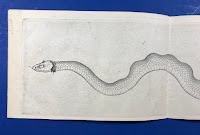
Diagram of the head and serpentine body of the supposed Gloucester sea serpent.
Diagram of the supposed
Gloucester Sea Serpent.
You’ve likely heard of Scotland’s famous aquatic cryptid who lives in Loch Ness, but what about the Gloucester sea serpent, which was said to have frequented the coast of Massachusetts a mere 30 miles north of Boston? The massive creature was supposedly sighted by multitudes of fishermen and townspeople in August of 1817, leading to a scientific investigation by the Linnaean Society of New England which sought to determine the “existence and appearance” of the beast. Here at Rauner, we house the official report which was produced after a committee questioned 11 witnesses regarding the Gloucester sea serpent’s size, coloring, and behavior.

In honor of this year’s Winter Carnival theme - "A Blizzard of Unbelievable Beasts" Rauner is hosting an interactive exhibit featuring books from the Renaissance through the 19th-century which document the many fantastic beasts - from unicorns to griffons to sea serpents - which were thought to roam the less-explored lands and oceans around the globe.  One of our favorite items which will be on display this afternoon for our “Unbelievable Beasts” exhibit is the aforementioned Gloucester sea serpent report, titled “Report of a Committee of the Linnaean Society of New England Relative to a Large Marine Animal, Supposed to be a Serpent, seen near Cape Ann, Massachusetts in August 1817.”

The Linnaean Society of New England (1814–1822) was established in Massachusetts, to promote the study of natural history. The Society ran a science museum, arranged lectures on topics ranging from mineralogy to ornithology, and excursions for its members. Before it became a central figure in the so-called “Gloucester sea serpent debate”, in the summer of 1816, society members travelled through Hanover on their way to explore New Hampshire’s White Mountains. Whilst in New Hampshire, the group surveyed Mount Monadnock and Ascutney among others, studying their mineral composition and searching for new species (they documented 4 new species of plants).

On August 18th, 1817, the Linnaean Society convened to investigate reports of an extraordinary “sea serpent” which had been making waves (pun intended) around Gloucester and Cape Ann, Massachusetts. The group formed an investigative committee which created systematic questionnaires, each containing 25 targeted questions meant to ascertain the nature of the sea serpent, including “How many distinct portions were out of the water at one time?” and “Had it gills and breathing holes, and where?” Within a few days after the initial sightings had been reported, the three committee members and the “Honorable Lonson Nash of Glouchester” met with 11 locals who professed actually to have seen the animal in question, first asking them to explain everything they remembered from the sea serpent encounter, and then recorded their responses to targeted questions. In order to keep the report as ‘scientific’ as possible, the examinations were done separately, and “the matter testified by any witness (was) not to be communicated until the whole evidence was taken.”

Title page of the Gloucester sea serpent report. According to eyewitnesses, the serpent was between “eighty and ninety feet in length and about the size of a half barrel, apparently having joints from its head to its tail.” Contrary to the typical renditions of glistening green sea serpents, the majority of the accounts describe the creature as a dull dark brown without any spots. The creature was capable of moving at extraordinary speeds, as according to one testimonial it could “travel a mile or two in three minutes” and even faster underwater. Although the serpent was observed during midday in most cases, it’s rather shy nature and quick movements made it difficult for any of the observers to get a good look at its facial features. Despite a general consensus on it’s large size, scaly skin, and fast undulating movements, it’s face looked “much like the head of a sea turtle” to one observer, yet “formed something like the head of the rattlesnake, but nearly as large as the head of a horse” to another fishermen who observed it the same day. The committee members asked witnesses whether they’d possibly mistaken other natural phenomena for a serpent, including “a number of porpoises following each other in a train”, but the answer was always a resounding “no.” As one witness responded, “I was in a boat, and within thirty feet of him… I could see his scales.” To those who testified, there was apparently no doubt that they had encountered a large serpentine beast.

Although most of the Gloucester sea serpent encounters documented in our committee report were rather uneventful - often involving the animal swimming by and occasionally stopping at the surface of the water to apparently rest and survey its surroundings - the seventh witness, Matthew Gaffney, had a rather frightening experience. Gaffney, a ship carpenter from Gloucester, recalled that on August 14th, 1817, he saw the sea serpent between 4 and 5 o’clock in the afternoon when he was out in the harbor sailing his personal vessel with his brother Daniel and friend Augustin Webber. As Gaffney explains it, “I was within thirty feet of him. His head appeared full as large as a four-gallon keg; his body as large as a barrel, and his length that I saw, I should judge forty feet, at least…. I fired at him, when he was nearest to me. I had a good gun, and took good aim. I aimed at his head, and think I must have hit him. He turned towards us immediately after I had fired...he was coming at us.” The scene didn’t end with an epic Jaws-worthy fight however, for as soon as the creature was hit it “sunk down and went directly under our boat, and made his appearance at about one hundred yards from where he sunk… (he) continued playing as before.” Gaffney was incredulous that he was unable to kill or otherwise wound the animal, making sure to highlight his marksmanship skills in the interview, stating, “My gun carries a ball of eighteen to the pound; and I suppose there is no person in town, more accustomed to shooting, than I am.”

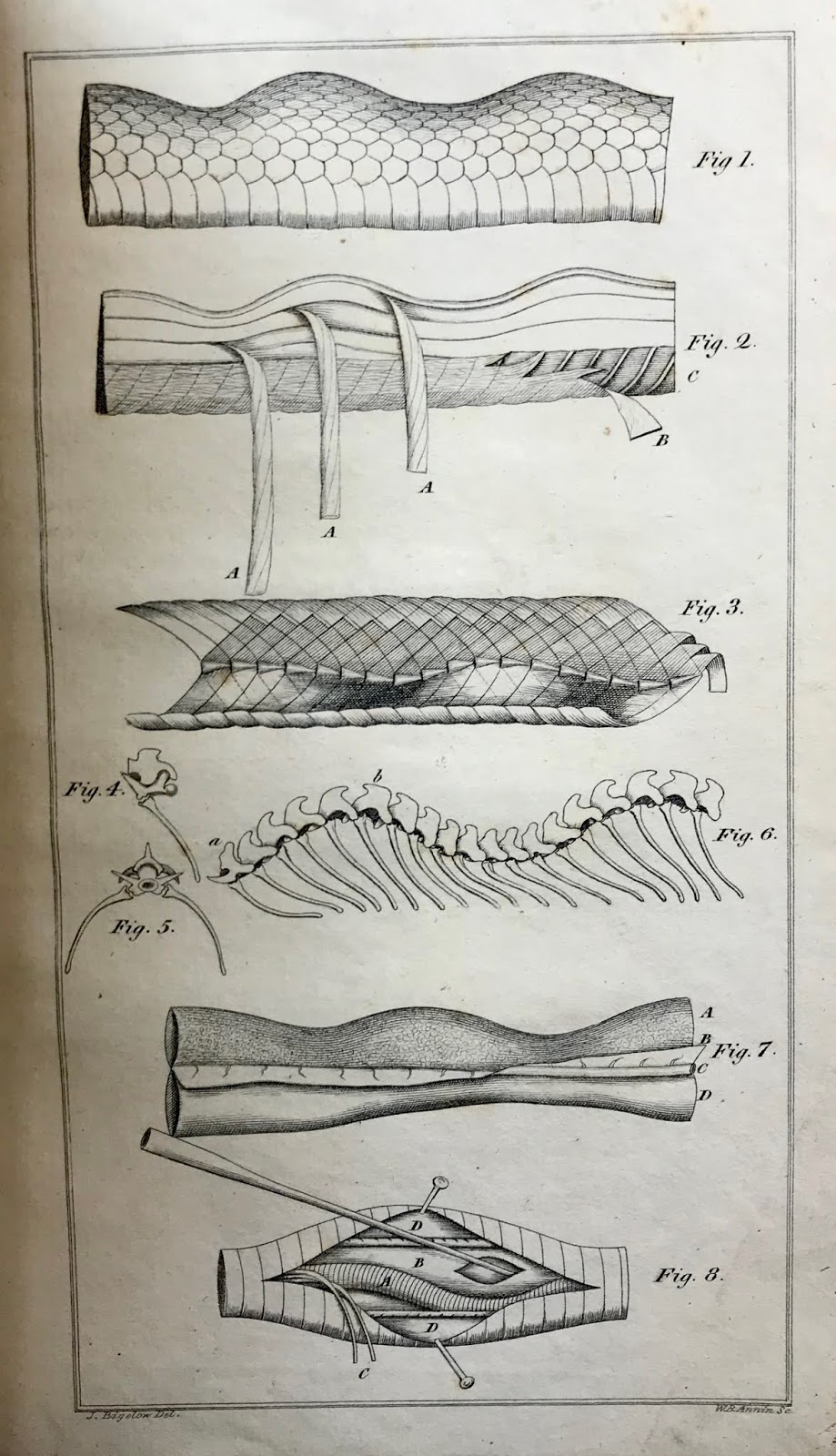
So, what precisely did the Committee of the Linnaean Society conclude about the sea serpent? They don’t state a definite “yes” or “no” answer, however if the report were a Magic 8-ball it would read “All signs point to yes.” For example, the report includes illustrations of a smaller Cape Ann sea animal actually examined and dissected, which the authors likened to "a remarkable serpent, supposed to be the progeny of the great serpent." The small serpent, which had unusual bumps along its back, was taken as concrete evidence that a larger sea serpent must exist. Additionally, to accommodate their ‘discovery’, the Linnaean Society established a new genus - Scoliophis Atlanticus - and included a diagram of what the adult animal must look like at the front of their report. As the reporters remarked following their interview sessions, “the deponents were interrogated separately, no one knowing what the others had testified, and though they differ in some few particulars, still, for the most part, they agree.”
Diagrams drawn from dissecting the supposed baby Gloucester sea serpent, which was actually a deformed black snake.
So what happened to the Gloucester sea serpent, and what about the supposed baby serpent collected in Cape Ann? At first the reports led to impassioned debates on both sides about the creatures' existence. An editor of the Philadelphia newspaper at the time wrote an editorial stating. “The evidence of the existence of the Sea-Monster is conclusive and irresistible.” Perhaps it was too irresistible though, as a French naturalist that acquired the supposed baby sea serpent soon concluded what had been thought to be a new species was in fact a common black snake (Coluber contrictor) whose spine undulated due to a skeletal disease. As the news broke, scholars questioned the validity of the Society’s report, and when the group disbanded in 1822 nobody followed up with further inquiries. Perhaps local residents of Gloucester really did see a remarkable marine animal in the summer and fall of 1817, but we’ll likely never know for sure.
To read this sea serpent story for yourself, stop by Rauner Library today and ask to see Rare QL 89.2.S4 L56 1817.

Tuesday, January 7, 2020

Hitting below the Belt

Front of letter to selectmenWe were digging though the Hanover Town Records for documents pertaining to the poor farm for a class next week on poverty in the 19th century. There was not a Federal safety net, and not much on the state level, so individual towns and counties ran poor farms for the indigent. We have file after file of sobering affidavits and letters documenting the plight of the poor.

Back of letter to selectmen
One jumped out at us because of the rhetoric it employed. In 1860, the aged Mrs. Hastings sought relief due to some unfortunate event in her life: her son only alluded to it in a letter by saying "I need not ever name the cause of her unhappyness." She desperately wanted to stay out off of the poor farm, but no one in her family had the means to keep her and the Selectmen of Hanover seemed to have little pity for her case. There are several letters back and forth between the town and her son and her grandson. The family offered to take her into the grandson's home if only the town would pay thirty cents a day for her board. The town repeatedly denied the request, and her grandson finally resorted to saying that sending her to the poor farm would be tantamount to one of the worst horrors of slavery: he said his reason for writing was "to relieve the feelings of an aged woman lame and infirm for what to her is like separating the families of the black slave."

Damn, that is harsh, especially directed at northern government officials just before the start of the Civil War, but it points to the treatment of the poor in the 19th century when poverty warranted the removal of individuals to the poor farm, and often the separation of children from their parents.

To see the letters, and many other similar stories, ask for DH-1, Boxes 10799 and 10801.

Tuesday, October 29, 2019

Tales from the Old Burying Ground

Student lying on the ground in the Dartmouth Cemetery with title adn URL of podcast "Tales from the Old Burying Ground: Stories Inspired by the Dartmouth College Cemetery." dartmouthcemetery.podbean.comWe are very excited to announce the launch of a second podcast series related to items that can be found in our collections; items that will lead you straight to ... the Dartmouth College Cemetery.

Rauner’s Ilana Grallert has been giving tours of the cemetery for several years and has become the resident expert on all matters cemetery. This year, she and Colleen Goodhue of DCAL have produced a podcast entitled Tales from the Old Burying Ground--Stories inspired by the Dartmouth College Cemetery. Each episode is conceived, written and narrated by a Dartmouth College student.  There are stories about blackmail, emancipated slaves, fraternities and murder. Part of the 250th celebration, the eight-part podcast will launch, fittingly, on Halloween with new stories being released weekly.

Over the years we have highlighted several aspects of the cemetery including the story of William Worthington Dewey and the journal he kept of the deaths in “the vicinity of Dartmouth College,” as well as Arthur H. Chivers, Class of 1902 and professor of botany at Dartmouth College who painstakingly reconstructed the entire layout of the cemetery.

Other blogs about the cemetery include the story of the Risley family, stonecutters who created many of the descriptions on the 18th century and early 19th century stones and “Trembling for the Relics of Their Dead,” the story of a group of Dartmouth College Medical School students who were caught graverobbing.

Tuesday, September 24, 2019

The Wine Hills of New Hampshire

Title page of Hubbard's "Narrative of the Troubles with the Indians"
This week, Rauner Special Collections Library's reading room is abuzz with independent student explorations of numerous and various maps of the American continent from the 16th, 17th, and 18th centuries. Tasked by Professor Paul Musselwhite to identify a location of interest and then track how its representation changes over time, the Dartmouth students have been poring over musty old tomes in the hopes of finding a small portion of the world that captures their interest enough to write a paper about it. Some of these students have even ventured beyond the cart of curated materials and have requested books that extend their knowledge of the Americas beyond what was shown to them in an earlier class session here in Special Collections.

One such book is William Hubbard's Narrative of the Troubles with the Indians. Printed in 1677, this handsome little volume is the locus for a puzzling map mystery that has
confounded scholars for centuries. Little did the student know when she requested it that she would open a can of cartographic worms. Hubbard's book was printed in New England and in London, and each edition contains a map of New England. Here is where the trouble begins, for the American map is the first known to have been published of the English colonies of North America, and lists the "White Hills" of New Hampshire, now known to us as the White Mountains. However, the English map, while very similar, refers instead to the "Wine Hills." While perhaps a supernatural premonition of the sorts of activities that have happened far too often on campus, this designation is an obvious factual error. The enigma for map scholars, however, is whether or not these two maps were made by the same engraver and which of them was made first.

To see one of the earliest perspectives of New England, come to Special Collections and ask to peruse McGregor 79.

Tuesday, June 4, 2019

A Coin Worth Impeachment

Letter from Teddy Roosevelt to Augustus Saint-Gaudens, 31 May 1901 We've alluded in the past to the artist Augustus Saint-Gaudens' commission from President Theodore Roosevelt to design a twenty-dollar gold coin. However, the actual letters between the two distinguished men deserve further comment. The context, too, is worth knowing. In the decade preceding the design of the coin, Saint-Gaudens had experienced several frustrating interactions with the United States Mint, including the rejection of his design for the official medal of the Chicago World's Fair in 1892. Instead, the directors went with a design submitted by the Mint's Chief Engraver, Charles Barber. Saint-Gaudens and Barber had both been on a silver coinage selection committee for the Mint in the previous year; after the committee failed to find a suitable artist, Barber had put himself forward as the only qualified candidate for the position (in his estimation). Saint-Gaudens disagreed and publicly criticized Barber's final product, saying that the work was inept and looked like the work of a sixteen-year-old beginner.

After these two experiences, Saint-Gaudens swore off working with the Mint in any capacity. True to his word, he rejected any and all commissions that might have any connection to the organization, no
Letter from Teddy Roosevelt to Augustus Saint-Gaudens, 6 November 1905
matter how tenuous. By 1904, President Teddy Roosevelt evidently felt the same way about the state of the nation's coinage. He reached out to Saint-Gaudens, with whom he had become friends, to see if the sculptor might be willing to help design some gold coins. Roosevelt, of course, had strong opinions about the appearance of the coinage. In a letter to Saint-Gaudens, written on November 6th, 1905, he says, "I was looking at some gold coins of Alexander the Great to-day, and I was struck by their high relief. Would it not be well to have our coins in high relief, and also to have the rims raised?"

Saint-Gaudens complied with the president's "suggestions" and ultimately produced model coins that delighted Roosevelt. In a letter to Saint-Gaudens dated December 20th, 1906, Roosevelt says, "These models are simply immense - if such a slang way of talking is permissible in reference to giving a modern nation one coinage at least which shall be as good as that of the ancient Greeks." He goes on to say that he has ordered the Mint to begin production immediately and hypothesizes that  he "shall be impeached for it in Congress" but that he "shall regard that as a very cheap payment!" Saint-Gaudens would never really see his final design reach fruition, however. He died of cancer in August of 1907, just a few months before production finally began on the coins.

Letter from Teddy Roosevelt to Augustus Saint-Gaudens, 20 December 1906Later this month, nearly a hundred and twelve years after his death, the Trustees of the Saint-Gaudens Memorial will award the Saint-Gaudens Medal to Dartmouth College Library in recognition of its care and preservation of the sculptor's papers. The Medal is being given to the library for its exemplary care and conservation of the collection of papers and artifacts relating to Augustus Saint-Gaudens, other artists of the Cornish Colony, and the Saint-Gaudens Memorial. Established in 1988, the Saint-Gaudens Medal is awarded, from time to time, by the Saint-Gaudens Memorial to such persons who, by their talents and beneficence, have made a distinguished contribution to the arts in America in the high tradition of Augustus Saint-Gaudens. The Saint-Gaudens Medal was designed in 1992 by sculptor Robert W. White (1921-2002), a long-time Trustee of the Memorial.

To read more about Dartmouth College Library's receipt of the medal, read the press release. To read the correspondence between Saint-Gaudens and Roosevelt, come to Special Collections and ask for the Saint-Gaudens Papers (ML-4), Box 16.

Friday, May 10, 2019

APB: Who Needs a Photograph?

Full Procalmation from State of New HampshireWe just picked up a new bit of ephemera from the 1891 Christie Warden murder case. Since we have blogged the case before, we won't recount it again. The item we just bought is a proclamation from the state declaring a $4,000 reward for the convict's capture. It is one of the most bizarrely thorough descriptions of a convict we have ever seen. It starts out normal enough, listing the suspect's age, weight, and height, complexion and eye color, but then it gets a bit weird:
...brown hair, but not shading on the red, thin on top, high forehead, hair growing down to point in centre, usually wore coarse stubby mustache; sometimes uses black cosmetic to make mustache and eye-brows match hair; often speaks of his classical nose.
Cosmetics? Speaks of his classical nose?  It goes on...
Fine set teeth, even and white; slight crow-foot marks about eyes. Large hands and wrists thickly covered with hair from which extends over his arms and body. Hands stubby in shape and course, though he takes excellent care of them. Has scar on left fore-arm made with corn cutter, which runs diagonally across. Small scar on right fore-arm made, he says, by bullet passing through.
 The little "he says" set off in commas is telling. In the next paragraph they doubt his bravado again: "Had, when he left Hanover, a russet leather valise of good size, nickeled trimmings with top end fastenings for which he claimed to have given fifteen dollars."

Detail of "Description of the Murder"
Then they give a description of his clothes down to the underwear, the serial number of his watch, and warn that he also carries a "44 revolver, perhaps two." It would have been good to know that at the start.

Then there is his past:
Said he was born in Maine and had attended school near Portland; claimed to have lived in the South and frequently spoke of himself as a Southerner; said he worked on a milk route in and about Lynn, at time of big fire there; but was very reticent concerning earlier years. Has spoken, in confidential way, admitting that his past life had been very wicked and dissipated, though not known to have drank liquor while in this state. Well educated and writes readily and well.
Okay, if I get in a conversation with this guy, I'll know who he is--if his classical nose, cosmetics, hairy arms, valise and watch, and tales of the South don't give him away, the two revolvers might.

We will get this cataloged soon and give you call number to request it.