Friday, September 19, 2025
Exhibit: "From Vision to Reality: The Appalachian Trail from Then to Now"
Friday, July 12, 2024
Rambling Boys and Ballads Migrant
Joseph Goffe was a New England minister and member of Dartmouth's Class of 1791. We have a few manuscripts connected with him -- primarily letters and sermons. We also have his 1783-85 notebook where young Goffe did some accounting for the labor and costs of building a new sawmill in Bedford, N.H. At the back of this notebook Goffe transcribed a few songs, one of which is "Rambling Boys." The manuscript is discussed by the Vermont-based ballad collectors Helen Hartness Flanders and Marguerite Olney in their 1953 book Ballads Migrant in New England, as well as in modern folk song indexes. As far as we can determine, Goffe's notebook represents the oldest surviving version of the song.
The intentional collection and recording of folklore gained momentum in the 19th century, influenced in part by nationalism and concerns that the lore of rural people, passed along by oral tradition rather than in writing, would be corrupted or lost in a rapidly changing world. While this premise was flawed and led to a lot of questionable academic practices, it also led to a mass recording of beliefs, crafts, music, and other ways that people engaged with their world. Goffe recording "Rambling Boys" at the back of his sawmill ledger established a small fixed point -- how one version of this song went at this specific time, and that a teenage boy liked it well enough to write down the words.
To see the manuscript, ask for Mss 783626. To see Ballads Migrant, ask for Alumni Alcove F9296bal.
Friday, December 9, 2022
Maxfield Parrish's Palette
Earlier this week, or perhaps it was last week, we had the good fortune to witness a beautiful sunset while walking out onto the Green. The radiant pink and purple clouds were stunning with the blue sky behind them, and it brought to mind the color palette of a certain painter and illustrator who lived and died in Plainfield, New Hampshire, only a dozen miles or so from the Dartmouth campus. Maxfield Parrish was born in Philadelphia, Pennsylvania, in 1870; he was raised in a Quaker society and attended Haverford College, like any good Pennsylvania Quaker should. He then attended the Pennsylvania Academy of the Fine Arts and studied under Howard Pyle at the Drexel Institute of Art, Science, & Industry.In 1898, Parrish and his wife moved to Plainfield, where he became an
important member of the Cornish Art Colony. Famous sculptor Augustus Saint-Gaudens was at the center of this gathering of artists and other creatives, which at times swelled to nearly one hundred people in size. After Saint-Gaudens died in 1907, the colony slowly dissolved. However, the Upper Valley had clearly made an impression on Parrish. He continued on in New Hampshire until 1966 when he died here at the ripe old age of 95.
Parrish was a wildly successful illustrator for over fifty years and the Upper Valley was his muse. Whenever we step outside and behold the glory of another New Hampshire/Vermont sunset, we always feel a kinship with him and, perhaps, that same sense of awe that he first felt upon settling here. Come to Rauner if you want to stumble upon even more stunning vistas within the Maxfield Parrish papers (ML-62).
Friday, February 11, 2022
Spies among us
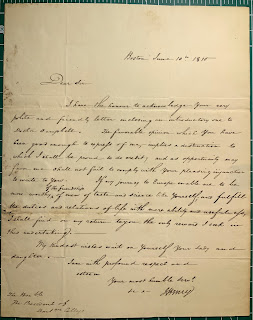
Written in 1810 by a formal military officer and sometimes Vermont farmer, John Henry, from his quarters in Boston, the letter thanks John Wheelock for a letter of introduction and expresses Henry's desire to get to know more people of Wheelock's social standing. Why might John Henry have been trying to get to know more social elites in the young republic? Well, at the time he was busy spying on the United States for the Canadian colonial government. When London failed to pay for his work, Henry switched allegiances and sold all of his information to the U. S. government. The result appeared to be another justification for deepening distrust of the British in the lead up to the War of 1812. It sounds kind of like a Mission Impossible plot: a spy cozying up to those in power, turned against one government and flipping to the other side when the profit margin reached the right level. [Cue Mission Impossible theme]
To see the letter ask for Mss 810360. Have a great Carnival!
Tuesday, November 12, 2019
"An Acquisition"
Henry Turner was part of an exodus of black families fleeing slavery after they discovered that the Union soldiers were across the river in Virginia. We do not know why Atherton hired Henry, nicknamed "Vort." Unions soldiers were allowed to have servants and Turner stayed with Atherton in that capacity. In his diary for the day Atherton wrote, "Take a little contraband, 15yr. old from the Provost Marshall’s for a servant with his mother’s consent. His name is Henry Turner [Vort]."I am writing at Colonel Veasey’s headquarters. I have made an acquisition today, viz: Henry Turner a contraband 16 years old, bright and active. He left his Secesh Master yesterday. His mother with four children and three grown women have gone to Washington. The boy will go with me wherever I go and finally, I presume to Vermont.
On April 16, 1862, Atherton was severely wounded at Lee’s Mills during General McClellan’s peninsular campaign and resigned on August 12, 1862. It was then that Turner came home with Atherton to Vermont. By all accounts, Turner was accepted into the family. He lived with the Athertons in Cavendish, Vermont, where Henry Atherton’s mother Roxane taught him to read and write and made him clothes.
By 1864, Turner had mastered writing and he wrote a letter to Atherton appearing to ask for a wage increase of "one dollar," which Atherton agreed to pay him. That same letter also includes news written by Atherton’s brother Joseph who felt that "Vort has worked hard for the Dollar but has not made so much progress in writing as he ought to." With Henry Atherton being occupied with his legislative duties, Turner worked primarily with and for Joseph on the farm and sawmill.
When he was suitably prepared, Turner attended the Duttenville district school, the same school Henry Atherton had attended as a boy. We do not really know what became of Turner, although, in another letter he sent the family in 1879, he describes his work in Boston as a driver for "the richest man in Cambridge."
Henry B. Atherton’s correspondence is part of his papers (MS-1409), which we have recently acquired and processed.
Friday, May 17, 2019
Edwin Drood through the Spirit-Pen
Charles Dickens was in the midst of writing The Mystery of Edwin Drood when he died suddenly on June 9th, 1870. The first three installments had already been published, the fourth and fifth were complete, and the sixth was partially finished. The problem was that it was to be a novel in 12 parts, so the book was only half finished... and it was a mystery!Of course Dickens was writing the novel as he went and he didn't even leave notes behind for the rest of the story. The publishers decided to just cut it off and call it a fragment, leaving a public wondering "who done it?" Luckily for the world, Brattleboro, Vermont, publisher T. P. James heard a voice from beyond. About a year after his death, Dickens began to dictate the conclusion to The Mystery of Edwin Drood to James. Why Dickens chose a small publisher in Brattleboro is anyone's guess, but James followed Dickens's instructions and published The Mystery of Edwin Drood Complete in 1873. The completed novel advertised itself as:
Part Second of the Mystery of Edwin Drood by the spirit-pen of Charles Dickens, through a medium. Embracing, also, that part of the Work which was published prior to the termination of the Author's Earth-Life.There is a preface by the medium (none other than the publisher) with a strong defense of the second half of the work as well as an author's preface by Dickens. Both the author and the medium chide critics who doubted the veracity of authorship. Dickens also provides a glimpse of the afterlife, assuring the public that Hell does not exist and that the spirits of those we have lost are still among us, just occupying a different plane of existence. But, far more important than solving the mystery of the afterlife, The Mystery of Edwin Drood is also solved. We won't give that away--to find out come in and ask for Val 826 D55 T411. You can also see the original six parts by asking for Val 826 D55 T413.
Friday, August 11, 2017
Vermont's Appeal...
...well, this time of the year it is the weather and the blueberries, but Stephen Bradley had something different in mind in 1779. At the time, the newly independent states of New Hampshire, New York, and Massachusetts all had various claims on chunks of land in Vermont. It had not been one of the original colonies, but was being actively settled and contested, and of course was the site of several major Revolutionary War battles.
Bradley advocated for Vermont's standing as an independent state and the arguments laid out in this pamphlet were instrumental in Vermont's eventual admittance to the Union as the 14th state in 1790. Our copy is inscribed by the author to Colonel Charles Sims of Virginia, a lawyer with considerable political clout in the new republic whose support Bradley would need.To see our copy, ask for McGregor 23.
Wednesday, July 12, 2017
Camp Fire Girls
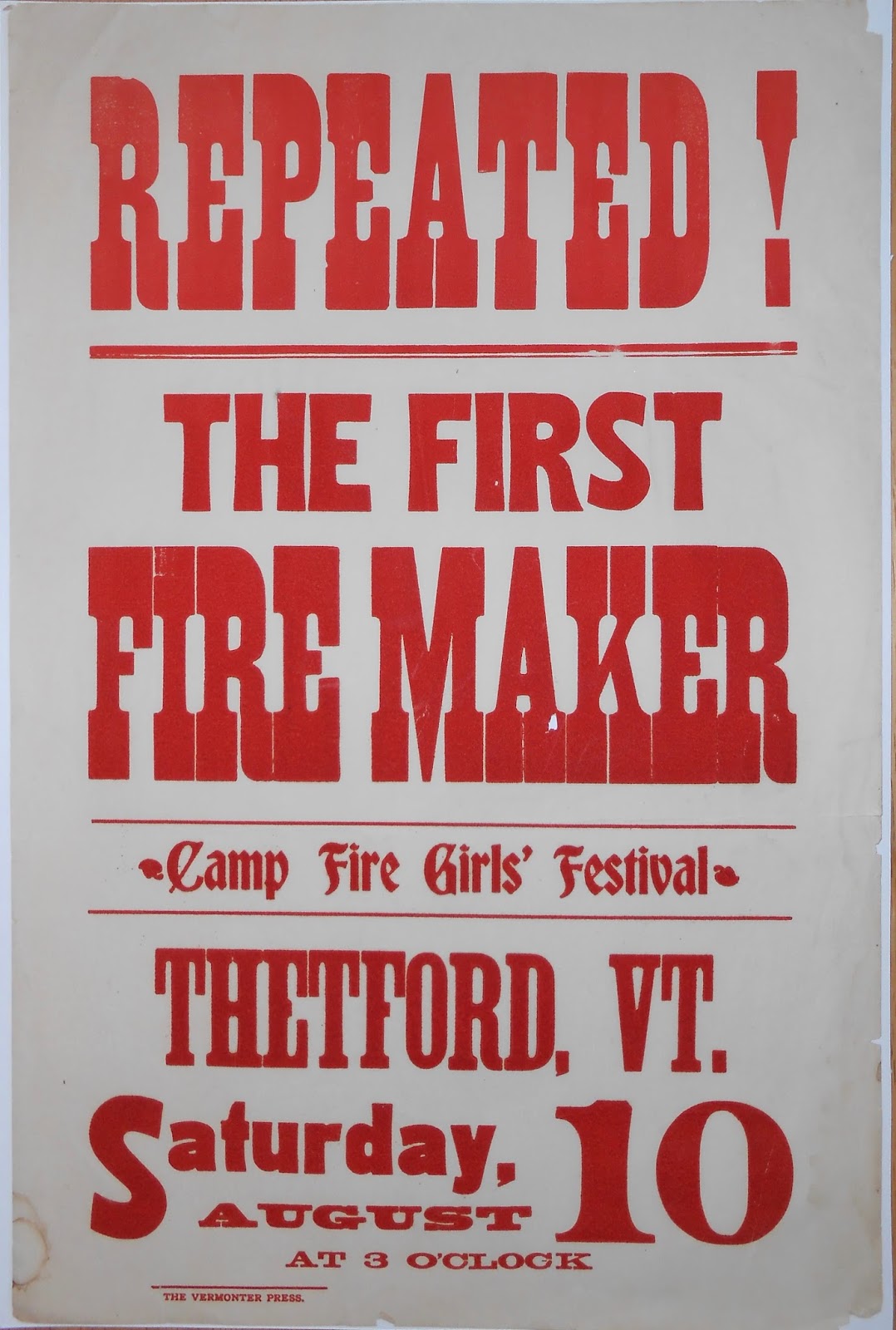
The Camp Fire Girls were founded just up the road from here in Thetford, Vermont, to give girls the same opportunities their bothers had in the Boy Scouts. We just acquired this poster from their 1912 festival with "The First Fire Maker" as the main performance. This complements correspondence between Percy MacKaye and Camp Fire Girls founders, and Luther and Charlotte Gulick. Percy, a multi-talented writer contributed to the first Camp Fire Girls songbook, and appears to have been a friend of the fledgling progressive organization.The poster is a great example of local printing (the Vermonter Press) from wood display type. It simple layout combines with the rich red ink to make an immediate impact.
We are still cataloging this one, but we will add the call number when we have it (and here it is! Broadside 912640). To see the Gulick's letters to Percy MacKaye, ask for ML-5, Box 39, Folder 10.
Friday, November 20, 2015
A Warning of Things to Come
We usually miss the early signs of impending doom and only later look back and piece together the clues. But one Dartmouth faculty member saw with sobering clarity the spread of the 1832 cholera pandemic into North America. On June 18, 1832, Benjamin Hale, professor of Chemistry, wrote a letter to his father reporting that a ship had arrived at Quebec and "40 or 50 persons are said to have died on the passage." Worse, another report stated that of the 90 people who had contracted cholera in Montreal the week before, 60 had died.Then it gets scarier: the Hanover postmaster said that one person had died on a boat coming from Montreal to Burlington that week, and there was another unconfirmed case "at the extreme southern part of Lake Champlain." He went on to warn:
There seems to be no doubt that this dreadful disease has at length reached this part of the world and we may expect it to sweep over our land. And we should each be prepared for its visitation. It will doubtless sweep thousands into their graves with very little warning--We ought to anticipate its approach and be ready if it should summon us to our account.He was right. The pandemic ravaged North America, killing well over 100,000 people, often within 24 hours of the first sign of illness. To see the letter ask for MS 815363.
Tuesday, August 19, 2014
A Head Full of Steam
If you've ever traveled across the Connecticut River between Orford, New Hampshire, and Fairlee, Vermont, then you did so on the Morey Memorial Bridge. The steel span, finished in 1938 and now listed in the National Register of Historic Places, was named for Samuel Morey, a resident of both Orford and Fairlee who was instrumental in the construction of the river locks between Connecticut's Windsor Locks and Olcott Falls in New Hampshire (now the site of the Wilder Dam).
However, Samuel Morey is perhaps better known today, at least around these parts, as the man who should rightfully be called the inventor of the steamboat as we now know it. Although Robert Fulton is generally regarded as the proper holder of that title, he instead should be credited with making the steamboat a commercially viable concept. Morey had built and successfully operated a steam-powered paddleboat in the early 1790s, more than a decade before Fulton's Clermont sailed up and down the Hudson between Albany and New York City in 1807. In fact, some historians speculate that if Morey had been a better businessman, his name would be synonymous with the steamboat, and not Fulton's. The financier for Fulton's "invention," Chancellor Robert Livingston, had originally approached Morey with an offer of $7,000 to use his invention. When Morey refused, Livingston turned to Fulton instead, and the rest is history.
The Samuel Morey papers at Dartmouth bear testimony to Morey's early inventive endeavors. They contain numerous United States patents for various inventions related to the use of wind and steam power and provide a veritable who's who of Founding Father signatures, from George Washington and Thomas Jefferson all the way up to Andrew Jackson. One of Morey's first patents, filed in 1793, involves a wind-powered cooking spit. One of his last is concerned with an improvement of the "decomposing and recomposing of water in combustion with spirits of Turpentine," filed in 1833.To see Morey's patents and other papers, ask for Rauner MS-150.
Tuesday, February 19, 2013
Picturing the Past
![]() | |
| South Main Street White River Junction, VT |
![]() |
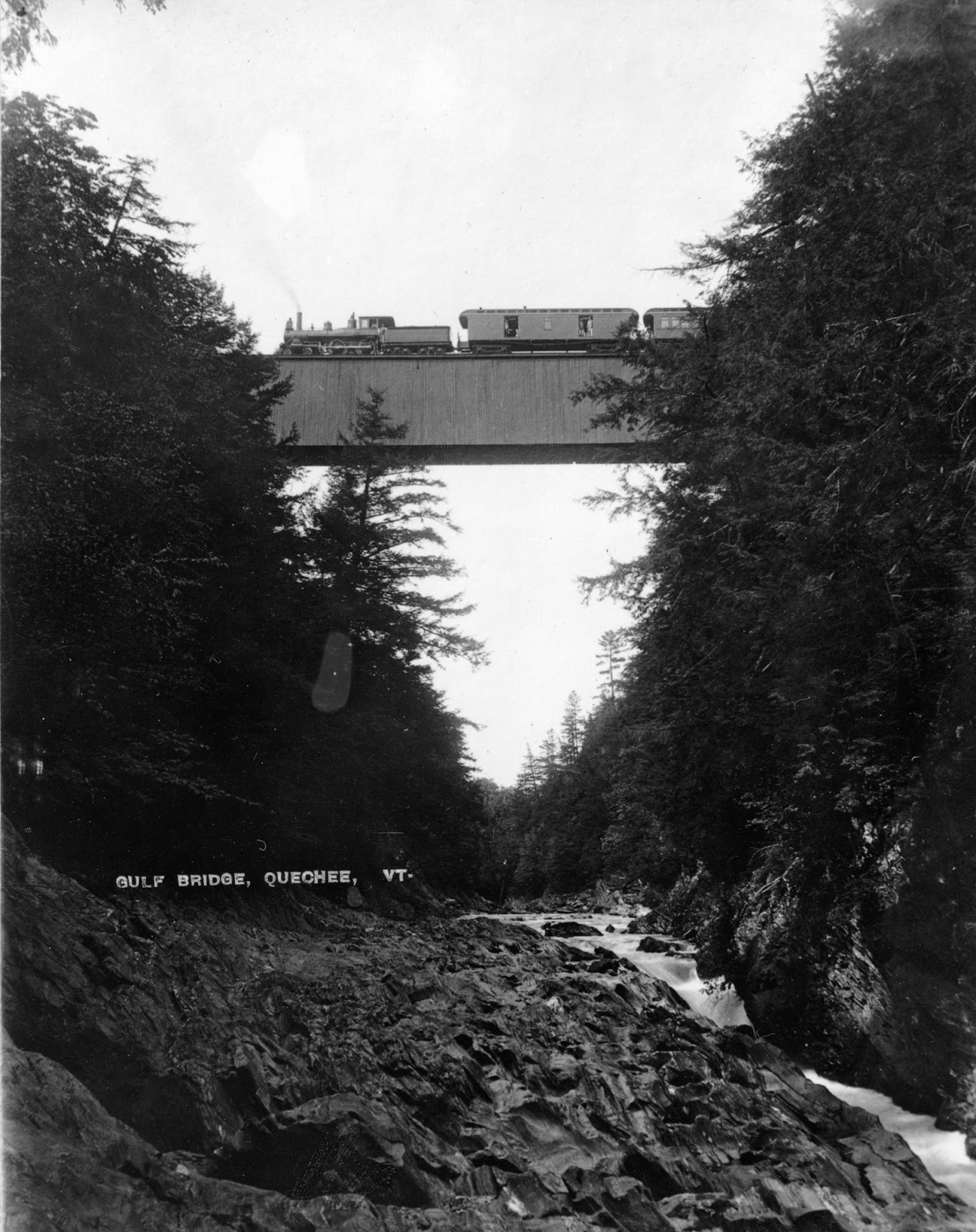
| Gulf Bridge Queechee, VT |
![]() |
| Mascoma Lake Enfield, NH |
Friday, June 3, 2011
The Flood of 1927
On November 2, 1927, the forecast in Vermont called for "fair and colder." However, as with many predictions, this one proved false. Around 9:00 PM that evening, the rain started. It didn't stop until two days later and almost nine inches of rain had fallen - the same as had fallen for the previous two months combined.The already saturated ground was unable to absorb the additional water and the rivers overflowed, causing one of the worst natural disasters in the history of Vermont. Many of the towns along the rivers were severely damaged as cars, trains, roads, bridges and even buildings were washed away.
Hanover is located on a hill overlooking the Connecticut River and escaped flooding damage, but the nearby towns of Hartford and White River Junction were devastated. In White River Junction, the water level reached some second floors after rising 38 feet over its normal level. Dartmouth students, including Nelson Rockefeller '30, aided in the recovery effort and according to a local newspaper account, were organized into nine divisions of one hundred and set to work removing the accumulated mud and debris. After a long day of recovery efforts, the local Police Chief, perhaps somewhat optimistically, declared that the homes the Dartmouth men had worked on would be "almost as good as new," thanks to the students' efforts.
![]() | |
| These three images are unidentified other than the location and date, but appear to be Dartmouth students on the scene in White River Jct. in 1927. |
Friday, April 29, 2011
The Hartford Bridge Disaster of 1887
In the frigid early morning hours of Saturday, February 5, 1887, a Vermont Central train, the “night express,” was heading north to Montreal. Having just left the station in White River Junction, it approached the 650-foot long wooden trestle bridge across the White River, four miles north of town. The train consisted of an engine, a baggage car, a mail car, two passenger coaches, a sleeping car from Springfield, Massachusetts, and a Pullman car from Boston. All told, about 80 people were on the train that morning.There was a jolt as the train approached the bridge abutment. The rear sleeper jumped the tracks and fell from the bridge onto the frozen river 40 feet below, taking with it the three cars ahead of it. These cars uncoupled from the front of the train, which was able to get off the bridge to safety. The impact of the fall scattered the coaches, and they almost instantly caught fire, likely from the burning stoves and oil lamps on board. The burning cars then set fire to the bridge, and it, too, collapsed onto the ice.
![]() |
| The Paine house where the wounded were first taken, and where Conductor Strutevant died February 6. |
![]() |
| South abutment from the ice, showing broken trucks, etc., in foreground |
Ask for the "Hartford, Vermont Bridge Disaster" photo file and the "Hartford (Vermont) Bridge Wreck" vertical file to find out more about this incident.
Wednesday, April 6, 2011
Lewiston - a Town that Disappeared
Do you ever wonder what can happen to make a town vanish? Lewiston, VT, started out life as a small community on the Connecticut River. Founded in the late eighteenth century, the town really came into its own when a more modern railroad station was constructed there in 1884. The station, which replaced an earlier, smaller freight depot (see image) was used by the towns of Norwich, VT, and Hanover, NH, and provided coal and other necessities to the area. In the early twentieth century, the station's importance began to decline and with it the town's. Most of the area rail commerce became centered in White River Junction, VT, though the station in Lewiston remained open until 1960. Having barely survived the construction of the Wilder Dam in Wilder, VT, in 1950, which flooded much of the low-lying farm areas near the river, the final blow came in 1967 when most of Lewiston was razed to make way for Interstate 91 and the access roads to Norwich and Hanover. Today only a few scattered buildings remain of what was once a typical rural community.
![]() |
| Lewiston ca. 1870 |
![]() |
| Lewiston in 1967 - before the I-91 construction. |