
Ever heard of a Carbonated Warbler? No, we’re not talking about a fizzy bird-themed cocktail nor a bird with a sweet tooth
for your favorite seltzer. I’m speaking about an unassuming yellow songbird
painted by famed artist and ornithologist John James Audubon in his voluminous
work
The Birds of America. Still doesn’t ring a bell? What about
Cuvier’s Kinglet, Bartram’s Vireo, the Townsend Finch (later called Townsend’s
Bunting), the Small-headed Flycatcher or the Blue Mountain Warbler? Even if you
are an avid bird enthusiast, there is a high chance you’ve never encountered
these species on your bird-watching checklists. Don’t be alarmed however. There
is a reason these species are elusive… it’s because they’ve likely never
existed.
Of the 435 bird species drawn
and painted by Audubon (1785-1851) for the original edition of his monumental
work,
The Birds of America (printed between 1827-1838), the six species
listed above continue to puzzle
ornithologists. Although renowned for the general precision and scientific
accuracy with which Audubon painted America’s bird species - even among
modern standards - the six 'mystery birds’ as they are collectively called,
have proven difficult to positively identify, and no identical specimens have
been confirmed since Audubon drew them. In the 181 years since Audubon finished
his work, his mystery birds continue to stir debates over whether they might be
color mutations, surviving members of species that soon became extinct, or even
rare interspecies hybrids.
Before we delve into this feathery mystery any further, it’s important to understand the context within which Audubon collected over 500 specimens and produced his four hundred and thirty-five watercolor plates. After unsuccessfully managing his father’s plantation in Pennsylvania and finding his passion in sketching wildlife, Audubon devoted himself to his ‘great idea’ beginning in 1826 - a plan to publish an anatomically-accurate book of
all bird species within the “United States and its territories” drawn life-size.
The herculean project eventually preoccupied Audubon for over 12 years, taking him on a journey of several thousand miles by boat, foot, and horse in pursuit of as many birds as he could find.
In order to depict each species as realistically as possible, Audubon had to view his artistic specimens in person. After all, Audubon couldn’t rely upon photographs. French inventor Joseph Nicéphore Niépce had only produced the first partially successful photo in 1816, a mere 10 years before Audubon embarked upon his journey to observe, shoot, and paint birds in their “natural realms.” It wouldn’t be for another decade and a half after he published
The Birds of America, in the mid-1850s, until the first semi-portable cameras came into use, meaning Audubon had to use real specimens as models for his paintings whether he wanted to or not.
Although it was common practice at the time for illustrators to work from taxidermied or formalin- preserved specimens, Audubon found this method unsatisfactory. He was frustrated by the challenge of accurately depicting colors from lifeless preserved corpses, especially since the eyes, bills, legs, and bare skin can rapidly change color after a bird’s death. After trial and error in the field, Audubon devised a quick method of rigging up the dead corpses of birds he or others had shot using a system of bent wires inserted directly into the bird’s body. This method better-preserved their vibrant colors allowing him to paint birds in more ‘lifelike’ positions, sometimes among natural backdrops.
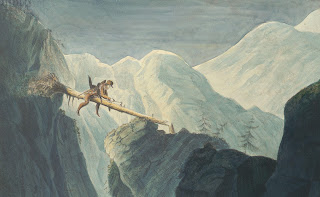
Audubon’s new method of illustration, which publishers likened to ‘drawing directly from nature’, bolstered the success of his publications. Whether true or not, while Audubon sought paying subscribers to help fund his expeditions and book printing, advertisers commonly implied
that Audubon’s work was somehow superior in it’s accuracy and scientific depiction of the natural world because of the process by which he painted his subjects. Using carefully crafted language, advertisers alluded that Audubon painted directly from life, glossing over the fact that his models were still dead (just dead more recently).
In Rauner’s copy of the 1826 prospectus (a printed advertisement and description of Audubon’s upcoming book,
The Birds of America) for instance, W. Swainson notes, “To those who have not seen any portion of the Author’s splendid Collection of original Drawings, it may be
proper to explain that their superiority consists in every specimen being of the full size of life, portrayed with a degree of accuracy…(Audubon’s) ornithological narratives...are as valuable to the scientific world as they are delightful to the general reader...There is a freshness about these essays, which can only be compared to the animated biographies of Wilson. Both these men contemplated Nature as she really is...they sought her in her sanctuaries. The shore, the mountain, and the forest were alternately their study, and there
they drank the pure stream of knowledge at its fountain-head. The observations
of such men are the cornerstones of every attempt to discover the natural
system.” This lively advertising language, as well as the inscription written
on Audubon’s illustrated plates, ‘Drawn from Nature’, are therefore misleading,
especially to contemporary readers familiar with the practice of photographic
and drawing from live animals or film.
Audubon did go to great lengths to draw
freshly-killed birds, but time constraints during publication (after all, he
agreed to release a certain number of plates each year to appease his paying
subscribers) meant this was not always possible. As time passed, he
increasingly used preserved specimens collected by others. Audubon’s occasional
reliance upon preserved specimens is cited as one explanation why two of the
mystery bird species- the “Small Headed Flycatcher” and “Cuvier’s
Kinglet” - are not found today. Both birds resemble known species but with
unfamiliar color patterns. Some scholars suggest that the plumage of older
specimens could have become worn or discolored during transport, leading to
later misidentification by Audubon.
Aside from facing constraints on his time and
ability to paint recently-killed specimens, a lack of robust scientific
knowledge surrounding American wildlife in the early 1800s may also explain why
several strange species appear in
The Birds of America. Audubon was
collecting, describing, and painting birds at a time when European Americans
didn’t know the breadth of American birdlife, nor the breadth of wildlife in
general across the continent for that matter. For example, just 20 years prior
to the launch of Audubon’s ‘great idea’, then U.S. President Thomas Jefferson
asked Lewis and Clark to keep an eye out for a live
mammoth during their
journey west, all while writing in a column for the
American Philosophical
Society’s Bone Committee: “It may be asked, why I insert the mammoth, as if
it still existed? I ask in return, why I should omit it, as if it did not
exist?…[the north and west] still remain in their aboriginal state, unexplored
and undisturbed by us, or by others for us. He may as well exist there now, as
he did formerly where we find his bones.”
The fact that academics were
still discussing the possibility of giant, wooly, 10,000-pound extinct
elephants roaming the American West, waiting to be discovered, seems laughable
today but paints a vibrant picture of the scientific excitement that
characterized discovery at the time.
To be fair, in the early 1800s the
discovery of new species was not only likely, but still extremely commonplace
in the New World. In fact, over the course of completing
The Birds of
America Audubon discovered 25 new species and 12 new subspecies (not
including the unidentifiable birds mentioned previously). For Audubon, every
unusual morning chorus could signal a newly-discovered songbird, every
‘unexplored’ mountain range and woodland thicket could host species of hawks,
owls, and herons no European ornithologist had yet seen or documented. The
possibility of discovery must have been exhilarating, however the lack of prior
literature to cross-check Audubon’s findings would also prove maddening by
today’s standards. As Audubon Magazine journalist Nicholas Lund writes,
“(Audubon) shot heaps of birds…and compatriots exploring far-flung regions of
the continent brought him heaps more. Among the messes of dead birds he had to
sort through were probably weird-looking juveniles, birds with plumage
anomalies, or even the occasional hybrid.” Considering the sheer number of
specimens Audubon examined and the relative unfamiliarity with color variations
of North American birds at the time (birds vary in coloration according to
their age, diet, sex, region of the country, and even time of the year) it’s no
wonder that Audubon didn’t get everything right.
Now, back to the six mystery birds that grace the pages of our copy of
The Birds
of America… perhaps they are just cases of mistaken plumage - like
two other avian oddities contained within Audubon’s work. Take for instance the
case of the mighty “Washington Eagle” which Audubon declared to be a new
species after acquiring a specimen along the banks of the Mississippi around
1818. After sighting five of these massive birds, Audubon was elated when he
discovered what he describes as “a magnificent” new eagle in the first volume
of his companion book,
Ornithological Biography. According to his
measurements the bird had a whopping wingspan of 10 feet 2 inches, making it
larger than any known eagle found anywhere around the globe (by comparison, the
largest known eagle species in the U.S. today, the Golden Eagle, tops out with
a 7.2-foot wingspan). Audubon named the species “The Bird of Washington” given
that it was, in his opinion “indisputably the noblest bird of its genus that
has yet been discovered” (pg. 61, Vol. 1). Adding to the patriotic fervor of
his new ‘discovery’ Audubon exclaimed “If America has reason to be proud of her
Washington, so has she to be proud of her Great Eagle” (pg. 61, Vol. 1). Today,
scholars don’t share Audubon’s enthusiasm; ornithologists commonly agree
Washington’s Eagle was a juvenile Bald Eagle that was either unusually large or
whose proportions were exaggerated for effect. Aside from the striking
resemblance of Audubon’s illustration to a young Bald Eagle, Audubon oddly
acknowledges in his
Biography that the bird closely resembled other
commonly-known species nesting in the vicinity, writing “passing over the
affinity of (the) bird to the young of the White-Headed Eagle (Bald Eagle)... I
shall institute a comparison between it and the true Sea Eagle, which bears so
strong a resemblance to the Bird of Washington, that by a superficial observer
they might be confounded.” Despite Audubon’s best attempts to convince his
readers that “the Bird of Washington stands forth as the champion of America ...and
henceforth not to be confounded with any of its rivals or relatives” today’s
bird experts (a far cry from the ‘superficial observers’ Audubon denounces)
agree that the species hatched from the imagination of a naturalist rather than
a unique egg. The birds’ larger-than-normal size combined with its juvenile
coloration likely explains why it was misclassified in Audubon’s
menagerie.
Audubon is also known to have mischategorized males and females of the same species as two distinct
ones. Males and females of many bird species, particularly songbirds, exhibit
striking differences in their plumage and overall appearance (a phenomenon
known as being ‘highly sexual dimorphic’). A good example here in the
northeastern U.S. is the Northern Cardinal; males of the species are a striking
crimson red with black face masks for most of the year, whereas the female
remains a dull tannish-brown. A result of sexual selection, sexual dimorphism
must have proven particularly puzzling to ornithologists like Audubon who were
observing new species in their natural habitats for the first time, especially
when males and females of some species are often not observed together except
during short breeding seasons. At a time when naturalists relied primarily upon
morphological differences to tell one bird species from another, the only way
Audubon could ground truth whether birds were indeed the same species was to
observe them breeding and nesting together or to have heard reputable accounts
of such activities occurring. More times than not, this luxury was not afforded
to Audubon. A good example of this confusion is evidenced by Audubon’s “Selby’s
Flycatcher.” The beautiful yellow songbird, painted in Plate 9 of his book, is
actually a female Hooded Warbler. It appears he classified the specimen
separately from males of the species due to the lack of black face rings,
having never observed males and females nesting together.
Unfortunately, the
origins of Audubon’s six mystery birds require more complex explanations than
simple mix-ups of juvenile/adult and female/male morphological traits.
This brings us to the third most-commonly-suggested explanation. Perhaps
Audubon’s mystery birds were on the brink of extinction as Audubon collected
specimens and have since disappeared. There certainly are, sadly, several
now-extinct species in Audubon’s illustrations including Bachman’s Warbler, the
Ivory-billed Woodpecker, Labrador Duck, Great Auk, Eskimo Curlew, Carolina
Parakeet, and the famous Passenger Pigeon. A handful of scientists have
entertained the possibility that some already-range-restricted species could
have been wiped out by the early 1800s before conservationists took any notice.
However, most of Audubon’s six mystery birds were observed only once or twice
by Audubon himself, and none of them left behind any fossil records or
specimens, unlike the five species Audubon painted that are known to have gone
extinct. This makes it highly unlikely that our six mystery birds are simply
extinct species. Instead, we must look to a combination of factors or
alternative explanations altogether (i.e. hybrids or birds with genetic
mutations?) in our ongoing attempts to classify these feathered friends.
Without further adieu, here’s a chronological rundown of Audubon’s six mystery
birds, along with our best explanations as to their true identities:
Audubon’s first mystery bird - “Cuvier’s Kinglet” (also called Cuvier's
Regulus;
Regulus cuvierii) - seems to be a unique case of
misidentifying a well-known species. Although birdwatchers would adore another
charming kinglet species, Cuvier’s Kinglet hasn’t been documented since Audubon
(supposedly) shot a male of “this pretty and rare” bird in Pennsylvania and
named it after “Baron Cuvier... at present unrivalled in the knowledge of
general Zoology.” Audubon noted that the specimen was very similar to
Ruby-crowned and Golden-crowned Kinglets, admitting he “supposed it to be one
of its relatives” until he picked the bird’s body up from the ground (pg. 288,
Vol 1,
Ornithilogical Biography). Unlike these well-studied species
however, Audubon’s bird sports a black forehead and a striking red cap
alongside the familiar dark head stripes characteristic of Golden-crowned
Kinglets. Nineteen years after collecting this odd bird, Audubon wrote in his
Ornithological
Biography that he “never (saw) another” and had not heard of anyone else
who had (pg. 288). This didn’t stop Audubon (nor other ornithologists) from
tirelessly searching for other examples of the supposed species. In 1840,
Audubon wrote to Spencer Fullerton Baird (famed natural historian and first curator at the Smithsonian Institution)
regarding a “singular variety” of Ruby-Crowned Kinglet the then 17-year-old had
shot, asking “Have you compared the Regulus with the description of
Regulus
cuvieri? Could you not send me your bird to look at?” Although the specimen
was never sent, Baird continued to believe Cuvier’s Kinglet existed nearly 20
years later (seven years after Audubon’s death); describing in his 1858 report
On
the Birds of the Railroad Surveys: “I have introduced the diagnosis
of (Cuvier’s Kinglet) from Audubon for the sake of calling attention to it and
of completing the account of the genus.”
 The verdict:
Although rumors of Cuvier’s
Kinglet sightings circulated well into the 1870s, the American Ornithological
Society declared that Audubon’s kinglet is likely just a Golden-Crowned Kinglet
with “aberrant plumage.” After all, the coloration is not all that different
from a Golden-Crowned Kinglet, save for the bright red (as opposed to yellow-orange)
headcrest and an additional black stripe extending over the top of the bird’s
beak. It is possible that the
specimen Audubon shot had a genetic condition occasionally observed in many
bird species known as melanism; which results in unusual darkening of body
tissues caused by the excessive production of dark melanin pigments. Since
melanin produces the blacks, browns, and reddish-browns in a bird’s body, this
could explain why the head crests and stripes are an unfamiliar - and darker-
color than your typical Golden-Crowned Kinglet.
Audubon’s second
befuddling species - the “Carbonated Swamp Warbler” (
Sylvia carbonata)-
appears on Plate 60 in our second volume of
The Birds of America. Named
for its dark streaking and head cap - not, unfortunately, because it lives in a
bubbly bog - Audubon painted his Carbonated Warbler from two males he shot on
his father’s plantation in Henderson, Kentucky. Audubon expressed uncertainty
about the familiar-yet-not-so-familiar coloration of the two birds, noting on page
308 of his
Biography (Vol. 1) that he was “of the opinion that they were
each young birds of the preceding year, and not in full plumage, as they had no
part of their dress seemingly complete, excepting the head. Not having met with
any other individuals of the species, I am at this moment unable to say
anything more about them.” Indeed, Audubon’s notes about
S. carbonata
are comparatively sparse amid his almost superfluous descriptions of other
warbler species.
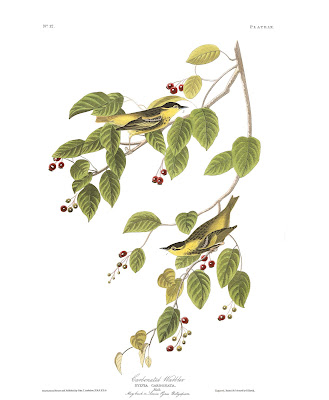 The verdict:
Although the black cap, wing bars, and general streaking pattern
match a commonly-observed species called the Blackpoll Warbler, Blackpoll
Warblers are black and white, rather than bright yellow as in Audubon’s
illustration. Blackpolls do exhibit surprising color variations including
yellow-tinged wings and backs, meaning Audubon’s
S. carbonata could be a
rare case of yellow mutation. A more likely explanation some contend -
including famed field guide author David Sibley (illustrator of Sibley’s Field
Guides) - is that Audubon mis-represented a bird he was drawing from memory. As
Sibley noted in a lively blog post from 2008, “We
know that Audubon worked on some paintings from memory at that time, and I
think this painting is consistent with ‘from memory’ work. As any artist knows,
working from memory will get some details correct and others very wrong. It's
impossible to perfectly recreate a memory as a drawing, because memories tend
to be fragmentary (drawings must be complete).”
Interestingly,
as if to preemptively quell any doubts that he hadn’t painted Plate 60 from
life, Audubon adds that his Carbonated Warblers “were drawn, like all the other
birds which I have represented, immediately after being killed” (pg. 308, Vol.
I). Although Audubon
asserted his works were “Drawn from Nature”, we know that in 1812 (one year
after he supposedly shot the Carbonated Warblers) rats destroyed almost
200 of his stored paintings, causing him to “nearly put a stop to (his)
researches in ornithology” and forcing him to repaint several of his illustrations
from memory. Audubon’s original Cerulean Warbler watercolor was lost to the
nibbling rats, so the Carbonated Warbler could have been destroyed too, forcing
Audubon to repaint the scene without a specimen at hand for reference. As
Sibley and other ornithologist point out, this may explain the appearance of
several anatomical oddities in the illustration, including several strange
feather groups which are arranged incorrectly and misshapen. As Sibley remarks,
perhaps he
was looking at actual specimens,
“But... the fact that this painting is one of his less detailed efforts, with
errors and omissions of a sort that I would expect from drawing without a
model, leaves open the possibility that he was working from a faulty memory.”
Plate 60 also lacks one of Audubon’s usual artistic flourishes - intricately
painted tails which he usually fanned in artful positions. As Sibley observes,
Audubon “seemed to be fascinated by the shapes and patterns of tails”, however
the tails of his Carbonated Warblers are frankly “vague and boring” when
compared to his other drawings. All of these clues have led him and other
artists to conclude that
S. carbonata is merely a result of a
jumbled memory. Still, others including famed American ornithologist Elliot
Coues (1842-1899) assert that the bird was a unique hybrid between a Cape May
and Blackpoll Warbler. Unless one of these birds is discovered, it seems
unlikely that we’ll never know the true story.
The
mystery behind our next species - Audubon’s “Townsend’s Bunting” or “Townsend’s
Finch” (
Emberiza townsendii) - recently concluded with a satisfactory
explanation, all thanks to a photograph captured in 2014 by a trigger-happy
birder. Audubon writes in the first volume of his
Ornithological Biography,
“Of this species only a single specimen has yet been found, which was lent to
me by Dr. (John) Townsend… Nothing is known of its habits” (90). The bird was
built like a sparrow with a conical bill, but had a white throat and “eyebrow”
in addition to a gray chest unlike any known sparrow species. Audubon said
nothing else about the circumstances surrounding the bird’s collection in 1833
near Philadelphia, PA, aside from his anatomical description which asserts that
“the throat and fore-neck are white..the middle part of the breast and abdomen
are also greyish-white” (pg. 184, Vol. II,
Ornithological Biography).
 The verdict:
Interestingly, unlike Audubon’s other five unknown species, the
specimen he painted still exists. After the stuffed bird sat collecting dust in
the Museum of Natural History in Washington D.C. for over 160 years,
Ornithologist Kenneth Parkes studied the specimen and consulted with Townsend’s
notes; concluding that is was an aberrant-plumaged Dickcissel. As Parkes noted
in his 1985 paper, “the specimen probably represents a Dickcissel that lacked
the normal carotenoid (yellow) pigments in its plumage … such pigment
deficiencies, resulting from mutations or failures in development, are common
in some groups of birds” (pg. 90,
Natural History 4/85). Parkes
hypothesized that Audubon stumbled upon a once-in-a-lifetime specimen with the
opposite ‘problem’ as his Cuvier’s Kinglet. Although it could produce melanin
at normal levels, it was either unable to process or store carotenoids
(pigments which typically come from berries or other foods in the bird’s diet)
in its feathers. Despite Parkes’ tentative conclusion (the specimen was, after
all, in rough shape) the birding world again erupted with excitement when
images of a supposed Townsend’s Bunting captured in Ontario helped confirm his
diagnosis in 2014. After the internet buzz subsided and the experts examined the
photographs, the consensus was… an aberrant-plumaged Dickcissel! Although we’re
now certain Townsend’s Bunting was never a distinct species, as only the
second-known example of this plumage in recorded history, it was a surprising
discovery to say the least.
Audubon’s final three
mystery species - “Bartram’s Vireo”, the “Blue Mountain Warbler”, and the
“Small-Headed Flycatcher” appear together in one odd illustration (Plate 434)
contained in the fourth volume of his work. First there’s Bartram’s Vireo,
which Audubon declared a new species not because of its appearance (its a
spitting image of the common Red-Eyed Vireo), but rather because of its
unfamiliar foraging and territorial behavior. According to Audubon’s biography,
though the species is “often confounded with, or mistaken for, the Red-Eyed
Vireo” Bartram's Vireo was “remarkable” in that “it rarely if ever ascends even
moderately tall trees” and exhibits “disregard for the approach of man, or
indeed of any other intruder” (pg. 297, Vol. V).
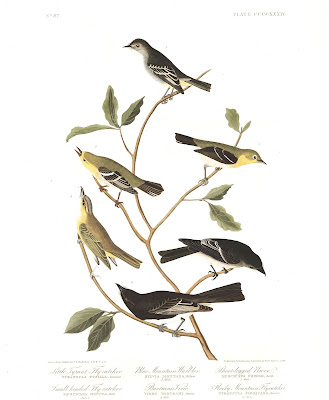 The verdict:
We frankly aren’t convinced that the behaviors Audubon viewed
were “remarkable” in any way. If anything, Bartram’s was a particularly bold
Red-eyed Vireo that preferred to forage in the understory.
Finally, we conclude with the Blue Mountain Warbler (
Sylvia
montana) and Small-headed Flycatcher (
Muscicapa minuta); both which
perch alongside Audubon’s misidentified Red-eyed Vireo. Both ‘species’ likely
owe their presence in
The Birds of America to Audubon’s main rival of
the 1800s, fellow ornithologist and artist Alexander Wilson.
M. minuta and
S. montana were first documented in Wilson’s groundbreaking work -
American
Ornithology - which he published in 1808. Wilson had embarked upon a
mission similar to Audubon’s twenty years prior, painting as many birds as
possible in his new abode after immigrating from Scotland. Although his work is
considered artistically and scientifically inferior to Audubon’s
The Birds
of America, Wilson became the first respected authority on America’s bird
species. Wilson died in 1813, but Audubon’s work was continually compared to
his predecessor's ( as evidenced in the prospectus for his new book, quoted
previously), which many bird enthusiasts (and hence potential subscribers to
his own work) were already familiar with. To omit a species from his work that
a supposed authority like Wilson had documented - whether real or not-
could have proven disastrous to Audubon’s reputation among observant readers.
Hence, it is quite likely that Audubon faced pressures to include some species
he himself never encountered.
Indeed, Audubon
expresses frustration about how difficult it was to obtain specimens of several
of his mystery species when he writes in his entry on the Blue Mountain Warbler
that, “it is somewhat strange, that among the numerous species of birds that
visit the United States, a few should have been met with only in single
instances. The present Warbler is in this predicament, as are the Carbonated
Warbler and Cuvier’s Wren… it has not been my good fortune to meet with (a Blue
Mountain Warbler)” (pg. 294, Vol. V). Although Wilson claimed to have shot his
warbler in Virginia’s Blue Mountains (hence the bird’s name), a combing of the
region by Audubon and his colleagues yielded no birds matching its description.
So where did Audubon supposedly acquire his specimen? Audubon briefly remarks
that his “figure was taken from a specimen lent to me by the Council of the
Zoological Society of London, and which had come from California” (pg. 295,
Vol. V). As Audubon Magazine journalist Nicholas Lund humorously remarks, “It
sounds to me like Audubon was jealous that Wilson found a bird he couldn’t, but
claimed he had one in the same way some people claim to have a “long-distance”
girlfriend.”
The verdict: It’s possible Audubon had only Wilson’s painting of the Blue
Mountain Warbler to reference, and, being unable to observe the species or
otherwise obtain a specimen for himself, felt compelled to paint an unknown
bird only documented in Wilson’s book. Overall, this one truly is an odd bird
with no conclusive explanation.
The story for the
Small-headed Flycatcher is reversed. Audubon claims to have discovered the
species first but did not disclose his finding at the time because as he
contends “In those happy days, kind Reader, I thought not of the minute
differences by which one species may be distinguished from another in words, or
the necessity of comparing tarsi, toes, claws, etc..” (pg. 291, Vol. V).
Audubon remarks that he first drew the species in Louisville Kentucky in “long-past
days… (in) the early part of the spring of 1808” (conveniently the year before
Wilson published his work!). He continues the narrative by stating “When
Alexander Wilson visited me at Louisville, he found in my already large
collection of drawings, a figure of the present species, which, being at the
time unknown to him, he copied and afterwards published in his great work, but
without acknowledging the privilege that had thus been granted to him” (pg.
291, Vol V). Audubon expresses contempt for what he considers to be plagiarism
of his discovery, noting “ I have more than once regretted this” , however he
assures his readers that his intentions for setting the record straight are
benevolent. He claims to be sharing the story because he respects Wilson’s
legacy, writing “I share this...for the sake of one to whom we are so deeply
indebted (Wilson) for his elucidation of our ornithology”(pg. 291, Vol.
V). Although Audubon did visit with Wilson in 1808, it seems odd that
Audubon waited until well after Wilson had died to contest Wilson’s narrative
of the Small-headed Flycatcher. For comparison, Wilson claimed he’d first seen
a flock of birds in New Jersey, where he shot one in an undisclosed apple
orchard.
The verdict: Unfortunately, neither of these stories shed any light on just
what these birds actually were, if they even existed. Both Audubon and Wilson’s
descriptions connote some type of wood warbler, but the coloration doesn’t
match anything described today. As Elliott Coues suggested back in 1870, the
Small-headed Flycatcher likely “never existed”, but was rather a result of
rivalry and misunderstanding between Wilson and Audubon.
Overall, at a time when
naturalists like Audubon lacked modern tools such as gene sequencing and remote
tracking to aid in distinguishing new species on the basis of reproductive
isolation, it’s remarkable that more birds we recognize today were not
misidentified in his monumental work. Equipped with only a looking glass that
today’s birders would probably dismiss as low-quality and a single-shot gun,
Audubon was able to accomplish something truly remarkable; he accurately
described and painted over 400 American bird species, many for the first time.
As Dr. Roberta J. M. Olson, Curator of Drawings at the New York Historical
Society and an authority on Audubon’s work, remarked, “The presence of a few
mystery birds in (Audubon’s) work “is a testament to the kinds of challenges
that the artist-naturalist faced in his pioneering attempt to study and codify
taxonomically hundreds of American birds in this pre-photographic age.” Even in
the instances when his work wasn’t scientifically accurate, Audubon’s
watercolors were undoubtedly memorable works of art that ignited considerable
interest in American birdlife, inspired future generations of artists, and
helped spur the modern age of wildlife field guides.
Although we’ve been
unable to positively identify all of Audubon’s mystery birds, their presence
adds to the intrigue that characterizes exploring old works of natural history
like
The Birds of America. These befuddling species continue to stir
lively debates involving scientists and artists alike, each one serving as a
window into the life and work of one of America’s most famous naturalists.
Although it’s unlikely we’ll discover the true identity of all Audubon’s
mystery birds, the search has furthered our understanding of known species, the
motivations that drove early artists to produce monumental scientific works,
and the behind-the-scenes logistical challenges that shaped Audubon’s artistic
renderings. In a world where we take for granted the increasing ease with which
we can fact check and cross-reference scientific discoveries, perhaps it's good
that we still have some old mysteries to ponder; not just for an added
challenge, but to remind us just how lucky we are to live in a world with so
much technology and information at our disposal.
To see our incomplete set of Audubon's
Birds of America, come in and take a look at the permanent display in our reading room. If you'd like to turn some of the pages, just ask the reference desk staff for help.


