Friday, November 10, 2017

East of the Sun and West of the Moon

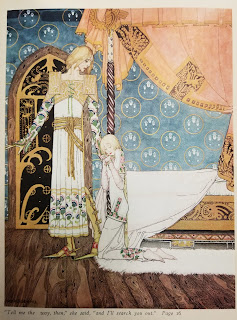
East of the Sun, West of the Moon, Illustration "Tell me the way" Even though many people today see fairy tales as nursery stories, folklore has a surprising and somewhat uncanny way of proving itself relevant and pervasive in human society. The titular story of this collection, “East of the Sun and West of the Moon,” is a Scandinavian fairy tale about a young girl who agrees to live in an enchanted castle with a talking white bear so that her poor family may become rich. Every night, a mysterious stranger comes and sleeps on the other side of the young woman’s bed, though she never sees who it is. Eventually, the young woman visits her family, and is persuaded to smuggle a candle back with her, so she can catch a glimpse of the person who shares her bed each night. When she does, she discovers that he is an incredibly handsome prince, but accidentally drips candle wax on him and wakes him. He laments that if she had held only out a year, he would have been free from the spell that trapped him as a white bear, but now he is instead doomed to be taken to live with his wicked stepmother, who is, incidentally, a troll. He can only tell the young woman that his troll stepmother is taking him to a place east of the sun, and west of the moon, before he and the enchanted castle are gone. Following this impossible clue, our young heroine undergoes a lengthy journey and multiple trials only to find him about to be married to the troll princess. Through some clever trickery, the young woman manages to meet alone with the prince, and together they devise some more clever trickery involving competitive laundry to free the prince from the trolls’ clutches, and allow him to marry our heroine. All the trolls are so angry that they explode, and everyone else lives happily ever after.

East of the Sun, West of the Moon, Illustration - riding the bear
But wait! This sounds oddly familiar…at first you were probably thinking “Beauty and the Beast.” Towards the end, though, you may have shifted more towards Greek mythology, and thought “Cupid and Psyche.” Indeed, “East of the Sun and West of the Moon” is remarkably like both stories, even though all three come from distinct cultures and periods of history. Finding common elements in fairy tales, or even almost identical fairy tales, in wildly distinct parts of the world is actually pretty common; some form of the story “Cinderella” has appeared in hundreds of variations around the world! Whether the universality of some of these stories hints at international trading of folklore and mythology, allowing these tales to travel globally as different societies intersect, or of some deeper insight these stories provide into the human experience that prompts them to arise out of cultures on different sides of the world, fairy tales seem to offer a depth of possibility worth exploring long after we leave the nursery.

East of the Sun, West of the Moon, Illustration - the north wind
Kay Nielsen’s stunningly illustrated East of the Sun and West of the Moon: Old Tales from the North, includes both this tale and other Scandinavian folk stories (many featuring trolls). Nielsen’s artwork lends an even more haunting feel to the fairy tales, evoking the stark yet unearthly beauty of the Scandinavian landscape. Whether these somewhat obscure northern stories resonate with the folklore you are familiar with or not, you may find something unexpectedly fun, fascinating, or profound within these pages. At the very least, you’ll be able to enjoy Nielsen’s striking illustrations! To see the book, come in and ask for Rauner Illus N554a.

Tuesday, November 7, 2017

Picturing David

manuscript illuminated page showing Kin David watching Bathsheba batheA powerful man, a king in this case, lustfully looks down on a woman in her bath--a woman whom he will sexually molest. A powerful man, again a king, handing a letter to a man who will not be complicit in his sin--a letter that instructs the man's commanding officer to abandon him in the heat of battle and guarantee his death. A powerful man, penitent for his sins, composing psalms in praise of the lord, passages that are among the most beautiful in the Bible. This is, of course, the story of David and Bathsheba. What is fascinating here is the three very different ways David and his victims are depicted in these three 15th-century Books of Hours. But what is so troubling is how utterly poignant and timely all three are.

Woodcut of King David handing a letter to UriahDavid was the hero of his nation and adored by his subjects. This is Michaelanglo's paragon of masculinity, larger than life, slayer of giants, father of Solomon, founder of the House of David and progenitor of Jesus. Yet, as so many have done through history, he took advantage of his power to abuse a woman, then killed a man to cover it up before being confronted by the prophet Nathan. He probably would have gotten away with it if that single courageous soul hadn't stood up to him.

manuscript illumination of King David kneeling in prayerThese images constitute a base for constructing a usable past. They give us the opportunity to look back and find moments that we can learn from and build upon for productive use today. If we can trace an historical narrative, we can help to justify and argue for the social changes we want to affect. We can use the past to create the future we desire. This is the active, forward thinking form of the dire warning, “whoever forgets the past is doomed to repeat it.” Instead, we argue that "whoever looks to the past can create the future he or she wants." In this case, don't be complicit, instead take action and change the culture.

To see it all for yourself, ask for  Codex MS 001598 (lustful David); Incunabula 154 (vengeful David); and Codex MS 003141 (penitent David).

Friday, November 3, 2017

"As Bad as Any in Spain"

an engraving of the Court of the Lions in the Alhambra in Granada.
In 1775, while the British colonists in America were in the midst of struggling to secure independence from Great Britain, English travel writer Henry Swinburne went on a Grand Tour of Spain with an English nobleman, Sir Thomas Gascoigne. Swinburne was from a Catholic family from Bristol and was very well connected on the Continent, to the extent that the Holy Roman Emperor Joseph II stood as godfather for one of their ten children. Gascoigne was a Catholic, a calculating politician (so much so that he later renounced his religion in service of his political ambitions), and a strong supporter of the American Revolution. He was also the sponsor for the two men's trip through Spain, which Swinburne had intended from the beginning to turn into a travel book.

Swinburne's eventual publication, Travels Through Spain in the Years 1775 and 1776, proved extremely popular at home, doubtless owing in part to the numerous large and beautiful engravings of
The first page of Swinburne's itinerary that lists town, inn, and hours needed to reach each location.
Moorish and ancient architecture that are interspersed throughout the sizable volume. However, despite these stunning images of Spain, our favorite portion of the book occurs before the narrative of the men's adventures even gets started. Between the preface and the first chapter, Swinburne includes an itinerary of the entire journey, listing the name of the town where they stayed, the inn or hostel that they stayed at, and the number of hours it took to reach each destination. The listing of inns is particularly enjoyable to read, because Swinburne spares no feelings in his blunt assessment of the quality of each boarding location. In Venta del Platero, along the Catalonian coast south of Barcelona, Swinburne stays at an inn that he judges to be "as bad as any in Spain." Another inn, in Venta del Golpe, is rated as "wretched." Although he doesn't hold back in his negative ratings, Swinburne does also give positive assessments as well: he decides that the Aquila d'Oro in Carthagena is "excellent," and of the Cavallo Blanco in Cadiz, he only cryptically states that it is "Italian," leaving the reader to infer his intended meaning.

To explore Spain through the eyes of Henry Swinburne, come to Rauner and ask to see Rare DP34 .S8 1779.

Tuesday, October 31, 2017

Trick or Treat

Drawing of two people dragging a body from a grave in the dark of nightIt's no secret that medical schools in the nineteenth century often had to resort to grave robbing to supply their anatomy labs. Dartmouth was no different and the archives are filled with little tidbits of evidence as well as the occasional smoking gun like this letter from 1810. While it was generally hushed up and kept under covers, it was still fairly common knowledge among the students and even fodder for jokes. Case in point: this image from the 1884 Dartmouth yearbook section on the medical school.

Happy Halloween!

Friday, October 27, 2017

The Morning of...

Diary entry for January 1, 1865When Elbridge West Merrill returned to Dartmouth College on January 1, 1865, he was looking forward to a good year. He acknowledged that “the past year was the most marked of my life, the most varying between Good and Ill –fortune, pleasure and pain.” However, things were looking up. He had “formed many pleasant acquaintances at College” and he hoped “some enduring friendships.” His motto for the upcoming year was “Look not mournfully upon the Past. It comes not back again. Wisely improve the Present. It is Thine.”

Diary entry for April 13, 1865, quoted at length
And then came the morning of April 13, 1865, an entry bordered in black. “This morning the terrible news spread across the wires o’er our happy and even jubilant land that last evening the President had been shot down by the dastardly hand of an assassin in Ford’s Theater at Washington.” Merrill was stunned, like most of the country. “How can I describe the feelings, the emotions of that day…Never shall I forget that crowd of students that stood at the posts discussing the sad news.” Lincoln, he wrote, was an “honest,” “kind hearted,” “God-serving,” honorable and upright statesman.” Some had, however, been concerned for Lincoln’s safety when he traveled but everyone believed him to be safe in Washington. Merrill also worried that future “Northern statesman and generals” could be
thus pursued and struck down by Southern fanatics many of whom frenzied by their utter overthrow and excited to madness by the spirit of malignant revenge and hatred would be only too eager to gain an eternal name of infamy and gratify their hell-born desires by emulating the example of the execrable Booth.
Merrill continues for several more pages to put his thoughts, feelings and assessment of the situation down before returning to describing in detail his life at Dartmouth College. Unfortunately, Merrill’s life after Dartmouth was a series of mishaps and financial disappointment and he died at the age of fifty-three.

To read his diary ask for Codex 003345. You can learn more about his life after Dartmouth by asking for his Alumni file.

Tuesday, October 24, 2017

More Birch Bark

Concert playbill printed on dark birch barkWhat is it about these birch bark items in our collections that keeps us blogging them? First, a student blogged our copy of Red Man's Rebuke, then another wrote about our copies of Charles Fletcher Lummis's Birch Bark Poems. So, it is probably a bit redundant to feature our latest acquisition, a playbill for a sacred concert at the Crawford House on September 26th, 1886, in the heart of the White Mountains printed on birch bark. But it is just too cool to resist.

The concert got off to a suitably rustic start with the William Tell Overture, but would any of the other composers dreamed their works would be listed on tree bark? Can't you just picture the concert goers idly fidgeting with the chalky bark playbill during the concert? The temptation to slowly shred it surely overcame many--birch bark just begs to be torn along its grain--but luckily someone had the self restraint to preserve their copy, and it now joins our amazing White Mountains Collection.

It is not cataloged yet, but we will put up a link to the record when it is.

Friday, October 20, 2017

Illustrated Iberia


An engraving of the Iberian peninsula with hand-colored borders to mark the separate regions.
This week at Rauner Library, we hosted a high school class that was studying the history of Spain. That gave us an opportunity to explore the Bryant Spanish Collection at Dartmouth College. This phenomenal collection was begun in 1952 and now consists of over several thousand volumes of books in Spanish and books that reflect the culture and history of Spain. The collection was created by William "Junior" Bryant, class of 1925, with the assistance of Dartmouth's Associate Librarian Harold Rugg, class of 1906. Bryant had taken a class from Rugg during his student days at Dartmouth and had fallen in love with books as a result. Over several decades, Bryant worked with Rugg and his successor Edward Lathem, class of 1951, to curate an amazing gathering of texts that is rich in archeological works, histories of Spanish towns and institutions, dictionaries, travel guides, art books, philology, various ethnic groups within Spain, and geography.

While selecting materials for the Spanish class, we came across many fascinating items, including a A hand-colored engraving of the entire world, represented as two circles to portray both sides of the globe.pocket atlas that was printed in Madrid in 1711. The charming little volume is filled with fold-out illustrations and maps, most of which have been hand-colored with enthusiasm, if not with care. The map of Spain colorfully divides the country into clear regions, and there is a delightful map of the heavens that shows all of the creatures of the zodiac filling the sky. The engraving of the entire world includes a representation of California as an island and some random mountains above it, a signal that the reader's guess is as good as the engraver's or author's as to what awaits future explorers to the region. One of the high school students was struck by the fact that these images of the world would have been taken as fact for Spanish people of the 1700s, despite their many inaccuracies. For us, helping to provide these sorts of intellectual discoveries is even more exciting than finding a lost treasure among our stacks.

To explore Francisco de Afferden's Atlas Abreviando, come to Rauner and ask for Bryant G1015 .A3 1711.