Showing posts with label Medieval Manuscripts. Show all posts

Friday, September 13, 2024

Exquisitely Stenciled

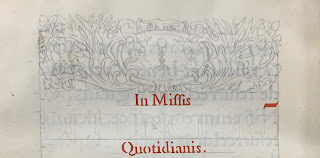
Decorated opening from Codex MS 003530This book is so cool, we can't believe it. It is a liturgical guide for feast days produced in the Benedictine monastery of Ambronay in 1740, and it is neither print nor traditional manuscript. Instead, the entire text was created using stencils on vellum. If you look closely, you'll see every letter is cut to make it hold together for inking. Imagine the work that went into creating this!

Detail of unfinished illuminationExtra interesting for us is that the illuminated decorations were never completed. That allows us to see the process they employed to create the book--sketching out the decorations, then carefully filling them in. It is another case of a devotional book being created as an act of devotion. Stunning, inspirational, and a joy to handle.

                                            Detail of unfinished illumination

Come in and ask for Codex MS 003530 to experience it for yourself.

Friday, March 29, 2024

Happy (Belated) Purim!

An image of an unrolled scroll with Hebrew text.Last weekend, Jews around the world gathered to celebrate the holiday of Purim, or the Festival of Lots. This joyous occasion, celebrated each year in the Hebrew month of Adar, celebrates the triumph of the Jewish community of ancient Persia against the threat of annihilation at the hands of the villain Haman. Jews traditionally celebrate Purim by dressing up in costumes, sharing baskets of treats and gifts with friends, eating delicious triangular hamantaschen cookies, putting on comedic plays (purimshpieln), and gathering in synagogue to listen to the Purim story read aloud from the Book of Esther. This is the story of how the beautiful Jewish Queen Esther and her cousin Mordechai foiled the plot of the wicked Haman, advisor to King Ahasuerus, who sought to exterminate the Jews. Unlike Torahs, which take the form of a double parchment scroll, the Purim story is traditionally written on a single parchment scroll called a megillah, which gives the Book of Esther its Hebrew name, Megillat Esther.

Rauner recently acquired a rare Megillat Esther, written in elegant Hebrew script on parchment. While it can be hard to determine the date and place of origin for Hebrew manuscripts, carbon dating tests performed by the dealer narrowed down the potential date range, and analysis of the Sephardic script and Italianate parchment indicate that it was most likely produced in Italy between 1500 and 1550. According to the dealer, this megillah is one of only 30 surviving copies of this text dating from 1400-1600.

An image of an unrolled scroll with Hebrew text.
Amazingly, the scroll that bears this infamous story of Jewish persecution was produced during another infamous moment of Jewish persecution: the advent of the Jewish ghetto in what is now Italy. The first Jewish ghetto was established in Venice by ducal decree in 1516, in the same time period and approximate location as our megillah. The Jews of Venice and, later, other Italian city-states, were required to live segregated from the gentile population, only permitted to leave the ghetto during the day before being locked in at night. I like to think that for the Italian Jewish community that produced and read this very megillah, the Purim story had special salience and significance - an inspiring story of Jewish survival.

To see our Megillat Esther, come to the reading room desk and ask for Codex 003513.

Friday, January 19, 2024

A Medieval "Book of Roots"

Original leaf written in Sephardic script on the right (ff. 264v) later replacement text written in Yemenite script on the left (ff. 265r)The Kimḥi family of Provence was a celebrated medieval Jewish family of biblical commentators and Hebrew grammarians. Rabbi Joseph Kimḥi and his two sons Moses and David were each renowned scholars in their own right, but Rabbi David Kimḥi (1160-1235 C.E., commonly known by his Hebrew acronym "Radak") was the most celebrated of all.

Rauner recently acquired a manuscript of Kimḥi's Hebrew lexicon, Sefer ha-Shorashim (literally translated as "book of roots.") First composed in the late 12th-early 13th century, the Radak's Sefer was one of the most influential Hebrew dictionaries in the medieval period. The entries are arranged alphabetically around the three-letter shorashim, or "roots," common to most Hebrew words, with quotes from religious texts and explorations of etymology.

Our handwritten copy of the Sefer was likely produced by a Sephardic Jewish scribe in Southern France or Northern Italy ca. 1370-1430 C.E., more than a century after Kimḥi’s death. Most of the pages are written in a consistent Sephardic semicursive script, on laid paper common in parts of France and Italy in the late 14th and early 15th centuries. It is possible that this scribe, like the Radak himself, was a descendant of Spanish Jews (Sephardim) who fled persecution and settled in the French region of Provence, which during the Kimḥis' time was a flourishing center of Torah scholarship known as Hachmei Provence.

By the 16th century, our copy had found its way from Provence to Yemen, where a Yemenite Jewish scribe painstakingly copied missing leaves and added some of his own marginal notes to the Radak’s text. Subsequent Yemenite owners of this Sefer also proudly scrawled their names and statements of ownership on the first and last leaves of the tome. After all, to own such an old copy of this famous work would have been quite the status symbol, testifying to the owner's material wealth, as well as his intellectual gravitas.

If you can read Hebrew but are still struggling to parse this 18th century inscription, there's a reason for that. It is partially written in Judeo-Arabic, a dialect of Arabic historically spoken by Jews in Arab countries, written using the Hebrew alphabet. Luckily, the dealer provided a translation of the message, which includes a fabulous book curse:

"I merited to purchase this Sefer ha-mikhlol through the labors of my hands. May the blessed Omnipresent give me the privilege to immerse myself in it—I, my descendants, and my descendants' descendants until the last generation. Amen, so may it be [His] will. He who takes it and does not return it—may his name and memory be obliterated from the world, and may he be bitten by a snake. But may the nation of God dwell in peace. [Signed] the humble Joseph, son of our teacher Shuker al-Sarem, may his Rock and Redeemer keep him and may his end be good."


Joseph ben Shuker al-Sarem's 18th century inscription wishing book thieves a snake bite.

To see our copy of the Sefer ha-Shorashim, come in and ask for Codex 003515.

Tuesday, March 3, 2020

Hiding in Plain Sight

Anitphonal open to folio 29 verso, 30 recto
We have blogged a couple of times in the past about the giant Antiphonal we keep out in the reading room. It is one of those very impressive, and very sturdy, manuscripts that are perfect for people stopping by who just want to see something old and cool.

Close up from folio 29 verso showing Dartmouth motto
But last week a student who is working on a transcription project pointed out something we had never seen. In the upper right corner of the verso of folio 29 is a little box (for a solo, we think?) containing the famous Biblical reference to Isaiah that Eleazer Wheelock adopted as Dartmouth's motto: Vox clamantis in deserto.

We have always been partial to the pages of the Antiphonal with decorative initials, but now folio 29 might be our new favorite.  Come in and take a look!

Tuesday, November 7, 2017

Picturing David

manuscript illuminated page showing Kin David watching Bathsheba batheA powerful man, a king in this case, lustfully looks down on a woman in her bath--a woman whom he will sexually molest. A powerful man, again a king, handing a letter to a man who will not be complicit in his sin--a letter that instructs the man's commanding officer to abandon him in the heat of battle and guarantee his death. A powerful man, penitent for his sins, composing psalms in praise of the lord, passages that are among the most beautiful in the Bible. This is, of course, the story of David and Bathsheba. What is fascinating here is the three very different ways David and his victims are depicted in these three 15th-century Books of Hours. But what is so troubling is how utterly poignant and timely all three are.

Woodcut of King David handing a letter to UriahDavid was the hero of his nation and adored by his subjects. This is Michaelanglo's paragon of masculinity, larger than life, slayer of giants, father of Solomon, founder of the House of David and progenitor of Jesus. Yet, as so many have done through history, he took advantage of his power to abuse a woman, then killed a man to cover it up before being confronted by the prophet Nathan. He probably would have gotten away with it if that single courageous soul hadn't stood up to him.

manuscript illumination of King David kneeling in prayerThese images constitute a base for constructing a usable past. They give us the opportunity to look back and find moments that we can learn from and build upon for productive use today. If we can trace an historical narrative, we can help to justify and argue for the social changes we want to affect. We can use the past to create the future we desire. This is the active, forward thinking form of the dire warning, “whoever forgets the past is doomed to repeat it.” Instead, we argue that "whoever looks to the past can create the future he or she wants." In this case, don't be complicit, instead take action and change the culture.

To see it all for yourself, ask for  Codex MS 001598 (lustful David); Incunabula 154 (vengeful David); and Codex MS 003141 (penitent David).

Tuesday, September 19, 2017

Return of an Old Friend

Antiphonal in Preservation labWe have a really amazing old Antiphonal that lives in our reading room. It is a beast of a book that can take a lot of use, so it is a good thing to have out. When it arrived, it was pretty beat up--some of the metal bosses were missing, a chunk of the back board had broken off, and it needed some cleaning. Still, it was made to be used, and we were able to use it for teaching and to satisfy people's curiosity fairly well. Then our terrific colleagues in Preservation Services had a vision to not only stabilize the book, but also have the work be a learning opportunity across campus.

New metal bosses being designed
They got the campus Jewelry Studio involved in creating new bosses based on the existing ones, and the Woodworking Shop built out the missing piece of the back board. Our conservator, Deborah Howe, worked with everyone to reassemble the book, and now it is back home in our reading room ready to be used again.

Back board being reparied with new wood
Come on in whenever we are open to take a look at it. The work they did is almost as amazing as the book itself!

Friday, December 2, 2016

The Medieval Hereafter

Book of hours hand colored illustration with gold leaf. Depicts Jesus Christ in the sky surrounded by two angels in blue, hovering above a group of the dead. A gold tower is to the left and a hell mouth is to the right.For those living in the Middle Ages, death was a constant presence: Plague, famine, war, and a lack of medical knowledge all contributed to high mortality rates among European medieval society, especially for those living in cities. Consequently, much of life was occupied by thinking about and preparing for death. The Church provided hope through its promotion of the afterlife, although the path to that blissful eternity was a narrow one. At the Final Judgment, upon the return of Jesus Christ, many souls would be forced into the mouth of Hell instead of being ushered into paradise. Given the inexorable approach of death, and the concerns of the living about what might come afterwards, many artists and authors from the Middle Ages to the present day have attempted to represent the lives and deaths of saints and sinners as well as imagining what life after death might entail.

Book of Hours illustration. Woodcut that depicts a monk and a skeleton side by side. The upper border features more skulls.
At Rauner, we're currently displaying an exhibit that explores representations of death and the afterlife, chiefly from medieval and early modern sources. The exhibit was curated in conjunction with the New England Medieval Consortium's annual conference, held here at Dartmouth College on November 19th. From now through January 27th, come visit Rauner's Class of 1965 Galleries and see breathtaking illuminations from our medieval books of hours, fascinating printed books made only a few decades after Gutenberg, and various representations of Dante Alighieri's Divine Comedy, arguably the most important work about the afterlife that has ever been written in Western culture.

The first image is from Codex 003134 and the second from Incun 154, about which we wrote a previous blog post.

Tuesday, January 27, 2015

Text Compression

An open codex of handwritten text with red and blue initialing.One of the first challenges that a student new to Rauner Library must grapple with is the desire to privilege exclusively a book's content without also considering its container as well. This is especially true of our medieval texts, many of which reveal numerous clues about their cultural context through their physical presence. Details such as the size of a manuscript book, the layout of its pages, the various ink colors, and even the style of handwriting can be used to create hypotheses about the book's intended purpose and audience.

A close-up.A great example of this in our collections is a pairing of identical passages from St. Jerome's Latin translation of the Bible, also known as the Vulgate. Both are written on sheets of specially prepared animal skin called vellum or parchment. Both contain the writings of an Old Testament minor prophet, specifically Zachariah 4:2-5:2. Both use the same color of ink and even the same basic script, or handwriting style. However, there are some important differences that might make it difficult for someone who is experiencing them for the first time to determine that the two texts are, in fact, identical.

Three columns of hand-written text with red and blue initialing. For one, the texts are very different in size. The first two images above are of the first text, which is over 700 pages in length, nearly five inches tall, and contains written text which is so small as to be nearly unreadable. The second text, at left, is over a foot tall (close to 14"). However, the larger page contains only a few verses of text, while the equivalent page in the smaller text compresses those same verses into a space barely an inch tall. Such physical discrepancies provide us, and the students, with the opportunity to ask important questions: Why is the first scribe's handwriting so small? Why are there two sizes of handwriting in the second manuscript? Why is there so much room in the margins of the second text, compared to the first? All of these questions draw attention away from the actual content of the manuscript text, which is unreadable anyways to many students, and instead encourage students to think about the larger world in which these books were made and once lived. We won't ruin it by giving you the answers, just like we wouldn't for our students, but we encourage you to come by Rauner, explore these two beautiful manuscripts side by side, and come up with your own conclusions. If you want to cheat a little bit, you can read an earlier blog post about the first one.

The first text can be requested by its call number, Manuscript Codex 003202.
The second text is Manuscript 002279.

Friday, October 10, 2014

Taj Torah

A full-page labyrinthine figure, accompanied by Hebrew text.We just acquired a truly amazing manuscript that has us all a twitter (though we don't Tweet, just blog!). The manuscript is a copy of the Taj Torah produced in Yemen c. 1400-1450. This is one of only three known Hebrew manuscripts with illustrated carpet pages. The Torah is prefaced with a copy of the Tajim, a Yemenite grammar and guide to reading the Torah, so the manuscript is both a sacred text and a pedagogical device for its reading.

The manuscript has many possible uses in the classroom at a time when medieval and early modern Jewish texts are growing in interest and importance in academia. The specific aspects of it that most excite us are the carpet pages that can be compared and contrasted with Western illuminations and elucidate children's education in the middle ages, and the potential for discussion of the manuscript as an object (i.e., its construction, material components). Among the nice carpet pages are  a drawing of the labyrinth of Jericho and a "Magical Square" of letters in a pattern.

A full-page grid filled with Hebrew characters.
Two years ago we worked with a class on medieval Christian, Islamic and Jewish traditions. We were able to lay out excellent medieval representations of the Koran and the Vulgate Bible but we lacked a comparative example of the Torah or similar Jewish text. That gap is now filled. We are able to lay, side by side, representative texts from all three monotheistic faiths, and all from roughly the same time period.

To take a look, come to Special Collections and ask to see Codex 003265.

Friday, July 11, 2014

Shrouded in Mystery

A painted, praying Mary Magdalene.Maria Magdalena, Duchess of Tuscany, was born into the Hapsburg family. The daughter of Archduke Charles the II and niece to Maximilian II, she married well. Her husband was Cosimo II de Medici. Her Book of Hours, perhaps originally prepared as a wedding gift, became for her a kind of album of miniature art and relics. The book is filled with miniatures she received as gifts from other royal families in Europe.

A piece of embroidered cloth.But what makes this so special is an extraordinary bit of cloth lovingly embroidered onto folio 172. On the back it is described in Latin, translated, "The Holy Cloth saved in Turin, in which was bound the body of Jesus Christ, as an example of its holy contact with the same, having been a gift to the most serene Mary, given by Fernando, Duke of Mantua." What this really is, we don't know. Likely it is a piece of cloth, painted with blood to look like the complete Shroud of Turin in miniature. But, could the cloth actually be a bit of the Shroud--a relic taken from it, then painted to represent the whole? Almost surely not, but the information on the back is inconclusive and these were the people with the connections, wealth and power to secure relics. That Maria treasured it as a relic is unquestionable.  Either way, it is an amazing bit of mystery.

To see it, ask for Codex MS 608940.

Friday, April 25, 2014

Saints' Days

A heavily decorated page from a book of hours.This weekend's canonization ceremonies in Rome are a timely reminder of all of the amazing depictions of saints in our collection. Since Saint George's Day was earlier this week, we thought you might appreciate this image of George taking aim at an unsuspecting two-headed dragon nibbling on some grapes. It hardly seems a fair fight in this depiction from a book of hours produced in France around 1450. The scene surrounds an image of a David in prayer that introduces the penitential psalms.

A painted centaur-like creature blowing a horn.A painted creature resembling a winged seahorse with the head of an elephant.

This particular book of hours has many whimsical characters inhabiting its borders that provide a kind of comic response to the piety of the texts and images they frame.

A painted mage of a centaur-like creature carrying a club over its shoulder.
To see it yourself, ask for Codex MS 003133.

Friday, December 20, 2013

Something Pretty for the Holiday

A floriated initial G in blue, red, and yellow.Among our many medieval manuscripts is this beautiful leaf from a 16th century Italian antiphonal celebrating the Christmas Day mass. This floriated initial G leads into one of the most famous lines of Christian choral music: "Gloria in excelsis Deo."
A page from a medieval antiphonal including the floriated "G."
We hope it brightens your holiday season.

We are closed through January 1st, but after that you can see the manuscript in person by asking for MS 002091.

Friday, November 1, 2013

Always With You

An image of an Arabic scroll from above.If we wanted to we could assemble an amazing cabinet of curiosities. Here is a favorite example. This is the entire text of the Koran executed in a miniature Arabic hand on a parchment scroll that is only 3 inches wide and 48 inches long. It can only be read with the aid of a magnifying glass, and rolls up small enough to be worn as an amulet.

An image of the scroll from the side.The scroll, which was produced in 1101 A.H. (1689 A.D.), leaves off the titles of the 114 Suras and elides any indications of the verses to concentrate the text into as small a package as possible. Other than some gold leaf, all of the decorative elements are created by leaving gaps between words. Creating this manuscript was almost surely an act of devotion demanding tremendous patience and skill.

The scroll photographed through a magnifying glass, showing an abstract pattern created by the negative space in the text.
It is amazing.  Ask for Codex MS 689940. We have a magnifying glass you can use.

Wednesday, May 8, 2013

A Beautiful Manuscript

An open, miniature book of hours with densely painted and illuminated illustrations. Today, we thought we would just treat you to a moment of beauty. These images are from a manuscript Book of Hours produced in Florence in the late 15th century. It is on uterine vellum made from the skin of unborn sheep or calves, and was illuminated in Attavante's atelier. Each miniature is a lovely Renaissance painting that fits in the palm of your hand.

An open, miniature book of hours with densely painted and illuminated illustrations. An open, miniature book of hours with densely painted and illuminated illustrations.
Come see it by asking for Codex Manuscript 001054, and there is a little more information on our "Script to Pixels" website.

Friday, October 19, 2012

A Beautiful Fake

A page from a medieval manuscript, elaborately and colorfully detailed.People frequently ask us how we know everything in our collections is real. We are quite certain about the authenticity of most of the things in our collection, but occasionally we are sure the other way--we know something is a fake, and we are proud to proclaim it.

One such example is our great collection of Thomas Wise forgeries donated by George Singer '50. Wise was a bibliographer, book collector and sometimes forger. He would insert very rare items (some of which never existed) into his bibliographies of English Romantics, then print some up, "discover" them and sell them as extraordinary rarities. Wise's forgeries tend to be fairly plain, in the style of a nineteenth-century English book.

A title page for "Two Letters Concerning 'Notes on the Construction of Sheepfolds,'" with handwritten additions.
More spectacularly, we have one piece by "The Spanish Forger." No one knows exactly who he was, but his body of work has been traced and well documented by curators at the Morgan Library and Museum. The Spanish Forger, who was active in the late-nineteenth century and early-twentieth century, would take old manuscript leaves lacking illuminations, which could be purchased quite cheaply, then illuminate them in a convincing style. Back on the market, they turned a tidy profit.

Ask for MS 002088 to see our loveliest fake (donated by Mark Lansburgh '49).

Friday, May 18, 2012

Terence

A color illustration of a man by a tree, interrupted by a doodle of a face.We recently digitized one of our nicest humanist manuscripts: a copy of Terence's Comoediae sex cum argumentis produced in Ferrara in 1462, just a few years prior to the introduction of the printing press in Italy. You can see it in its digital glory, or come in and feel the vellum for the full sensory experience.

A manuscript page beginning with a single ornamented initial.
 We have another 15th-century Terence that is worth looking at for comparison: Comodiae (Strassburg: Johann Gruninger, 1496). While the manuscript has a simple design connoting a quiet dignity, with many annotations in a contemporary hand, the printed copy from 1496 is far more extravagant and theatrical. Not only does it contain dozens of hand-colored woodcuts and ample rubrication, it also has a prankster's doodles (date unknown) throughout.

A color illustration at the bottom of a printed page. Several doodles decorate the margins and the illustration.
The manuscript is Codex MS 001999, and the book is Incun 125.

Tuesday, May 15, 2012

Order of the Golden Fleece

A page of handwritten text with a blue and gold initial.We continue to build our collection of vernacular secular manuscripts with our latest acquisition, The Statutes of the Order of the Golden Fleece. It was most likely produced in 1531 at the request of Charles V to be distributed to all of the knights of the Order. This copy is utilitarian in that it was meant to be used, but also had enough decorative flourish to make it a treasured object.

At first, it seems the manuscript is an anachronism: 80 years after the invention of moveable type, it is still entirely done by hand. But printing in the early hand-press era demanded scale to make it profitable. If you only needed 50 copies (and the Order of the Golden Fleece was limited to 50 members) then it would have been cheaper to produce manuscript copies than set the type and print them. Generally speaking, printing only pays for itself after about 200 copies, but then it can become quite profitable. Still, members of the Order would have expected something more dignified than print, and this manuscript fits the bill.

A page of handwritten text with colored initials.
The description of the manuscript from Les Enluminures included this account of the Order and the manuscript in hand:
The most renowned of all chivalric orders, the Order of the Golden Fleece was founded in 1430 by Phillip the Good, duke of Burgundy (1396-1467) "out of respect for God and for the advancement of the Christian Faith." It was instituted as a Burgundian alternative to the influential Order of the Garter, founded in 1348 by Edward III, and designed to strengthen the allegiance of Phillip's vassals and friendly foreign states to his realm.

The Order of the Golden Fleece, whose first chapter was held in 1431, came to be considered the highest order of knighthood. It originally included twenty-four knights; the 1431 statutes fixed the number admitted to 31 (later increased to 51 by Charles V in 1516, and then to sixty-two by Philip IV) and four officers (Chancellor, Treasurer, King of Arms, and Greffier). Upon being inducted as a member, each knight received, in addition to the famous collar from which a gold enameled pendant of the Golden Fleece was suspended, a copy of the Statutes—also referred to as a "quayer de l’ordre"—most often in manuscript form and copied on vellum. The official language of the Order, and therefore of the manuscripts, was the langue bourguignonne, but from the sixteenth century some manuscripts were copied in Latin. Following the death of a knight, the copy of the Statutes and the collar were supposed to be returned to the Archives of the Order, but this rule was not rigorously respected and numerous copies of the Statutes remained in circulation.

This manuscript is a copy of the Statutes enacted in 1531 after the chapter held in Tournai; it includes the thirteen additions made to the statutes up to that year. The manuscript was certainly copied before 1545, the year of the chapter held in Utrecht where a new draft of the Statutes was instituted with 68 articles rather than the traditional 66. During the chapter of 1531, complaints were voiced concerning the numerous copies of the Statutes in circulation whose content was both erroneous and incomplete. Hence the greffier Laurent de Blioul was ordered by Charles V (1500-1558) to have 50 new exemplars copied, some in French, others in Latin, complete with thirteen added articles, to be distributed to all the knights (Reiffenberg, 1830, p. 382-7, and de Lannoy, 2000, p. 38). Payment for sixteen copies was recorded in October, 1532 (Korteweg in Cockshaw and Van den Bergen-Pantens, 1966, p. 43, note 48). The present manuscript is probably one of these "revised" copies (Korteweg, in Cockshaw and Van den Bergen-Pantens, 1966, p. 43, note 50 lists nine additional copies in public collections). Presumably most of the existing knights already owned luxury illuminated copies of the text, which they would not want to discard, so they would have needed relatively plain, practical volumes (such as the present one), with an accurate text, rather than a new lavishly illuminated copy. 
You can see it by asking for  Codex MS 003234.

Friday, January 20, 2012

Lost and Found

A colorful ornamented medieval manuscript.We made a wondrous discovery right before the holiday break. In the late 1960s, Mark Lansburgh '49, donated several medieval manuscripts to the collection, among them two stunning leaves from a fifteenth-century Breviary. The leaves were documented in a catalog of Darmouth's manuscript holdings in 1971, but then disappeared. For at least 30 years we have been tormented by the Breviary. Was it sent back to the donor? Could it have been stolen? Is it somewhere right in front of us and we are missing it? We looked and looked and looked, but to no avail.

A colorfully ornamented medieval manuscript.
Then, this December while reshelving some rare books, one of our staff members noticed an unmarked portfolio in amongst our Shakespeare collection. He pulled it off the shelf and lo and behold, there were the Breviary leaves. They had been shelved incorrectly back when Special Collections still resided in the Treasure Room in Baker Library. Some have theorized that the manuscript had been tucked in with the Shakespeare collection in the Treasure Room so it could be pulled out to impress visitors as a colorful accompaniment to our First Folio, then forgotten. Whatever the reason, finding it was a Holiday thrill for us and for Mark Lansbugh whom we called immediately.

A page of handwritten musical notation.
Beneventan Antiphony
Three columns of handwritten text.
Liber Glossarum
Two of the most celebrated medieval manuscripts in the Dartmouth College Library were donated by Mark Lansburgh. The earliest item among his gifts is a leaf of a Liber Glossarum circa 825; it is complemented by another ninth-century piece, a leaf of a Beneventan Antiphony that is perhaps the oldest known fragment containing musical notation found in the United States. Also included in the collection are a series of fourteenth-century accounts, bills, and receipts. The eclectic selection (music, a glossary, and the mundane merchant accounts) helps students piece together bits of medieval life for a deeper understanding of abstract descriptions they discuss in class.

If you want to see the long lost Breviary, come in and ask for Lansburgh 53.

Tuesday, November 15, 2011

Romaunt of the Rose

A blue poster for the "Dartmouth's Rose Undying" lecture, featuring an image from the manuscript.This Thursday, November 17th, Stephen Nichols of the Johns Hopkins University will give a lecture, "Dartmouth's Rose Undying," on our 14th-century manuscript of the Roman de la Rose. We are pretty infatuated with this manuscript, and have blogged about it in the past. The lecture is free and open to the public and a reception will follow where you can see the manuscript in the flesh.

In addition to our manuscript copy, we have many editions of Chaucer's translation, The Romaunt of the Rose. We have several 16th-century editions, and this one from 1687 with an interesting commentary:
A photograph from a 1687 edition of the "Romaunt of the Rose," including a paragraph of commentary in a Roman type, followed by two columns of verse in a gothic type.In this Book the Authour hath many glaunces at the Hypocrisie of the Clergy; whereby he got himself such hatred amongst them that Gerson, Chancellour of Paris, writeth thus of him: saith he, There was one called Johannes Meldinensis, who wrote a Book called, The Romaunt of the Rose; which Book if I only had, and that there were no more in the World, if I might have five hundred pound for the same, I would rather burn it than take the Money. He sayeth more, That if he thought the Authour thereof did not repent him for that Book before he dyed, he would vouchsafe to pray for him no more than he would for Judas that betrayed Christ.
To take a look, ask for Val 823 C39 I16.  The Manuscript is Codex MS 003206.

Tuesday, May 17, 2011

From Medieval Britain to Dartmouth

A poster for the "From Medieval Britain to Dartmouth" event. The poster is red with three stylized lion silhouettes, within which are images of text from the manuscript.This Friday and Saturday, we will be feting our 15th-century Brut Chronicle manuscript with a conference, From Medieval Britain to Dartmouth, organized by Michelle Warren of the Department of Comparative Literature and sponsored by the Leslie Center for the Humanities and the Dartmouth College Library.

To accompany the conference, eight students have collaborated with Professor Warren to curate an exhibition here in Rauner drawing from our Medieval holdings. "Bringing out the Leaves: Manuscripts and their Meaning," looks at manuscripts and early printed books from different vantage points to show how their meanings shift in varying contexts. The exhibit will remain up through June, so even if you can't make it to the conference, you can stop by and see some beautiful manuscripts.

A color scan of a page from a medieval manuscript, including an elaborately decorated initial and an ornamental border full of plants and animals.
Codex 001969