Friday, April 14, 2017

From Bondage to Conscription

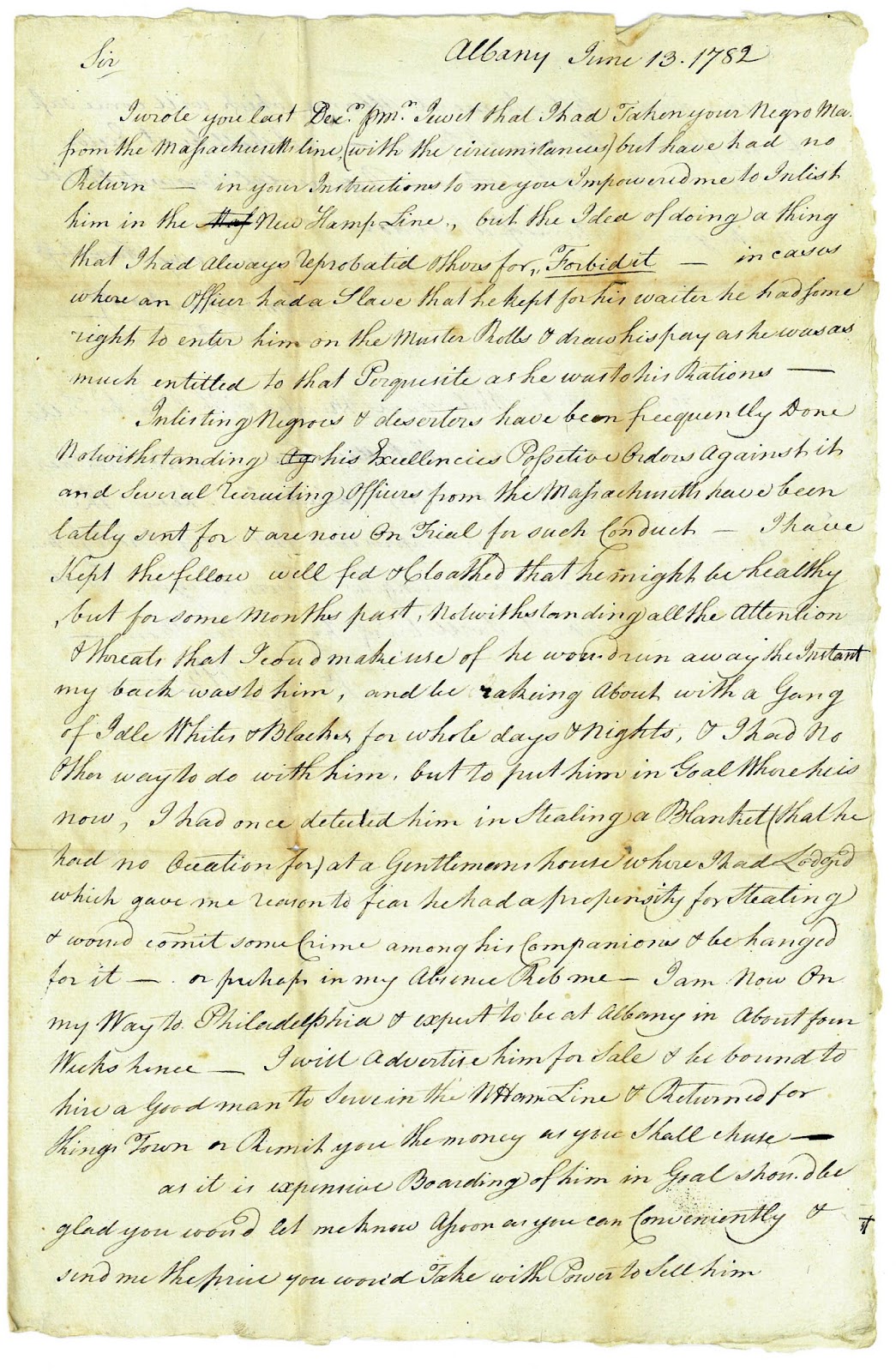
Letter; Blanchard to Bartlett; June 13, 1782; first pageOn June 13, 1782, James Blanchard, who had served in the 3rd New Hampshire Regiment as quartermaster and paymaster from 1776-1781, wrote to Josiah Bartlett, then a member of the New Hampshire State Supreme Court. In the letter Blanchard replies to Bartlett's request to have one of his slaves conscripted into the revolutionary forces: “in your instructions to me you empowered me to enlist him in the New Hampshire Line.”

The enlistment of slaves during the Revolutionary War was not unusual. New Hampshire enacted a law in the fall of 1777 that allowed owners to enlist their slaves as substitutes for themselves or their relatives or in return for their enlistment bounty. However, by the end of 1777, Congress, in an attempt to appease southern slave owners, discouraged this practice. On the loyalist side, Lord Dunsmore, the royal governor of Virginia had enacted a law in April 1775, that promised slaves owned by rebels their freedom if they fought on the side of the British. 

Blanchard was not happy about Bartlett’s request “of doing a thing that I had always reprobated others for.” Instead he tells Bartlett that he should sell him because Blanchard believed the slave “had a propensity for stealing.” Throughout the letter, the name of the slave is not revealed. However, in a postscript he is referred to as Peter, which is interesting because two years later there are two additional letters from Blanchard to Bartlett regarding the escape of a slave named Peter. In those insistences, Blanchard, tasked by Bartlett to recover said Peter, relays a saga that involves Peter being illegally sold by some shadowy characters to a man “at Livingston Manor … by the name of Alkenburg (a Tory),” and then declaring himself a free man. Blanchard informs Bartlett that during the course of his investigation, he had a “very considerable expense in employing men to look for the black dog,” and that he plans to sue the Tory and the other men involved, one of whom he calls “an itinerant horse Jockey.”

Letter; Blanchard to Bartlett; April 12, 1784; first pageLetter; Blanchard to Bartlett; May 8, 1784; first page

Unfortunately, we may never know what happened to Peter, but Blanchard became an advocate for veterans, serving as agent for several veterans pursuing claims against Congress. Josiah Bartlett, who was a signer of the Declaration of Independence, became the 4th Governor of the State of New Hampshire.

Blanchard's letters to Bartlett are contained in a small but rich collection of letters that are part of MS- 181, the Josiah Bartlett papers. Other correspondents include Bartlett’s co-signer of the Declaration of Independence William Whipple, as well as John Langdon and Nathanial Peabody.

Tuesday, April 11, 2017

Learning Your Lessons

Image of an Axe on the ground illustrating the rhyme of "A"We always thought the New England Primer was the most morbid of alphabet books--at least of the ones that were meant for children. But, we just bought one printed here in Hanover in 1811 that gives it a run for its money. Where the New England Primer uses "In Adam's fall, we sinned All" to illustrate A, The Royal Alphabet, Embellished with Cuts, Designed for the Amusement and Use of Little Children (Hanover: Charles Speare, 1811) offers the following charming rhyme:

"The Axe which traitors often dread
And husbandmen employ;
Will sure, in time cut off the head
Of every naughty boy."

Image of Christ being crucified on a cross to illustrate X.
X focuses on the crucifixion of Christ, but at least offers future hope. What lessons are being taught here? Surely more than the alphabet. One wonders what Hanover kids thought of it in 1811.

To see it, come in and ask for 1926 Coll R6878.


Friday, April 7, 2017

Fogg and Steam

The cover of Fogg and Steam by Frank Coldfelter, showing a steam locomotive coming through a snowy mountain pass.
We owe the title of our post today to a book of the same name written by Frank Clodfelter in 1978 about the railroad artwork of Howard Fogg, Class of 1938. Fogg was born one hundred years ago today on April 7th, 1917, in Brooklyn, New York. An only child, Fogg and his family soon relocated in 1920 to Mountain Lakes, New Jersey, where he first became entranced by steam locomotives moving down the old Lackawanna Railroad, before he finally settled outside of Chicago in 1923.

Fogg entered Dartmouth in the fall of 1934 as a member of the class
A portrait of Howard Fogg in his WWII aviator flight gear with "J. L. Fogg Jr. 42J" printed across the bottom in white lettering.
of 1938 and graduated with a degree in English. After his sojourn in New Hampshire, he went back to Illinois to earn a degree from the Chicago Academy of Fine Arts with the intention of becoming a political cartoonist. However, while still in art school, Fogg sold his first train painting for $25. Soon after, he abandoned his aspirations of political cartooning and took a job with the Union Pacific Railroad, all the while painting and selling watercolors of trains in his spare time. He then found employment as an apprentice engineer with Baldwin Locomotive Works, although his stay there was brief: in 1941, Fogg was drafted into the military, became a second lieutenant in the Army Air Force, and flew seventy-six missions as a fighter pilot in World War II.

One of Fogg's paintings of a steam locomotive coming through a snowy pass (the image was used on the front of a Christmas card).During the war, Fogg married Margot Dethier; after moving to Summit, New Jersey, they had three sons while Fogg's true career began as the company artist for the American Locomotive Company (Alco) in 1946. At that point, Fogg began an impressive run of prodigious output, averaging nearly thirty railroad paintings a year for decades afterward. He and his family later moved to Boulder, Colorado, where Fogg would continue to pursue his passion for trains by becoming a very successful and well-respected freelance artist. He died on October 1st, 1996, in his adopted town of Boulder, Colorado. He was one of five honorary members of the Brotherhood of Locomotive Engineers, a designation that underscored the high regard which working railroaders had for his dedication to detail and accuracy in his paintings.

To leaf through Fogg and Steam, come to Rauner and ask for Alumni F688f. To read more about Howard Fogg's time at Dartmouth, ask for his alumni file. We would like to thank Jeff Ashworth '71 for bringing Fogg and his 100th birthday to our attention. For more about the captivating art of Howard Fogg '38, he recommends Ronald C. Hill and Al Chione's The Railroad Artistry of Howard Fogg, published in 1999. To read more about Fogg's experiences as a fighter pilot during World War II, read Richard and Janet Fogg's Fogg in the Cockpit, published in 2011.

Tuesday, April 4, 2017

Adrift in the Soviet Era

Image of four scientists on a mount of ice holding up two flags. On flag has Stalin's image on it.In May of 1937, four Soviet scientists and their faithful dog were set down on the ice in the Arctic Ocean with supplies (five tons of food!) and an insulated tent in an endeavor to better understand drifting ice and the dynamics of Arctic waters. After 274 days and innumerable measurements of water and air temperatures, wind speeds and water depths, they were picked up by icebreakers over 2,800 kilometers from where they started.

Four photos montaged to show an icebreaker coing to retrieve the scientistsThroughout their drift, they took photographs and these were turned over to one of Stalin's favorite designers, Alexander Rodchenko, and fellow constructivist artist Varvara Stepanova. In their hands, the photographs were transformed into photo montages that sought to accent the heroic qualities of the expedition and celebrate it as "A Feat Worthy of the Age of Stalin." They managed to make what must have been an extremely boring expedition (over nine months of drifting on the ice) into a dynamic, exciting event. You can see it all in their Podvig, Dostoinyi Stalinskoi Epokhi: Fhotoseriya (Moscow: Soyuzfoto Fotokhudozhnik, 1938).

Photo montage of the arrival home of the scientists. It shows a train, hogs on the platform and a Soviet official adressing a crowd.
We haven't cataloged this yet, but when we do, we will add a link to the catalog record here.
UPDATE: to see it, ask for Stef G630.R8 P638 1938

Friday, March 31, 2017

Barrie at Bay

A photograph of Melville Island, primarily a large snow-covered mountainside with several small figures at the mid-right and one tiny individual standing in the lower left corner of the frame.
In October of 1916, the world-renowned arctic explorer Vilhjalmur Stefansson had returned to his winter quarters on Melville Island in the far north of Canada. As the leader of the Canadian Arctic Expedition (1913-1916), he had just spent the past several months discovering new islands in the Arctic Circle, including Meighen Island and Laugheed Island. Although the return to Melville was meant to signal the beginning of the expedition's official completion, Stefansson would defy his orders and strike north again one last time, eventually returning home in 1918. It was the last time that he would venture into the Arctic.

First page of Barrie's Letter to Stefansson: "3 Robert Street, Adelphi, W. C. 2. London. June 9, 1918. Dear Sir, It may amuse you as it has amused me to know the history of your letter to the author of "Barrie at Bay," which you sent off from Melville Island in Oct 1916 and which has just been forwarded to me. In those two years you must have been living a stirring..."While on Melville Island at the conclusion of his 1916 exploratory adventure, Stefansson evidently found time to catch up on news about the world war that had begun since he had set out on his expedition back in 1913. During his perusal of what must have been a stockpile of old papers, Stefansson happened upon a write-up of an interview conducted by "Anon" in the October 1st 1914 issue of the New York Times. The interview was ostensibly a tell-all about the author of Peter Pan, J. M. Barrie, by his manservant Brown and provided several opinions about the war and what America's role should be. After reading it, Stefansson took the time to send a letter of appreciation to the reporter who conducted the interview.

Page two of Barrie's letter to Stefansson"...time while I have been a dreary stick at home (I have always wanted to do the things you do). However you are chiefly (?) wondering why your letter was sent to me, and I have to confess (with bowed head) that it came to its rightful owner, as it was I, in some spirit of gentle (?) diablerie, who wrote that paper about myself. Long forgotten and now recalled by you, and I was very pleased to think it gave any one on Arctic exploration bent (Cpt. Scott of the Antarctic was a close (?) friend of mine) a moments exhilaration. Now I know why I wrote it. With kindest regards Ever Sincerely (Signed) J. M. Barrie
Nearly two years later, on his way back to civilization, Stefansson must have been surprised to receive a personal letter from J. M. Barrie himself. In his missive, Barrie somewhat abashedly confessed to being the author of the fictitious interview (which is how he had belatedly received Stefansson's letter) and concluded by expressing his delight that it had been of enjoyment for "any one on Arctic exploration bent."

To see photographic images from Stefansson's Canadian Arctic Expedition (MSS-229), come to Rauner and have a look at them in person, or take a look at the digital archive available online.  To see the letter from J. M. Barrie to Stefansson, ask for MSS-196, Box 2, folder 45.

Wednesday, March 29, 2017

Insta-Exhibit

Poster for "Insta-Exhibit" exhibition. It shows nine images from Rauner Library's Instagram: an Ethiopian scroll; a cuneiform tablet; a jugsaw puzzle; a minitature book of Rudolph; a marbled endpaper; two people and a piece of the Old Pine; a manuscript drawing of a ship; a mineature book next to a hair pin; an a detail from a medieval manuscript.This is getting absurd. Here I am using one form of social media (this blog) to promote a physical exhibition that is based on another form of social media (Instagram) that, at least for us, is a virtual gallery of our physical objects. Arghh, to almost quote xkcd, It's So Meta Even This Acronym....

But really, it is a great exhibit that you should come in and see. It features items from some of our most popular Instagram posts from the past 18 months. The actual physical objects are in the cases alongside the wise and whimsical commentary of Bay Lauris ByrneSim '15 and Hannah Chung '16.

So, even if you are not on Instagram, now you can enjoy our posts through May 1st! And, if you are on Instagram, follow us at @raunerlibrary.

Friday, March 24, 2017

Staring at the Sun

An oval portrait photograph of Charles A. Young, arms crossed, with a full beard and mustache. He looks to be in his mid-40s.
Yet another snowy day in late March on campus has us casting our eyes in desperation to the sky in the vain hope of seeing a warm and welcoming sun. It also brings to mind another sun-worshipper who got his start gazing heavenward in Hanover. Charles Augustus Young, the best and brightest of Dartmouth's class of 1853, was a world-renowned astronomer and a native son of the Upper Valley. After initially teaching Latin and Greek at Phillips Andover Academy, he went on to be the chair of mathematics, natural philosophy, and astronomy at Western Reserve College (now Case Western Reserve University). After a lengthy tenure as a professor of astronomy at Dartmouth, he moved to Princeton for the conclusion of his long and prestigious academic career. Young's expertise was in solar physics, a field in which he discovered a layer of the sun's chromosphere and invented the automatic spectroscope.

Charles A. Young's passport issued by the United States Consulate in Tien-Tsin on Sept. 11, 1874. It reads "The undersigned, United States Consul for Tien-tsin, requests the Civil and Military Authorities of the Emperor of China in conformity with the ninth article of the British Treaty of Tien-tsin to allow Charles A. Young, Esquire, a Citizen of the United States to travel freely and without hindrance or molestation in the Chinese Empire and to give him protection and aid in case of necessity. Mr. Young being a person of known respectability is desirous of proceeding to Peking & the Great Wall and this passport is given him on condition of his not visiting the cities or towns occupied by the Insurgents." The passport is authorized by the signature of Eli Sheppard and states that it will remain in force for a year from the date of issuance.While at Dartmouth, Young's reputation was such that in May of 1874 he received a telegram from another major luminary in the field astronomy, James C. Watson. Watson was an astronomical prodigy who was, among other accomplishments, a recipient of the prestigious Lalande Prize in 1867 and the director of the Ann Arbor Observatory. Upon his death, a bequest from his estate established the James Craig Watson Medal, an honor that is still awarded today by the United States National Academy of Sciences for contributions to the field of astronomy. In the 1860s and 1870s, Watson was involved in some of the most important astronomical observations commissioned by the U. S. Government, and his message to Young was an invitation to join him on a trip to Peking, China, to witness the rare occurrence of the transit of the planet Venus across the face of the sun. After securing his passport, Young embarked upon a long journey across the Pacific to China as a member of one of eight separate observation groups sent out by the U. S. to observe the transit.

A stereoscopic photograph card that contains two side-by-side images of what appears to be the primary telescope in the Peking Observatory from 1874.
In addition to bringing back stereoscope cards of Peking and his observations on the transit, Young also returned with numerous fascinating Chinese books and other souvenirs from his visit abroad. To explore the rest of the Charles A. Young papers, which contain photographs, scientific data, and correspondence, come to Rauner and ask to see ML-49. Young's passport is MS 874511, and his alumni file is filled with articles and photographs from different stages of his life and career.