Friday, March 29, 2024

Happy (Belated) Purim!

An image of an unrolled scroll with Hebrew text.Last weekend, Jews around the world gathered to celebrate the holiday of Purim, or the Festival of Lots. This joyous occasion, celebrated each year in the Hebrew month of Adar, celebrates the triumph of the Jewish community of ancient Persia against the threat of annihilation at the hands of the villain Haman. Jews traditionally celebrate Purim by dressing up in costumes, sharing baskets of treats and gifts with friends, eating delicious triangular hamantaschen cookies, putting on comedic plays (purimshpieln), and gathering in synagogue to listen to the Purim story read aloud from the Book of Esther. This is the story of how the beautiful Jewish Queen Esther and her cousin Mordechai foiled the plot of the wicked Haman, advisor to King Ahasuerus, who sought to exterminate the Jews. Unlike Torahs, which take the form of a double parchment scroll, the Purim story is traditionally written on a single parchment scroll called a megillah, which gives the Book of Esther its Hebrew name, Megillat Esther.

Rauner recently acquired a rare Megillat Esther, written in elegant Hebrew script on parchment. While it can be hard to determine the date and place of origin for Hebrew manuscripts, carbon dating tests performed by the dealer narrowed down the potential date range, and analysis of the Sephardic script and Italianate parchment indicate that it was most likely produced in Italy between 1500 and 1550. According to the dealer, this megillah is one of only 30 surviving copies of this text dating from 1400-1600.

An image of an unrolled scroll with Hebrew text.
Amazingly, the scroll that bears this infamous story of Jewish persecution was produced during another infamous moment of Jewish persecution: the advent of the Jewish ghetto in what is now Italy. The first Jewish ghetto was established in Venice by ducal decree in 1516, in the same time period and approximate location as our megillah. The Jews of Venice and, later, other Italian city-states, were required to live segregated from the gentile population, only permitted to leave the ghetto during the day before being locked in at night. I like to think that for the Italian Jewish community that produced and read this very megillah, the Purim story had special salience and significance - an inspiring story of Jewish survival.

To see our Megillat Esther, come to the reading room desk and ask for Codex 003513.

Friday, March 22, 2024

How much is that in Beavers?

Chart showing items for sale with prices in beaver pelts
While prepping for a class this Winter, we stumbled on an amazing 18th-century chart of prices. It has the typical merchandise you would expect for sale at a remote trading post: cloth, glass beads, shoes, guns, pots and pans, blankets, and other things you might need. But what makes this one so foreign, is that everything is priced in beaver pelts!

A yard of broad cloth would run you two beavers, and a gallon of rum four. One blanket was six beavers, and a pair of cargo breeches three. It seems like a luxury, but two ivory combs were just one beaver.

This system was put in place by the Hudson Bay Company and it radically disrupted the economic world for Indigenous tribes throughout the area, leading to the "Beaver Wars" and upending traditional cultural systems and practices.

The trade goods were a powerful incentive, and the impact on the beaver population can be seen by the annual harvest recorded by the Hudson Bay company in the same report.

Chart of annual fur harvest by the Hudson Bay Company, 1738-1740

To take a look yourself, ask for John Strange 1749 Report from the Committee, Appointed to Enquire into the State and Condition of the Countries Adjoining to Hudson’s Bay, and of the Trade Carried on There : Together with an Appendix (Stefansson  F1060.4 .G774 1749).

Friday, March 15, 2024

Writing "The Blues"

First page of Lizzie Jackson's letterLizzie Jackson, in this letter from February 1853, paints an accurate depiction of someone suffering from depression.  Interestingly, though, she never names her affliction as depression. She calls it “the blues”--even putting it in quotes. Still, she describes the slower perception of time in a way that those who have experienced depression will understand all too well:

“The days appear like weeks to me, and Sunday, I thought night never would come. I have wished a few times that I was with my dear Nat, I have thought of nothing since you left but you, I would give any thing that is have to be with you to night.”

She also describes her low energy level and unwillingness to do certain activities: “I would write more if I could interest you but I know I could not do that when I have the ‘blues’.”

In the 19th century, the “blues” originated with an English phrase “the blue devils,” referring to the symptoms of withdrawal from alcohol. Soon after, the phrase was shortened to “the blues” and associated with sadness and the state of depression and feeling upset, which is the way that Lizzie uses it. A century later, a musical genre would come to be called “the blues” because of the melancholic songs at its heart.

In the 1850s, though, there was an extreme stigma around “the blues” and mental illness. Mental illness was viewed as untreatable and more of a spiritual problem, a perception that was reinforced by the devilish history of the phrase. Society at the time would place people in asylums or call people possessed. With that sort of social stigma, would you want to admit if you were feeling depressed? Lizzie certainly feels the need to hide her depressive state and expresses this need for secrecy, ending her letter with a strict command: “Come home soon. Give my love to Pa, Ma, and all of the family. Let no one see this.” She then goes so far as to not fully sign her name, instead using only the first letter of her first and last name, “L— J—”, to provide her with some anonymity.

While the stigma around depression and mental health has decreased significantly, the need to hide how one truly feels still pervades our culture. According to the most recent data from the World Health Organization, about 280 million people worldwide suffer from depression. Lizzie writes to her husband because she needs support during this time. Let’s do what we can to support those around us, and reach out to those who are close to us when we need help.

To see this letter, ask for MS-1106, Box 1, Folder 3.

Friday, March 8, 2024

Jamaican Pepper and Turkish Figs

Front page of the 1726-27 grocer's invoiceWe recently acquired two humble yet fascinating little manuscripts that shed an impressive amount of light on the capitalistic and exploitative foundations of British colonialism: early 18th-century London grocery bills. Both of these folio pages supply a wealth of information about what England was bringing home from its colonies abroad for Great Britain's upper class. At the top of both invoices, grocer John Cosins boasts that he "sells the best coffee, tea, chocolate, [with] all sorts of Grocery at reasonable rates."

In this circumstance, these superior groceries had been sold to Sir Thomas Sebright, 4th Baronet of Beechwood Park, in the late 1720s. Sebright was an English politician and landowner whose father-in-law was the Lord Mayor of London. Sebright was also implicated in the notorious "South Sea Bubble" stock market crash; he and other politicians had received gifts of stock in the South Sea Company, which had artificially inflated its value through similar schemes.

Despite his questionable ethics, Sebright seems to be doing quite well for himself years later as he enjoys the fruits of other's labor: pepper from Jamaica, figs from Turkey, and Asian spices like cloves and nutmeg. To have a look at a colonizer's shopping list, inquire at Rauner's reference desk. These items haven't been catalogued yet but soon will be.

Friday, March 1, 2024

In March the Wind Blows Down the Door...

Happy March! We're getting impatient for spring around here and are celebrating the changing seasons with a look at one of the smaller books in our Maurice Sendak collection. Chicken Soup with Rice is a children's book of months, part of the miniature Nutshell Library set. Not quite four inches tall, it lays out each month with a rhyme leading back to the eponymous dish. Here's this month's:

In March the wind
blows down the door
and spills my soup
upon the floor.
It laps it up 
and roars for more.
Blowing once
blowing twice
blowing chicken soup
with rice.     

The Morton E. Wise Collection of Maurice Sendak was presented to the library in 2007 for the tenth anniversary of Dartmouth's Roth Center for Jewish Life. To check out this particular treasure, ask for Illus S467nuts.


Friday, February 23, 2024

Perfection through Portraiture

The title page to the Illustrium Imagines.Can we become more virtuous just by looking at portraits of illustrious people? Yes, we can! This is the claim of 16th century portrait books like the Illustrium Imagines (Images of the Illustrious), published at Rome in 1517. The printer’s preface points out that the noble Romans had portraits of illustrious people “in the halls and even in the very doors” so that “by constant recollection of them, not only in thought but by sight, their minds were encouraged and supported to emulate their glory.” Portrait books offered readers an edifying gallery of portraits in the palm of their hands.

The portraits in the Illustrium Imagines are mostly based on coins – making it the earliest illustrated printed book about ancient coins. It is probably the work of Andrea Fulvio, an antiquarian and Latin teacher active in Rome.

The book’s layout is striking. Ornate woodcut frames surround and “support” coins depicting Roman emperors and members of their families. Brief biographical, historical, or antiquarian notices accompany each coin. Though mostly dedicated to Roman emperors, the Illustrium Imagines includes Byzantine and medieval rulers, but their likenesses are almost entirely imaginary and suggest that medieval coins, despite being nearer in time to Fulvio’s day, were less readily available to collectors.


[The emperor Tiberius depicted in the Illustrium Imagines and a gold aureus issued in 16 CE (image courtesy of the American Numismatic Society).]

The portrait artist (both Ugo da Carpi and Giovanni Battista Palumba have been proposed) has crammed many details into the tiny portraits: craggy wrinkles, exquisitely coiffed hair, and fierce or benign gazes. The inscriptions around edge of the coins, like the coins themselves, are sometimes genuine.

The Illustrium Imagines was widely imitated. Johann Huttich’s Imperatorum et Caesarum Vitae cum Imaginibus ad Vivam Effigiem (Lives of the Emperors and Caesars with Lifelike Portraits, published in Strasbourg in 1534; an earlier edition was printed in 1525) copied many portraits from the Illustrium Imagines, including those of Emperor Galba and his wife. Fulvio's version is below on the left, and Huttich's on the right.

Fulvio's portraits of the emperor Galba and his wife.

But Huttich also corrected many of Fulvio’s errors, added coins to which he had access, and included blanks in cases where he had no coins at hand, such as the empty space shown below where the emperor Leo's image should be. Book owners could draw in their own if they had them.


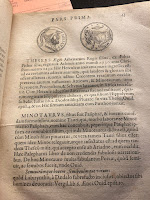
In the second half of the 16th century, the formula of coin with text was still popular. The French printer Guillaume Rouillé published his Promptuarium Iconum Insigniorum (Treasury of Portraits of Distinguished People) in 1553 (often reprinted; our copy is from 1578). Less concerned with historical accuracy – there are coins depicting Theseus and the Minotaur, for example, as seen below on the left – Rouillé’s work includes historical and contemporary people of note, like modern kings and men of letters. The images below on the right are his renditions of Renaissance luminaries Erasmus and Guillaume Budé.

Rouillé's images of Theseus and the Minotaur      Rouillé's renditions of Renaissance luminaries Erasmus and Guillaume Budé

Fulvio’s and Huttich books held great value for those interested in ancient coins. Rouillé’s has more of a general appeal. But perhaps the most important reason for the success of their books, and Rouillé’s, is the human desire to see (or imagine) what illustrious people looked like. And, of course, to make ourselves more virtuous.

In his preface to the reader, Rouillé suggests that the edifying effect of gazing upon such illustrious people could even result in the reader himself being immortalized in print: “Conduct yourself in this way,” he writes, “so that through the exceptional praises of your virtues, your likeness too might be deemed worthy of a distinguished place in future editions of this book.”

To see the Fulvio, ask for Rare N7585 .F8 1517; the Huttich, RareDG203 .H8 1534; and the Rouillé, Bryant CJ5569 . R73.

Further reading:

Cunnally, John. Images of the Illustrious: The Numismatic Presence in the Renaissance (Princeton 1999).

Haskell, Francis. History and Its Images: Art and the Interpretation of the Past (New Haven 1993).

Madigan, Brian. Andrea Fulvio’s Illustrium imagines and the Beginnings of Classical Archaeology (Leiden 2022).

Pelc, Milan. Illustrium Imagines: Das Porträtbuch der Renaissance (Leiden 2002)

Stahl, Alan. “Numismatics in the Renaissance.” Princeton University Library Chronicle 69.2 (2008), 217-240.

Weiss, Roberto. “The Study of Ancient Numismatics during the Renaissance.” Numismatic Chronicle 7.7 (1968), 177-187.

Published for Daniel Abosso, Subject Librarian (Baker-Berry Library).

Friday, February 16, 2024

Breaking Bread: The Development of Kosher and Halal Dining at Dartmouth

Brightly colored brochure advertising the Pavilion station and showing its location on a map

“[A] joint Halal-Kosher dining venture on campus … would significantly advance Dartmouth’s vision for its future.”

1999 was an important year in the history of food inclusivity at Dartmouth. President emeritus James Wright and the Board of Trustees introduced the Student Life Initiative (SLI) in February of 1999. The main goal of this initiative was to make Dartmouth’s campus more socially inclusive and welcoming, and administrative leaders found that centralizing dining and renovating campus dining facilities would help them achieve this objective. Jewish and Muslim student leaders similarly determined that the creation of a Halal-Kosher dining facility would advance the SLI’s inclusivity mission.

Jewish and Muslim students in the late 20th and early 21st centuries began working together to research the logistics for creating a Kosher-Halal-friendly dining option. They eventually formed a committee, which included the President of Dartmouth Hillel, the President of the Al-Nur Muslim Student Association, and former Dartmouth Rabbi Edward Boraz. This committee collaborated with Dartmouth Dining Services (DDS) to determine what was possible for the future of a more inclusive dining experience. The committee finalized their research in a report titled “The College Committee’s Report on Kosher and Halal Dining.”

Final page of the committee report on Halal and Kosher dining, signed by three committee members

The committee determined that a “dedicated dining facility that would meet the needs of Muslim and Jewish students” would “[e]nable those with religious dietary requirements to feel more at home.” It would “creat[e] a better sense of inclusivity for those who wish to observe these [religious dietary] laws.” Other students who do not follow these requirements would also benefit. A Halal-Kosher facility would “[a]dd to the array of dining options and thus encourage the development of cross-cultural interaction among students.”

In the late 90s and early 2000s, Kosher and Halal dining options at Dartmouth were flawed, limited, or non-existent. The student committee reported that “there [were] no Halal products presently available.” Committee leaders acknowledged the efforts of DDS and Hillel but relayed that “existing facilities [did] not satisfy orthodox standards of Kashrut.” Barring “religious holidays and Friday evening services, Kosher dining [at Dartmouth was] marginal at best.” Dartmouth offered “Kosher sandwiches and microwavable dinners,” but the use of non-Kosher products in microwaves “render[ed] both the microwave and food subsequently warmed in it to be unfit.”

Students adhering to Kosher policies faced additional barriers during religious holidays, despite the Roth Center for Jewish Life serving Kosher-compliant food. Dartmouth Hillel, in response to the “increased demands for improved quality and greater supervision” of Kosher food, “retained Andrew Wiener Catering Service of Boston, an orthodox certified kosher caterer, to provide meals for Rosh Hashanah, Yom Kippur, and post-fast meals.” However, the “dramatic increase in costs” forced Dartmouth Hillel to “charge half of its cost to the students’ meal plans.” In other words, there were economic obstacles that made dining less accessible for students with certain dietary needs.

Dartmouth administration, working towards inclusivity, began focusing on resolving these issues and accommodating more dietary needs. A Student Life Initiative planning document shared that in November 2000, the College announced that “‘Muslim and Jewish students forge[d] a ground-breaking agreement for a joint Halal-Kosher dining facility’ to be located in Thayer Hall.” This dining facility would later become known as the Pavilion, which still serves Kosher and Halal food options today. The SLI document also stated that College leaders advocated for this dining outlet’s placement in the Collis Center, Robinson Hall, or Thayer Hall: they found that it should reside in a “primary campus dining venue.” Administrators wanted those with these dietary requirements to feel fully integrated into the campus community. This indicates the College’s efforts to make dietary needs — and religious identities — welcome at Dartmouth.

To read the “The College Committee’s Report on Kosher and Halal Dining,” visit Rauner Library and request “The College Committee's Report on Kosher & Halal Dining” in Box 30887 from collection DA-798. For access to the Student Life Initiative planning document, ask for folder “SLI Social Dining” from Box 30373 from collection DA-8.

Posted for Thomas Corrado '25, recipient of a Historical Accountability Student Research Fellowship for the 2024 Winter term. The Historical Accountability Student Research Program provides funding for Dartmouth students to conduct research with primary sources on a topic related to issues of inclusivity and diversity in Dartmouth's past. For more information, visit the program's website.