Friday, July 15, 2016

A Salty Cookbook

cover of Good Maine FoodOur Kenneth Roberts Library collection consists of Roberts' personal library, including a well-thumbed and annotated cookbook. After Robert's article about New England food in the Saturday Evening Post went viral (or whatever the pre-digital phrase would be), he worked with Majorie Mosser to write a book on Good Maine Food. 

Roberts' annotationThis copy is Roberts' personal copy, presented to him by Mosser in 1947. It contains his notes for the 1959 update (Foods of Old New England), but it seems to have served as a repository for any kind of recipe from couscous to avocado salad -- neither of which are from Maine or New England.

Devilled ham saladToday, some of the recipes seem quite dated. Who wants to eat corn and deviled ham salad? It also shows Roberts' more ... acidic side. "Fanny Farmer, the dope, says to cook the bones about an hour ...."

Roberts must have used the book often, as he re-backed the paper dust jacket with what looks like a napkin or handkerchief.

To see these salty annotations and retro recipes, Ask for Roberts Library TX715 .M915 1947.

Tuesday, July 12, 2016

Shivering Shakers: July 12, 1841

1816 is famous for being the year without summer. A volcano in the Dutch East Indies spread so much ash into the atmosphere that crops failed across the world. New England was particularly hard hit with frosts in each month of the summer and snow in August. A 1817 almanac in our collections reflected on 1816 philosophically: "Frost destroys the seeds of disease'--Perhaps if the frost had not prevented, a destructive pestilence might have depopulated North America."

Apparently 1841 wasn't much better in New Hampshire. We have the daily diary of Seth Bradford from June 1834 to March of 1849. A farmer and member of the Shaker community in Enfield, New Hampshire, Bradford recorded the mundane but essential facts of each day that pertained to his crops. Mixed into entries like "Washed Sheep," and "The Peas Bloomed" are moments of historical importance such as "Began to raise the Stone Dwelling House" on July 1, 1837. But what caught our eye was the sobering entry (and sobering is a strong word for Shakers) on July 12, 1841. Underlined and written larger than any other day is, "A Frost in the morning." The weather was important. The next year, he records over nine inches of rain in a two-week period causing a dam to break, after which he reported, "Reuben Dickey becomes deranged and put into close confinement."

Luckily, we have been having a lovely July so far this year.

To see the diary ask for Codex MS 000585, Leavitt's Farmer's Amanac is at NH Imprints Gilmanton 1804 (ask for the 1815-1829 volume).

Friday, July 8, 2016

Birch Bark Poems

1870 and 1880 editions of Birch Bark PoemsSometimes a book's form and content give little indication of the life its author led. Birch Bark Poems, by Charles Fletcher Lummis, is just such a book. A collection of small poems written in the transcendental style, Birch Bark Poems is printed on thin and delicate birch bark, sporting beautiful engravings of birch trees on front and back.

Birch Bark Poems began as a summer enterprise in Lunmis's college years. Lummis attended Harvard and was a known jock and rebel, but during his summers he worked at the Profile House in the White Mountains as the in-house printer of things like menus and programs. Lummis had been enamored with printing for several years, and was efficient enough at his job to do some projects on the side.

Back cover of 1880 Birch Bark PoemsLummis was a fairly serious poet, and after a few years on the shores of Profile Lake (where he was known to sleep in a birch bark canoe) he had written enough poems that he deemed publishable if they were to come in an attractive package. Lummis printed his poems on birch bark, puzzling out the medium's eccentricities and making about a dozen little books to sell for twenty-five cents each in the Profile House gift shop. The books were far more popular than expected, and by the end of the next summer Lummis had printed over 3,500 copies in various editions. Lummis's enterprise was so successful that other publishers in the area began to put out similar books of poetry and engravings of local scenes on birch bark, and even on fake birch bark paper (Birch Bark Souvenirs, Views, F41.32 B57; Smith's Birch Bark Poems, PS595.W4 S54 1900;  and A Voice from the Mountains PS595.W4 G73).

Collage of books printed on birch bark
Lummis was an excellent self-publicist, so he had the brilliant idea that he would send a few copies of his book to the eminent poets of the day--Whitman, Longfellow, and Lowell, to name a few--who actually responded with encouragement. With these poets' blessing, Lummis proceeded to send his book to literary journals and even Life Magazine, who thought the binding of the book was better than the poems within, but that they "may have some lasting power."

To learn more about Lummis's colorful life, see Mark Thompson's American Character: The Curious Life of Charles Fletcher Lummis and the Rediscovery of the Southwest (New York, Arcade, 2011).

Ask for White Mountains PS3523.U49 B5 1870, PS3523.U49 B5 1880, and PS595.W4 B46 1900 to see editions of Birch Bark Poems. For a political rather than aesthetic use of birch bark for printing, check out Pokagon's Red Man's Rebuke.

Posted for Kassie Amann '16

Tuesday, July 5, 2016

The British Gazette

British Gazette, May 5, 1926In the age of the internet we forget that there once was a time when the news was not accessible 24 hours a day, 7 days a week. In those days people relied on the broadcasting services and the newspapers for that steady stream of news. It is, therefore, not surprising that when a 1926 general strike related to coal miners shut down the United Kingdom,
the fear of rumors replacing factual news accounts was worrisome to its government.

British Gazette, May 13, 1926With "nearly all the newspapers hav[ing] been silenced," the government decided to go into the newspaper business themselves, likening the lack of accurate news to that of "African natives" carrying tales from place to place. Winston Churchill, who at that time was the Chancellor of the Exchequer, was instrumental in getting it done. Drawing on his past experience as a journalist he offered editorial guidance - turning the newspaper into an effective organ for the government. Printed on the presses of the Morning Post, the British Gazette set out "to carry full and timely news throughout all parts of the country."

British Gazette, May 13, 1926 - circulation numbers
Run without profit (it sold for 1 penny) and entirely at the expense of the government, the paper was published between May 5 and May 13, 1926 and was disbanded when the strike ended after 9 days.

The entire run of the British Gazette can be found in in the Forsch Collection of Winston Churchill material, MS-788.

Friday, July 1, 2016

John Williams and The Picture Printer

It must have seemed impossible. In the early 1800s, George Baxter awed England with his innovative color prints, easily mistaken for hand painted illustrations. Such detailed and vibrant prints had never been produced before on a press. And, they have not been reproduced with equal quality, leading some to suggest that Baxter kept his true methods secret.

Baxter’s patented technique is a two-step process. The first step is to print a key plate, which contains the details and shading of the final image. Usually, he used aquatint, which is an etching technique that can produce watercolor-like gradients of ink. After the key plate, the second step is to print several woodcuts layers. He often used between 4 and 20 different woodcuts, but sometimes up to 30. The final result was a color print with unprecedented depth and range of color.

In addition to his passion for engraving, Baxter was a devout Christian. He developed a relationship with the London Missionary Society’s publisher, John Snow, who inspired Baxter’s decade long venture into missionary printing. During this decade, Baxter produced many prints with religious themes and, on Snow’s advice, began selling his prints as separate objects.

Among these specimens was a handsome portrait of the popular missionary, John Williams. Williams was an active member of the London Missionary society and traveled extensively in Polynesia, spreading Christianity. In 1837, he published A Narrative of Missionary Enterprises in the South Sea Islands chronicling his missions. It featured Baxter’s portrait of him, which is a particularly significant print because it was the first of Baxter’s many color portraits. His religious portraits and other missionary prints were among his most popular works. The subject matter appealed to the Victorian enthusiasm for religion and support of the missionary efforts. Even the royal family raved about Baxter’s prints. John Williams, in particular, was very highly regarded, so Baxter’s prints of him sold well. Despite Baxter’s popularity, he was not a great businessman. Plagued by an inability to meet deadlines, he was unable to make a profit and went bankrupt.

Ask for Illus B334wi or Illus B334mu to see the color printing in person.

Posted for Marie Schwalbe, Thayer School.

Tuesday, June 28, 2016

Animal, Vegetable, or Mineral?

Lamb of Tartary in Paradisi in Sole...
Rauner's Paradisi in Sole...
A few weeks ago, the W. D. Jordan Library at Queen's University in Ontario posted an image on Instagram of John Parkinson's gardening book, Paradisi in Sole Paradisus Terrestris (1629), with the casual note, "Of particular interest in this lush Garden of Eden is the mythical Lamb of Tartary, in the middle behind the figure of Adam."

At that, our book nerd senses tingled. We set off in search of the Lamb of Tartary in our collections to find out what it was.

Edward Topsell, in his 1607 Historie of Fovre-Footed Beasts, writes that in "Muscovy" near the Volga, there is a "certaine beast of the quantity and forme of a little Lamb, the people call it Boranz ... [that is] generated out of the earth like a reptile creature ... [and is] thus lieth a litle [sic] while and neuer stirreth far from the place it is bred in, I mean it is not able to moue it selfe, but eateth vp all the grasse & green things that it can reach, and when it can find no more, then it dyeth." He cites "Sigismundus," Topsell's anglicized name for Sigismund von Herberstein (1486-1566), a Hapsburg nobleman and diplomat who wrote the first account of Russia widely known in Western Europe, Notes on Muscovite Affairs (1549). Von Herberstein was known for his accuracy, refusing to record anything unless it had been corroborated by multiple sources.

The legend of the Vegetable Lamb endured through the Enlightenment. Denis Diderot (1713-1784) was the co-founder, co-editor and author for the 18-volume Encyclopédie, ou dictionnaire raisonné des sciences, des arts et des métiers, one of the foundational Enlightenment texts. Published over a period of 21 years (1751 to 1772), the Encyclopedia was meant to change the way humans thought. The entry on the "Agnus Scythicus" (Scythian Lamb) describes the Lamb -- which was probably a misunderstood plant -- and then immediately launches into a diatribe about truth. "All the wonder of the Scythian lamb reduced to nothing, or at least to very little, to a hairy root which people twist and turn to make it look a little like a lamb."
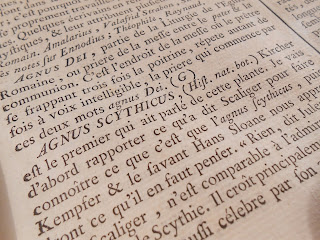
Agnus Scythicus in Diderot's Encyclopédie
"Agnus Scythicus" entry in Diderot's work


Today, most historians agree with Diderot, and cite the wooly fern Ciborium barometz as the inspiration for the legend.

For Topsell, ask for Rare Book QL41 .T66 1607. John Parkinson's Paradisi in Sole Paradisus Terrestris is Val 635 P229p. Diderot's
is Rare Book AE25 .E53 (18 vols.) Luckily for those of us who don't speak French, the University of Michigan has translated the entries into English (Scythian Lamb, cited above).

Friday, June 24, 2016

Artifact of His Time

We are always blogging about the really cool things you can find in Rauner. Usually, once things come here, they stay, but today we focus on one of our favorite things that we are losing. Dean of Libraries, Jeffrey Horrell, is retiring in June. A frequent denizen of Rauner, when he is here, he is definitely one of the coolest things not exactly in the collections, but among the collections.

We thought we might be able to declare him a part of the archives, but then we realized we would have to put a twenty-five year restriction on him (Dean's records, you know), and that seemed a little unfair to his family and friends. So, he'll just be deaccessioned and cast out into the world.

We will miss the delight he took in everything he saw in Rauner and his unceasing support for the collections. But, what we will miss most is the care, thought, and support he gave all of us everyday. He made us better at what we do, and made Dartmouth a more humane and decent place to work.