Tuesday, March 5, 2013

Cloud Computing

A black and white photograph of a woman seated at a desk and typing.
In September, 1940, during a meeting of the American Mathematical Society, George Stibitz publicly demonstrated remote data processing for the first time. His "Complex Computer" at Bell Telephone's New York laboratory was able to process queries and return solutions to several problems as entered by an operator in Hanover, NH. The user in Hanover typed in the calculation to be performed on a keyboard identical to one in New York. The keystrokes made in Hanover were transmitted via telegraph to New York where they were manipulated by the computer to produce a solution. The completed solution was then transmitted back to Hanover to be printed by the remote terminal.

A black and white photograph of a relay rack.
Relay Rack for the
Complex Computer
 The "Complex Computer" was so named as it had been specifically designed to handle calculations involving complex numbers. Stibitz felt that a mechanical means of computing was not flexible enough to handle this type of problem but instead designed his device around telephone switching relays which could be "made to perform any strictly logical thinking" as the mathematics used to describe purely logical operations and those of relay circuits are the same. The one caveat to this proposed method was that all numbers would have to be translated into binary notation to simplify design as the relays themselves were standard 2-position relays.  Stibitz notes in the first draft of his talk that as far as he was aware this was the "first so-called 'practical' use...of binary notation."

A blue circuit diagram.
Portion of circuit diagram
for the Complex Computer.
Ask for ML-27, Box 1 to see Stibit'z drafts of his talk as well as blueprints and notes on the Complex Computer. The slides used in the original presentation are held in Box 53. A guide to the collection is available.

Friday, March 1, 2013

Howard Pyle's Book of Pirates

An illustration of a pirate in a long red coat, standing on the deck of a tossing ship.From Peter Pan's Captain Hook to Pirates of the Caribbean's Captain Jack Sparrow, pirates are established and identified though their dress. The credit for the classic pirate costume (coat, boots, sash, and tricorne) could easily be given to Disney, but Disney had a source from which to draw inspiration: Howard Pyle.

Raised in the Brandywine Valley, Pyle spent his childhood in the picturesque town of Wilmington, Deleware; there, stories such as Grimm's Fairy Tales, The Arabian Nights, Robinson Crusoe, and The Tanglewood Tales fostered Pyle's imagination and creativity. After studying art under F. A. Van der Weilen, Pyle became an author/illustrator for Harpers Magazine. His first illustrated pirate tale, "Buccaneers and Marooners of the Spanish Main," was published here in the August/September 1887 issue. Pyle continued to produce pirate tales, even as he gained recognition for The Merry Adventures of Robin Hood of Great Renown, in Nottinghamshire and his King Arthur tales.

A lushly colored illustration of a rowboat of figures behind a large ship.Howard Pyle spent his summers near the ocean in Rehoboth Beach, Delaware, with his family; many pirates were painted during these summers. Though many of the buccaneering characters of his tales hailed from New York, Virginia, and Delaware, Pyle's pirates stuck to a dress code influenced by sixteenth century sailors and Spanish Gypsies. These clothes would have been impractical for a true pirate, but the task of the buccaneer on the page is not to climb rigging or wash the deck—Pyle's pirates job is to look distinct, exotic, and dangerous.

Pyle's pirates became iconic, changing the world's perception of what makes a pirate. Harper & Brothers was able to capitalize on Pyle's pirates' popularity by publishing his pirate tales as a collection in 1921, ten years after his death. Howard Pyle's Book of Pirates is not a complete tribute to "Father of Illustration," but does highlight his genius in creating the modern pirate.

A page of text from "Howard Pyle's Book of Pirates."
Ask for Illus P993howp

Posted for Laura Vang '15

Tuesday, February 26, 2013

Sound Sampler

A photograph of a pile of wax cylinders.
Edison Wax Cylinders
Charles Furlong Papers (Stef Mss 197)

Sound recordings, whether spoken word, music or field recordings have always been part of the aural landscape (well at least as long as sound recording equipment has been around). There's a natural impulse to create some lasting impression of an event or artistic achievement.

As with any medium, the method of capturing sound has evolved over time. The earliest methods (called phonautographs) recorded sound as visual lines on paper. These were replaced by Edison's wax cylinder phonograph and the gramophone.  Both used a stylus to impress a continuous groove in some malleable material  - typically wax, lead, or tin foil. The "records" that are still in use today are a direct descendant of these early formats.
A blue-violet flexography and the case for an LP.
Flexigraph
Great Issues (DA-12)
Standard 33 1/3 LP
Rauner Phonodisc 5
Magnetic recording technology was the next major evolution in the history of sound reproduction. Instead of capturing the vibrations as physical changes, an electrical analog of the sound was used to drive a recording head whose magnetic field varied according to the frequency and amplitude of the sound being recorded. Those magnetic imprints were then read back through a complimentary signal path. Wire recordings, reel to reel tapes and cassette tapes are all part of this format family.
A reel.A recording spool.
10" reel to reel
WDCR tapes (uncatalogued)
Wire Recording spool
Great Issues (DA-12)
The current age of digital recording employs DACs (digital to analog converters) and ADCs (analog to digital converters) to map the analog sound waves to a stream of ones and zeros and back again. Once in the digital realm, these files are typically distributed in magnetic (hard drives) or optical (CDs) form factors - a potentially ironic nod to their ancestor formats.

Rauner holds numerous sound recordings in many different formats.  We present a limited sample of those found in various collections.

Friday, February 22, 2013

Dragons of the Alps

An illustration of a flying, legless dragon or wyrm, breathing fire.We have written before about unicorns being sited in the New World, and a seven-headed hydra in a cabinet of curiosities, but now we find evidence of dragons roaming the Alps. The first edition of Johann Jakob Scheuchzer's Itinera Alpina (London: H. Clements, 1708) contains some fantastic images, but it is the expanded 1723 edition from Lugduni Batavorum that caught our eye. The exhaustive study of the regions in and around the Alps contains a series of images of exotic fauna of the region including several dragons.

An illustration of a three-legged, wingless dragon.
Scheuchzer expressed his doubts about the first-hand accounts of the dragons that he reports, but still chose to include them. Either he held out a romantic belief in the ancient beasts or he hoped they would be sensational enough to heighten interest in his work.

A black and white illustration of a two-legged, wingless dragon or warm startling a man with an axe.
To see the fire-breathing monsters, ask for Rare QH175.S32 Vol. 3-4. The first edition is Rare QH175.S3. Unfortunately, there is no information on how to train the dragons...

Tuesday, February 19, 2013

Picturing the Past

A black and white photograph of a mostly empty street.
South Main Street
White River Junction, VT
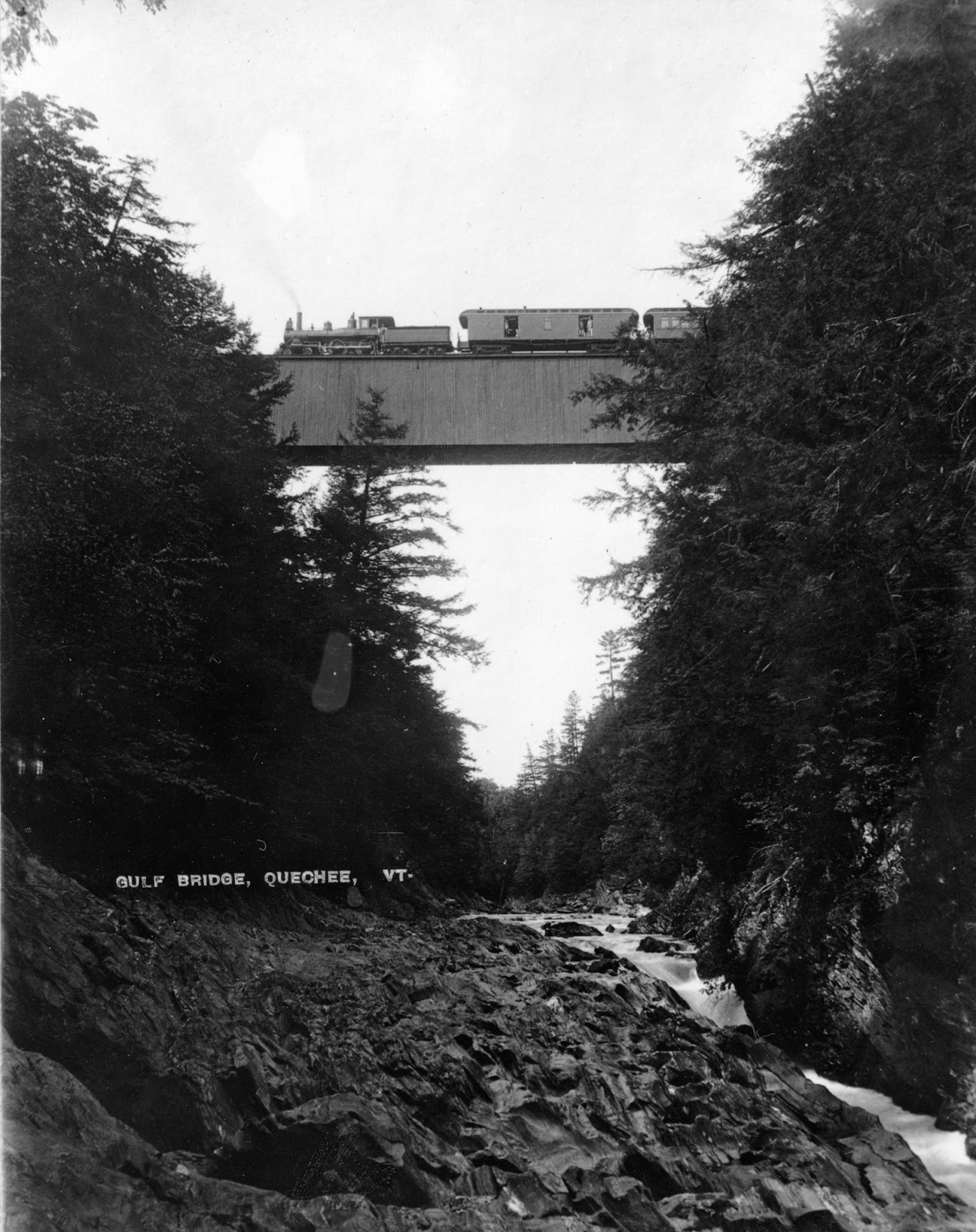
George Fellows was a local photographer who was most prolific in the late nineteenth and early twentieth centuries. He owned at least three studios in the Upper Valley area - one in Royalton, VT, another in White River Junction, VT and a third in Claremont, NH. The studio in White River Junction (pictured in the photograph of South Main Street) operated until his death in 1916. Not much is known about Fellows' origins, though it is thought that he may have originally been from Charlestown, New Hampshire.

A black and white photograph of the Gulf Bridge.
Gulf Bridge
Queechee, VT
Rauner Library holds a significant collection of over a thousand early twentieth-century negatives taken by Fellows of the surrounding area. Most of these are dry gelatin glass plates, though a small number are on celluloid. Towns represented in the collection include Canaan, Enfield, Lyme, Orford and West Lebanon in New Hampshire and Ascutney, Fairlee, Norwich, Royalton, Sharon, Thetford, Woodstock and White River Junction in Vermont. The images are typically labeled by place name or building and occasionally include a specific date. They provide a rich visual record of this small section of New England at the turn of the last century.
A black and white photograph of Mascoma Lake.
Mascoma Lake
Enfield, NH
Ask for Iconography 1513.  While the glass plate negatives are available for viewing, they are extremely fragile and we encourage patrons to ask for the modern (and much less fragile) study prints for extensive study and image selection.

Friday, February 15, 2013

A Nobleman's Entertainment

An illustrated title page for "The Book of Falconrie or Hawking."What to do, what to do? How does a nobleman spend his time in 1611?  We just acquired George Turbervile's The Book of Falconrie or Hawking for the Onely Delight and Pleasure of All Noblemen and Gentlemen (London: Thomas Purfoot, 1611) to answer just that question. The book provides detailed descriptions of the birds of prey suitable for the sport and methods for training and caring for them.

The hawking party depicted here shows the wealth and opulence associated with the sport. Falconry had been popular throughout Europe and Mesopotamia for centuries and its practice spread with the Norman conquest. Henry the VIII's enthusiasm made it all the rage with those who could afford it.

An illustration of a hunting party.
We couldn't help notice the fashion statement in these images. The blooming pants seem to evoke the feathered legs of birds of prey and the patterns a bird's plumage. Despite the probable lack of a causal relationship, the dual patterns of feathered finery are striking.

Our copy is bound with The Noble Art of Venerie or Hunting (London: Thomas Purfoot, 1611) also clearly intended for an elite audience.  To see them ask for Rare SK321.T8 1611.

Tuesday, February 12, 2013

The Great Unknown

A map of the arctic with large unfinished portions.One of our favorite maps in the collection is woefully incomplete. "The General Chart Showing the Track of H. M. Ships Hecla & Griper," from William Parry's Journal of a Voyage for the Discovery of a North-West Passage (London: John Murray, 1821) has huge blank spaces. There are no sea monsters or interesting decorative elements to fill in the Great Unknown, just empty space with an imposed grid of latitude and longitude.

The map demonstrates how little was known of the polar regions at the time. Some theorized they would find an open Polar sea while others anticipated ice filled channels leading to the Bering Straits.  Competing theories advanced the idea that land would block the way through.

Seeing this map makes the perilous journeys seeking a Northwest Passage all the more real. Not only were the explorers headed into ice with wooden hulled sailing vessels, they also had no idea what to expect as they charted the unknown.

To see the map, ask for Stef G650 1819 P151.