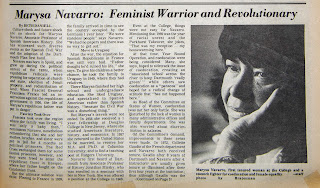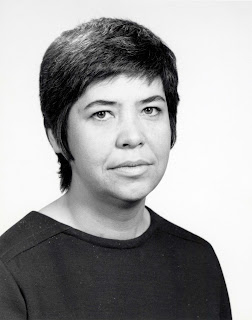
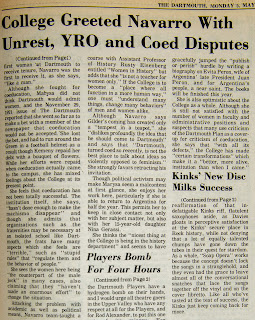
Traditions are typically celebrated at Dartmouth, and Ivy League institutions are renowned for their rich history, traditions, and culture. The Dartmouth of today is an ever-changing place, with the school becoming increasingly diverse in race, ethnicity, and socioeconomic class. However, there was a time when questioning traditions at Dartmouth was much more taboo. Throughout most of Dartmouth's history up to the 1960s, Dartmouth was an almost all-white, all-male university to which most of the American population likely never had access. It came as a shock to me when I discovered that one of the first women to receive tenure at Dartmouth, Latin American History Professor Marysa Navarro Aranguren, was also a Hispanic immigrant. given our shared Hispanic identity, along with having experienced the immigrant perspective from the third person perspective through my parents, I was immediately interested in studying her life and career at Dartmouth.
Saturday, February 19, 2022
Giving It to the Man by Doing It Like a (Wo)man
Navarro positioned herself in Dartmouth's history as a trailblazer and an advocate, helping those after following in her footsteps. As a result, students like myself and many of my peers are now able to attend Dartmouth and enjoy their experience. Although I never personally had the chance to meet Professor Navarro here, I am moved by her immense efforts to make students like myself a part of Dartmouth's history.
Read Professor Navarro's interviews by consulting past issues of The D in the Rauner reading room. To see the 1981 letter and the rest of Navarro's manuscript collection, come to Rauner and ask for MS-1174.
Posted for Emmanuel Mariano '23, recipient of a Historical Accountability Student Research Fellowshipfor the 2021 Winter term. The Historical Accountability Student Research Program provides funding for Dartmouth students to conduct research with primary sources on a topic related to issues of inclusivity and diversity in the college's past. For more information, visit the program'swebsite.
Friday, February 11, 2022
Spies among us
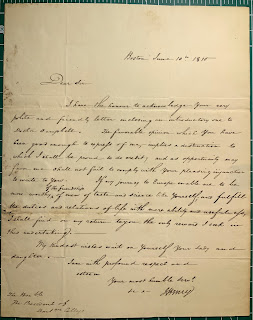
Written in 1810 by a formal military officer and sometimes Vermont farmer, John Henry, from his quarters in Boston, the letter thanks John Wheelock for a letter of introduction and expresses Henry's desire to get to know more people of Wheelock's social standing. Why might John Henry have been trying to get to know more social elites in the young republic? Well, at the time he was busy spying on the United States for the Canadian colonial government. When London failed to pay for his work, Henry switched allegiances and sold all of his information to the U. S. government. The result appeared to be another justification for deepening distrust of the British in the lead up to the War of 1812. It sounds kind of like a Mission Impossible plot: a spy cozying up to those in power, turned against one government and flipping to the other side when the profit margin reached the right level. [Cue Mission Impossible theme]
To see the letter ask for Mss 810360. Have a great Carnival!
Friday, February 4, 2022
Ketchup, Five Ways
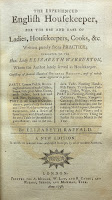
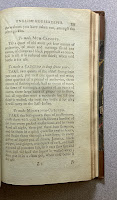
A 1796 edition of Elizabeth Raffald's The Experienced English Housekeeper offers five recipes. The fourth, "catchup that keeps seven years," reads as follows:
"Take two quarts of the oldest strong-beer you can get, put it to one quart of red wine, three quarters of a pound of anchovies, three ounces of shalots peeled; half an ounce of mace, the same of nutmegs; a quarter of an ounce of cloves, three large races of ginger cut in slices, boil all together over a moderate fire till one third is wafted, the next day bottle it for use; it will carry to the East-Indies."
None of Raffald's ketchups make use of tomatoes, a trend that wouldn't emerge for a few more years. It would be nearly another century before tomato ketchup took on the sweeter flavor we're used to today - adding sugar improved the effectiveness of the preservation process.
To read Raffald's other four ketchup recipes, and to sneak a peek at more in The Experienced English Housekeeper, ask for Rare Book TX705 .R33 1796.
Friday, January 28, 2022
Best-Laid Plans
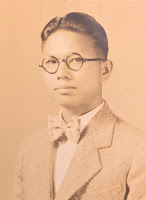
However, as the saying goes, the best-laid plans of mice and men often go awry. While in San Diego, Kong became a husband, and then a father. He also decided that the quickest way to raise money for travel was by having a business of his own. He started a Chinese arts store in 1932 in Santa Barbara with the intention of shuttering the business once he had enough capital to fund his family's trans-Pacific passage. Still, opening a business during the Great Depression, and then keeping it open, soon occupied so much of his time and energy that his dreams of moving to China became a distant memory. He also discovered, to his delight, that he greatly enjoyed the independence of owning his own endeavor as well as the joys of interacting with his customer. As Kong himself said, "My business experience in Santa Barbara made the picture of teaching in China...unattractive."
Still, despite his decision to be a businessman instead of a teacher, Kong found other ways to lead and to educate those around him, especially with regard to international relations. He was both the director of the Santa Barbara chapter of the United Nations Association and the president of the Santa Barbara China Club, as well as participating in numerous civic organizations. He also published several magazine articles, one of which emphasized the importance of racial empathy and offered practical advice for how Americans from different communities and races could build cross-cultural relationships.
A copy of that article as well as a brief auto-biography, are housed here at Special Collections in Kong's alumni file. Rauner Library has an alumni file for every deceased previous student of the college, all the way back to the 1770s. Come explore the past lives of amazing alumni like Walter Y. L. Kong whenever we're open by walking into Webster Hall and asking our desk staff to help you get started.
Friday, January 21, 2022
In Memoriam: Stanley Brown '67
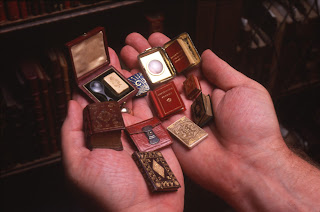
This image of Stan's loving hands cradling a selection of miniature books donated by Madelyn Hickmott best exemplifies the nurturing attention Stan devoted to the collections. The rare books were literally in good hands with him.
Stan retired from Dartmouth Library in 2004, but he stayed connected to Special Collections and was an avid reader of this blog. We will miss his meticulous fact checking, and his enthusiastic responses when we published a particularly meaty post. But we will always remember Stan through the collections that he grew and cultivated with a loving and skillful touch.
Friday, January 14, 2022
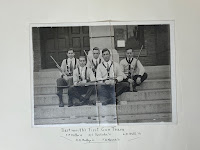
Dartmouth's First Gun Club
To look through the earliest scrapbook of the Dartmouth Gun Club, come to Special Collections and ask to see Box 6245 from the Dartmouth Outing Club's records (DO-1).
Friday, January 7, 2022
A "Robbery" at the Hanover Post Office
“We have had some great excitement in Hanover,” Frank Whitcomb, class of 1911, wrote to his sister during his first winter at Dartmouth, “which is a very rare thing I assure you.” Whitcomb goes on to relate that the Hanover postmaster had claimed just days ago that, while he was counting out money, a man broke the window beside him, pointed a gun through it, and forced him to hand over hundreds of dollars. The Boston Globe commented that the robber was “surprisingly daring” to have committed the robbery “in easy view of the back part of a drug store and a hardware store,” and that the terror of being robbed at gunpoint left the victim in a “fainting condition.” If this sounds too dramatic to be true—it was. The broken glass from the window was found on the outside of the building, suggesting it had been broken from the inside. Unable to explain this, the postmaster eventually confessed that he had recently taken some money himself and faked the robbery to cover up the shortage.
Aside from the crime taking place in Hanover, there was a commotion happening on campus. Whitcomb told his sister that Dartmouth student vigilantes heard about the “robbery” and took matters into their own hands, taking their “revolvers and shot guns” and running “about on [campus] shouting, here he is and there he goes, following their shouts with shots and yells” until it sounded like “the fourth of July.” Of course, they were chasing nobody, because the robber didn’t exist. But when the D gave its update on the “robbery” situation a few days later, it didn’t even mention the students’ response. It’s possible that in 1908, guns were so normalized on Dartmouth’s campus that students running around shooting them wasn’t considered newsworthy. It’s also possible that Whitcomb exaggerated this part of the story. It would not have been the wildest embellishment in Hanover that winter.To read Whitcomb’s letters, come to Rauner and ask for MS-1438. (Or, ask about our other collections of student letters!)