Wednesday, August 19, 2020

Haptics: The Terrain Between Accessible Design and Universal Design

Atlas of the United States - title page

Image of title page from the Atlas of the United States : printed for the use of the blind by S.G. Howe. Rare Book G1200 .H7 1837


Map of New Hampshire in Boston Line Type

Image of a map of New Hampshire printed without ink in Boston Line Type. 

Needlework - Sentiments

Image of needlework from a collection with text: "Sentiments, signed." Manuscript 001924 See also: Laura Bridgman hand work (doilies, carving): MS-1207. Hanover (N.H.) Historical Society records, folder 17, box 23.

Laura Bridgman

Image of Laura Bridgman. Laura Bridgman and S.G. Howe worked extensively together, including at the Perkins School for the Blind.

Consider: Touch This Page

'Perkins Archives partnered with Northeastern and Harvard Universities to create "Touch This Page! Making Sense of the Ways We Read," an exhibition about multisensory experiences of reading. The exhibit focuses on the work of Perkins founder Samuel Gridley Howe, who developed a tactile form of the print alphabet known as Boston Line Type. Included on the website are 3D printed copies of Perkins Archives artifacts that are available for download.'

Citation: Special Issue on Tactile Fluency. Future Reflections, volume 38, number 2 (2019). National Federation of the Blind. National Organization of Parents of Blind Children.

Wednesday, August 12, 2020

I Like the Cut of Your Jib: Fathom & Fetish, Illustrated Editions of Moby Dick

Call Me Ishamel in Emojis
Pixelation & Material Textuality:
Prosumer and Peer Production.

Emoji Dick, or, The whale / by Herman Melville ; edited and compiled by Fred Benenson ; translation by Amazon Mechanical Turk.  "Emoji Dick is a crowd sourced and crowd funded translation of Herman Melville's Moby Dick into Japanese emoticons called emoji. Each of the book's approximately 10,000 sentences has been translated three times by an Amazon Mechanical Turk worker. These results have been voted upon by another set of workers and the most popular version of each sentence has been selected for inclusion in this book. In total, over eight hundred people spent approximately 3,795,980 seconds working to create this book. Each worker was paid five cents per translation and two cents per vote per translation. The funds to pay the Amazon Turk workers and print the initial run of this book were from eighty three people over the course of thirty days using the funding platform Kickstarter."--About this book.


What The White Whale Was to Ahab in Emojis
Poe’s Law or Digimodernism?


Seeing histories in the literary canon:

The first London edition, The whale (title-page) / The whale; or, Moby Dick (half-title page), published in three volumes by Richard Bentley in October of 1851 was not illustrated, except for a whale, stamped in gold, on the spine. The first American edition, Moby-Dick; or, The whale published in one volume in November of 1851 by Harper and Brothers was not illustrated.

Neither a sperm whale, nor white: The first sighting of Moby Dick?

Several decades later, in the late 19th and early 20th century, four black-and-white illustrations designed by A. Burnham Shute were used in several of the earliest illustrated editions. Soon after, another four black-and-white illustrations by I.W. Taber were published for a Scribner’s illustrated edition. Twelve paintings by Mead Schaeffer were used for one of the earliest color-illustrated editions, around 1923. [Rauner holds each of the items mentioned in Seeing histories for you to explore].

Kent Rockwell illustration from Moby Dick showing Moby Dick beneath rowboat.
Deeper meanings
and body texts.
Moby Dick as a symbol
Hardcovers: Binding and meaning.
See also (unbound):
Collection of proofs of illustrations
for the Lakeside Press edition of
Moby Dick.

“...the unspeakable unspoken may reveal those texts to have deeper meaning, deeper and other power, deeper and other significances. One such writer, in particular, who has been almost impossible to keep under lock and key is Herman Melville.”--Page 139-140. "Unspeakable Things Unspoken" / Toni Morrison.

Cover from Barry Moser's Moby Dick
Dust jackets:
skins and wrappers.

A different tack: unmoored, aloof 😊

See also (Rauner blogs and exhibits):

Reference: Images of Moby-Dick. Department of Special Collections. University of Kansas. 1995.

Consider: Elizabeth Schultz. "The new art of Moby-Dick." Leviathan. Volume 21, Number 1, March 2019.


Monday, August 3, 2020

Speculative Fiction & Contingency: Aubrey Beardsley, Toni Morrison and Edgar Allan Poe engaging in the archives

Cover design for Edgar Allen Poe’s Tales by Aubrey Beardsley (Unpublished)

Cover design for
Edgar Allan Poe’s Tales
by Aubrey Beardsley
(Unpublished)

A mystery: What would Poe's reactions be to the illustrated edition by Beardsley?

In this case, the illustrations to a particular text are removed from their context as illustrations and seen as stand-alone images, whether published or unpublished (Illustrations to Edgar Allan Poe from Drawings by Aubrey Beardsley. Indianapolis: Privately printed for the Aubrey Beardsley Club, 1925. Rauner Illus B38i). Some authors illustrate their own works, others identify the illustrator and also exercise editorial decisions concerning the illustrations (see variations: Alice's Adventures in Transatlantic Publishing) and other authors have no say in illustrated editions, though editors and publishers do.

A specific voice, placed and displaced in technology.

Cassette of Toni Morrison speaking. July 30, 1986. Reading excerpt from Beloved
Another type of mystery: The label would suggest one could hear Toni Morrison reading Beloved at Dartmouth in 1986. Given that Beloved was published in 1987, one wonders what version she would be reading or from what actual artifact, typescript or manuscript, etc. It is quite possible that this very specific version of Toni Morrison speaking at Dartmouth in 1986 has been unheard except for the original individuals attending the reading. [Dartmouth College, Provost records (DA-7). Montgomery Fellowship Recordings, 1980-1996. Audio cassette recording of lectures by Montgomery Fellows, 1983-1986.] (Note: We do need to create “use copies” from some media, such as magnetic-based recordings).

The works of Edgar Allan Poe (unpublished, incomplete).

A collection of correspondence and 12 volumes in various stages of development (illustrators, forewords, etc. uncertain), that was never published.

Another mystery: How to include in a chronologically earlier “complete works” the unnamed, incomplete, and unfinished last story of Poe that is referred to as The light-house and what can artifacts of unpublished, perhaps unseen, versions of other works tell us? See Rauner manuscript MS 577.

Collaboration and engagement in the spaces of the archives: Toni Morrison engaging with the unnamed fragment by Poe. Poe and Beardsley reading and listening to Beloved. You now reading an edition of Beloved, illustrated by Beardsley with a foreword by Poe?

Navigating archives : Systemic structuring of spaces : Fragments & Lacunas.

Wednesday, June 24, 2020

Vanishing: Making of an Extinction Crisis

Poster from the exhibit featuring animals and scientists related to the issue of extinction
The last mass extinction, leading to the destruction of the dinosaurs, was caused by an asteroid colliding with earth around 66 million years ago. The blame for the next one lies much closer to home - with us. Soon, all that might be left of some of the planet’s 1 million species at risk of going extinct in the next century are specimens, photographs, and memories contained within archives and museum collections. As human actions lead to the extirpation of an increasing number of the world’s plants and animals, the burning question remains: what do we really lose when a species disappears, and is there anything we can do to slow or halt extinction in the age of the Anthropocene?

An online exhibit curated and designed by Alexander W. Cotnoir ’19, the 2019-2020 Edward Connery Lathem ’51 Special Collections Fellow, seeks to answer some of these complex questions, including how we arrived at where we are today using historical examples. Hopefully, by learning from the past we can change our direction in the future.

You can visit the exhibit online here: https://exhibits.library.dartmouth.edu/s/vanishingexhibit/page/intro

Friday, June 5, 2020

Protest: Through A Child's Eyes

Drawn by a 4th-grader, this map scene, drawn in pencil and crayon, may have had its inspiration from newspaper maps published at the time of the 1968 riots showing areas most damaged by fire. “Those who cannot remember the past are condemned to repeat it” wrote Italian philosopher, poet, and essayist George Santayana (1863 - 1952). At Rauner Library, we often come across historical items and artifacts that speak to the reality behind Santayan’s words - demonstrating shocking parallels between current and historical events. This week, amid widespread protests, one such group of items captured our attention - John Matthew’s collection of political protest drawings and ephemera, which we previously highlighted on the Rauner blog back in 2015. Alongside political posters, student newspapers, flyers, banners, pamphlets and ephemera related to civil rights protests between 1968 and 1969, the collection also contains 23 original drawings depicting riots in Washington DC following Reverend Dr. Martin Luther King Jr.’s assassination in April of 1968. The drawings - created by Black school children ages 8 to 16 who lived in neighborhoods most affected by the protests - strike a particular cord given their similarity to recent events unfolding in Washington D.C. and cities across the U.S. like Minneapolis and Chicago, where protestors have mobilized following the death of George Floyd.

Norman W. Nickens, the assistant superintendent of D.C.’s Model School Division at the time of Martin Luther King Jr.’s death, was the impetus for creating this unique record of the Washington protests as recounted through the eyes of schoolchildren. As President Lyndon B. Johnson quelled demonstrations and looting using federal troops, Nickens instructed his teachers to have the students use a variety of creative forms to express their feelings about the turmoil they’d experienced, including in-class discussions, compositions and finally - drawings.

Many of the drawings depict burning buildings, ruined storefronts, and imposing crowds of helmeted federal troops amid figures with comic-strip balloons crying “help me!” or “stop!” Although some drawings focus solely on police and federal troops confronting Black protesters and others depict store looting, they all convey a sense of fear and a feeling that the world was spinning out of control. As the author of one of our drawings - a 5th grader - said at the time, “I thought the world was coming to an end… I felt like a man in a house fire.”
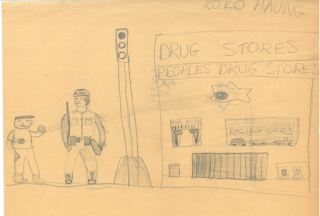
Pencil drawing by an junior high school student depicting a Black protester hurling a rock through the front window of a store in front of an armed military personel.During what has since been called the “Holy Week Uprising” of 1968, crowds of as many as 20,000 overwhelmed Washington’s 3,100-member police force, and President Lyndon B. Johnson dispatched some 13,600 federal troops, including 1,750 federalized D.C. National Guard troops to patrol D.C.’s streets. By the time the city was considered “pacified” on Sunday, April 8, some 1,200 buildings had been burned, including over 900 stores. Across the country, over 40 protesters died and over 2,500 were injured.

As some of the children’s drawings show, Black store owners across Washington D.C. wrote “soul brother” or “soul sister” across their storefronts so that looters would spare their stores. What did the phrase mean? To some of the interviewed children, being a soul brother or soul sister meant “being proud of being Black”, but to others - including a 7th-grader who drew one of the protest drawings - “A soul brother is a person who treats his neighbor as he would want his neighbor to treat him.” One group of Black second-graders wrote “Soul Sister” across their white English teacher’s blackboard the day after Dr. King was assassinated, even “advising her to go home early because the streets were unsafe” according to a New York Times article written by education reporter John Mathews, who had access to some of the material that had been created by the children. As the teacher recounted, her young pupils were “unusually affectionate and protective” amid the violence, having recognized her as what we would call an “ally” today- someone who stands up for others, even when they feel scared, and acknowledges and transfers the benefits of their privilege to those who lack it. These, along with many other stories of shared humanity and kindness - comprise the largely untold narrative behind an overwhelmingly violent collection of illustrations.
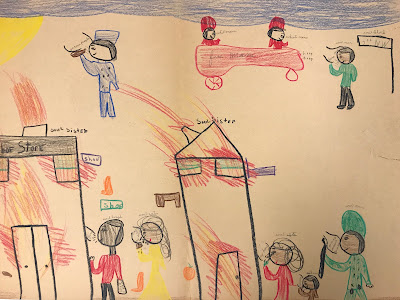
Colorful crayon drawing, authored by an elementary student, depicts Black community members mourning the loss of their stores and a police vehicle with occupants labelled as "white men". Notice the tops of the storefronts, which read "soul sister" and "soul brother."

Despite the fact that inscribing “Soul Brother” generally provided insurance against damage, the children’s drawings also show that not all destruction was strategically planned. For instance, some of the drawings depict stores owned by white community members, engulfed in flames, with Black families living above them trapped and burned out of their own homes. Such illustrations depict the disproportionate impacts of the Holy Week Uprising felt by predominantly Black communities following the protests, despite the initial strategy of targeting white businesses.

Three part crayon drawing by an elementary student depicting what the student's block looked like before, and after the riots broke out across Washington D.C., and what the students thought their neighborhood would look like in the future. In the future, the street looks largely the same, save for all the stores are brimming with goods.In addition to reflecting upon their past experiences during the four days of unrest, the  younger children were asked to draw pictures of their neighborhoods on Friday  - the day after MLK’s assassination; on Monday - after the largest riots had occurred - and visions of what they believed it could look like in the future. The Friday scenes usually show fires, looting, and skirmishes with police, whereas the post- riot illustrations show shells of smoldering buildings, shattered windows, and militarized occupation by federal troops. Although these pre and post-riot illustrations are interesting, it is perhaps the children’s’ depictions of the future that are most illuminating… Many of these drawings depict city blocks completely transformed into a pastoral suburbia of single-family homes, with beautiful trees, families walking together, and blooming flowers.

Other pictures show the same city block, but with all the stores opened and the shelves brimming with food and supplies. These images speak to the shared hopes each of these children held for the future even amid experiencing some of the worst civil unrest during the Civil Rights movement - the desire for safety - a loving family-like community, and plentiful food and shelter. Today, although protests have taken different forms, these same desires inspire activists. The same hopes and dreams that brought thousands to the streets in 1968 still pulse in the hearts and minds of protesters today.

To view these striking snapshots of history through the eyes of the children who were living it, I encourage all those who are interested to request “MS-1335” the next time you visit Rauner Library.

Friday, May 22, 2020

Not to Worry

Five-page letter from Maurer to his mother
In 1922, Viljahlmur Stefansson had the idea to send a small group of explorers to settle Wrangel Island. Wrangel was uninhabited, and strategically located to control an important swath of the Arctic Sea above the Bering Strait. Years earlier, the survivors of the Karluk stayed there awaiting rescue after the ship was crushed by ice. There was plenty of wildlife, so Stefansson thought it could be inhabited. It fit perfectly with his ideal of the "Friendly Arctic."

So he sent four young men and Ada Blackjack, an Inupiat seamstress from Nome, to claim Wrangel Island for Canada. A year later, only Ada remained alive. It is a horrible story of Anglo-American hubris being shattered by ice and the harsh reality of the Arctic climate.

Detail of letter text about "Vic" the cat
We have all of the correspondence related to planning the Wrangel Island Expedition. It is full of optimism so it is difficult reading when you know the end result. But the worst is a letter we found from Frederick Maurer to his mother written just days before he left Alaska for Wrangel. He tells of finding "Vic," the kitten they brought along, his recent hastily arranged marriage, and his hopes for the expedition ahead and the rewards to be reaped with its success. Like a good son, he first reassured his mother not to worry:
I could not be very comfortable feeling that you were at home worrying over my safety when it is so unnecessary. You know that we are well equipped and although we are going to Wrangel Island, we are going to be living in comfort compared to the last experience up here.
Then he prophetically ties his success to Stefansson's reputation:
My going North is not for adventurous reasons as it was before, instead we are planning on commercializing the resources of the island along with exploration. It is possible that its developments may prove well worth while and as far as my investment is concerned it is as safe as Stefansson's reputation.

Fredrick Maurer on Wrangel Island
The resulting catastrophe took Maurer's life and seriously damaged Stefansson's reputation. His mother had every reason to worry.

To see the letter, ask for Stef MS-98, box 9, folder 7.

Friday, May 15, 2020

Cromwell's Bible

There is nothing better for social distancing then a really good book. If you are like a lot of us, you are knee deep in Hilary Mantel's final installment of the Wolf Hall series, The Mirror & the Light. It lives up to the previous two novels in the series following Thomas Cromwell's rise and fall in the court of Henry VIII.

Throughout the third novel, Cromwell is overseeing the production of what came to be know as The Great Bible--a full English translation fit for the evolving Church of England. The book was being printed in Paris because they wanted the best quality work Europe had to offer, but political difficulties kept rearing up (a Protestant bible in France... not cool with the Inquisition). When it was nearly finished, Cromwell had all of the type and printed sheets brought to England to complete the printing.

Our copy is particularly nice because when it was bound someone put "Lord Crumwel" on the spine--you get the feeling, based on the various pronunciations of Cromwell's name in Wolf Hall, that it was a native French speaker--though I doubt it was a member of the Boleyn family!

The title page, probably designed by Hans Holbein, is amazing. The word comes from God, but Henry doles it out to the people--on his right to the head of the church to distribute to the clergy, and on this left, to Cromwell to send out to the laity.

Cromwell didn't last much longer after the publication was finished, but the book is alive and well in our collections. To see it, ask for Rare BS155 1539.