Friday, October 12, 2018

Illustrated Rose

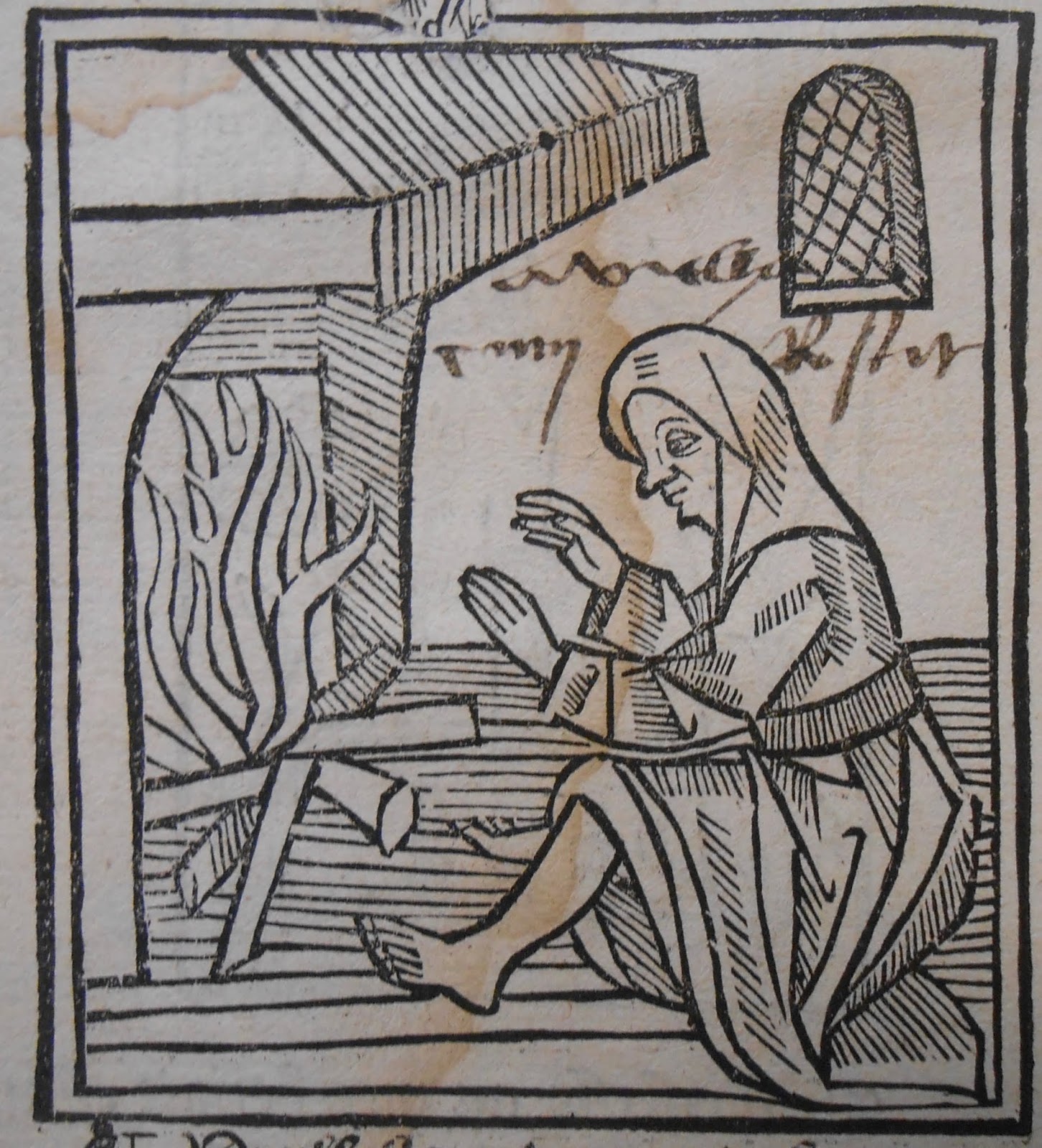
Poet entering the gatesWe just picked up a beautiful early edition of the Romant de la Rose (Lyon, 1503). It is the perfect complement to our early 14th-century manuscript of the poem. This copy has a series of woodcuts that enliven the text, add an interpretive layer, and evoke the manuscript tradition of our earlier copy. But, while our manuscript has only seven images, this copy is illustrated throughout with 140 woodcuts, many with manuscript notes from an early reader.

Man and woman entering a castleWoman warming herself by fire

Man speaking to an angel
It is a stunner, so come in and take a look by asking for Rare PQ1527.A1 1503.

Tuesday, October 9, 2018

The Dartmouth Commercial Crisis of 1903

Broadside announcing the Tuck School - Thayer School baseball game scheduled for April 4 1903 While preparing for a Tuck Reunion event that occurred this last Saturday, we stumbled upon a fascinating broadside announcing a "Great Commercial Crisis!!" Intrigued, we read on. "Capital vs. Labor," the flyer declared, before then going on to describe an upcoming baseball game between the Tuck School of Management ('Capital') and the Thayer School of Engineering ('Labor'). The program lists all of the players by position, complete with nicknames and dubious monikers: 'Jaygould' Brown, the Man without a Country; H. E. Plumer, the Mud Pie Mixer; and 'Monsieur' Murray, Le Professor, to name a few.

The Tuck School was a fledgling institution at the time, merely two years old to Thayer School's thirty-three years of existence, but clearly it didn't take the two schools long to form a collegial relationship. The Special Code of Rules at the end of the broadside declares that the defeated team will be responsible for setting up drinks at Deacon Downing's bar. A Tuck School class photograph for the 1903 graduates doesn't give any hint of the sort of humor clearly evident in this printed promotion for a casual ball game held during the Easter break. Although it was doubtless easy for the students to joke about the conflicts between capitalists and the work force, given their privileged station in life, it is also nice to have a perspective that contrasts with their formal appearance in their group photo. It's also interesting to note that the entire class could just field a nine-man baseball team.

Group photo of the nine members of the Tuck School class of 1903

To see the baseball broadside, come to Rauner and ask for Broadside 903254. To see the group photograph of the Tuck class of 1903, ask for the "Tuck School -- Students" photo file or download a copy yourself from the Dartmouth Photo Files database online.

Friday, October 5, 2018

100 Years of Bethlehem (N.H.)


A page from the Taylor scrapbook containing an article about a mink farm fire.Hattie Whitcomb Taylor was born in 1898 in a small farmhouse in Bethlehem, New Hampshire, about seventy miles north-northeast of Hanover. In her sixties, serving as an amateur historian with a wealth of knowledge of the region, she wrote a history of Bethlehem. In addition to her book, Taylor also created a remarkable record of small-town New Hampshire life that spans nearly the entire twentieth century: four scrapbooks filled to bursting with photographs, postcards, letters, newspaper clippings, and handwritten supplementary information.

A page from the Taylor scrapbook showing photographs of an organ grinder and an ice geyser from a broken water main.Photographs of the 1947 Bethlehem Winter Carnival parade are cheek-to-jowl with newspaper articles about a civic leader who was killed in a truck accident and a local mink farm going up in flames. An organ grinder's photograph shares a page with images of a beautiful frozen geyser of ice from a broken water line that left the town without water pressure for two days in 1935. Bethlehem firemen assist Littleton, New Hampshire, firemen in extinguishing the Northern Hotel fire in January of 1924. The governor of the state is welcomed to town in 1897 by a marching band, their instruments proudly on display. These photographs and pages capture the feeling of small-town pride and tragedy in a way that is seldom found in the pages of a printed book.

To read Taylor's history of Bethlehem, New Hampshire, come to Rauner and ask for White Mountains F44.B4 T39 1960. To turn through the four large scrapbooks that contain a century's worth of memories, ask to see White Mountains F41.37 .T385 v.1-4.

Tuesday, October 2, 2018

What to do in Italy

Frontispiece and title page to The Voyage of ItalyAh, the struggle of making sense of things! Think of the poor English gentleman setting out in the 1670s on the Grand Tour. Italy--so much to see, but what of it matters? What should he know when he returns home, cultured, worldly, and all grown up? If he had a good tutor along, things would be easier, but lacking that, a guide book might help.

Enter Richard Lassels, "Gent, who Travelled through Italy Five times, as Tutor to several of the English Nobility and Gentry," and his The Voyage of Italy (Paris, 1670). With nearly 700 pages of detailed information in a handy pocket-sized volume, he filled the eager traveler's need for a comprehensive education. Besides giving the reader a must-see list for each city, he evokes epic journeys of the past to instill a rich history into each place while giving the Grand Tour novice the sense of belonging to a great tradition:
Some twelve miles before we came to Rome, we saw the Cupola of St Peter's Church and were glad to see it a farr off, as the weary Trojans in Aeneas his company, were glad to see Italy after so much wandering...
To wander the streets of 17th-century Rome with Lassels, ask for Rare DG424.L337 1670.

Friday, September 28, 2018

Coeds and Cohogs: A Student-Curated Exhibit

This summer, as a part of their final project, the students in Darrin McMahon's "History of Equality" class created an exhibit at Rauner Library titled "Coeds and Cohogs: The Struggle over Female Integration at Dartmouth College." Using documents curated from the archives at Rauner Library, the exhibit considers the evolution of the College’s social character in the decades since the adoption of coeducation in 1972. Each of the three cases in the exhibit represents a distinct but interrelated facet of this unfolding process.

They treat, respectively, three complex and shifting perspectives: male students, women students, and the Dartmouth administration. When placed in dialogue with one another, the cases seek to explain how women's issues on campus today have been shaped by distinct instances of convergence and discord at Dartmouth for more than forty-six years.
Photographs of Dartmouth student protestors from the 1980s with signs and posters related to women's issues on campus
The exhibit was curated by Matthew Ix '20, Dante Mack '20, Chris Meister '20, David Nesbitt '20, Madeline Press '20, Ian Reed '21, Rushil Shukla '20, and Dayle Wang '20, all students in Darrin McMahon’s “The History of Equality” HIST 08 class, during the Summer of 2018. It will be on display in the Class of 1965 Galleries from September 17th through November 5th, 2018, and there will be a reception during Homecoming 2018 where the students will talk about their project.

Tuesday, September 25, 2018

The Webster Hall that Almost Was

Photograph of Rauner Special Collections Library's reading room
Last week, Robert Venturi died at the age of 93. Venturi was an American architect and founding principal of the firm Venturi, Scott Brown & Associates. He was a major contributor to the postmodern architectural movement, and in 1991 he won the Pritzker Prize (and acknowledged that it was owed as much to his wife, Denise Scott Brown, as it was to him). We here at Special Collections are lucky to benefit from one of his firm's notable projects: in 1998, Venturi, Scott Brown completed the renovation of Webster Hall, where Rauner Special Collections Library now resides.

Still, long before Venturi, Scott Brown & Associates had imagined their redesign of Webster Hall's interior, one that would ultimately win them an Honor Award for Architecture from the American Institute of Architects, the
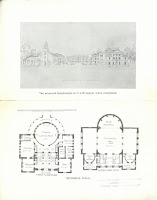
A single sheet with an artist's rendering of the quadrangle on the top half of the page and a layout of the Webster Hall first and second floor on the bottom half.building had already been the target of many other proposed plans. Originally, Webster Hall was meant to have a domed roof and to form part of a balanced college quadrangle, with Sanborn Hall on the opposite side of the lawn. A later suggestion for the venerable building, after the Hopkins Center's auditorium space had rendered it redundant, was to make it into an indoor swimming pool.

A photograph of Webster Hall during its time as an auditorium, with rows of seats and an elevated stage.Luckily for us, the College and Venturi had better things in mind. Nowadays, students, faculty, staff, and visitors marvel at the natural light that streams into the reading room, at the beautiful natural cork floors, and at the majestic glass tower where the collections are housed.

To see more of Webster Hall as it once was, come inside and ask for the Webster Hall Vertical File and the Webster Hall Interior Photographic File. To see photographs of the renovation and subsequent Rauner Special Collections Library, ask for the Special Collections Library Rauner in Webster Hall Photographic File.

Friday, September 21, 2018

What a Downer!

Cover to Novermber 16, 1940, Dartmouth-Cornell football programWhat a weird cover for a football program. It is for the 1940 Dartmouth-Cornell game that was held here in Hanover on November 16th. The strange dolls on the cover represent Cornell cheerleaders and the drum major in a state of despair. The designer of the cover couldn't have gotten it any better, but the dismay of the Cornell faithful was not over a thrashing of the football team by Dartmouth--it was far stranger.

It was a defensive battle. The game remained scoreless until the fourth quarter when Dartmouth managed a field goal to go up 3-0. But the next drive, with only minutes to play, Cornell methodically marched down the field for a first and goal on the six-yard line. On first down, they moved it to the three, then on second down to the one-yard-line, and on third down to the one-foot-line. The quarterback called a timeout, but the team had none, so Cornell penalized five yards back to the five-yard line. Fourth down... and the pass into the end zone was knocked down by a Dartmouth defender. As the head linesman carried the ball out to the 20-yard line for Dartmouth to take over and run out the final three seconds, the referee overruled him and placed the ball on the five, Cornell ball. In the ensuing play Cornell scored to win the game. You can picture those cheerleaders on the cover perking up!

But... that was FIVE downs. Cornell got the hell out of town with a 7-3 victory. Protests and chaos overcame campus for two days until, on Monday, the head linesman sent a telegram to Lou Young, the captain of the Dartmouth football team, apologizing for his mistake, and Cornell conceded the game to Dartmouth. According to the yearbook, the campus "went all out in the greatest demonstration of  football enthusiasm the college has ever known." Those Cornell cheerleaders stooped in despair, the drum major despondent, just like the program prophesied.

We pulled this program from Charles "Stubbie" Pearson's papers, MS-895, Box 4, Folder 16. Stubbie is one of our favorite Dartmouth heroes--for more on him see our "March Madness" post.