Friday, January 15, 2016

Occom Pond Ice Record

Skaters on Occom PondOccom Pond, conveniently located at the Northwest part of town, just a short distance from the campus center and the village of Hanover, has long been a destination for winter recreation and fun. Dartmouth students and local community members take to the ice for free skate and pond hockey.

However, with the unusually late onset of freezing temperatures in Hanover, the pond has yet to ice over completely.  Turning to the college archives for some answers, or at least some comparative data, we were able to locate a record book documenting the “frozen over” and “ice going out” dates of Occom Pond from 1914-1965.

1965 entry from Occom Pond Ice record
The creator of the record book, known only by the initials F.H.C provides detailed notes down to the day of the month of when ice first appears on the pond until it disappears in the spring. The last entry from April 17, 1965 states:
ice all out of the Pond
a nice Sunday ice disappeared from this
end up to the other-
From the record book it appears that on average the pond was frozen over by the end of November or early December. This year’s data definitely logs in as below average. For those already hoping and praying for signs of spring you may be interested in knowing that on average the ice melted by April of each year… only a few more months of winter?

Horses on Occom Pond
F.H.C also maintained detailed notes on daily observations of usage, recreation, temperatures and snowfall. An entry from 1939 states that on “Dec. 26th horses put on, Dec. 27 tractor.” Perhaps, a way to measure the safety of the ice for human masses? More probable, the horses and tractors were used for plowing and maintaining the pond.

cover to Occom Pond Ice Record
1949 entries from Occom Pond Ice RecordOur daily observations here at Rauner report that as of yesterday, January 14th  the DOC has not yet approved the pond for skating. The snow covered pond may look inviting but please be advised that the ice is still considered too thin. We would not risk the lives of our horses, nor our tractors. According to the Dartmouth Cross Country Ski Center website, the college will test the ice again next week.  So, stay tuned!

Whether you are counting down the days until spring or sharpening your skates in anticipation of some future frozen fun, come take a look at Codex MS 914269, "The Occom Pond Ice Record." You can also search for “Occom Pond” to browse additional photographs of the pond from our digital photo files collection.

Tuesday, January 12, 2016

Turn and Face the Strange

image from Reuff's De conceptu, 1580History is pretty strange, and human curiosity even stranger. One of our favorite genres is monstrosities. People hear "monster" and immediately think of horror film beasts or Frankenstein's creation, but the Latin root of the word is monstrare, or "to show." For centuries, monstrosities were seen as a window into the wonders of God's creation, not to be feared, but to be understood to better comprehend the divine.

This 16th-century obstetrics manual, Jacob Rueff's De conceptu et generatione hominis (Frankfurt, 1580), has a whole section celebrating the history of anatomical abnormalities--some witnessed, others read about in the histories.
image from Reuff's De conceptu, 1580
Come on in and experience the strange, and marvel over what they show us by asking for Rare RG91.R9.

Friday, January 8, 2016

Committed to Social Justice: 50 Years of the Afro-American Society

Letter from Afro-American Society to members of the federal governmentFounded in April of 1966, in the midst of the American civil rights movement, the Afro-American Society (AAS) was a deliberate attempt to increase awareness of and create community for African-American students at Dartmouth as well as to make the Dartmouth experience relevant to the outside world. Before this time, black students on campus had tended to "go their separate ways," according to a member of the class of 1958. However, in the 1960s, the American civil rights movement came to campus through speeches given on campus by Dr Martin Luther King, Jr., and other national black leaders such as Malcolm X and Stokely Carmichael. These intersections with issues of national importance had a profound impact upon the African-American students at Dartmouth, who began to see themselves as a community on campus instead of isolated individuals. Their subsequent increased commitment to social justice and desire to strengthen their communal identity gave birth to the Afro-American Society, which has continued a strong tradition of fighting against social inequality both on campus and in the larger global community.

Response from the White House to the Afro-American Society's letterIn the decades following its inception, the Afro-American Society has continued to be a force for change at the national level. In 1981, the organization sent a letter to several prominent national political figures in Washington, D.C., including President Ronald Reagan and Speaker of the House Tip O'Neill to recommend that Martin Luther King Jr.'s birthday become a national holiday. Two years previously, a bipartisan effort to that effect had been narrowly defeated in the U.S. House of Representatives. The White House's response was carefully crafted, avoiding any mention of the fact that Reagan himself was not a fan of the proposal. However, true to his word, the President eventually signed the holiday into existence on November 2, 1983, when the bill finally came to his desk. Still, it would take nearly seventeen years before the entire country formally recognized the holiday, with Utah being the last state to hold out.

This year marks fifty years since the Afro-American Society first came into being. In celebration of that fact, and in collaboration with the Office of Institutional Diversity and Equity's week-long celebration of the life of Dr. Martin Luther King, Jr., Rauner Library is displaying an exhibit in the Reading Room related to the efforts of the Afro-American Society to promote social justice down through the years. The exhibit will be up from January 8 through February 26. Come by any time we're open to check it out! Once the exhibit comes down, you can still see the exchange of correspondence by asking to see Box 3607 from the African-American Society records (DO-47). The letters are in a folder marked "Correspondence with National Government."

Tuesday, January 5, 2016

Campaign Expenses

Expense voucher for two six-packs of beer for Paul NewmanIt is that time again. The New Hampshire primaries are in full swing. The airways are filling with campaign ads, and robo calls are harassing us at dinner. To commemorate New Hampshire's periodic step up onto the national stage, we have just mounted an exhibit, "Up For Grabs: Campaigning, Debating and the New Hampshire Primaries" in the Class of 1965 Galleries. It is full of interesting memorabilia from past campaigns, but perhaps the most intriguing item is a simple expense voucher from 1968 for beer--beer for Paul Newman.

In 1968 the Associate Director of Dartmouth College's Public Affairs Center, David Hoeh, helped to persuade Senator Eugene McCarthy to enter the New Hampshire Primary. He coordinated McCarthy's campaign that ended up restructuring the whole race. McCarthy's strong showing in New Hampshire led to President Johnson's decision not to seek reelection and Robert Kennedy's entrance into the fray. Hoeh had a little help: one of McCarthy's biggest backers was Paul Newman, who parlayed his fame into support for the little-known Senator. Apparently, one of his needs on the campaign trail was a supply of beer. His tastes seemed modest: $2.50 bought two six-packs.

You can see the voucher now through February 9th in the exhibition. After that, ask for ML-56, Box 6, Folder 2.

Wednesday, December 30, 2015

Seeing the Elephant--not the Pink One!

Playbill from Lyme Dramatic Club, December 1876You can't beat the way they ushered in the New Year in Lyme, New Hampshire, in 1877.  On New Year's Day, the Lyme Dramatic Club took over Church Hall in Lyme to perform the three act drama, Little Brown Jug, followed by the "side-splitting farce" Seeing the Elephant.

We had to know more, so we did a little research to see just what they were watching. Seeing the Elephant was written by Vermont native David "Doc" Robinson and was first preformed in California during the gold rush where Robinson opened a theater. It was an immediate success, and according to a 1969 article in Western Folklore, the phrase entered the lexicon of American slang. It carried the connotation of having seen everything and was used by people touring the rowdy Barbary Coast. It makes us wonder about the crowd that New Year's evening, 1877, in Lyme. After the show, did they "see the elephant" with a stroll through town?

Have a Happy New Year!

To see the playbill, ask for Broadside 876925.


Tuesday, December 22, 2015

Death at Christmas

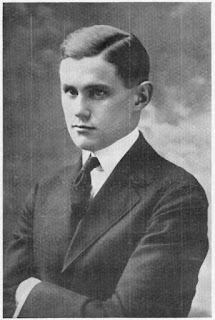
Richard Nelville Hall graduated from Dartmouth on June 23, 1915. Six months later he was dead, the first Dartmouth man to perish in World War I, the Great War. By all accounts, he was a fine young man, greatly beloved by all who knew him. Born into an academic family in Ann Arbor, Michigan (where his childhood home still stands), he matriculated at the University of Michigan, then transferred to Dartmouth at the beginning of his sophomore year. His older brother, Louis, was a member of the Class of 1911.

Immediately upon graduation, Dick Hall volunteered to serve as a driver in the Dartmouth Ambulance Corps in France, which was part of the American Field Service Ambulance Corps. Keep in mind the fact that the United States did not officially enter the war until April 1917, so Hall’s service was that of a non-combatant and humanitarian. Nevertheless, he faced great danger and peril every day, and his courage and valor were legion.

Photographic portrait of Dick HallLate on the night of December 24, 1915, or in the early hours of December 25 (reports vary), a stray German shell hit the ambulance Hall was driving in the Vosges mountain range in eastern France, where fierce trench fighting was raging. He was killed instantly, and his body discovered several hours later in the ruined hulk of his ambulance. He is buried in the French Military Cemetery at Moosch, Alsace-Lorraine.

Edward Tuck, Class of 1862, that great benefactor of Dartmouth and ardent Francophile, paid for a fine memorial to Hall which may be seen just inside the west door of Baker Library on the lower level.

Photograph of Hall on Dartmouth CampusRauner Special Collections Library holds several highly evocative relics of Hall’s life and death, including the rusted casing of the shell that took his life, and the Red Cross insignia from the side of his ambulance. These were given to the College by his parents. Ask at the Rauner reference desk to see these items, or his alumnus file, which is unusually large and detailed for one whose life was so short.

Requiescat in pace, son of Dartmouth. On this, the centenary of your young death, we acclaim you, we honor you, and we remember you.

Friday, December 18, 2015

Bored at Home?

cover of Charades bookTry Acting Charades! This 19th century pastime is way more complicated than what we call charades today. There's a whole book dedicated to the proper art of Acting Charades, or, Deeds not Words: A Christmas Game.

The book begins with an introduction to the history of charades (French), so started because of the national "inability to sit still for more than half and hour." As to the actual game, the two "most celebrated performers" choose their teams, then decide upon a two syllable word or phrase. One team then performs a charade -- silently, as "nothing more than an exclamation is allowed" -- "as puzzlingly as possible" in the order of "my first, my second, and my whole." It's somewhat similar to how nowadays, we do "1st syllable" and so on. But these pantomimes are not simple.

Let's follow "Mistletoe."

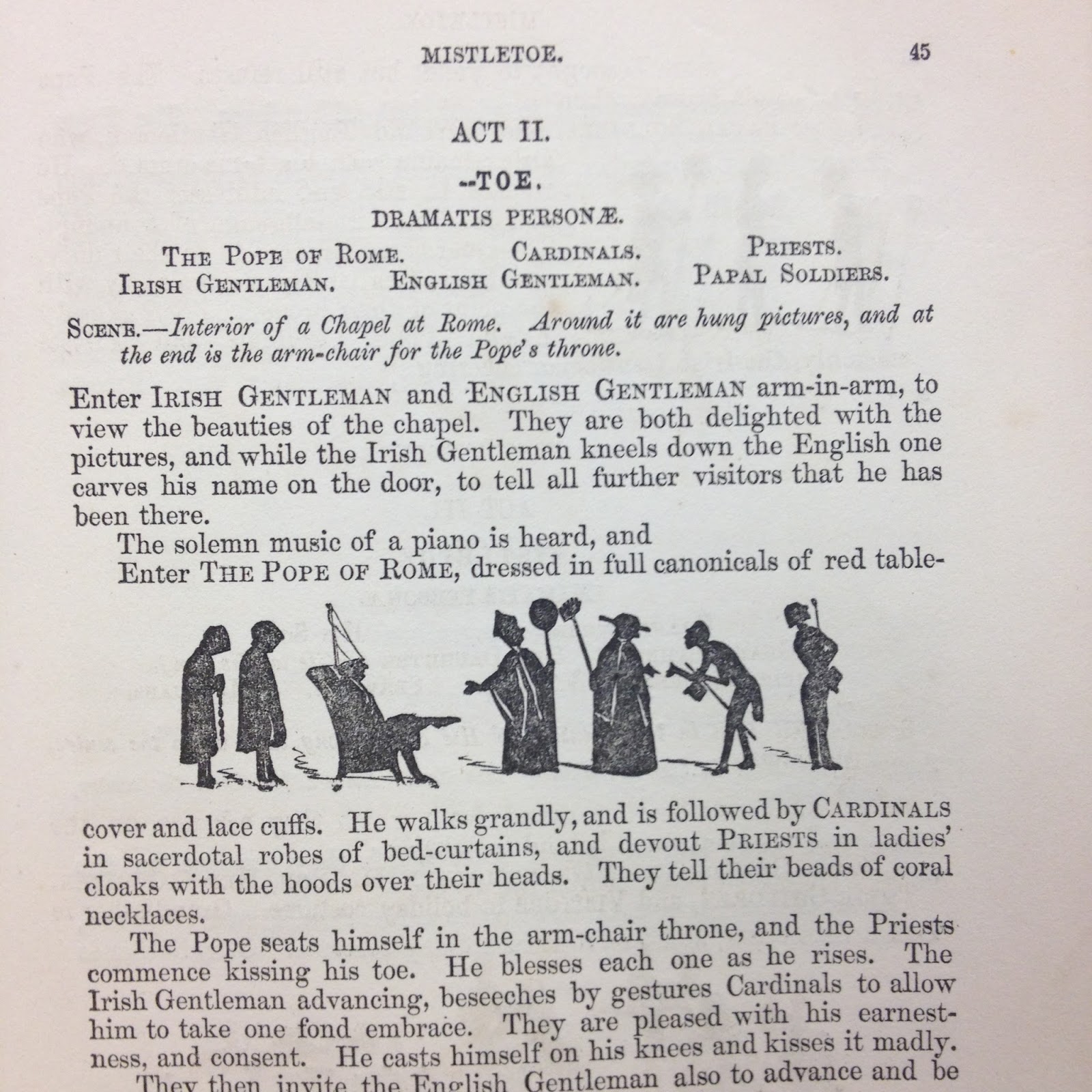
Kiss the pope's toe!Act I. Mistle -- (Mizzle). A Poor Tenant cannot pay his rent; he and his family remove all of their belongings from the home. The Angry Landlord arrives and is angry.

Act II. Toe. An English gentleman refuses to kiss the Pope's toe. An Irish gentleman attempts to help, but when the English gentleman is escorted away at broom-point, he joins the Catholic cheers.

Act III. Mistletoe. A grandfather sets up some mistletoe over the Christmas dinner table. Everyone is delighted at this"wickedness," and many couples embrace theatrically ("by crossing their heads over their shoulders") under the mistletoe. Then they have to get married.

Not sure I'd be able to guess "mistletoe" from that, but that's just my 21st century attention-span speaking. Maybe if I were a Victorian scholar ...

My favorite part is the incredible set-up to the actual action itself. It's not like our version of charades -- this requires costumes. And though they understand their are constraints, they expect "high-pressure ingenuity" to save the day. They have seen a Louis XVI with an "ermine victorine wig for a well powdered peruke, and the dressing-gown for embroidered coat." Let me just go get my ermine victorine wig.

To try a charade of your own, ask for Sine Illus H56act. The British Museum also has provided a scanned version via Google Books if you want to try during the winter holiday.