Friday, December 11, 2015

Who Am I?

As mentioned in a previous post, Rauner Library holds Abner Dean's papers. Dean (Dartmouth class of 1931) was a cartoonist whose work appeared in Esquire, Collier's, The New Yorker, and Life magazines. In the collection is a set of masks - one of which we know is of Franklin D. Roosevelt and was used as part of the illustration for the September 1932 cover of Life magazine.

Identifying the other masks is a bit trickier.

For example, this next one is probably Winston Churchill - or perhaps W. C. Fields.

And almost certainly Ed Wynn - the nose helps a lot here.

And we think this might be Truman Capote, though if this mask is a contemporary of the Roosevelt, that would be highly unlikely since Capote would have been 8 years old at the time.

But for the rest...well we're not sure. Let us know what you think!
Ask for ML-44 to see the Dean papers. A guide to the collection is available.

Tuesday, December 8, 2015

Lest Old Traditions...

Editorial Cartoon reading 'An Old Dartmouth Tradition ... Goes to Pot'Doesn't this just scream 1968? The College was cracking down on campus drug use, and a week earlier a student was forced to "resign" from Dartmouth for the "alleged use and sale of hallucinatory drugs." The D responded with an editorial decrying the severity of the punishment alongside this editorial cartoon.

Here in Rauner, we have documentation of many old Dartmouth traditions that have gone to pot--figuratively.

To see the cartoon, ask for The D from February 28, 1968. Issues from the prior week discuss the campus drug controversy (and also feature lots of great materials from the 1968 Presidential primaries).

Friday, December 4, 2015

The Black Box ... of Canada?

outside of box
One of the best parts of being a staff member at Rauner is wandering through the stacks. You come across strange and wonderful items that you have no idea existed -- like this mysterious black box.

I've been eyeing this box for quite some time. It's in our "Illustrated" collection, so I wondered if there were racy images that had to be locked up (I mean, we just did a class using some of our uncatalogued erotica). But no. After struggling with the latches, I was greeted by a serene title page: Canadian Scenery Illustrated, from Drawings by W. H. Bartlett. Not quite what I was expecting, but still cool!
view of Montreal
The box contains a series of magazines published in London in 1842 concerning Canada. During this period, Canada was under British rule. Canadian Scenery becomes a participant in the project of British imperialism, bringing "human interest" scenes of Canada to London homes, from descriptions of Native American life to engravings of Montreal.
advertisement for Shakespeare's playsThe author, Nathaniel Parker Wills (Esq.), also wrote "Pencillings by the Way" and "Inklings of Adventure," two titles with a bit more punch than Canadian Scenery Illustrated. He was one of the highest-paid magazine writers of his day and established the Home Journal, which would eventually become Town and Country. We have a lot of other items in our collection by Wills, including a play titled Bianca Visconti; or, the Heart Overtasked and Hurry-graphs; or, Sketches of scenery, celebrities and society, taken from life. 

But, as in almost all nineteenth-century serials, the most comic part is the advertisements. My favorite advertises an edition of The Works of Shakespere [sic], which includes "the Attributed Plays" -- Locrine, Sir John Oldcastle, Thomas Lord Cromwell, The London Prodigal, The Puritan, and Yorkshire Tragedy. I've never even heard of any of these plays, but it turns out we have several copies of those plays, too -- a future blog entry?!

Ask for Illus B258c to learn more about nineteenth-century Canada.

Tuesday, December 1, 2015

Tour of America

Opening page form John Tawse's journalOn Monday, July 1st, 1839, John Tawse and George Lyon set off from Edinburgh on a journey to America. They were representing the Society in Scotland for Propagating Christian Knowledge and their mission was to investigate Moor's Indian School located on the Dartmouth College campus. The Society had been a major source of funding for the school since Eleazar Wheelock founded Moor's in 1754. The pair produced a published report of their investigation, but it is the unpublished journal kept on the voyage by John Tawse that provides an intimate account of the impressions of the two rather stodgy travelers.

Tawse filled 260 pages in his journal, drew a map of their travels, and even created an index so he could easily refer back on his reflections. Most of the journal is dedicated to describing the places and people they met, but he occasionally launched into impassioned discourses on subjects he found most interesting. There is a diatribe against slavery and another on the treatment of people of color in free states, a long description of the American system of government, a section on the Oneida Indians, and a odd passage about American women's lack of beauty (no symmetry of form!). For the most part he is curious, morally judgmental, and somewhat in awe of the grandeur of the country.

Index to John Tawse's journal
His visit to Hanover gets scant coverage. He arrived quite ill, was treated by Doctor Oliver Wendell  Holmes, who taught at the Dartmouth Medical School from 1838-1841, and then spent the rest of his short stay meeting with President Lord and inspecting the school.

To see his journal, ask for Codex MS 003114

Tuesday, November 24, 2015

Johnny Johnson's Rum and Molasses Fund

Johnny Johnson turkey eats studentRum and Molasses -- what better way to spend a Thanksgiving holiday at Dartmouth? The Rum and Molasses Fund provided turkeys and other delicious foods for Dartmouth Outing Club members staying in Hanover over the break.

We have a few documents from the 1930s and 1940s outlining the festivities. One year, there was the "Thanksgiving feed at Moose" cooked by a member of the class of 1934 at Moosilauk, then the "Annual Thanksgiving Mt. Washington Trip," a trip with members of the Yale Outing Club ("For a real bunch of fellows, a Dartmouth-Yale combination is hard to beat!"), as well as hikes in the Adirondacks, hiking to various DOC cabins, and some cabin work at Jobildunc.

In a letter from 1940 (above), "Sir Robert Montcalm," "Loafing Trips Big-Blowout" and the "Agent Extraordinary of Yhoodi," announces that you can reserve a free turkey and go off and have your own wilderness adventure -- unless, of course, your Johnny Johnson Turkey eats you first!

The Fund was established by "Johnny Johnson '66," also known as John Edgar Johnson, Class of 1866 (picture below).  In 1913, an article by Fred Harris, the founder of the DOC, inspired Johnson to donate a 100-acre farm called Skyline to the DOC. This was only the beginning of his generosity. Johnson was not a wealthy man, but he was a passionate gifter, constantly surprising DOC members with random presents -- from a case of Worcester sauce for one Thanksgiving feast, to 24 scarlet jackets for DOC members during Carnival to a black bear cub. Some of the funds that Johnson established still exist, but the Rum and Molasses fund is sadly defunct.
John Johnson Class of 1866
Johnson described himself as a "wall-flower" at Dartmouth, but he was certainly a passionate and outspoken man later in life. He was a member of Kappa Kappa Kappa, served in the Civil War, and later became a minister. Reverend Johnson also claimed that the Class of 1866 had chosen green as Dartmouth's color. His alumni files is bulging -- come in and check it out!

In all our research, it remains unclear whether the funds were ever used to purchase rum and molasses ...or just turkey.

For more trending Thanksgiving topics, we've blogged about what Dartmouth students in 1946 were thankful for ("I'm thankful that after eating in Thayer Hall for two months I can go home for a decent meal"), early recipes, and the tragic death of Molly Goosey, back before turkey was the Thanksgiving bird of choice. To see the original Rum and Molasses documents, ask for DO-1, Box 6138, Folder 22. 

Friday, November 20, 2015

A Warning of Things to Come

Letter from Benjamin Hale to his father, 18 June 1832We usually miss the early signs of impending doom and only later look back and piece together the clues. But one Dartmouth faculty member saw with sobering clarity the spread of the 1832 cholera pandemic into North America. On June 18, 1832, Benjamin Hale, professor of Chemistry, wrote a letter to his father reporting that a ship had arrived at Quebec and "40 or 50 persons are said to have died on the passage." Worse, another report stated that of the 90 people who had contracted cholera in Montreal the week before, 60 had died.

Then it gets scarier: the Hanover postmaster said that one person had died on a boat coming from Montreal to Burlington that week, and there was another unconfirmed case "at the extreme southern part of Lake Champlain." He went on to warn:
There seems to be no doubt that this dreadful disease has at length reached this part of the world and we may expect it to sweep over our land. And we should each be prepared for its visitation. It will doubtless sweep thousands into their graves with very little warning--We ought to anticipate its approach and be ready if it should summon us to our account.
He was right. The pandemic ravaged North America, killing well over 100,000 people, often within 24 hours of the first sign of illness. To see the letter ask for MS 815363.


Tuesday, November 17, 2015

Independent of Politics

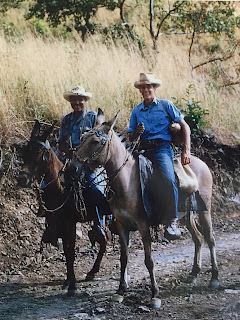
Dawley on horsebackIn 1961, President John F. Kennedy signed Executive Order 10924 establishing the Peace Corps under the directorship of R. Sargent Shriver. During the first year, volunteers were deployed to nine countries: Ghana, Tanzania, Chile, Columbia, India, Nigeria, the Philippines, St. Lucia and Pakistan. By 1962 Honduras became one of 28 total host countries. The following year Honduras requested an additional 50 volunteers to serve in rural communities throughout the country. Among the fifty new volunteers was recent Dartmouth College graduate, David Dawley.

Dawley’s service abroad began during a period of political unrest for the Honduran government and national tragedy for the United States. President John F. Kennedy’s assassination occurred during Dawley’s training in New Mexico and just two months prior to his scheduled departure, the Honduran military staged a “golpe de estado”, overthrowing the government and replacing President Ramon Villeda Morales, with General Oswaldo López Arellano. The military takeover was condemned by the United States and subsequently led to a break of diplomatic relations between the two governments.  Despite the strained relationship between Honduras and the United States and the drama created by the assassination of J.F.K, the Honduras Rural Community Action Program moved forward as planned, affected only by a two-week delay.

Image of letter from Dawley to LowtherIn a letter dated November 24, 1963 to Kevin Lowther, his Dartmouth classmate, who was serving as a Peace Corps Volunteer in Sierra Leone, Dawley noted the justification for moving forward with the program:
Sorry for the delay in writing, but I was waiting to hear the final word. Our training was extended two weeks as a result of the revolution…. At any rate, I’m off for Honduras on December 6, with diplomatic relations still broken. The justification for sending us in is that the Peace Corps is a people to people program and operates independently of politics. This is simple in words, but the reality remains that we are an experimental group. Though all factions in Honduras--except the Communists--support our program, the implications of our aid are very uncertain…
This excerpt is from Dawley’s last letter to Lowther before his arrival in Honduras for his two-year assignment in El Triunfo, Choluteca, a rural town in the southern region of the country. His service is thoroughly documented through journaling, extensive correspondence to family and friends and summary reports.

Peace Corps group photo, Honduras
His papers offer vivid descriptions and detailed reflections upon his interactions with the Honduran people, the programming, the uncertainty of his work, and his overall experience as a community organizer.  Anecdotal memories of his Dartmouth days as well as updates about Big Green’s athletic pursuits are fondly recapped throughout his correspondence with Lowther and other classmates. His reflections consider the possibility of having “mistakenly romanticized” the notion of serving in the Peace Corps and whether or not he is making an impact.

In a letter dated May 9, 1964, Dawley explains to Lowther, “You’re the first guy I know who has said that he knows he is accomplishing something. The... unreflecting humility in wondering if you are really doing any good is out for this volunteer. In terms of latrines built, schools constructed, or water systems installed, I suppose this might be a valid preoccupation for some. But this is a false index to measuring the success of Peace Corps.”

Dawley’s service abroad ended in 1965. In 1970, President Richard Nixon appointed him to the National Advisory Council of Peace Corps under Chairman Neil Armstrong.

Girls' track meet, HondurasBoys' track meet, Honduras

Request MS-1329 at the reference desk if you would like to learn more about Dawley’s community organizing efforts and his work developing the first interscholastic track and field competition in Honduras. His papers documenting the Peace Corps are just part of a larger collection. Upon returning to the United States, Dawley continued his community organizing efforts in Chicago after two years of graduate school at the University of Michigan. He worked with the Vice Lords, a street gang from the Lawndale neighborhood of the city. However, that story is for another blog post…