Friday, December 6, 2013

A Story of Crime, Punishment and Redemption Torn from the Headlines!

A color engraving of the College.The history of the best known engraving of Dartmouth College--how it came about, and the life of the artist who created it--is one of the more unusual tales in American print history.

Christian Meadows (1814-after 1872) was an engraver who immigrated to Boston from England in the 1830s. In early 1849, Meadows was working for W. W. Wilson of Boston, engraving plates for bank notes and dies for stamping coins. He disappeared about the same time some plates for printing bank notes were stolen from the firm. In March of that year, Meadows appeared in Wells River, Vermont, in the company of his wife, the burglar and bank robber William "Bristol Bill" Warburton, and Margaret O'Connell, a Boston counterfeiter. Meadows was suspected of passing counterfeit notes at a Wells River bank, and a search of the group's Groton, Vermont, house revealed burglar's tools, a printing press, and some of the engraved bank note plates that had been stolen from W. W. Wilson. Meadows was arrested, tried for counterfeiting, convicted, and sentenced to ten years at the Vermont State Prison in Windsor beginning in June, 1850. The story of the breaking of this counterfeiting ring was sensational enough to be carried in newspapers from as far west as Wisconsin.

The following year, three Dartmouth students--E.T. Quinby, George W. Gardner, and Charles Caverno--planned to commission an engraving of the College. The trio went to Boston in search of an engraver and learned that New England's finest engraver was imprisoned at Windsor. They asked Warden Henry Harlow to permit Meadows to work on the project. Meadows must have been a model prisoner, for Harlow allowed him to travel from Windsor to the Dartmouth campus under guard to make drawings for the engraving. Upon returning to the prison, Meadows engraved the copper plate for the print.

Meadows chose a view looking south from near the present site of Rollins Chapel to depict Wentworth Hall, Dartmouth Hall, Thornton Hall, and the whitewashed Reed Hall. The three-and-a-half story brick Dartmouth Hotel can be glimpsed through trees at the right opposite the common which is bordered by fences and crisscrossed by paths. The prominent elm in the foreground recalls the tree's popularity as an ornamental, and saplings protected by tree boxes to prevent hitched horses from damaging their trunks flank the elm and are planted around the common. Meadows' view projects order and serenity--qualities that he seems to have been unable to integrate into his life up to that time.

A engraved diploma.The print was seen by Dr. John Walker of the New Hampshire Agricultural Society who offered the jailed engraver the job of producing the Society's diploma to be awarded at the annual agricultural fair. A pastoral drawing by portrait painter Daniel G. Lamont who was then living near Daniel Webster's birthplace in Franklin, New Hampshire, was incorporated into the final image by Meadows. A copy of the engraved diploma was sent to Webster who was Secretary of State in the Fillmore administration. Upon seeing it, Webster remarked: "Who is the engraver that has done this? Where does he dwell? I have been searching for such a man. We want him at the State Department to engrave Maps."

Webster asked Vermont Governor Charles K. Williams to pardon Meadows, asking "Why do you bury your best talents in your state prisons?" The Governor declined, and a year later Webster was dead. A new Governor, Erastus Fairbanks, issued the pardon probably out of respect for Webster and his earlier effort. Meadows was freed on July 4, 1853, and he remained in Windsor until 1859 making engravings of education institutions including Appleton Academy in New Ipswich, New Hampshire, and Vermont's Thetford Academy.  Meadows moved to Buffalo, New York, the following year where he worked as an engraver, he was listed under the same occupation in Toronto city directories for 1871 and 1872, and then he disappears from the record.

To see engravings made by Meadows in and out of prison, ask for Iconography 72, 416, 735, Broadside f852590, and f862626.

Posted for Richard Miller
     

Tuesday, December 3, 2013

Body of Inquiry

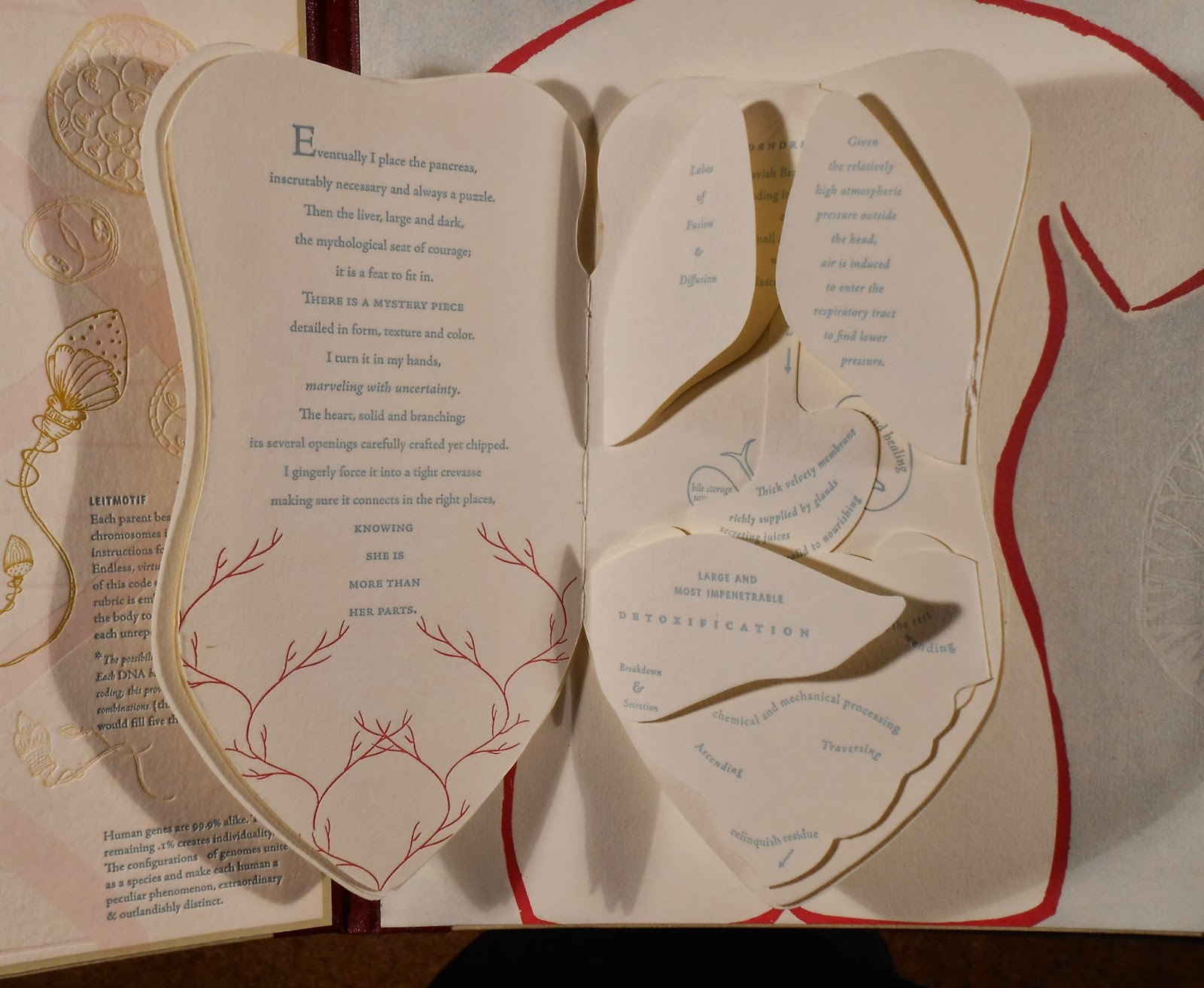
A book shaped like a torso, opened to show cut-out pages shaped like organs, bearing printed text.The last few blog posts have been a bit disturbing--first a woman being flayed alive, and then poor Molly Goosey being served up for Thanksgiving dinner. So its time for something a little more empowering: a reclaiming of the body. Inspired by an anatomical model, "Torso Woman," Casey Gardner created a stunning triptych flap-book, Body of Inquiry (Berkeley: Casey Gardner: Set in Motion Press: Still Wild Books, 2011). The book harkens back to historical flap books like this 1702 edition in our collections (Remmelin's Survey of the Microcosme, or the Anatomy of the Bodies of Man and Woman) to create a new understanding of the politics of the body.

An illustration of a woman with flaps cut out of the page.In Gardner's hands the flaps do more than reveal the basic anatomy of her subject. They provide the author with an opportunity to meditate on life, the body and its many parts, and the literal and metaphoric meanings attached to those parts.

Interestingly, Remmelin originally created his flap books for the use of "Physicians, Chyrurgeons, Statuaries, Painters, etc." Over 300 years later, an artist has successfully taken him up on his offer.

"Body of Inquiry" opened to show several panels of text and illustrations, including the central image of of a woman's head and torso, which contains several cut-out pages shaped like organs.
To see Body of Inquiry, ask for Presses S492bod. The Survey of the Microcosme is Rare QM21 .R4513.

Tuesday, November 26, 2013

The Ill-Fated Moll

A colored illustration of a seated group being served a large roast.To celebrate Thanksgiving this year we bring you a charmingly illustrated book from our Class of 1926 collection. Thanksgiving Day: or the Fate of Poor Molly Goosey (Boston: Wier & White, ca. 1850). This hand-colored children's book relates the tale of young Prince Gander's courtship with the lovely Miss Molly Goosey. The two fall madly in love and became engaged, then the troubles start:

Both looked forward, soon, to a sweet honeymoon,
A page of verse and an illustration of geese on a pond.For neither of them did remember,
That once, every year, there comes, it is clear,
A Thanksgiving day in November.

And then, I've heard say, it is a Festival day,
When people scorn beef, veal, and mutton,
By way of excuse, on a well stuffed goose,
To play the inordinate glutton.

As the lovers were walking, one morning, and talking,
O, think of the pangs they must suffer,
To hear the fat cook say, with ominous look,
"I must presently kill her and stuff her."
A page of verse and an illustration of a woman holding a goose by the neck.
At Molly our swain looked with evident pain,
For he feared Moll might be such a sinner
His young bride to choose for her Thanksgiving goose,
To be killed, stuffed, and roasted for dinner.

As the day nearer drew, more uneasy he grew,
For a kind of foreboding possessed him!
But Moll, not a whit cared for cookery or spit,
As she said,---whilst she fondly caressed him.

But oh! lady gay,---'ere that Thanksgiving day,
In fact, two or three days before it,
A chase there was seen, upon Roxbury Green,
And the lovers had cause to deplore it.

The illustration of the roast being served, now placed in the center of a page of verse.
Without more delay, then suffice it to say,
That some farmers that day met together,
Of a goose to partake, and a good dinner make,
While they talked of the markets and weather.

But the goose they extol, is the ill-fated Moll,
Whilst Prince Gander, as pale as a muffin,
Faintly uttered, "Alas!" as he saw the dish pass,
And died upon smelling the stuffing.

Ask for 1926 Collection T3544, and enjoy your TURKEY,

Friday, November 22, 2013

Gender, Skin, and Power

An illustration of a whole human skin pinned to a wall.Jean Struys's sensational accounts of travels in the East established many of the western European myths about Persia. He took stories he heard on his travels and retold them as unquestioned truths to an audience eager for exotic tales of the East.

An illustration showing the pinned skin on the lefthand page, while on the right a nude woman is being tied down.One story he recounted was of a woman captured and forced into a Persian harem. She tried to escape, was captured, then flayed alive as punishment. Her husband displayed her skin as a warning to his other wives, or so the story went. It is a horrific tale of misogyny that was illustrated in many editions of Struys's Voyages. The image here, from the French language edition Les Voyages de Jean Struys (Amsterdam: Ches la Veuve de Jacob van Meurs, 1681), shows both the flaying and the display of the skin. It depicts a scene of cruelty and torture that is made even more disturbing by the way it exploits the positioning of the woman to become almost pornographic.

An illustration of a standing male figure with no skin. In his left hand is a knife, in his right, his skin.
Compare it to another scene of flaying in Juan de Valverde's Anatomia (Roma: A. Salamanea et A. Lafrerj, 1560). Here it is a man whose skin has been stripped off his body. But rather than being a victim, he is portrayed as a heroic figure displaying his exposed musculature to the world as an example of the wonder of the human form. Moreover, he is given agency: it is his hand that holds the flaying knife. The contrast couldn't be more stark.

To see the Struys, ask for Rare G460.S934 1681. The Valverde is Rare QM21.V35.


Tuesday, November 19, 2013

Sophisticated Traveler

A color illustration showing a man and woman in a sea-side restaurant being served a plate of black sludge with red tentacles creeping out of it.There are seemingly few things more incongruous than the work of illustrator Edward Gorey and a magazine called the Sophisticated Traveler, filled with advertisements of escapism for the elite upper class of the 1980's. So, imagine my surprise upon finding just that in Rauner Special Collections.

"Being Brave Abroad" and "Back Home" by Edward Gorey feature four captioned cartoons each. The pictures show snapshot moments of white elites navigating the world around them. In "Being Brave Abroad," under the caption, "Ordering the spécialité de maison without even asking what it is," one image shows a man and woman in a sea-side restaurant being served a plate of black sludge with red tentacles creeping out of it. Gorey's mockery becomes evident when one notices the small shelf of human skulls behind the couple. The joke takes on two forms: one that a member of the upper class would laud themselves for simply trying something new without asking what it is; and the other, that maybe this couple should have asked, in case the skulls are a product of the dish.

An advertisement for Black & Decker's Stowaway Travel series.Flipping through the pages of the magazine can give a taste of the very world that Gorey pushed against in these illustrations. The advertisements feature smiling, predominately white couples boasting about their escape to the "exotic" places pictured. One of my favorites ads declares "How to feel on top of the world while travelling around it," and offers the simple solution of Black and Decker's travel hairdryer set. I had no idea it was that easy!

Time gives us a lens to see the absurdity and deeply problematic delusion of the upper class "living the fine life," and Gorey's illustrations provide that same lens. The ability to compare Gorey's perspective positioned within the pages of the magazine, and ours, outside of the magazine and the time that bore it, can allow us to better understand how we can push against the pictures of perfection in our own magazines. Or, simply enjoy wondering what the editors were thinking in including cartoons that mock their own magazine.

A four panel comic by Edward Gorey, titled "Back Home."
To become a Sophisticated Traveler yourself--or to enjoy mocking one--ask for Illus G675bei and Illus G675bac.

Posted for Lucy Morris '14

Friday, November 15, 2013

The Faithful Ten

A black and white photograph of "the Faithful Ten."John Wingate Weeks began his campaign in 1904 to represent Massachusetts in the United States House of Representatives. A retired Army captain and veteran of the Spanish-American War, Weeks began his political career as an alderman in Newton, Massachusetts, in 1899 and became mayor of the city in 1903.

Having made a fortune as a banker, co-founding the Boston financial firm of Hornblower and Weeks in 1888, Weeks had all the money he needed to run for higher office. In the days before direct primaries, a candidate had to be nominated in a district convention. Weeks seemed like the right candidate for the job.

A page of typed verse addressing the Faithful Ten.Almost immediately an active working group of his devoted friends formed to support his election. The group met regularly and became known as the "Faithful Ten" after the title "The John W. Weeks Campaign Luncheon Club" was found to be lacking in conviction. The group was comprised of William F. Garcelon, Jesse S. Wiley, George S. Bullard, Eben D. Bancroft, William M. Flanders, Henry N. Sweet, Seward W. Jones, Edward W. Baker, Charles E. Hatfield and James E. Shaw and was instrumental in Weeks's election to the House with an overwhelming majority.

John Weeks served four terms in the House before moving on to the Senate in 1913. During his time in Congress, Weeks pushed key banking and conservation legislation including the Weeks Bill (which allowed for the creation of National Forests) and the Forestry Bill (which insured federal protection for migratory birds). After failing to win re-election in 1918, Weeks retired to his house in Mt. Prospect, New Hampshire. In 1921 he was asked back to Washington to serve as the Secretary of War under Presidents Harding and Coolidge.

To learn more about John Wingate Weeks ask for ML-1, The Papers of John Wingate Weeks and The Life of John Weeks by George C. Washburn.

Tuesday, November 12, 2013

Sgt. Allen Scott Norton

A black and white photograph of two men in uniform overseeing a trench.Veterans day is a day when we remember those served, as well as those who paid the ultimate price. In the end, though, it is just that: a day. It is vastly more important that we go a step further, that we try to remember the deeds and the lives that made our way of life possible. The best way to do this is to talk with veterans, to engage in an ongoing dialogue with those who witnessed history first hand. Unfortunately, we are witnessing the last of our World War Two veterans pass away, and Our First World War veterans are no longer with us. Where we cannot discuss history with first-hand witnesses, we must turn to the words and pictures they set down in their diaries and scrapbooks. As luck would have it, Rauner Special Collections Library holds a treasure trove of such items.

A black and white photograph of a torn up field covered in branches.
With the approaching anniversary of the First World War, a few gems in the broad collection of materials stand out. Unbeknownst to most Dartmouth students, our college played an important part in the war. Before America's entry, Dartmouth sent the Dartmouth Ambulance Corps to France, where they valiantly contributed to the war effort. As a result, the first American to die in the First World War was a Dartmouth student. Upon America's entry into the war, Dartmouth raised a regiment of the Dartmouth Fusiliers, tearing up the athletic fields to build a full-scale trench system for the young men to drill in.

A black and white photograph of two men looking over the edge of a trench.Many albums in Rauner are filled with these jovial pictures of training and parades. Others depict the voyage to France or the destruction wreaked by German artillery. One small group of items stood out among these, more poignant than any image.

Sgt. Allen Scott Norton, a Dartmouth student, diligently kept a small and neat diary, complete with many photographs and very much typical of those in the Rauner collections. Unlike many others, his diary is not finished. Sgt. Norton's mother learned of his death when a letter she sent her son was returned, stamped, "Deceased." A local newspaper reported that the family had yet to learn any further details. Later, they would receive a brief letter informing them of their son's death, and a small picture of the crude wooden cross that marked his final resting place. After the war, another letter was sent, informing them that the cross had been replaced with a stone marker, and providing them with a picture of the vast field of similar headstones, each representing on of his fallen comrades.

A collection of papers including a telegram and an envelope.Clockwise from the top left: A letter to Sgt. Allen Scott Norton from his mother, stamped "Deceased." This is how the family first heard of their son's death in WWI. A postcard of the cemetery in which Sgt. Norton was buried. The official telegram noticing his family of his death. A photo that accompanied the official telegram to his family, depicting his makeshift wooden grave marker.

I think these four objects commemorate service better than any day can.

Posted for Sandor Farkas, a '17 from Western Massachusetts. He is enrolled in ROTC and his passion for military history manifests itself in the American War of Independence reenacting and diorama making he does in his "free" time.