Tuesday, October 15, 2013

Occom to Wheatley

A handwritten list of letters.In 1765, Samson Occom, a minister and Mohegan Indian who figured largely in the founding of Dartmouth, traveled to Great Britain to solicit funds for the Indian Charity School run by Eleazar Wheelock. Occom kept a detailed journal during his tour, and in its back pages, he lists the letters he sent to America. Occom records that, in March of 1766, he wrote to "Mrs. Wheatley in Boston," noting directly underneath that he has also sent a letter "to a Negro Girl Boston." There can be little doubt that the girl to whom Occom refers is Phillis Wheatley, a slave who would have been about 12 years old at the time.

Phillis was a young girl, not even 10, when she arrived on a ship from Africa (named the Phillis) and was purchased by Susanna Wheatley, matriarch of a wealthy Boston family. Taught to read and write by a Wheatley daughter, precocious Phillis soon proved she had a taste and talent for poetry, and her work was first published, in a newspaper, in 1767. Four years later, Phillis took her own trip to Great Britain, where, accompanied by Wheatley son Nathaniel, she and her poetry were introduced to London nobility to great acclaim. Upon her return, Phillis was forced to defend the publication of her book Poems on Various Subjects, Religious and Moral to a group of Boston bluebloods (including John Hancock), enduring what amounted to an oral and written exam to prove that she was indeed its author. But Occom would have been perfectly acquainted with her talents by then, for as the line in his journal indicates, he and Phillis had already been pen pals for years.

The last page of a handwritten letter from Samson Occom.Although none of the letters between Occom and Wheatley reside at Dartmouth, if they still exist at all, Dartmouth’s Occom collection is sprinkled with tantalizing references to what must have been an incredible correspondence. In 1773, writing to Susanna Wheatley, he says "I want Much to hear from your Dear Son and Phillis," while two years before, in a truly amazing postscript, he asks "Pray madam, what harm woud it be to Send Phillis to her Native Country as a Female Preacher to her kindred…." This from a man who only six years earlier asks Wheelock to borrow "one of your Negroes."

Part of a handwritten letter, including the signature of Samson Occom.
A page from a letter addressed to Eleazar Wheelock.It’s intriguing to wonder how much of themselves Samson Occom and Phillis Wheatley saw in the other. Despite their vastly different origins, both Occom and Wheatley were drawn into the world of white men from far outside it, even celebrated in that world. Yet both would find that celebrity to be of little benefit in the end — after a bitter break with Wheelock, and repeated snubs and reversals from white clergy and lawmakers, Occom turned towards advancing Indian causes from within Indian communities; while Phillis, though eventually freed, died young, destitute and alone after enduring public indifference, an unhappy marriage and the deaths of her children. At the very least, it appears the two were mutually inspiring. Occom scholar Joanna Brooks speculates that Occom paraphrases Wheatley's poetry in a 1784 letter to one John Bailey and, in a more illustrative example, a well-known letter from Wheatley to Occom was reprinted in The Connecticut Gazette in 1774. It's a glowing response to a letter of Occom's, now missing, in which he apparently professes his belief in the "natural rights" of her people. "How well the Cry of Liberty, and the reverse Disposition for the exercise of oppressive Powers over others agree," she writes in return, "I humbly think it does not require the Penetration of a Philosopher to determine." One can only imagine Occom would have agreed completely.

Posted for Dawn Dumpert: The Occom Circle Project


Friday, October 11, 2013

I Went to Dartmouth Night, and it was Okay

A newspaper clipping with the heading "College to Celebrate 29th Dartmouth Night."The D and other voices of Dartmouth usually gush over Dartmouth Night. Now the bonfire is an iconic symbol of Dartmouth and student scrapbooks from the early twentieth century record the night so it could be remembered as the good old days. Today we stumbled on a less than enthusiastic response from Radford Tanzer, class of 1925. In the fall of 1924, his senior year, he finally decided to check out the annual festivities. His description is a classic in understatement:
Tonight is Dartmouth Night, when they have a big rally and a lot of speeches, and yells, and all that sort of thing. I wasn't so crazy for all that stuff, but went out with Dave to watch the torchlight procession.
He goes on to say he enjoyed the scene:
I'd never seen it from the outside before; it was beautiful to see that great long stream of lights winding across the campus with the band playing and the cheers echoing back and forth from one end of the line to the other.
A typed note.
Tanzer went on to become a pioneering plastic surgeon and faculty member at the Dartmouth Medical School (now named after his classmate, Ted Geisel). He certainly enjoyed college, but wasn't the most enthusiastic student on the social scene. His letter home about Winter Carnival from his senior year calmly states, "The Carnival wasn't violently exciting without a girl. It was quite a novelty to have such a flood of girls here all at once." But another letter relates, "Had quite an exciting meeting of the biology club the other night."

His letters are a delight to read.  You can see them by asking for ML-102, Box 47.

Tuesday, October 8, 2013

Unlimited Water

A black and white photograph of a man with a dowsing rod.In the late 1930s, author Kenneth Roberts, who had made a name for himself with historical novels including Northwest Passage, Lydia Bailey and Oliver Wiswell, had an experience that would put him at the forefront of the controversial practice of water dowsing. While building his house in Kennebunkport, Roberts solicited the help of former game warden Henry Gross, an expert dowser, to find water on his estate. Using his divining rod, a forked twig, Gross found several "veins" of water as well as a new devotee to the cause. Absolutely convinced about Gross's abilities, Roberts became his agent, establishing an organization called "Water Unlimited" to promote his friend and further the cause. He also published three books on the subject Henry Gross and His Dowsing Rod (1951), The Seventh Sense (1953) and Water Unlimited (1957) which was published posthumously.

Business was good with requests for Gross's services coming in by the dozens. However, ridicule followed as well. In particular Gross's claims that he was able to dowse long distance by using a map, or that he could locate lost objects by the same method, met with great skepticism. Roberts belief in Henry's ability never wavered though it appears that he was well aware of the limitations of dowsing for anything but water.


Yet, he did try to prove that dowsing could be useful in finding oil as well. In 1954, Roberts sent Gross to the California and Texas oil fields. In a memo to Gross, Roberts acknowledges that this trip was a "great opportunity for you to prove something about which we so far know nothing." He also chastises Gross about his loose tongue and for making claims "that haven't been proved," something Roberts attributed to Gross "using whiskey, especially early in the day." "This is serious business for all of us," he proclaims, "you have no way of knowing how much your abilities are impaired by daytime drinking."

A black and white photograph of two men holding a dowsing rod up against a map on a wall.

To find out more about the "business" of dowsing take a look at ML-25, the Papers of Kenneth Roberts.

Friday, October 4, 2013

Who's the Boss?

An open book of handwritten text.Upstate New York was a hotbed of abolitionism in the nineteenth century, but in the 1780s, when Samson Occom traveled there as an itinerant preacher, slavery was still prevalent. In a diary entry from 1786, Occom describes his journey to Stillwater, a town near Saratoga:

Fryday Janr 6 we got up very early, got Break[fast] Soon, and a little after Sun rise, a Slay and Horses were ready to Carry me down towards the Still Water, and, the generl’s Boss orderd one of the genls Negroes to Carry me, Boss in English is Overseers, we had a fine Span of Horses we got to Mr Williams, in a bout an Hour, 6 miles & half, the Negroe return right back, and I Stayd a little while...
At this time, the word boss was only just making its way into English from Dutch, and was variably spelled base or bass. The Oxford English Dictionary establishes that the first use of the word in English is from John Winthrop's journal. In a 1635 entry about the construction of a Dutch settlement at the mouth of the Connecticut River, Winthrop notes the arrival of "one Gardiner an expert engineer or work base." The next citation comes from Dutch New Amsterdam, in a letter from Francis Newman, English governor of the New Haven colony, to Peter Stuyvesant, Dutch governor of the New Netherlands. Newman's letter, dated May 24, 1653, was written from "our Place of Residence at the Basses house in the Monhatoes." The OED cites the first modern spelling of boss in a letter written by Washington Irving in 1806: "I had to return, make an awkward apology to boss, and look like a nincompoop" (although nincompoop sounds like another Dutch loan word, its etymology is unknown).

In Cookies, Coleslaw, and Stoops: The Influence of Dutch on the North American Languages, Nicoline van der Sijs notes that in the early American republic, boss was seen as "an alternative to master," which had "hierarchical... [and] negative connotations." John Russell Bartlett's 1848 Dictionary of Americanisms discusses the word's racial and geographical stratification: "The blacks often employ it in addressing white men in the Northern States, as they do massa (master) in the Southern States." Samson Occom, as a Native American preacher visiting white, black, and Indian communities, was likely to have noticed the connotations of different terminology among the people to whom he ministered.

Occom, writing in 1786, found boss a sufficiently unfamiliar term that he was compelled to offer a translation, even in a personal document like his diary. Although eighteenth-century spelling was notoriously variable (Occom occasionally spells the same word several different ways on a single page), this may be the first recorded modern English spelling of boss, predating the OED's citation by over 25 years.

The Occom Circle Project is currently digitizing Dartmouth's Samson Occom letters, diaries and other papers. Until the site is up, you can see this journal as simple page views or ask for DC Hist MS 785665.

Wednesday, October 2, 2013

Not Your Usual Alice

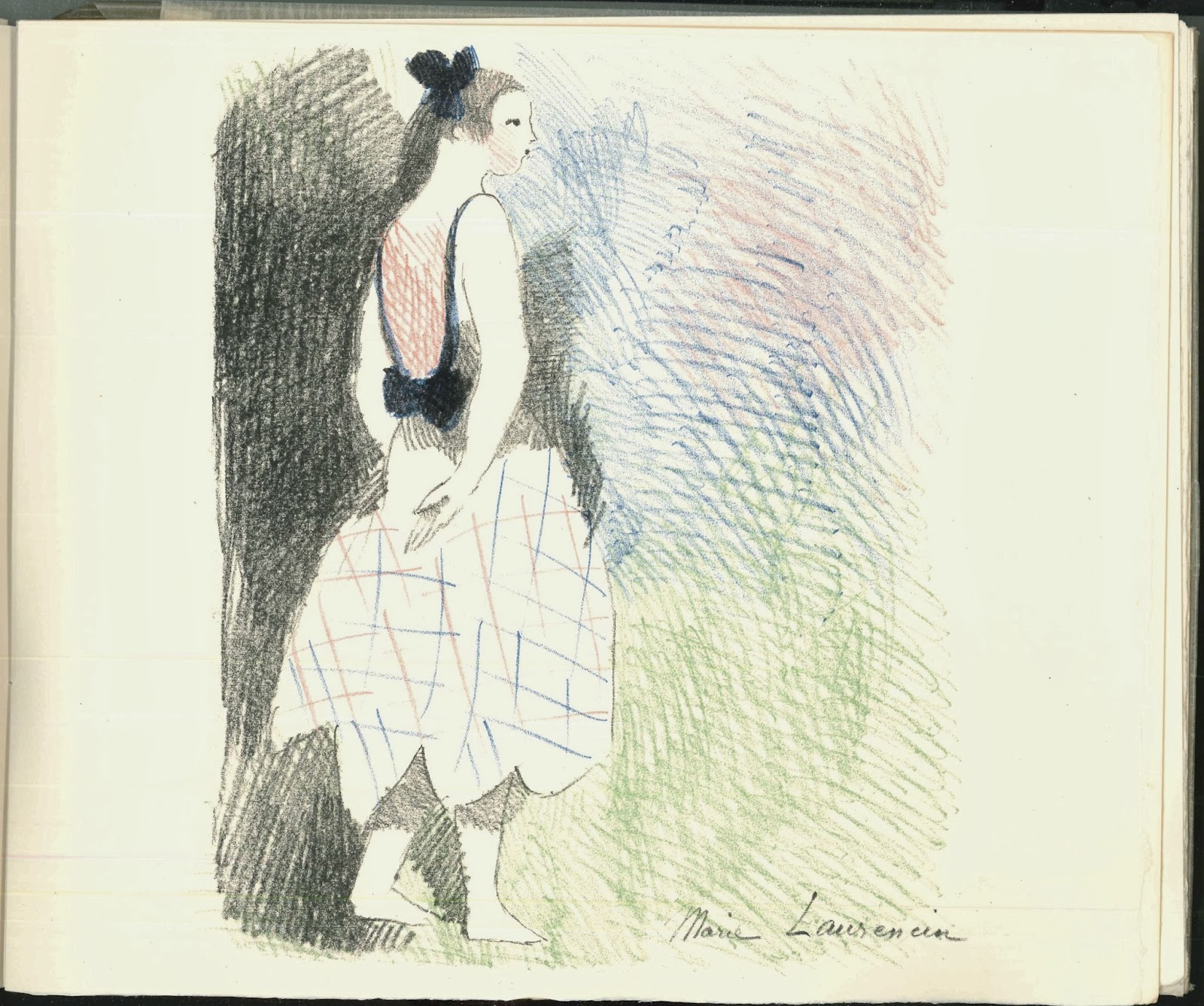
A stylized color pencil drawing of a girl floating through the air.When most people think of Alice's Adventures in Wonderland, their minds jump to either John Tenniel's classic illustrations or the Disney Alice of 1951. We have blogged about our flapper Alice, and Barry Moser's rendition, and here is another Alice, altogether different.

A color pencil drawing of a girl and some kind of animal outside a house. This 1930 rendering of Alice is considered to be among the finest productions of Harry and Caresse Crosby's Black Sun Press. Established in 1927 by the Crosbys as a vehicle for their own writing, but also to distribute the work of their ex-pat compatriots, Black Sun allowed the Crosbys to have control over editorial decisions and production. This particular book is one of their more ambitious attempts, and something of a curiosity. The text was not new and it fit only marginally with the literary visions of the writers associated with the Press. The delicacy of the binding and lavish production surely kept it out of the hands of children. It appears to be more an elaborate vehicle for six lithographs by Marie Laurencin.

A color pencil drawing of a girl.A color pencil drawing of a girl and a woman in a crown.

Laurencin does fit in with the Black Sun Press style and vision. She exhibited with major cubist artists of the time, was romantically involved with Guillaume Apollinaire, and was part of the Paris avant-garde.

You can see it by asking for Presses B561d.

Friday, September 27, 2013

Boundaries

A black and white photograph of men and surveying equipment in a wooded area.In 1933, George Howard Richardson became the official surveyor of the town of Littleton, NH. A native of the state of New Hampshire, George had followed in his father's footsteps when, after graduating from Dartmouth College in 1914, he became a surveyor. He worked primarily in Coos and Grafton Counties and over the years accumulated a large collection of survey plans, not only from surveys that he conducted but also from surveys conducted by his father William, Ray T. Gile and many others. By the time of his death in 1979, the collection contained more than 3000 survey plans and plat maps covering private and public properties throughout northern New Hampshire and Vermont, including properties in the White Mountains such as the Mt. Washington Observatory and the Mt. Pleasant Hotel. Towns surveyed include Littleton, Lisbon, Haverhill, Dalton, Easton, Franconia and Bethlehem, NH.

The surveyors whose maps were collected by Richardson did not often venture south. However, between 1909 and 1918, the Richardsons spent some time in Windsor, Vermont, where they surveyed the Evarts property, the LaFountain Woolson property and the Toll Bridge property, off the Cornish-Windsor Covered Bridge.

A surveyor's map.
A printed form with handwritten notes.
In addition to the survey plans, the collection contains deeds and land descriptions - some dating back to the late 18th and early 19th century - as well as field notebooks by Richardson, William Richardson, Chester Abbot, Percy E. Smith and Ray T. Gile whose work included the setting of the boundary between New Hampshire and Massachusetts during 1891-1901.

You can find the finding aid under MS-740, The George H. Richardson Surveying Collection.

Tuesday, September 24, 2013

Why Wolves Don't Roam Dartmouth

A handwritten statement.We just acquired a very simple little document that says so much. On one side is a statement from the constable of Chesterfield, New Hampshire, attesting that Abner Ally brought to him on December 12, 1778, one dead adult male wolf. The other side is a receipt from Nicholas Gilman dated March 13, 1779, for ten pounds given to Abner Ally for killing a wolf.

A handwritten receipt.
Ten pounds! That was just a little less than a sergeant in the British army would have earned in a year. Abner Ally must have protected that scrap of paper very carefully for the long winter until he could collect his bounty (marked on the document with the hole punch).

A printed page on "An act for repealing the laws relating to Wolves."
This sent us searching into our copy of the first published laws of the newly formed state of New Hampshire from 1780. Sure enough, on November 28th, 1778 (just two weeks before Abner killed his wolf), the state passed a law offering a bounty of ten pounds for a full-grown wolf, and five pounds for a whelp.

The law fulfilled its intent. The state paid its last bounty in 1895 and wolves are only just now beginning to return to the area.

You can see it by asking for Ms 778662.