What's with the stained blank page? If you could feel it, you would also ask why it feels so odd. It has a kind of waxy coating, feels a little like vellum, but not as supple, and it has streaks of old ink set into its scratched surface.
We often value our old books for the extensive marginalia left behind by generations of readers. The comments give us insights into how the text was received in other times and places. But not all readers wanted to fill their books with notations.
This copy of the Elsevier 1665 edition of Boccaccio's Decameron was highly portable, but the compact size left little room in the margins for notes. The solution was ingenious. At the front and back are two leaves very different from the rest of the paper in the book. These are erasable surfaces, where a reader could jot down notes as he or she read. The reader could then transcribe the notes into a commonplace book and, with a damp rag, rub away the comments. The book stays clean, the notes are captured, and there is space for further musings.
The staining shows at least one reader was actively using the erasable pages to record thoughts, what they were, we will never know.
Ask for Presses E52bo.
Friday, May 17, 2013
Tuesday, May 14, 2013
Postcards from the Green
The first postcard ever sent was in Austria in 1869, but it took a few years for the trend to catch on in the United States. The U.S. Post Office issued its first postcard in 1873. However, it was not until 1907, when postcards were allowed the divided back for a message and the address on one side and a full picture on the other, that postcards hit their "Golden Age." As photographic technology improved, postcards gained the ability to showcase the daily lives of the senders. At Dartmouth, postcards have been used throughout the years to promote the college, give family back home and idea of what is happening, or simply to let someone know they are missed. Looking at Dartmouth postcards over time shows how much has changed in Hanover in the last century - and what has stayed the same.

Perhaps the most revealing postcard in terms of changes at Dartmouth is not a photograph, but instead a miniature poster from 1916. Nate, the author and a member of the class of 1920, wrote his father "This is a miniature of the poster that all Freshmen must buy." The poster addresses, "Ye Puny Prodigals of Prep-school, Ye Pups of Ignorance, Ye Illiterate Imbeciles:" in other words, the freshman class. The class of 1919 lays forth twelve rules for the class of 1920 to follow, including the need to wear a "cute green cap with a monstrous white button" and to "never short-cut across the grass." While the college no longer allows such hazing of freshmen, Nate's writing on the postcard is similar to that of a quick e-mail home. He requests curtains for his dorm room windows, asks how everything is at home and of course tells his father of all the work he has to get done before his vacation Friday. Check out Dartmouth's postcard collection to see the evolution of other aspects of Dartmouth, from fraternity houses to Winter Carnival, in 3 1/2 by 5-inch tidbits.Ask for Rauner Iconography 1523 to see all 1400 plus postcards.
Posted for Kate Taylor '13
Friday, May 10, 2013
Civil War Diary
Reading early entries, one almost cannot tell he is at war. On January 7th, 1864, he visits two friends in the 12th New Hampshire Regiment. On the 16th, he writes the weather is "cold as greenland." However, as he travels south, Muchmore’s diary signals the approaching battles. In June and July, he was involved in the Vicksburg campaign. A turning point in the Civil War, the Vicksburg campaign allowed General Grant to gain control of the last Confederate-controlled section of the Mississippi River. The micro-view of the operation is less grand. Muchmore grants the ripeness of blackberries and the quarts picked the same detail as the numbers killed and wounded in Jackson in mid-July. In the battles of Wilderness and Spotsylvania Court House, Muchmore had less time to pick berries. Though inconclusive battles, with heavy losses on both sides, Wilderness and Spotsylanvania were part of the Grant's final push towards victory. Muchmore is minimalist as always in these entries: he only had room to record miles marched, the number of dead or wounded and the repeated "hot." The Battle of Cold Harbor continued the trend of battle-driven entries, broken up by a few entries to record miles marched. Cold Harbor was a bloodbath for the Union, and one of the final victories of the Confederate army. Grant would go on to write in his memoirs, "I have always regretted that the last assault at Cold Harbor was ever made… No advantage whatever was gained to compensate for the heavy loss we sustained." Muchmore's diaries lack the analysis of Grant's reflections, but notes 4 killed and 17 wounded.
Due to illness, Muchmore's duties decreased in November 1864. In the year 1864, he traveled 1874 miles, wrote 34 letters and received 33. Entries from January to March 1865, primarily on chopping wood, represent a much-deserved break. Muchmore returned to capture the city of Petersburg in 1865. On April 9, 1865, he records Robert E. Lee's surrender. His next entry, on the 14th, he states "President shot." Muchmore continued serving in the military for two more months. He arrived home at 5 PM on June 10th, having been away for two years, nine months and five days.
Ask for Rauner Mss 863101.3 to see the diary.
Posted for Kate Taylor '13
Wednesday, May 8, 2013
A Beautiful Manuscript
Today, we thought we would just treat you to a moment of beauty. These images are from a manuscript Book of Hours produced in Florence in the late 15th century. It is on uterine vellum made from the skin of unborn sheep or calves, and was illuminated in Attavante's atelier. Each miniature is a lovely Renaissance painting that fits in the palm of your hand.
|
|
Friday, May 3, 2013
Typographic Sound
Vladamir Maiakovsky's poems were meant to be read aloud; in fact, the title of this book, Dlia Golosa (Berlin : R.S.F.S.R. gosudarstvennoe izdatelʹstvo, 1923) translates to For the Voice. El Lissitzky applied his Constructivist aesthetic to the book. Drawing
primarily on display types and decorative devices common in printing
shops he illustrated the poems and created emphasis. You have to wonder, if the book is meant to be heard rather read, why the lavish typographic attention? Lissitzky delineates each the poems with a tab. The layout and decoration of the book gives it the feel of a medieval litergical book--albeit one with a radically modernist aesthetic. The tabs steer the reader through the text making it simple to select a poem at a glance, and the typographic designs act as decorated initial letters to stir the reader into the proper oratory mood. The mission was similar--read out to the congregation, the texts were meant to inspire their souls. The final product is a masterpiece of Constructivist book design and a great example of early Soviet experimentation in the arts.
You need to see this book to really appreciate it. Ask for Rare PG3476.M3 D57.
Tuesday, April 30, 2013
The Unfriendly Arctic
Viljhalmur Stefansson, who taught at Dartmouth from 1947 to 1962, organized the Karluk's voyage to explore the area north of the Canadian coast. Karluk began its journey in June 1913. The Executive Council of British Columbia presented Stefansson with a silver salver upon his departure. However, the crew would soon need more practical goods than an engraved tray. By September 10th, Karluk was ice-bound for the winter. Stefansson became separated from the ship: Karluk began to drift through the ice while he was on a hunting trip with five other members of the expedition. Though Stefansson claimed the separation was accidental, some of the remaining crew saw his departure as the abandonment of a mission he suspected would fail. Stefansson did not return from the trip until 1918 after an extensive exploration that included the discovery of new Islands, but the Karluk sunk after months of drifting on January 10th, 1914.
The sinking of Karluk left twenty-two men, one woman and two children stranded on what would become known as "Shipwreck Camp." Divisions between the shipwrecked soon arose on the ice camp. Two parties set out in attempt to reach Wrangel Island and set up a more permanent site on land. These parties overestimated how close they were to the island and the ease with which they could set up a new camp. Both perished in the Arctic conditions. Finally, the main party managed to reach Wrangel Island in March. The captain, Robert Bartlett, and an Inuit hunter, Kataktovic, continued on in search of a means to alert the rest of the world of the fate of Karluk. The rest of the group set up camp, desperately awaiting rescue. Finally, on September 7th, a walrus hunting ship accompanied by Bartlett picked up the fourteen remaining survivors.
Six survivors would publish first-hand accounts of "the last voyage of the Karluk." Bartlett went on to lead many more Arctic voyages. Stefansson lectured widely on "the Friendly Arctic," organized another ill-fated expedition to Wrangel Island and eventually became the Director of Polar Studies at Dartmouth. You can find much more about the Karluk and practically anything else related to the polar regions by exploring the Stefansson Collection on Polar Exploration.
Posted for Kate Taylor '13
Friday, April 26, 2013
Polar Players
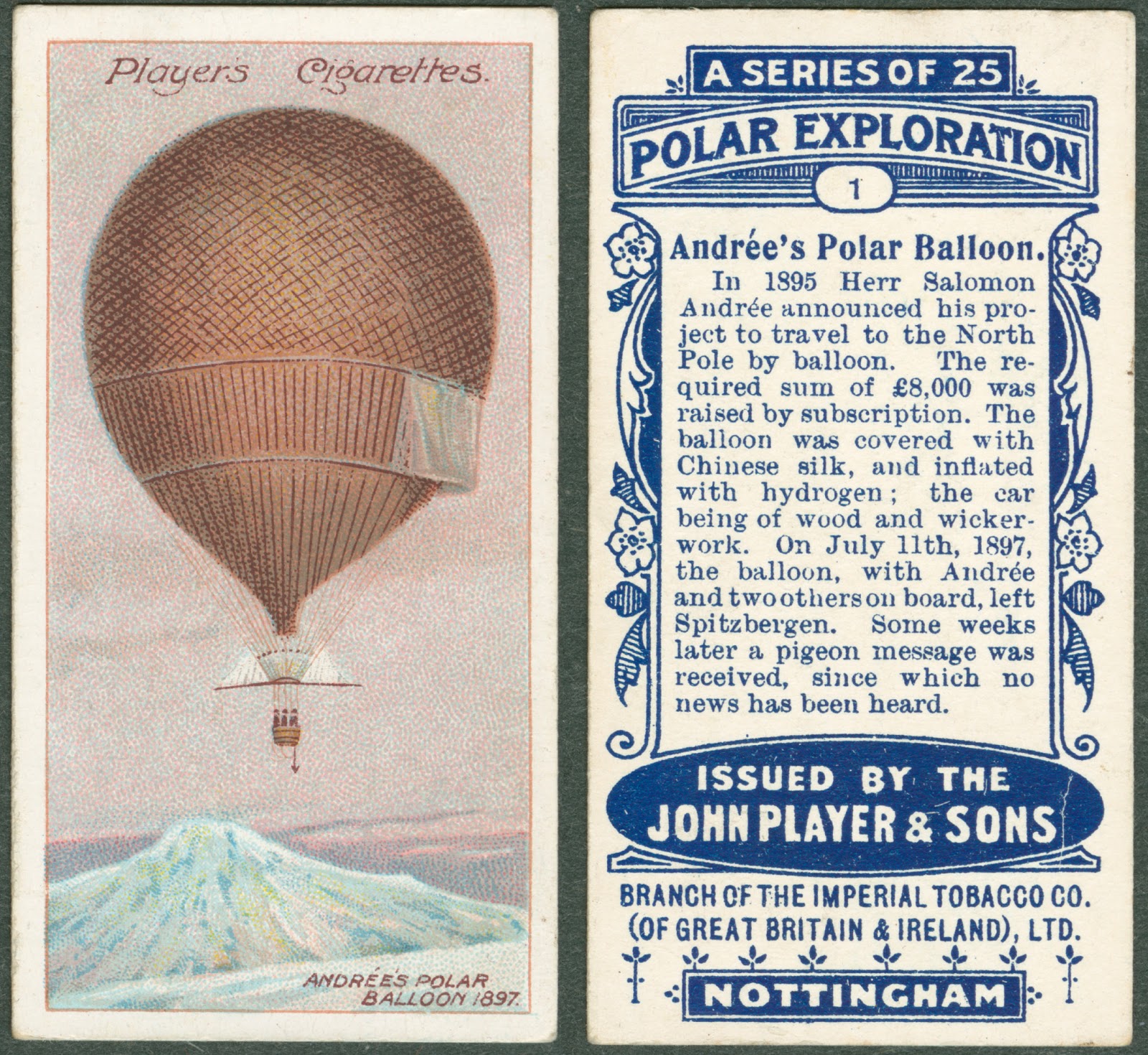
Sometimes, as we get older it is easy to forget the excitement of mystery, but in Rauner we have countless items that recapture that childhood imagination—like the Player's Cigarette Cards. The cards, which came with Player's Cigarettes, each feature a different representation of Arctic exploration: from explorers to ships and the formation of Icebergs, every card tells a short story about the frozen ends of the Earth.One of my favorite of the cards features "Andrée's Polar Balloon." It describes Herr Salomon Andrée, who raised money for his Polar hot air balloon, made from Chinese silk and filled with hydrogen. A few weeks after his departure, a pigeon message was received, after which nothing was heard from him again.
The mystery lies not only in each story, but also in the story of the cards' circumstance: who collected these cards? Were they meant for kids, despite their being contained in cigarettes cartons? What is the connection between cigarettes and polar exploration?
If you come by Rauner and ask for Realia 536 you can find out the answers to some of these questions, but even more importantly, you can look at these beautiful cards and discover questions of your own!
Posted for Lucy Morris '14
Subscribe to:
Posts
(
Atom
)