Friday, November 2, 2012

Hitting the Right Note in Presidential Elections

A booklet titled "The National Whig Song."One aspect that dominated earlier presidential elections in the United States missing from modern day elections is campaign songs. Candidates today often use already popular songs as "theme songs," a tradition started by FDR in 1932. In previous centuries lyrics specific to the candidate would be set to well known tunes. This allowed for more direct arguments in songs to be sung in rallies and spread in support of certain candidates. Looking at the bold and sometimes absurd lyrics, the images the candidates wanted to portray of themselves (and their opponents) becomes strikingly clear.

For example, "For Jefferson and Liberty" made the pretty obvious link between the election of Thomas Jefferson and escape from religious bigotry and tyranny. George Washington was similarly straightforward in "Follow Washington" (featuring lyrics such as "My lads march on/And follow, follow Washington"). The peppy, upbeat melodies were easy to follow, allowing for wide distribution and singing at events.

However, candidates were not opposed to an occasional smear campaign. Depictions of the grim future other candidates would bring to America are common in modern elections and were just as prominent in the nineteenth century. "Little Know Ye Who’s Coming" was a frankly terrifying description of the future should John Quincy Adams not be elected--an America filled with swords, pistols, guns, famine, slavery and knavery. On a similar note, "If the Johnies Get Into Power Again" warned against allowing the Southern Democrats to win the 1880 election, as "The nation’s flag will lose its stars/The stripes they’ll change to rebel bars."

An open booklet. On the lefthand page is sheet music, and on the righthand verse. Both are titled "National Whig Song."Rauner has a number of works from one election famous for its campaign songs. The 1840 presidential election had one of the more extensive and influential repertoires, forming a key part of William Henry Harrison's enthusiastic campaign. "Tippecanoe and Tyler Too" is perhaps the best-known campaign song of all time. The song that became Harrison's slogan refers to Harrison's battle between his Indiana militia and Native Americans while gesturing to his vice president, John Tyler, "too." While "Tip and Ty" was most popular, Harrison had other songs, such as the "National Whig Song," which called for citizens to vote for this "fine, true-hearted gentleman." Harrison's aggressively upbeat campaigning allowed him to side-step national issues, such as slavery. Instead, he was able to portray himself as the candidate of the people in a time of economic depression. Unfortunately, his intense campaigning and extended inauguration speech led to Harrison's death of pneumonia only a month after being sworn into office.

Looking at these examples makes one wonder - should Obama and Romney be writing their own campaign songs? While will.i.am created a memorable music video "Yes, We Can" supporting Obama in 2008, no such tunes have emerged this year. Would YouTube and the Internet offer a new way to make these campaign songs go viral?

To sing along, ask for: The National Whig song - SC 414, Tip and Ty - SC 288, The Whigs of Colombia shall prevail - SC 478

Posted for Kate Taylor '13.

Tuesday, October 30, 2012

Shakespeare's Superstorm

A playbill for "The Tempest."The Shakespeare play that best lends itself to a spectacular performance is The Tempest.  Magic, fairies and huge storms gave 19th-century producers an opportunity to put on a Big Show and entertain audiences with the latest special effects. These playbills from our extensive Williams/Watson Theater collection present Shakespeare as a rousing good time--not exactly the high culture we have come to expect.

The 1823 production at Theatre-Royal in York hyped the "BURSTING of a MOUNTAIN into a VOLCANO" and "the ascension of Ariel." The play was based on Dryden and D'Avenant's popular 1670 rewrite of The Tempest and contained nearly 20 songs. More impressive was the 1856 production that featured 23,000 feet of painted scenery scrolling behind the actors in an "enchanted panorama" and used "extensive machinery" for other effects.

A playbill for "The Tempest."
Curiously, a playbill from 1897 has Isadora Duncan in a bit role as one of the "spirits attending on Prospera." The next year she moved to London where she would soon become one of the giants of dance.

A set of advertisements, including one for "The Tempest."
Come in and ask for Playbills PR ENK-You-TR 8230512, PR MA-Boe-BoT2 8560329, PR MA-Bos-Hol 8970510.

Friday, October 26, 2012

Friends Conceived

A printed page titled "Married Love."With birth control a hot button issue with the upcoming election, Dartmouth students can look inside Rauner library to gain some insight on topics that are still inciting national controversy. The papers of Juliet Barrett Rublee offer a peek into the beginnings of the birth control movement in America, with private letters and publications from which Planned Parenthood stemmed.

Rublee became involved in the birth control movement after meeting Margaret Sanger at a literary salon in 1912 and was immediately drawn to the activist. Sanger, at that time just beginning her work in sex ed and the fight for birth control, would go on to become the infamous founder of Planned Parenthood. She and Rublee became fast friends in the 1910’s, just as the birth control movement was beginning to blossom and Sanger was forced into exile in Europe. The pair was in near constant communication over the following decades. While Rauner has an extensive collection of letters Rublee received from a number of people, including her husband and other birth control activists, her letters from Sanger are perhaps the most intriguing.

A title page reading "An Amendment to the Federal Law Dealing with Contraception."
Sanger is a figure that has been portrayed in modern times as impossibly forward-thinking and inconceivably cruel, an opinion usually divided across political lines. However, her letters to Juliet Rublee instead show an emotional and passionate woman deeply invested in the issue of birth control. Her letters are intended to keep Rublee, one of Sanger’s major funders as well as a leader in the movement, in the loop on different fronts on the birth control movement. Sanger’s casual name-dropping of authors, radical political figures and celebrities paint a rich picture of the interconnected world of early-nineteenth-century radical politics.

A handwritten letter.
The letters also offer a window into Sanger’s private life. While Sanger and Rublee were brought together by political activism, they also shared less lofty interests: the opera, worrying about illness, strange crash diets. Sanger and Rublee, despite their warnings to the other to burn the letters in fear of discovery, rarely censored themselves in their writing, leading to both sordid details and a few tersely worded fights. Some particularly juicy letters touch on Sanger and Rublee’s interest in psychic mediums, Sanger’s involvement in the free love movement and associated affairs, and hints at a relationship between Sanger and Rublee that borders on romantic.

Check out MS-731 to see how Juliet Barrett Rublee mixed her personal and political life in helping found the birth control movement in America.

Posted for Kate Taylor '13.

Tuesday, October 23, 2012

Operation Crossroads

A black and white photograph of clouds from a plane window.David Bradley, Dartmouth Class of 1938, was a member of the Radiological Safety Section for the Able and Baker tests conducted during Operation Crossroads, one of several peacetime nuclear bomb blasts carried out at Bikini Atoll in the Pacific Ocean. He was a member of the team that measured radioactivity at various altitudes immediately after each explosion. Bradley's book No Place to Hide (Boston: Little Brown, 1948) was a memoir about the Bikini Atoll experiments and attempted to expose the dangers associated with nuclear fallout and atomic warfare to the public at large.

In a May 5, 1947, letter to David Lilienthal, chair of the Atomic Energy Commission, Bradley explains his purpose in publishing information about the tests. He writes, "in light of current world affairs we Americans cannot afford the luxury of ignorance," and adds that "informed public opinion is the only hope in playing our cards right in the great international game going on today."

In addition to his correspondence and manuscripts of No Place to Hide, Bradley's papers contain numerous photographs associated with the tests as well as his personal log for that period. The entry for July 1, 1946, reads
A page of handwritten text.
For us miles away from the Target, the bomb went off unannounced. We saw no flash through our goggles, and felt no impact. But soon after we could see the fateful cloud, boiling up thru the strato cumulus, thick, dense, white. At first it looked like many another thunderhead, but its rapid climb and mushrooming, white, evil looking head soon stamped it as the McCoy.
Ask for MS-1002. A guide to the collection is available.  The published version of No Place to Hide is also available in Rauner.

Friday, October 19, 2012

A Beautiful Fake

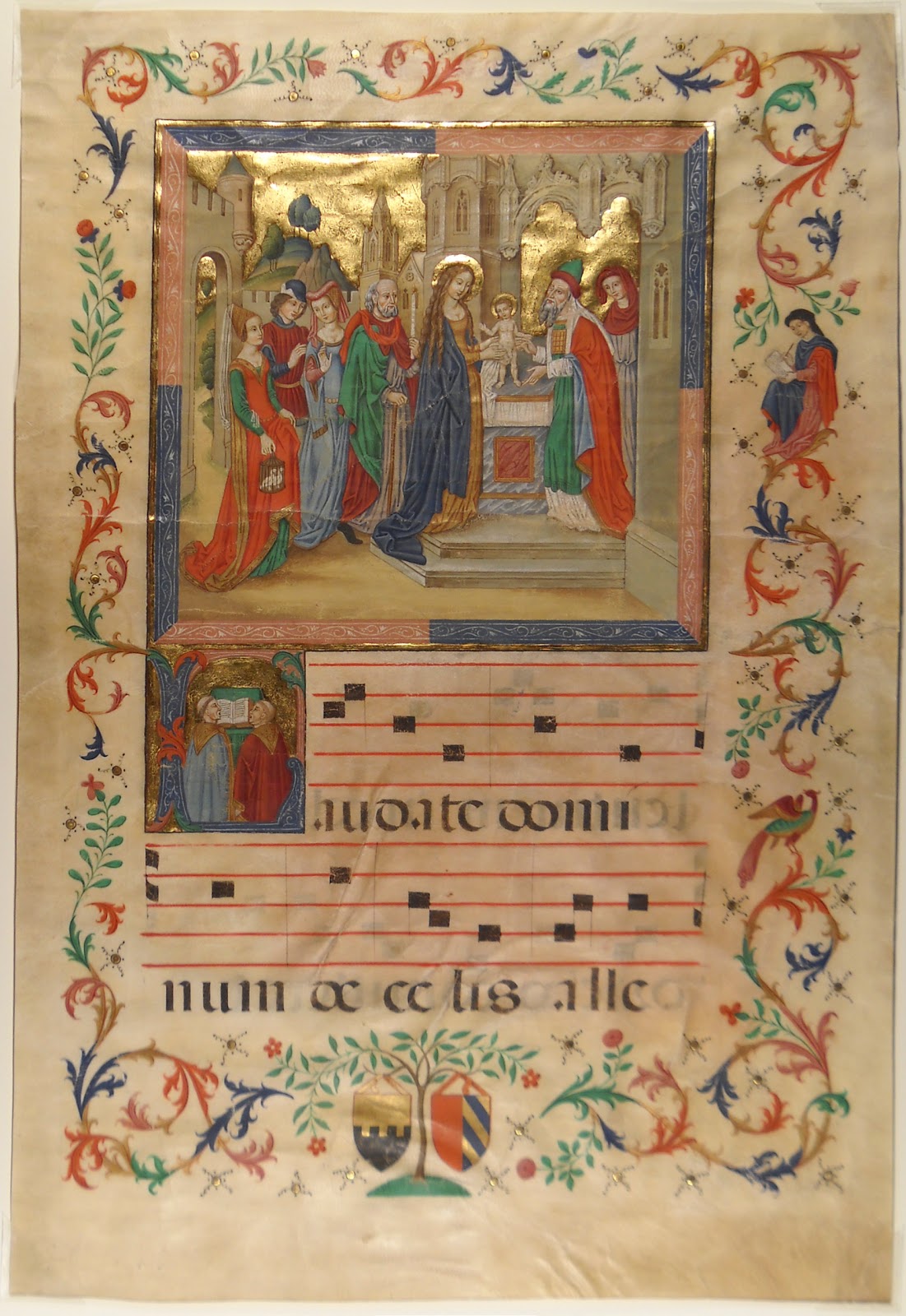
A page from a medieval manuscript, elaborately and colorfully detailed.People frequently ask us how we know everything in our collections is real. We are quite certain about the authenticity of most of the things in our collection, but occasionally we are sure the other way--we know something is a fake, and we are proud to proclaim it.

One such example is our great collection of Thomas Wise forgeries donated by George Singer '50. Wise was a bibliographer, book collector and sometimes forger. He would insert very rare items (some of which never existed) into his bibliographies of English Romantics, then print some up, "discover" them and sell them as extraordinary rarities. Wise's forgeries tend to be fairly plain, in the style of a nineteenth-century English book.

A title page for "Two Letters Concerning 'Notes on the Construction of Sheepfolds,'" with handwritten additions.
More spectacularly, we have one piece by "The Spanish Forger." No one knows exactly who he was, but his body of work has been traced and well documented by curators at the Morgan Library and Museum. The Spanish Forger, who was active in the late-nineteenth century and early-twentieth century, would take old manuscript leaves lacking illuminations, which could be purchased quite cheaply, then illuminate them in a convincing style. Back on the market, they turned a tidy profit.

Ask for MS 002088 to see our loveliest fake (donated by Mark Lansburgh '49).

Tuesday, October 16, 2012

Be Ready to Receive Them

A printed broadside.The Fugitive Slave Act of 1850 was part of a compromise designed to maintain the Union. In the end, it turned out to be one of Congress's most controversial acts and helped to galvanize the abolitionist movement. Part of what made it so abhorrent to abolitionists was that it made it a crime to harbor runaway slaves even in free states. Federal marshals were required arrest runaway slaves and those who aided them.

This undated, unsigned broadside in our collection hammers home the response in many communities. Posted as a warning to fugitive slaves, it informed the community of a slave hunter in the area. The rhetoric pits good against evil: "the slave-hunter is among us." The definite article "the" assigned the whole of the slave hunter's identity to his task--and he is "among us," suggesting an evil infiltration into the community.

But it is the last sentence that is the most chilling: "Be ready to receive them, whenever they come!" Who is "them?" The slave hunters or the fugitive slaves? And how exactly should they be received, with open arms or well armed? It could be read either way, and no doubt, the community members read it as they wished. Some would have seen this as a call to arms, others readied their basements to hide runaway slaves.

Come in and see for yourself by asking for Broadside 000294.

Friday, October 12, 2012

The Execution of Private Henry

A page of handwritten text."Notwithstanding promises given by Pvt CB Henry yesterday he has since as acknowledged to me tampered with seal thongs if not other food... Pvt Henry will be shot today... This order is imperative & absolutely necessary for any chance of life."  So read the orders given by A.W. Greely on June 6, 1884, to Sergeants Brainard, Long and Fredericks.

The 1881-1884 Lady Franklin Bay Expedition led by Greely started out well enough according to George Rice, though matters deteriorated the following year when an expected supply ship failed to reach the party. A second provisioning attempt in 1883 also failed when the Proteus was crushed by ice, again preventing any additional supplies from reaching Greely and his men.

Without the expected supplies at their main base of Fort Conger, Greely decided to head south and retrieve the secondary caches that were supposed to have been left by the relief expeditions that had been unable to rendezvous with his party. Unfortunately, the cache at Cape Sabine only contained forty days worth of provisions and by the time Greely reached it in October of 1883, the weather conditions prevented the party from continuing on to Greenland or returning to Fort Conger.

A page of handwritten text.
Needless to say, rationing was put in place and all members of the party were expected to share in the hardship. According to Greely's note from June 5, 1884, Private Henry had made a practice of stealing food and while this had been "so far condoned and pardoned," enough was enough.  Greely wrote that "if this man be detected... eating food of any kind not issued him... you will at once shoot him and report the matter to me." Private Henry failed to refrain from further stealing and was executed the next day. The remaining seven of the original twenty-one members of the expedition were rescued sixteen days later.

Ask for A.W. Greely's papers, Stef Mss-64. The two notes regarding Private Henry are in Box 2, folder 18.