Tuesday, September 6, 2016

Crackpots and Cranks

Crank Letter - Joshua's TrumpetAnyone who has ever read the comments under articles, YouTube videos or other postings on the endless stream of the Internet can attest that there are many strange and crazy opinions out there in the ether. (And let's not forget the incredibly nasty world of mean tweets.) However, the Internet did not create these methods of expression, it just made them instantaneous.

Crank Letter - Kenneth Roberts Back in the day of pen and paper those articulations were transmitted by form of a crank letter*, with the recipients being mostly people in the public eye. Several of our manuscript collections are fertile grounds for this form of expression, in particular the papers of writer Kenneth Roberts and the politician Charles W. Tobey.

Crank Letter - Newspaper clippings Crank letters range from the nonsensical to the conspiratorial to the "what the hell are these people thinking." However, there are certain commonalities that are present across most of these compositions. For one, the writers seem to have an inflated sense of their own importance and intelligence. They feel that they are the only ones with the answer to whatever they feel is the problem. They are intolerant, blind to reason and argumentative without substance to back up their arguments.

Crank Letter - Robert FrostIn 2014, Miss Manners of the Washington Post, in a response to a question regarding the issue of conspiracy letters wrote, "Conspiracy theorists are not known for their sense of humor, and inflaming them would only waste your time….What you need is not a response, but a crank file," which is exactly what the recipients in this case did..

To see some of the files look for them in ML-3 and ML-25. In addition, there is a small collection of them on display in the Rauner Reading Room.

*  a hostile or fanatical letter often sent anonymously

Friday, September 2, 2016

The Nugget at Webster Hall

Nugget ad from the D, September 25, 1916
Hanover's movie theater, The Nugget, will celebrate its centennial later this month. It opened up during the first week of classes in 1916. Not only could you see a movie, but you could also catch baseball scores on the "World Series Wire." We often joke that the demise of student scrapbooking that happened just a few years later is related to the Nugget's appearance. With a theater in town, students had something new to do. Add radio and the Model T to the movies, and who would want to spend all their time assembling their "Memorabilia of College Days"?


Most people don't know about the Special Collections link to the Nugget's history. In 1944, the Nugget burned down. It was considered so essential to the town and the College that Dartmouth offered up Webster Hall as an alternative venue until a new theater could be built.
Lining up for the Nugget in Webster Hall, May 1951
For the next seven years, when people went to "The Nugget" they actually came to Webster Hall, now home to Rauner Special Collections Library. We still have alumni come in and tell us about how they used come here for the latest Hollywood releases.

To learn more about the Nugget's history, come in and ask for "The Nugget" Vertical File. You can also see some great photos of the old building by searching "Nugget" in our Photo Files.

Tuesday, August 30, 2016

In the Grub Box

Top of wooden boxWe fantasize about someday doing an exhibition of chunks of wood in our collections. We have many: a box made from wood from Shakespeare's house: a fragment of a goal post; dozens of carved pieces of the Old Pine; plus lots of other odd bits and pieces. Today we discovered a small wooden box made from the wood of Roald Amundsen's skis that he used on his attempt to navigate the Northeast Passage in 1918-1924. Amundsen was already famous for being the first to pass through the Northwest Passage and as the first person to reach the South Pole.

Bottom of wooden box
Penguin on side of box
The ski was given to members of the Byrd Antarctic Expedition on July 12, 1929, a little more than a year after Amundsen's death. That would be the heart of the Antarctic winter, cold as hell and dark. So, the members of the expedition turned the skis into keepsakes. This segment of the ski was hollowed out and fitted with a sliding panel. Then it was lovingly carved with a "remembrance" of the Chinook dogs on the top, a penguin on one side, a seal on another, and the latitude, "78ยบ 34 S" on a third side. The underside has the details of the object's origin.

Lat 78 34 S
Inside we found a 1928 dollar signed by several members of the Byrd Expedition.

Dollar partially inside of box
To take a look, it is inside of the "grub box" used by Arthur Walden on the Byrd Expedition 1928-30, so ask for "Grub Box," Realia 80.

Friday, August 26, 2016

The Undiscovered Exhibit, Part III

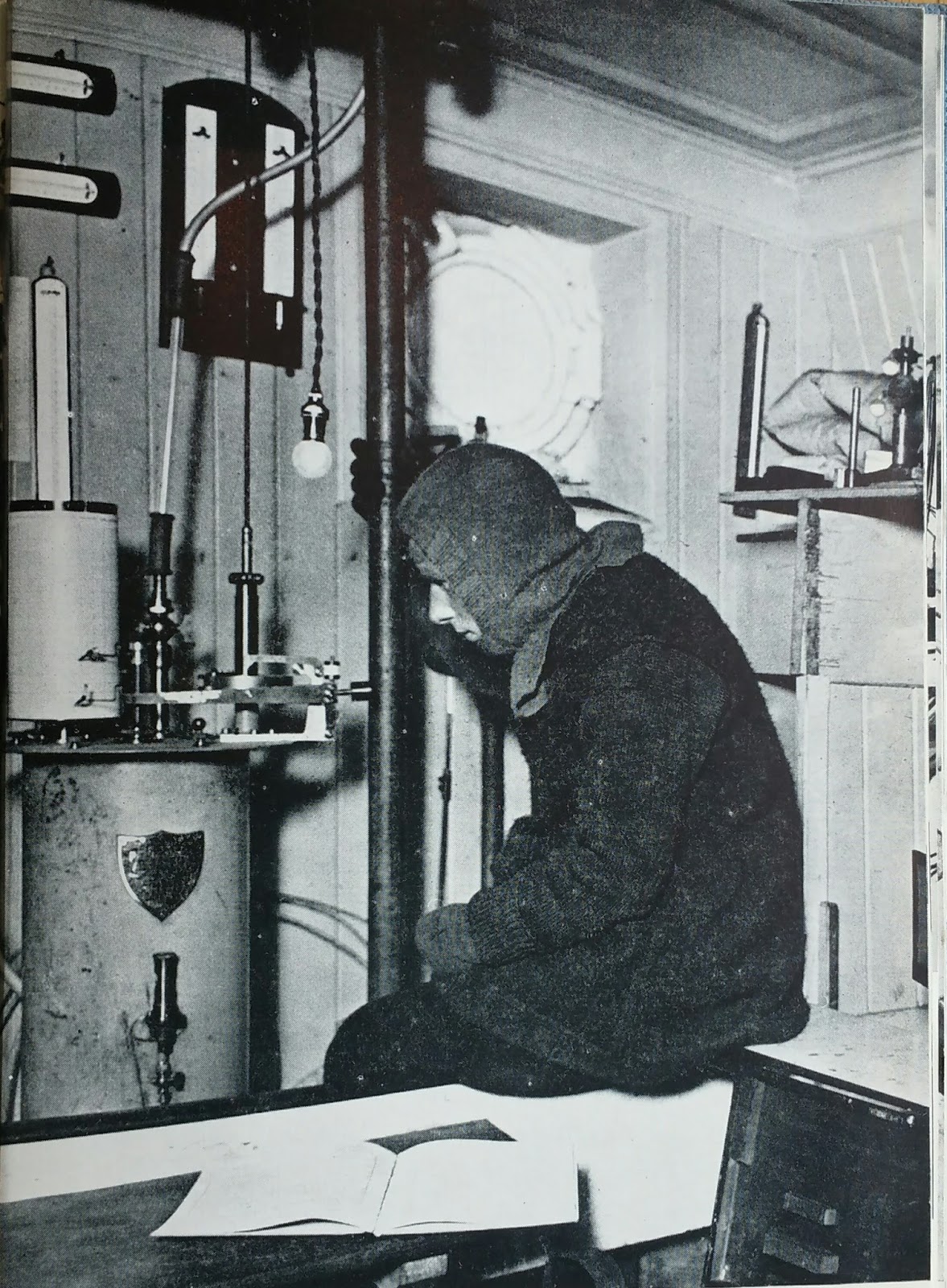
An Endurance crew member observing a scientific experiment instrument.For the last installment of the “Exhibit that wasn’t”, we introduce the last batch of items that the students from Ross Virginia’s Spring 2016 “Pole to Pole” class selected but could not be displayed in the physical exhibit cases. These items fell into three themes that the students thought were significant for Shackleton’s expedition.

The first theme is scientific documentation. Though preoccupied with worries of being stranded in an uninhabited island, the Endurance crew did not let those fears hamper them from carrying out the original purpose of the journey - obtaining more knowledge of the Antarctica.

This photo of the laboratory aboard the Endurance from Shackleton’s Argonauts by Frank Hurley shows the crew members making scientific observations. The crew proceeded research and experiments in meteorology, oceanography and physics with full speed while stranded, and the observations made during this time were highly valuable. For instance, the crew’s observations contributed to a better understanding of different characteristics of sea-ice forms.
Frank Hurley standing on top of a mast to take a photo.
Another important item on the agenda for the crew was to document the scenery of Antarctica as thoroughly as possible. This photo of Frank Hurley, the official photographer of the Endurance expedition, portrays his willingness to risk bodily harm to capture the perfect image.
The crew’s tenacity to document the Antarctic is especially noteworthy in the context that nothing guaranteed their survival or rescue. However, the crew members never lost hope, and this hope was what motivated them to continuously pursue research goals and create records for future study. Their perseverance has enriched our understanding of the arctic region and scientific knowledge in various fields.

Endurance crew members waving their hands at the rescue boat.Another theme that students emphasized through their selection of exhibit items was struggle for survival.

The photo to the left, found in Shackleton’s Argonauts by Frank Hurley, documents the crew's rescue at the end of the Endurance expedition in 1916. Upon Shackleton’s return, the crew members were whooping and hollering as they rejoiced over their rescue after a strenuous time on Elephant Island. The rescue came after almost two years of a struggle for survival. What struck students as impressive was that not a single life was lost. This demonstrates the crew members' mental and physical robustness which is exceptional in that they manage to maintain such tenacity in the midst of mental and physical challenges in a barren land.
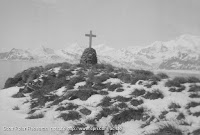
A cross on top of Shackleton's tomb in South George Island.The last theme is the legacy of Shackleton's Endurance expedition.

This picture of the Shackleton Cross on South Georgia Island in Endurance: An Epic Polar Adventure and the subsequent passage describe the construction of the cross on South Georgia Island in memory of Ernest Shackleton after his death in 1922. Though it has been a hundred years since the Expedition's return, the courageous story of Shackleton's Endurance expedition lives on through the archival materials and memorabilia like the Cross on South Georgia Island. The account of the expedition continues to be passed down to following generations in more accessible forms such as movies, novels, and children books.

Material selection and exhibit conceptualization by Kelsey Catano '18, Taryn Deck '17, Kiana Outen '18, Max Saylor '19, Miranda Gish '18, Anna Ellis '19, Nora Masler '18, Margaret Currie '17, Kevin Gross '19, and Noah Van Dyke '18.

After the exhibit comes down, you can see Shackleton's Argonauts by asking for Stef G850 1914 .H87; Endurance: An Epic Polar Adventure is Stef G850 1914 .W6.

To learn more about the physical exhibit, visit the exhibits page.

Tuesday, August 23, 2016

Sigh... Another Book... Oh, Well...

Title page to A Treatise of MelancholyIt is hard to be glum today when the summer sun is still shining and the Dartmouth Outing Club's First-Year Trips are about to get started. The next few weeks are a comfortable time on campus: quiet for most of the day, punctuated by outbursts of joyous frivolity courtesy of the DOC Crew in their flair. But it is hard to see the beauty if you are steeped in the pages of A Treatise of Melancholy (London: William Stansby, 1613), our latest acquisition by the inaptly named Timothie Bright.  It explores the causes and treatment of the voguish melancholia of the time, and also takes a look at its "companions," fear, sadness, desperation, and tears.

The first edition of the book was published in 1586 and is thought to have served as source material for Shakespeare. Picture poor Hamlet, and you can imagine Shakespeare reading up on the subject of melancholy. As the first text in English on the subject, A Treatise of Melancholy would have been his best bet.

Take a look at it and contemplate your mental state (and Hamlet's as well) by asking for Rare RC 618.B7 1613.


Friday, August 19, 2016

The Undiscovered Exhibit Part II

Image of "An interview with an Emperor" One of the frustrations of an exhibit, at least a physical one, is that you can only show one opening in a book. Some books deserve so much more, so here we have captions and images selected by the "Pole to Pole" class from books actually in the physical exhibit but hidden by other page openings. This is the second installment of the "Exhibit that Wasn't."

Within Antarctic Days: Sketches of the Homely Side of Polar Life by Two of Shackleton's Men, is the image “An Interview with an Emperor” sketched by crew member George Marston. It provides compelling insight to the deteriorating level of sanity felt by the crew of the Nimrod expedition. The anthropomorphizing of a penguin and outlining an impossible happenstance in which the penguin confronts the men and boldly commands them to leave his property, illustrates a weak state of mind prone to illusions and day dreams. Navigating the difficulties of coping with isolation during the Nimrod expedition became a very real and almost impossible task. This sketch attests to result of spending too much time in isolation, with a loosening grip on reality that the crew battled against until their return home.

Image of the king and queen inspecting the Nimrod
The September 1909 issue of Pearson’s Magazine was dedicated to Shackleton’s journey. The magazine features numerous ads and sections commemorating the triumph, and culminates in a first-hand account of the dangerous excursion. The image here shows Lieut. Shackleton on the Nimrod accompanied by the King and Queen, who gave their blessings to the expedition. During this farewell visit, King Edward VII awarded Shackleton the status of "member of the Victorian Order," and Queen Alexandra entrusted Shackleton with a Union Jack to carry to on the southern sledge journey to plant at the South Pole. This royal visit helped generate national support for the expedition.
The fantasy land fof Bathybia from the Antarctic Book
Douglas Mawson's "Bathybia," from The Antarctic Book: Winter Quarters, 1907-09, is a fictional story written during Shackleton’s Nimrod expedition that chronicles an excursion across the frozen Antarctic continent, and the discovery of a sunken basin in an extinct volcanic crater containing a lush tropical environment. Named "Bathybia" by the men, this tropical basin was home to gigantic fungi, as well as enlarged and dangerous forms of previously known animal taxa such as tardigrades, rotifers, and mites. Mawson crafts a fantastic tale of exploration, discovery, and survival in "Bathybia," only to wake up from a short nap at the end of the story to realize that everything had been a dream. The fantasy showcases Mawson's creativity, the quest for scientific discovery during the Nimrod expedition, and the mentality of the men on the voyage as they coped with the frozen, harsh conditions of Antarctica.

Material selection and label concepts from Ravynn Nothstein '17, Christian Frey '18, Jo Nazareth '17, and Kyle Kittleberger '16

After the exhibit comes down, you can see Antarctic Days by asking for Stef G850 1907 .M8Pearson's is Stef Mss-242, Box 21, folder 70; and The Antarctic Book is Stef G850 1907 .A322.

Tuesday, August 16, 2016

Vortex of Misery

Oh dear, be careful who you fall in love with! We just bought a little booklet with a dire warning: Miss Eliza Rossell: A Tale of the Unfortunate-Female, written by "a Friend." Poor Miss Eliza made an unfortunate decision in life. She was wooed by a rake, Mr. Seldon. He had a little property, but as Eliza's wise father noted, it was not from "his own hard earnings." Only after she eloped did she learn he was nothing less than a cutthroat highwayman.

Image of Eliza's lover being shot
He is killed in a robbery attempt, and Eliza returned home in a fever with her children. She made a full confession to her family then promptly passed out. Her family feared her dead, but then she stirred:
Looking around in amazement, she said, "oh, what a pleasant dream I have had! I thought I had made my confession to you and you had all forgiven me, and were going to take care of my poor, fatherless children"
Image of Eliza's confession
Her father (not only wise, but just) reassured her that it was not a dream, and that all had been forgiven. After a bit more melodrama, poor Eliza died. The moral of the story is clear:
Thus we see the end of one who, early in life, bid fair to prosper and be happy; but who, by one false step, in disregarding the advice of her friends, was plunged into a vortex of misery, from which no human efforts could deliver her.
You can wallow in Eliza's misfortunes by asking for 1926 Coll M577.