Tuesday, January 5, 2016

Campaign Expenses

Expense voucher for two six-packs of beer for Paul NewmanIt is that time again. The New Hampshire primaries are in full swing. The airways are filling with campaign ads, and robo calls are harassing us at dinner. To commemorate New Hampshire's periodic step up onto the national stage, we have just mounted an exhibit, "Up For Grabs: Campaigning, Debating and the New Hampshire Primaries" in the Class of 1965 Galleries. It is full of interesting memorabilia from past campaigns, but perhaps the most intriguing item is a simple expense voucher from 1968 for beer--beer for Paul Newman.

In 1968 the Associate Director of Dartmouth College's Public Affairs Center, David Hoeh, helped to persuade Senator Eugene McCarthy to enter the New Hampshire Primary. He coordinated McCarthy's campaign that ended up restructuring the whole race. McCarthy's strong showing in New Hampshire led to President Johnson's decision not to seek reelection and Robert Kennedy's entrance into the fray. Hoeh had a little help: one of McCarthy's biggest backers was Paul Newman, who parlayed his fame into support for the little-known Senator. Apparently, one of his needs on the campaign trail was a supply of beer. His tastes seemed modest: $2.50 bought two six-packs.

You can see the voucher now through February 9th in the exhibition. After that, ask for ML-56, Box 6, Folder 2.

Wednesday, December 30, 2015

Seeing the Elephant--not the Pink One!

Playbill from Lyme Dramatic Club, December 1876You can't beat the way they ushered in the New Year in Lyme, New Hampshire, in 1877.  On New Year's Day, the Lyme Dramatic Club took over Church Hall in Lyme to perform the three act drama, Little Brown Jug, followed by the "side-splitting farce" Seeing the Elephant.

We had to know more, so we did a little research to see just what they were watching. Seeing the Elephant was written by Vermont native David "Doc" Robinson and was first preformed in California during the gold rush where Robinson opened a theater. It was an immediate success, and according to a 1969 article in Western Folklore, the phrase entered the lexicon of American slang. It carried the connotation of having seen everything and was used by people touring the rowdy Barbary Coast. It makes us wonder about the crowd that New Year's evening, 1877, in Lyme. After the show, did they "see the elephant" with a stroll through town?

Have a Happy New Year!

To see the playbill, ask for Broadside 876925.


Tuesday, December 22, 2015

Death at Christmas

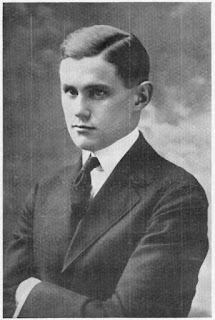
Richard Nelville Hall graduated from Dartmouth on June 23, 1915. Six months later he was dead, the first Dartmouth man to perish in World War I, the Great War. By all accounts, he was a fine young man, greatly beloved by all who knew him. Born into an academic family in Ann Arbor, Michigan (where his childhood home still stands), he matriculated at the University of Michigan, then transferred to Dartmouth at the beginning of his sophomore year. His older brother, Louis, was a member of the Class of 1911.

Immediately upon graduation, Dick Hall volunteered to serve as a driver in the Dartmouth Ambulance Corps in France, which was part of the American Field Service Ambulance Corps. Keep in mind the fact that the United States did not officially enter the war until April 1917, so Hall’s service was that of a non-combatant and humanitarian. Nevertheless, he faced great danger and peril every day, and his courage and valor were legion.

Photographic portrait of Dick HallLate on the night of December 24, 1915, or in the early hours of December 25 (reports vary), a stray German shell hit the ambulance Hall was driving in the Vosges mountain range in eastern France, where fierce trench fighting was raging. He was killed instantly, and his body discovered several hours later in the ruined hulk of his ambulance. He is buried in the French Military Cemetery at Moosch, Alsace-Lorraine.

Edward Tuck, Class of 1862, that great benefactor of Dartmouth and ardent Francophile, paid for a fine memorial to Hall which may be seen just inside the west door of Baker Library on the lower level.

Photograph of Hall on Dartmouth CampusRauner Special Collections Library holds several highly evocative relics of Hall’s life and death, including the rusted casing of the shell that took his life, and the Red Cross insignia from the side of his ambulance. These were given to the College by his parents. Ask at the Rauner reference desk to see these items, or his alumnus file, which is unusually large and detailed for one whose life was so short.

Requiescat in pace, son of Dartmouth. On this, the centenary of your young death, we acclaim you, we honor you, and we remember you.

Friday, December 18, 2015

Bored at Home?

cover of Charades bookTry Acting Charades! This 19th century pastime is way more complicated than what we call charades today. There's a whole book dedicated to the proper art of Acting Charades, or, Deeds not Words: A Christmas Game.

The book begins with an introduction to the history of charades (French), so started because of the national "inability to sit still for more than half and hour." As to the actual game, the two "most celebrated performers" choose their teams, then decide upon a two syllable word or phrase. One team then performs a charade -- silently, as "nothing more than an exclamation is allowed" -- "as puzzlingly as possible" in the order of "my first, my second, and my whole." It's somewhat similar to how nowadays, we do "1st syllable" and so on. But these pantomimes are not simple.

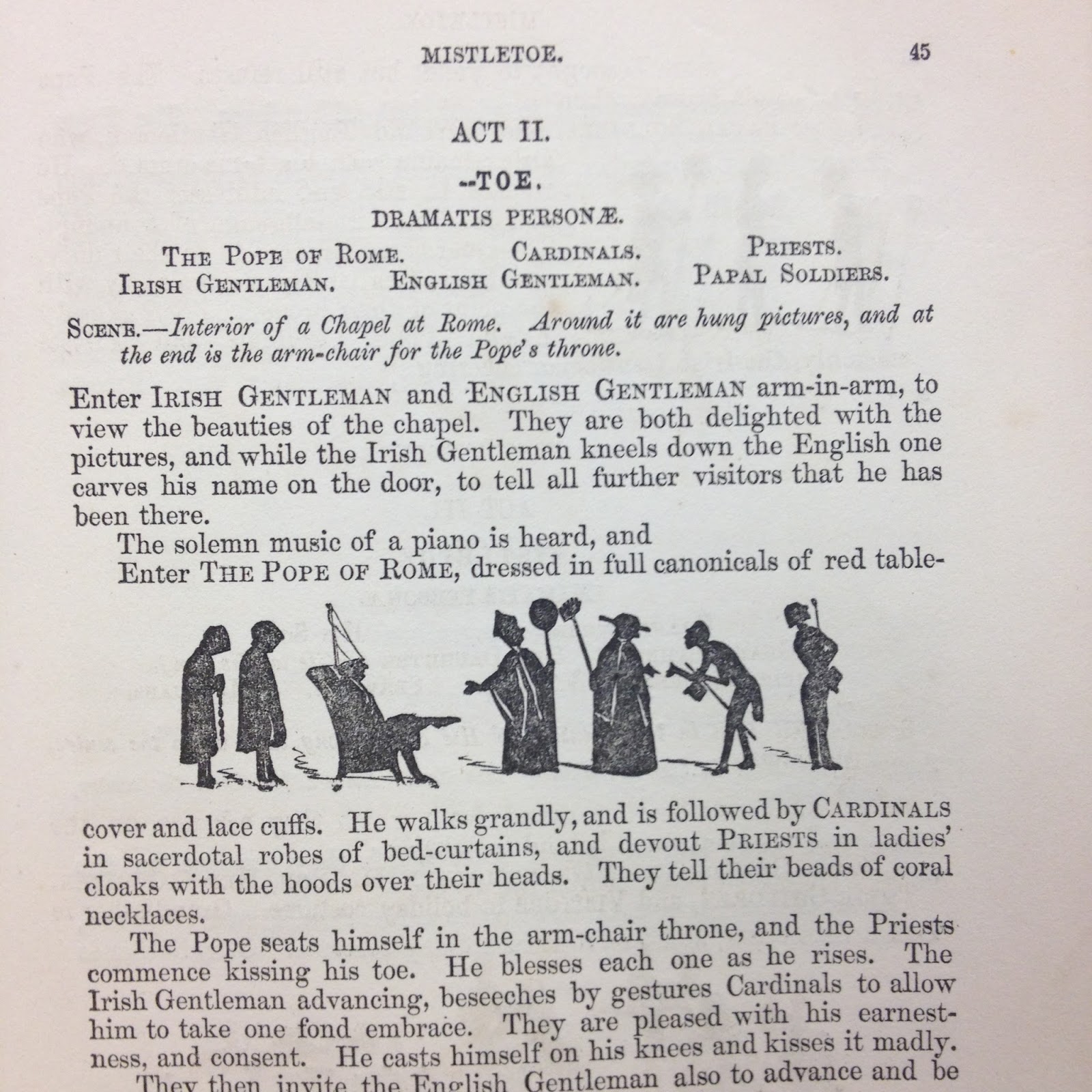
Let's follow "Mistletoe."

Kiss the pope's toe!Act I. Mistle -- (Mizzle). A Poor Tenant cannot pay his rent; he and his family remove all of their belongings from the home. The Angry Landlord arrives and is angry.

Act II. Toe. An English gentleman refuses to kiss the Pope's toe. An Irish gentleman attempts to help, but when the English gentleman is escorted away at broom-point, he joins the Catholic cheers.

Act III. Mistletoe. A grandfather sets up some mistletoe over the Christmas dinner table. Everyone is delighted at this"wickedness," and many couples embrace theatrically ("by crossing their heads over their shoulders") under the mistletoe. Then they have to get married.

Not sure I'd be able to guess "mistletoe" from that, but that's just my 21st century attention-span speaking. Maybe if I were a Victorian scholar ...

My favorite part is the incredible set-up to the actual action itself. It's not like our version of charades -- this requires costumes. And though they understand their are constraints, they expect "high-pressure ingenuity" to save the day. They have seen a Louis XVI with an "ermine victorine wig for a well powdered peruke, and the dressing-gown for embroidered coat." Let me just go get my ermine victorine wig.

To try a charade of your own, ask for Sine Illus H56act. The British Museum also has provided a scanned version via Google Books if you want to try during the winter holiday.

Tuesday, December 15, 2015

How Monahan Saved Christmas (Trees)

Photo of Robert MonahanHow the Grinch Stole Christmas by Dr. Seuss (Theodor Geisel ’25) and Rudolph the Red-Nosed Reindeer by Robert May ’26 are two of the most beloved Christmas stories of all time. Here at Rauner Library, the holidays are an opportune time of year to celebrate our alumni connection to these holiday classics and to share with you a lesser-known, true story about the pilferage of Christmas trees in New Hampshire.

Letter from MonahanI for one was unfamiliar with this story until I came across a letter in the papers of Robert S. Monahan, Dartmouth College Class of 1929, college forester and member of the New Hampshire House of Representatives. In the letter, dated December 16, 1966, Monahan writes to a Mr. and Mrs. Annis of Millsfield, New Hampshire regarding an ongoing issue of theft:
When we last met you mentioned the problem of Christmas tree pilferage, which you have observed on your own property, and wondered why somebody didn’t try to do something about it. Well, I did, back in 1957!
 It seems that throughout the state of New Hampshire Christmas tree theft was so prevalent that legal support became paramount.

In March of 1957, The Manchester Union reported, “the protection of natural resources has to have legal support. That is because human ‘wild life’ is predatory, because it cares nothing about the rights and property of others, and because it is unconcerned when it leaves havoc in its wake.” Illegally cutting a tree was not only considered an act of thievery but broke trespassing laws and posed an imminent threat to the protection of natural resources.

Newspaper clipping, 'Destruction of Trees'Newspaper clipping, 'Tree Stealers'

Later that year Robert Monahan introduced House Bill No. 254 addressing said havoc and calling for closer regulation of the transportation of Christmas trees.
Anyone apprehended transporting more than three coniferous trees on public highways outside of the compact parts of cities or towns from October 1 to December 23 is liable to a $50 penalty unless he can produce proof of ownership and name and address of seller.
House Bill No. 254In 1959 the bill was amended to decrease the number of trees from three down to “one or more” and increased the fine to $300.00.

Outside of the Dartmouth community the story of Robert Monahan may not be as well known as The Grinch or Rudolph, but at Rauner he will forever be remembered as a son of Dartmouth, college forester and savior of Christmas trees.

If you would like to learn more about legislation related to Christmas trees or Monahan’s forestry career ask for MS-1088 and his Alumni File.

Friday, December 11, 2015

Who Am I?

As mentioned in a previous post, Rauner Library holds Abner Dean's papers. Dean (Dartmouth class of 1931) was a cartoonist whose work appeared in Esquire, Collier's, The New Yorker, and Life magazines. In the collection is a set of masks - one of which we know is of Franklin D. Roosevelt and was used as part of the illustration for the September 1932 cover of Life magazine.

Identifying the other masks is a bit trickier.

For example, this next one is probably Winston Churchill - or perhaps W. C. Fields.

And almost certainly Ed Wynn - the nose helps a lot here.

And we think this might be Truman Capote, though if this mask is a contemporary of the Roosevelt, that would be highly unlikely since Capote would have been 8 years old at the time.

But for the rest...well we're not sure. Let us know what you think!
Ask for ML-44 to see the Dean papers. A guide to the collection is available.

Tuesday, December 8, 2015

Lest Old Traditions...

Editorial Cartoon reading 'An Old Dartmouth Tradition ... Goes to Pot'Doesn't this just scream 1968? The College was cracking down on campus drug use, and a week earlier a student was forced to "resign" from Dartmouth for the "alleged use and sale of hallucinatory drugs." The D responded with an editorial decrying the severity of the punishment alongside this editorial cartoon.

Here in Rauner, we have documentation of many old Dartmouth traditions that have gone to pot--figuratively.

To see the cartoon, ask for The D from February 28, 1968. Issues from the prior week discuss the campus drug controversy (and also feature lots of great materials from the 1968 Presidential primaries).