Tuesday, October 27, 2015

Excavating Hamlet: The Play as a Palimpsest

Here at Rauner, we love Hamlet. We’ve previously written about an edition of the play performed in French and a 1949 woodcut version that resembles a graphic novel style, but we figured there’s no such thing as too much Shakespeare.

Mary Heebner’s The Tragic History of Hamlet: An Artist’s Interpretation of the Classic Text by William Shakespeare is a 2008 edition that produced only 20 copies. The “book” (I use the term loosely) is encased in a clamshell case and features loose-leaf excerpts from the text, which fold over paintings that follow the subject matter. Heebner says in her Artist’s Note that her works are “palimpsests of sorts” created by painting over printed text and then scraping into the paint. Drawn to the play’s subtext about female relationships that manifests itself through the figures of Gertrude and Ophelia, she meditates deeply upon the nature of feminine emotional conflict through her repeated depictions of the female body.


Interacting with a play as a series of paintings is definitely a unique experience. Each piece has to be carefully lifted out of its case and handled individually, forcing readers to reflect upon each one as a unique art object. Instead of being presented with the play as a whole, it’s an ant’s eye view of Heebner’s perspective of Hamlet - and what a view it is!

To explore Heebner’s interpretation of Hamlet, ask for Presses S579heh.

Posted for Emily Rutherford '16

Friday, October 23, 2015

Grimm in English

Title page to Grimm, 1823We just acquired the first English translations of the brothers Grimm's German Popular Stories. The first volume was published in 1823 and the second in 1826. The presentation of Grimm's fairy tales in English is much different than the first German editions from 1812 and 1815. The brothers Grimm were engaged in a philological exploration of German language and culture. The German title,  Kinder und Hausmärchen, suggests that the stories were for children, but the scholarly apparatus and some of the more disturbing tales made the books a little less kid friendly.

Title page to Grimm 1826When the volumes were translated in to English, though, the publisher commissioned the popular George Cruikshank to illustrate the volumes. Some of the more gory details of the stories were softened to appeal to multiple audiences and Cruikshank's illustrations give an indication of those audiences. For the first volume, the title page shows a man in a tavern reading aloud from a book to a group of entertained revelers of all ages. It is interesting that the tales come from a book in Cruikshank's vision, since they were collected by the Grimms from an oral tradition.

Frontispiece to Perrault, 1697The second volume's illustration is an homage to the first printings of Charles Perrault's Mother Goose tales. The two images of an older woman sitting by a fire regaling a listeners with her tales are remarkably similar, even down to the cat warming itself by the fire. The big difference is that in Cruikshank's image, the listeners are obviously children, while there is plenty of ambiguity in the age of Mother Goose's audience.

To see the Grimm, ask for Rare PT921.K5613 1823.  The 1697 Perrault is Rare PQ1877.C513 1697.

Tuesday, October 20, 2015

My Dinner with Alessandro

I Promessi Sposi, 1845In 1836, while touring Europe, the well connected, wealthy Bostonians, George (Dartmouth class of 1807) and Anna Ticknor, paid a visit to Alessandro Manzoni at his villa in Milan. Manzoni, famous for his classic novel I Promessi Sposi, was a major force in the nineteenth-century Italian unification movement. Both George and Anna Ticknor recorded the visit in their journals. Their impressions of the day's events differed.

Anna noted that Manzoni "is not striking in his appearance or manner, and in conversation is neither fluent nor very interesting." George was granted a longer time with Manzoni and found him more talkative: "Thus, for instance, he was positively eloquent, when he urged his fears, that the attempts to introduce liberal institutions into Europe would end in furthering its claims of a heavier despotism on the people; and that the irreligious tendencies of the age would but arm the priesthood with new and more dangerous power."

Image of exhibit in Rauner Library
Ian Blanco, Claire Daly, Paul Maravelias, and Zonia Moore, the four members of Nancy Canepa's Italian 24 class, "Questions of Identity in the 19th Century," have just mounted an exhibit in the Rauner Reading Room showing the Ticknor diaries alongside early editions of Manzoni's I Promessi Sposi. The exhibit will be up until the end of term, so come in to see their amazing work.

After the exhibit comes down, you can see the diaries by asking for MS-1249, Box 1 and MS-983, Box 3.

Friday, October 16, 2015

Walking among the Dead

A black and white photograph of an older man in a suit, leaning against a desk with an open book in his hand.While a freshman at Dartmouth College in 1898, Arthur H. Chivers fell in love with  the Old Dartmouth Cemetery. He could often be seen wandering the grounds. After he graduated in 1902, Chivers went on to earn a M.A. and a Ph.D in botany from Harvard. He joined the Dartmouth faculty as an instructor in botany in 1906. He retired a full professor in 1950. During his time at Dartmouth, Chivers was involved with many town and civic affairs. Having never forgotten his love for the cemetery he was happy to take over the supervision of the cemeteries as a member of the Board of Selectman of Hanover in 1948. First on his list of actions regarding the cemeteries in Hanover was to create a card index of all known burials, reading and recording the inscriptions on each stone. By 1951, he had made 1,814 entries.

A drawn plot of the Hanover Cemetery.Using William Worthington Dewey's journal "List of Deaths in the Vicinity of Dartmouth College Including Likewise the Hamlet usually Called Greensborough from AD 1769 to 1859," John Richard's "Record of Death, Internments and Descriptions 1771-1858" and official town records, Chivers then proceeded to map out the Old Dartmouth Cemetery, creating a location map and diagrams of every monument, stone and marker. Chivers also discovered that there were many discrepancies between the different sources and so, whenever it was possible, he contacted family members of the deceased to verify dates and names.

The entire project, a labor of love, took him four years to complete. As part of the process, Chivers could be seen crawling around the cemetery. At one point an unsuspecting visitor to the cemetery was so perturbed by this strange behavior that she rushed away to report it. According to Chivers, she said, "There's a very queer man in the cemetery and I think that the police should be told about him."

A drawn image showing which cemetery plot is Chivers's.
In 1952, Chivers gave his research to Kenneth C. Cramer, the college archivist, and it became part of Rauner's cemetery collection DH-38. We recently scanned Chivers's seven three-ring binders and they are available as one searchable record in pdf form on our web page. Since Chivers completed his record more than sixty years ago, many more inscriptions have disappeared. As such his contribution to the history of the Old Dartmouth Cemetery is invaluable. Arthur H. Chivers died in 1981, at the age of 101. At the time of his death, he was the oldest living alum and the only surviving member of the Class of 1902. He is buried in the cemetery that he loved.

Usually we tell you come in and take a look, but this time why not use Chivers's guide as you stroll through the cemetery.

Tuesday, October 13, 2015

The "God" in the Iliad

Publicity photo of Richmond LattimoreRichmond Lattimore '26 is widely regarded as one of the best modern translators of ancient Greek texts. For example, his 1952 translation of the Iliad is excellent and praised by his fellow classicists. Rauner Special Collections Library possesses a large amount of material relevant to Lattimore, ranging from poems he wrote as an undergraduate about sunny Hanover afternoons to his personal correspondence with friends.
Lattimore's notebook page displaying Book 15 line 403
Among these materials is a notebook he kept while translating the Iliad, conveying something of the method of his translational process. The notebook, covering Books 15 to 22 of the Iliad, contains little in the way of editing marks and closely resembles the finished, published translation, which is itself quirky. One example of this quirkiness is that it capitalizes "God," doing so ten times. Out of five other famous Iliad translations (Fagles, Lombardo, Fitzgerald, Merrill, Mitchell) there is no precedent for this decision. Interestingly, the notebook at Rauner indicates Lattimore’s initial uncertainty regarding the capitalized "God" in two different places, 15.403 and 17.101, images of which are shown here.
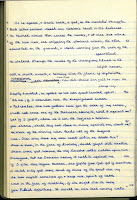

Lattimore's notebook page displaying Book 17 line 101For those unfamiliar with or rusty on the Iliad, the speakers of these two passages are, respectively, Patrokolos and Menelaos. Patrokolos (a Greek) speaks of his desire to bring Achilleus back into the fighting, and Menelaos (also a Greek) contemplates the consequences of yielding before Hektor, the mightiest Trojan warrior. Plot details aside, the strikethrough as seen in the first notebook image (Lattimore's own) conveys his somewhat intensive deliberation regarding phrasing, the subject of the sentence, and the capitalization of "God." As is evident, he does not capitalize the first instance of the word in his notebook, yet does so with the later Menelaos passage, shown here in the next image. In the published version of his translation, both instances are capitalized. So, the issue of capitalization in the notebooks, later resolved in published format, reveals Lattimore’s initial trepidation regarding whether to capitalize "God."

A letter addressed to Lattimore and archived in Rauner provides some valuable context for his deliberation over the unique capitalization of the word "God." Dated June 27, 1933, the letter’s author Page 5 from Jackson's letter to Lattimorewas Richard Jackson, a friend of Lattimore's from Dartmouth who graduated Phi Beta Kappa with a degree in Classics. The body of the letter is a speech that Jackson produced at Lattimore's request. The speech is somewhat discursive but discusses the importance of poetry and religion:
"Everywhere in epics and lyrics... is the poetry of religion. Religion, I realize, is a hazardous subject to discuss these days.... We should not lose sight of the immaterial idea.... Nay, we must believe in that idea, not through logic, but through poetry...."

The comment about religion being "hazardous" might explain Lattimore’s timidity. More importantly, the letter enshrines a moment when Lattimore apparently sympathized (by requesting the speech from Jackson) with the desire to believe in that "immaterial idea… through poetry." Moreover, the mention of "epics and lyrics" in the letter brings to mind the Iliad. This letter potentiates a Christian subtext to the capitalized "God" of Lattimore's translation, a potentially dangerous move for one who wished to have a reputation as a serious scholar of Greek literature.

To examine Richmond Lattimore's notebooks and correspondence in greater detail, ask for MS-503 at Rauner Library.

Posted for Henry Woram '17, CLST 4 class

Friday, October 9, 2015

Welcome Home

John Flaxman's image of Odysseus slaying the suitorsWe know you are going to have a better Homecoming than poor Odysseus. What a nightmare--coming home to find his house infested with suitors and his kingdom in disarray. This image is one of the tamer ones in John Flaxman's suite of images for the Odyssey.

Dartmouth Night is upon us, the bonfire is built and ready to blaze despite the rain. It is about welcoming back the alumni while welcoming in the new class. It is always a festive weekend and the fall colors make campus seem like paradise. We hope your homecoming is bucolic and filled with fun--and everything Odysseus's was not.

To see more of Flaxman's images, ask for Illus F619h copy 3.

Tuesday, October 6, 2015

Of Blue Points and Cigars

Kappa Kappa Kappa Initiation Banquet menu 1890Roast mallard duck, celery, queen olives, lobster croquettes, and blue point oysters. This sumptuous meal comes to us through the archives of Kappa Kappa Kappa, one of the oldest fraternities at Dartmouth. The occasion? The Initiation Banquet of 1890 (program at right).

In a bygone era, new fraternity members were welcomed into their houses at an Initiation Banquet, featuring multiple courses, speeches, and songs. For each Initiation Banquet, the fraternity produced a commemorative booklet. These small pamphlets are scattered throughout the collection in membooks and fraternity files, just like the dance cards we've previously blogged.

Psi Upsilon Initation Banquet 1885Most banquet booklets follow a basic format: the fraternity name, date, location, a list of new members, a list of toasts, song lyrics, and, most importantly, the menu. But unlike dance cards, there's no set name for these items: Are they pamphlets? Programs? Menus?

Psi Upsilon Initation Banquet 1884They give us a glimpse into what students considered fancy and sumptuous in the late nineteenth century. One thing is certain -- they thought blue point oysters were awesome. They're the first item on almost every banquet menu. Oysters required ice and rapid transportation from the sea coast, indicating that they would be expensive, and therefore, a status symbol. They probably tasted pretty good too!

Other popular menu items include crackers, sherbet, and jellies. The evenings concluded with cigars and cigarettes, listed on the menu as though they were just another food group.

To see some examples, come into Rauner and ask for the Vertical File of almost any fraternity that existed before 1950. The menus in this post are from Kappa Kappa Kappa (Initiation Banquet, 1890), and Psi Upsilon (Initiation Banquet 1885 on the left and Initation Banquet 1884 on the right).