Tuesday, May 14, 2013

Postcards from the Green

A postcard showing the Ledyard Bridge.The first postcard ever sent was in Austria in 1869, but it took a few years for the trend to catch on in the United States. The U.S. Post Office issued its first postcard in 1873. However, it was not until 1907, when postcards were allowed the divided back for a message and the address on one side and a full picture on the other, that postcards hit their "Golden Age." As photographic technology improved, postcards gained the ability to showcase the daily lives of the senders. At Dartmouth, postcards have been used throughout the years to promote the college, give family back home and idea of what is happening, or simply to let someone know they are missed. Looking at Dartmouth postcards over time shows how much has changed in Hanover in the last century - and what has stayed the same.

A postcard showing the interior of Webster Hall.
A postcard showing the interior of Baker Library.
A photograph showing a series of men in white uniforms on the green.
Viewing old postcards, it is easier to spot changes at Dartmouth than what has stayed the same. The first Ledyard Bridge, for example, was built in 1859 and bears little resemblance to the current uncovered bridge. The view of campus was very different, with more tress and lacking a number of notable buildings. However, some landmarks, such as Webster Hall (which now houses Rauner Library) and Baker Library, built in 1928, remain the same. A 1932 postcard of the Tower Room bears a photo that looks like it could have been taken in 2013. Often, the biggest changes in iconic areas such as the Green are the people. In some postcards, the changes are minute, such as different clothing styles or cars. The most starkly divergent postcard in Dartmouth's collection is from World War II, bearing a photo of military men in uniform arrayed in formation on the Green in uniform, with Baker Library and Webster Hall in the background.

A printed poster addressing Freshmen.A postcard filled with handwriting. Perhaps the most revealing postcard in terms of changes at Dartmouth is not a photograph, but instead a miniature poster from 1916. Nate, the author and a member of the class of 1920, wrote his father "This is a miniature of the poster that all Freshmen must buy." The poster addresses, "Ye Puny Prodigals of Prep-school, Ye Pups of Ignorance, Ye Illiterate Imbeciles:" in other words, the freshman class. The class of 1919 lays forth twelve rules for the class of 1920 to follow, including the need to wear a "cute green cap with a monstrous white button" and to "never short-cut across the grass." While the college no longer allows such hazing of freshmen, Nate's writing on the postcard is similar to that of a quick e-mail home. He requests curtains for his dorm room windows, asks how everything is at home and of course tells his father of all the work he has to get done before his vacation Friday. Check out Dartmouth's postcard collection to see the evolution of other aspects of Dartmouth, from fraternity houses to Winter Carnival, in 3 1/2 by 5-inch tidbits.

Ask for Rauner Iconography 1523 to see all 1400 plus postcards.

Posted for Kate Taylor '13

Friday, May 10, 2013

Civil War Diary

An open book of handwritten entries attached to printed dates.The Civil War is one of the most influential and defining moments in American history. However, in the lives of the men fighting the war, the war was a daily struggle – not just in battle, but also marching for miles, finding food and writing letters home. The diary of Henry S. Muchmore highlights the minutia that made up the everyday life of a Civil War soldier. Muchmore was an enlisted soldier in the 11th New Hampshire Volunteer Infantry, Company G. His diary entries are only a few words long describing what he did that day, the weather or important occurrences. Muchmore's diary covers January 1, 1863 to June 10, 1865, when he returned home to New Hampshire.

A worn case with the words "Diary 1864" stamped on it.
Reading early entries, one almost cannot tell he is at war. On January 7th, 1864, he visits two friends in the 12th New Hampshire Regiment. On the 16th, he writes the weather is "cold as greenland." However, as he travels south, Muchmore’s diary signals the approaching battles. In June and July, he was involved in the Vicksburg campaign. A turning point in the Civil War, the Vicksburg campaign allowed General Grant to gain control of the last Confederate-controlled section of the Mississippi River. The micro-view of the operation is less grand. Muchmore grants the ripeness of blackberries and the quarts picked the same detail as the numbers killed and wounded in Jackson in mid-July. In the battles of Wilderness and Spotsylvania Court House, Muchmore had less time to pick berries. Though inconclusive battles, with heavy losses on both sides, Wilderness and Spotsylanvania were part of the Grant's final push towards victory. Muchmore is minimalist as always in these entries: he only had room to record miles marched, the number of dead or wounded and the repeated "hot." The Battle of Cold Harbor continued the trend of battle-driven entries, broken up by a few entries to record miles marched. Cold Harbor was a bloodbath for the Union, and one of the final victories of the Confederate army. Grant would go on to write in his memoirs, "I have always regretted that the last assault at Cold Harbor was ever made… No advantage whatever was gained to compensate for the heavy loss we sustained." Muchmore's diaries lack the analysis of Grant's reflections, but notes 4 killed and 17 wounded.

A page of handwritten text.
Due to illness, Muchmore's duties decreased in November 1864. In the year 1864, he traveled 1874 miles, wrote 34 letters and received 33. Entries from January to March 1865, primarily on chopping wood, represent a much-deserved break. Muchmore returned to capture the city of Petersburg in 1865. On April 9, 1865, he records Robert E. Lee's surrender. His next entry, on the 14th, he states "President shot." Muchmore continued serving in the military for two more months. He arrived home at 5 PM on June 10th, having been away for two years, nine months and five days.

Ask for Rauner Mss 863101.3 to see the diary.

Posted for Kate Taylor '13

Wednesday, May 8, 2013

A Beautiful Manuscript

An open, miniature book of hours with densely painted and illuminated illustrations. Today, we thought we would just treat you to a moment of beauty. These images are from a manuscript Book of Hours produced in Florence in the late 15th century. It is on uterine vellum made from the skin of unborn sheep or calves, and was illuminated in Attavante's atelier. Each miniature is a lovely Renaissance painting that fits in the palm of your hand.

An open, miniature book of hours with densely painted and illuminated illustrations. An open, miniature book of hours with densely painted and illuminated illustrations.
Come see it by asking for Codex Manuscript 001054, and there is a little more information on our "Script to Pixels" website.

Friday, May 3, 2013

Typographic Sound

A paper book cover.Vladamir Maiakovsky's poems were meant to be read aloud; in fact, the title of this book, Dlia Golosa (Berlin : R.S.F.S.R. gosudarstvennoe izdatelʹstvo, 1923) translates to For the Voice. El Lissitzky applied his Constructivist aesthetic to the book. Drawing primarily on display types and decorative devices common in printing shops he illustrated the poems and created emphasis. You have to wonder, if the book is meant to be heard rather read, why the lavish typographic attention?

Lissitzky delineates each the poems with a tab. The layout and decoration of the book gives it the feel of a medieval litergical book--albeit one with a radically modernist aesthetic. The tabs steer the reader through the text making it simple to select a poem at a glance, and the typographic designs act as decorated initial letters to stir the reader into the proper oratory mood. The mission was similar--read out to the congregation, the texts were meant to inspire their souls. The final product is a masterpiece of Constructivist book design and a great example of early Soviet experimentation in the arts.
An open book of designs.
You need to see this book to really appreciate it. Ask for Rare PG3476.M3 D57.


Tuesday, April 30, 2013

The Unfriendly Arctic

An engraved silver tray.Shipwrecks capture the imagination with epic tales of tragedy and heroism. From Robinson Crusoe to Life of Pi, shipwrecks have provided readers stories of life and death they just can’t put down. While Rauner has endless books on shipwrecks, it also has its own relics of a voyage gone wrong. Over the years, a number of tokens from the last voyage of the HMCS Karluk have washed up on Rauner's shelves.

A handwritten letter.
Viljhalmur Stefansson, who taught at Dartmouth from 1947 to 1962, organized the Karluk's voyage to explore the area north of the Canadian coast. Karluk began its journey in June 1913. The Executive Council of British Columbia presented Stefansson with a silver salver upon his departure. However, the crew would soon need more practical goods than an engraved tray. By September 10th, Karluk was ice-bound for the winter. Stefansson became separated from the ship: Karluk began to drift through the ice while he was on a hunting trip with five other members of the expedition. Though Stefansson claimed the separation was accidental, some of the remaining crew saw his departure as the abandonment of a mission he suspected would fail. Stefansson did not return from the trip until 1918 after an extensive exploration that included the discovery of new Islands, but the Karluk sunk after months of drifting on January 10th, 1914.

A handwritten letter.
The sinking of Karluk left twenty-two men, one woman and two children stranded on what would become known as "Shipwreck Camp." Divisions between the shipwrecked soon arose on the ice camp. Two parties set out in attempt to reach Wrangel Island and set up a more permanent site on land. These parties overestimated how close they were to the island and the ease with which they could set up a new camp. Both perished in the Arctic conditions. Finally, the main party managed to reach Wrangel Island in March. The captain, Robert Bartlett, and an Inuit hunter, Kataktovic, continued on in search of a means to alert the rest of the world of the fate of Karluk. The rest of the group set up camp, desperately awaiting rescue. Finally, on September 7th, a walrus hunting ship accompanied by Bartlett picked up the fourteen remaining survivors.

An open book with a map on the left page and text on the right.
Six survivors would publish first-hand accounts of "the last voyage of the Karluk." Bartlett went on to lead many more Arctic voyages. Stefansson lectured widely on "the Friendly Arctic," organized another ill-fated expedition to Wrangel Island and eventually became the Director of Polar Studies at Dartmouth. You can find much more about the Karluk and practically anything else related to the polar regions by exploring the Stefansson Collection on Polar Exploration.

Posted for Kate Taylor '13

Friday, April 26, 2013

Polar Players

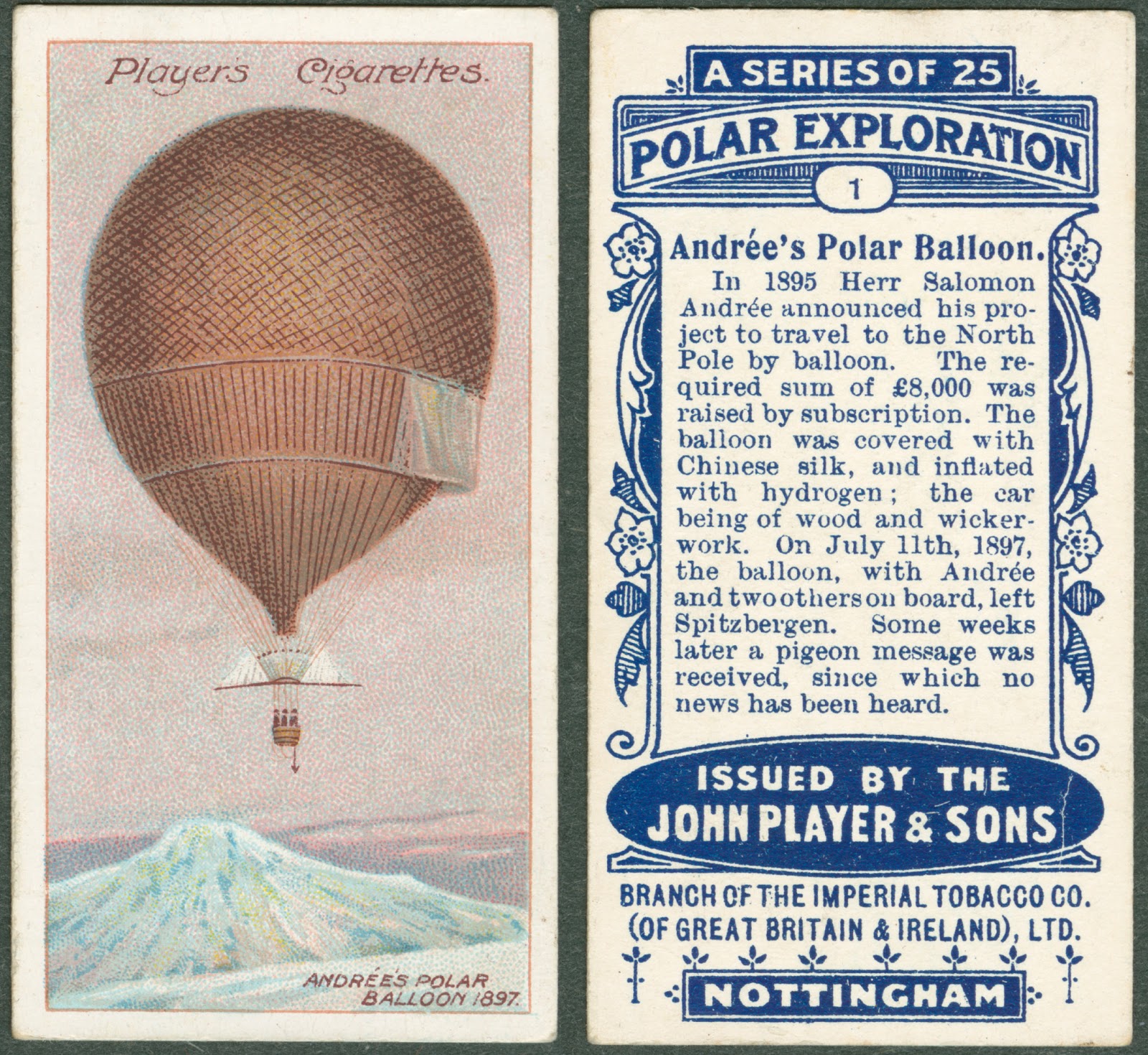
A card with an illustration and text block on Andree's Polar Balloon.Sometimes, as we get older it is easy to forget the excitement of mystery, but in Rauner we have countless items that recapture that childhood imagination—like the Player's Cigarette Cards.  The cards, which came with Player's Cigarettes, each feature a different representation of Arctic exploration: from explorers to ships and the formation of Icebergs, every card tells a short story about the frozen ends of the Earth.

A card with an illustration of the northern lights over a snowy cabin.
One of my favorite of the cards features "Andrée's Polar Balloon." It describes Herr Salomon Andrée, who raised money for his Polar hot air balloon, made from Chinese silk and filled with hydrogen. A few weeks after his departure, a pigeon message was received, after which nothing was heard from him again.

A pile of illustrated cards.
The mystery lies not only in each story, but also in the story of the cards' circumstance: who collected these cards? Were they meant for kids, despite their being contained in cigarettes cartons? What is the connection between cigarettes and polar exploration?

A card bearing an illustration of a group of men smoking, drinking, and playing music together.
If you come by Rauner and ask for Realia 536 you can find out the answers to some of these questions, but even more importantly, you can look at these beautiful cards and discover questions of your own!

Posted for Lucy Morris '14

Tuesday, April 23, 2013

Waste Lands

A title page for "The Waste Land."
We have three "firsts" of T.S. Eliot's The Wasteland. Two variant copies of the first American edition, each with typographical oddities of interest to obsessive collectors, and the first English edition. They are all fascinating in their own right but two things jumped out when we had them pulled for a class last week.

One of our American editions published by Boni & Liveright in 1922 still has its original dust jacket--a rarity in itself--but also a bookseller's advertising tag attached. On the bottom corner of the back cover is simple ad for the original seller of the book, The Old Corner Bookstore in Boston. At the time, it was the largest retail book outlet in the country. It was known as the haunt of Boston's literary elite, but was also famous for innovative sales gimmicks--this being one.
A paper cover for "The Waste Land."The back cover.

The first page of "The Waste Land."
The first English edition will give you goosebumps. It was published by Leonard and Virginia Woolf at the Hogarth Press in 1923. Virginia Woolf herself hand set all of the type (she said her hands were shaking when she finished). The Woolfs had impeccable taste as publishers, but they were not the best printers the world has seen. The type was unevenly inked in the printing process giving the page a blotchy look. In a way, that just makes Virginia's work more apparent and heightens the aura of the book. You can see the handmade quality.

Come see all three by asking for Rare PS3509.L43 1922 copies 1 and 2, and Val 817 E42 Y512.