Friday, March 1, 2024

In March the Wind Blows Down the Door...

Happy March! We're getting impatient for spring around here and are celebrating the changing seasons with a look at one of the smaller books in our Maurice Sendak collection. Chicken Soup with Rice is a children's book of months, part of the miniature Nutshell Library set. Not quite four inches tall, it lays out each month with a rhyme leading back to the eponymous dish. Here's this month's:

In March the wind
blows down the door
and spills my soup
upon the floor.
It laps it up 
and roars for more.
Blowing once
blowing twice
blowing chicken soup
with rice.     

The Morton E. Wise Collection of Maurice Sendak was presented to the library in 2007 for the tenth anniversary of Dartmouth's Roth Center for Jewish Life. To check out this particular treasure, ask for Illus S467nuts.


Friday, February 23, 2024

Perfection through Portraiture

The title page to the Illustrium Imagines.Can we become more virtuous just by looking at portraits of illustrious people? Yes, we can! This is the claim of 16th century portrait books like the Illustrium Imagines (Images of the Illustrious), published at Rome in 1517. The printer’s preface points out that the noble Romans had portraits of illustrious people “in the halls and even in the very doors” so that “by constant recollection of them, not only in thought but by sight, their minds were encouraged and supported to emulate their glory.” Portrait books offered readers an edifying gallery of portraits in the palm of their hands.

The portraits in the Illustrium Imagines are mostly based on coins – making it the earliest illustrated printed book about ancient coins. It is probably the work of Andrea Fulvio, an antiquarian and Latin teacher active in Rome.

The book’s layout is striking. Ornate woodcut frames surround and “support” coins depicting Roman emperors and members of their families. Brief biographical, historical, or antiquarian notices accompany each coin. Though mostly dedicated to Roman emperors, the Illustrium Imagines includes Byzantine and medieval rulers, but their likenesses are almost entirely imaginary and suggest that medieval coins, despite being nearer in time to Fulvio’s day, were less readily available to collectors.


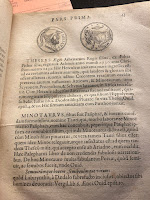
[The emperor Tiberius depicted in the Illustrium Imagines and a gold aureus issued in 16 CE (image courtesy of the American Numismatic Society).]

The portrait artist (both Ugo da Carpi and Giovanni Battista Palumba have been proposed) has crammed many details into the tiny portraits: craggy wrinkles, exquisitely coiffed hair, and fierce or benign gazes. The inscriptions around edge of the coins, like the coins themselves, are sometimes genuine.

The Illustrium Imagines was widely imitated. Johann Huttich’s Imperatorum et Caesarum Vitae cum Imaginibus ad Vivam Effigiem (Lives of the Emperors and Caesars with Lifelike Portraits, published in Strasbourg in 1534; an earlier edition was printed in 1525) copied many portraits from the Illustrium Imagines, including those of Emperor Galba and his wife. Fulvio's version is below on the left, and Huttich's on the right.

Fulvio's portraits of the emperor Galba and his wife.

But Huttich also corrected many of Fulvio’s errors, added coins to which he had access, and included blanks in cases where he had no coins at hand, such as the empty space shown below where the emperor Leo's image should be. Book owners could draw in their own if they had them.


In the second half of the 16th century, the formula of coin with text was still popular. The French printer Guillaume Rouillé published his Promptuarium Iconum Insigniorum (Treasury of Portraits of Distinguished People) in 1553 (often reprinted; our copy is from 1578). Less concerned with historical accuracy – there are coins depicting Theseus and the Minotaur, for example, as seen below on the left – Rouillé’s work includes historical and contemporary people of note, like modern kings and men of letters. The images below on the right are his renditions of Renaissance luminaries Erasmus and Guillaume Budé.

Rouillé's images of Theseus and the Minotaur      Rouillé's renditions of Renaissance luminaries Erasmus and Guillaume Budé

Fulvio’s and Huttich books held great value for those interested in ancient coins. Rouillé’s has more of a general appeal. But perhaps the most important reason for the success of their books, and Rouillé’s, is the human desire to see (or imagine) what illustrious people looked like. And, of course, to make ourselves more virtuous.

In his preface to the reader, Rouillé suggests that the edifying effect of gazing upon such illustrious people could even result in the reader himself being immortalized in print: “Conduct yourself in this way,” he writes, “so that through the exceptional praises of your virtues, your likeness too might be deemed worthy of a distinguished place in future editions of this book.”

To see the Fulvio, ask for Rare N7585 .F8 1517; the Huttich, RareDG203 .H8 1534; and the Rouillé, Bryant CJ5569 . R73.

Further reading:

Cunnally, John. Images of the Illustrious: The Numismatic Presence in the Renaissance (Princeton 1999).

Haskell, Francis. History and Its Images: Art and the Interpretation of the Past (New Haven 1993).

Madigan, Brian. Andrea Fulvio’s Illustrium imagines and the Beginnings of Classical Archaeology (Leiden 2022).

Pelc, Milan. Illustrium Imagines: Das Porträtbuch der Renaissance (Leiden 2002)

Stahl, Alan. “Numismatics in the Renaissance.” Princeton University Library Chronicle 69.2 (2008), 217-240.

Weiss, Roberto. “The Study of Ancient Numismatics during the Renaissance.” Numismatic Chronicle 7.7 (1968), 177-187.

Published for Daniel Abosso, Subject Librarian (Baker-Berry Library).

Friday, February 16, 2024

Breaking Bread: The Development of Kosher and Halal Dining at Dartmouth

Brightly colored brochure advertising the Pavilion station and showing its location on a map

“[A] joint Halal-Kosher dining venture on campus … would significantly advance Dartmouth’s vision for its future.”

1999 was an important year in the history of food inclusivity at Dartmouth. President emeritus James Wright and the Board of Trustees introduced the Student Life Initiative (SLI) in February of 1999. The main goal of this initiative was to make Dartmouth’s campus more socially inclusive and welcoming, and administrative leaders found that centralizing dining and renovating campus dining facilities would help them achieve this objective. Jewish and Muslim student leaders similarly determined that the creation of a Halal-Kosher dining facility would advance the SLI’s inclusivity mission.

Jewish and Muslim students in the late 20th and early 21st centuries began working together to research the logistics for creating a Kosher-Halal-friendly dining option. They eventually formed a committee, which included the President of Dartmouth Hillel, the President of the Al-Nur Muslim Student Association, and former Dartmouth Rabbi Edward Boraz. This committee collaborated with Dartmouth Dining Services (DDS) to determine what was possible for the future of a more inclusive dining experience. The committee finalized their research in a report titled “The College Committee’s Report on Kosher and Halal Dining.”

Final page of the committee report on Halal and Kosher dining, signed by three committee members

The committee determined that a “dedicated dining facility that would meet the needs of Muslim and Jewish students” would “[e]nable those with religious dietary requirements to feel more at home.” It would “creat[e] a better sense of inclusivity for those who wish to observe these [religious dietary] laws.” Other students who do not follow these requirements would also benefit. A Halal-Kosher facility would “[a]dd to the array of dining options and thus encourage the development of cross-cultural interaction among students.”

In the late 90s and early 2000s, Kosher and Halal dining options at Dartmouth were flawed, limited, or non-existent. The student committee reported that “there [were] no Halal products presently available.” Committee leaders acknowledged the efforts of DDS and Hillel but relayed that “existing facilities [did] not satisfy orthodox standards of Kashrut.” Barring “religious holidays and Friday evening services, Kosher dining [at Dartmouth was] marginal at best.” Dartmouth offered “Kosher sandwiches and microwavable dinners,” but the use of non-Kosher products in microwaves “render[ed] both the microwave and food subsequently warmed in it to be unfit.”

Students adhering to Kosher policies faced additional barriers during religious holidays, despite the Roth Center for Jewish Life serving Kosher-compliant food. Dartmouth Hillel, in response to the “increased demands for improved quality and greater supervision” of Kosher food, “retained Andrew Wiener Catering Service of Boston, an orthodox certified kosher caterer, to provide meals for Rosh Hashanah, Yom Kippur, and post-fast meals.” However, the “dramatic increase in costs” forced Dartmouth Hillel to “charge half of its cost to the students’ meal plans.” In other words, there were economic obstacles that made dining less accessible for students with certain dietary needs.

Dartmouth administration, working towards inclusivity, began focusing on resolving these issues and accommodating more dietary needs. A Student Life Initiative planning document shared that in November 2000, the College announced that “‘Muslim and Jewish students forge[d] a ground-breaking agreement for a joint Halal-Kosher dining facility’ to be located in Thayer Hall.” This dining facility would later become known as the Pavilion, which still serves Kosher and Halal food options today. The SLI document also stated that College leaders advocated for this dining outlet’s placement in the Collis Center, Robinson Hall, or Thayer Hall: they found that it should reside in a “primary campus dining venue.” Administrators wanted those with these dietary requirements to feel fully integrated into the campus community. This indicates the College’s efforts to make dietary needs — and religious identities — welcome at Dartmouth.

To read the “The College Committee’s Report on Kosher and Halal Dining,” visit Rauner Library and request “The College Committee's Report on Kosher & Halal Dining” in Box 30887 from collection DA-798. For access to the Student Life Initiative planning document, ask for folder “SLI Social Dining” from Box 30373 from collection DA-8.

Posted for Thomas Corrado '25, recipient of a Historical Accountability Student Research Fellowship for the 2024 Winter term. The Historical Accountability Student Research Program provides funding for Dartmouth students to conduct research with primary sources on a topic related to issues of inclusivity and diversity in Dartmouth's past. For more information, visit the program's website.

Friday, February 9, 2024

Fill the Bowl Up?

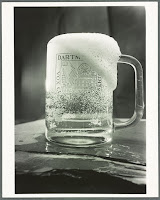
Glass beer mug with Dartmouth seal etching"If every dormitory man had one identical piece of personal furniture, it was a beer mug."

In 1975, Norman Carpenter '53 was living in Minneapolis and working as an attorney when he decided to write back to his alma mater and raise the alarm about alcohol use at Dartmouth. Carpenter had been receiving treatment for alcoholism for nearly a year when he opened the 1975 Alumni Bulletin Newsletter. He noted with a new "sensitivity" that the commencement and reunion events seemed to all revolve around alcohol consumption. In response, Carpenter wrote to the alumni magazine to share his story and concern for the Dartmouth community's relationship with alcohol.

Carpenter conceded that there was no "hard evidence" that Dartmouth is where he developed a drinking problem. However, after starting treatment for alcoholism in 1974, Carpenter noted an outsized incidence rate of other Dartmouth men and spouses seeking treatment as well. Going back to his Dartmouth experience, Carpenter remembered efforts taken by the administration to limit alcohol use, like a restriction on cup size and restrictions on the times alcohol could be served in fraternities. Still, Carpenter claimed "the strong impression on an immature underclassmen was that acceptance on campus depended upon the ability to imbibe ethyl alcohol. Even among the less impressionable it must have seemed that drinking was integral to the social process, more especially at Dartmouth than at similar colleges." From there, the message of the letter was clear: "...if anything was missing at Dartmouth it was hard facts about alcohol."

While hard facts about alcohol were missing from Carpenter's Dartmouth experience, there was no shortage of drinking mythology to guide students' attitudes. In the alumni magazine, Carpenter's letter appears under the title "Fill the Bowl Up?," a reference that would have been instantly understood as a nod to alumnus Richard Hovey's song Eleazar Wheelock:

Eleazar Wheelock
Oh, Eleazar Wheelock was a
very pious man; He went into the
wilderness to teach the Indian,
With a gradus ad Parnassum, a Bible, and a drum,
And five hundred gallons of New England rum.
Fill the bowl up!
Fill the bowl up! Drink to Eleazar
And his primitive Alcazar
Where he mixed drinks for the heathen,
In the goodness of his soul.

In October 1976, the letter was reprinted in The Dartmouth under the name "No son-of-a-gun for beer," a nod to another quintessential Dartmouth drinking song:

A Son of a Gun
I wish I had a barrel of rum and
sugar, three hundred pound;
I'd put it in the College bell
and stir it 'round and 'round,
Let ev'ry honest fellow drink
his glass of hearty cheer,
For I'm a student of old
Dartmouth and a son of a gun for beer.

In the 1970s, these songs were popular and well-known. While historians agree that Wheelock arrived to Hanover with rum, there's no reason to believe he had 500 gallons. This type of embellishment reinforced Dartmouth's drinking mythology for nearly a century, and typified an environment where manliness was conflated with drinking.

After Norman Carpenter’s words were aired through The Alumni Magazine and The Dartmouth, a series of campus events highlighted discussions surrounding alcohol use and the role of fraternities on campus. The film Animal House, written by Dartmouth '63 Chris Miller, was released in 1978 and brought a national spotlight down on the fraternity system at Dartmouth. Only a week after Animal House aired on campus, Dartmouth faculty famously voted nearly unanimously to abolish Greek Life on campus. Spearheaded by English Professor James Epperson, charges were levied against the Greek system on the basis that fraternities perpetuated a culture of sexism, racism, homophobia, anti intellectualism, and alcohol abuse.
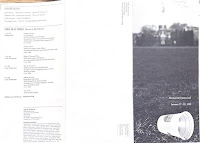
One side of a pamphlet for a 1982 "Alcohol at Dartmouth" conference. The cover shows an empty Dartmouth-branded plastic cup lying on the Green in front of Baker Tower.
The Board of Trustees voted against abolishing the Greek system with the provision that fraternities clean up their act, and a slew of committees were established to study the role of Greek Life on campus. One such committee was the Alcohol Concerns Committee, chaired by Steve Nelson (director of Student Activities at Collis). In January 1982, the Alcohol Concerns Committee held a three-day alcohol awareness conference. As part of the coverage for the conference, The Dartmouth published a profile on Norman Carpenter, claiming that his letter was a "major impetus for the formation of the Alcohol Concerns Committee." One of the capstone events of this conference titled "Alcohol at Dartmouth" was a panel of Dartmouth alumni who were recovering alcoholics, including Norman Carpenter and Chair of the Dartmouth Board of Trustees Sandy McCullough.
Detailed listing of events from the "Alcohol At Dartmouth" pamphlet.

In Norman's original letter, he wrote that he had no intention to "embark on a messianic course to reform" Dartmouth. Instead, he opened his story to the community to ask if it's Dartmouth's responsibility to educate students about the dangers of alcohol abuse. Years later this aim was realized.

To read more about the Epperson proposal, request box 8181 from the Office of Residential Life records (DA-670). To read more about the history of alcohol use on campus, request Rauner Vertical Files "Drinking I" and "Drinking II" (DA-857).

Drinking Songs found on the Dartmouth Review Website "Lost Songs of Old Dartmouth" (https://dartreview.com/lost-songs-of-older-dartmouth/).

Posted for Spencer Mancuso '25, recipient of a Historical Accountability Student Research Fellowship for the 2024 Winter term. The Historical Accountability Student Research Program provides funding for Dartmouth students to conduct research with primary sources on a topic related to issues of inclusivity and diversity in Dartmouth's past. For more information, visit the program's website.

Friday, February 2, 2024

A Donkey in the Chapel and a Pig on the Train

Newspapers illustration of donkey on stage with a studentNo one knew how the donkey had gotten into the chapel. But there it was, standing near the center of the platform, tied securely.

This storied incident took place one afternoon in the spring of 1888. In those days, the Dartmouth chapel was reserved on Wednesdays for a mandatory, school-wide meeting to hear the seniors perform their original oratories. This particular Wednesday, a live donkey had joined in on the presentations.

 Students could tell something was afoot even before they reached the chapel: as W. A. Charles, class of 1890, recounted, “cheers and loud laughter,” emanated from the hall. By the time W. A. Charles entered, the speakers and the English professor were seated on the platform, next to the animal. The only one missing was President Bartlett, who usually arrived at the last chime of the bell.

Newspaper article by W. A. Charles about Donkey on stageWord spread that the president was approaching the building, and the cheers died down. Bartlett entered, and the students stood, watching him ascend toward the podium. Then he caught sight of the donkey. There was a pause; a moment of hesitation. William A. Bartlett, class of 1882 (no obvious relation to the Dartmouth president), wrote, “The president and the animal regarded each other amicably.” Then, reports W. A. Charles, “the students broke into tumultuous yells and cheers.”

What happened next has been blurred by history. One version claims that the president said calmly, “Gentlemen, excuse me for disturbing your class meeting,” and then departed. As William Bartlett chronicles it, the president took the list of speakers in his hand and remarked, “As I call the names you may come up and stand beside your brother and declaim.” W. A. Charles’ remembers an entirely different version: in his account, the president held his hand for silence and then told the crowd, “I perceive one of the classes has lost a brother.” This, of course, provoked a “burst of applause” from the students.

Charles claimed that the speeches went on as usual, the seniors standing right next to the donkey: “whenever a hand was extended as a gesture, the donkey would stretch forth his head, apparently thinking he was to receive some food from the outstretched hand. The student would quickly withdraw his hand and sidestep a little, not knowing what the donkey would do, and of course at every opportunity the student body burst into wild laughter.” The speaker struggled through his oration, the donkey occasionally swished his tail or moved his head, the English professor sat quiet and sour, the audience eagerly awaited an occasion to erupt into giggles, and President Bartlett, by all accounts, never stopped smiling.

Over the next several decades, other animals would be roped into student pranks. According to The Dartmouth, a flock of turkeys was led into the chapel; horses, donkeys, and cows were left in Dartmouth hall; one skunk was hidden in an instructor’s desk; and another skunk–dubbed “Stinky”–was paraded around town, the pet of a student in the class of 1942.

The cleverest of animal “pranks” came in October of 1915. A group of Dartmouth students had been trying to find a cheap way to attend the upcoming away football game between Dartmouth and Amherst. According to the Washington Evening Star, the Interstate Commerce Commission “refused to allow students to ship themselves as livestock on freight trains,” which would have been cheaper than travel by passenger train.

But there was an exception for people caring for livestock. The students devised a plan to ship a small pig on a “special car” to Amherst, with “as many students as possible as caretakers.” If there was enough interest, wrote the Washington Evening Star, another pig would be bought and shipped in a second car.

"Rooters to Ride as Caretakers for Pig," Washington Evening Star, October 27, 1915

No word on what happened to the pig when it reached Amherst, but I’d like to imagine it enjoyed the football game and was not part of the celebratory post-game feast: Dartmouth won, 26-0.

To read more, ask for the “Student Episodes, Pranks, and Diversions” vertical file.

Posted for Kira Parrish-Penny '24

Friday, January 26, 2024

White Sheiks and Flappers

First page of letter from Eastman to WahsburnPreparing for a visit from a delegation of the Osage Nation, we made a stunning discovery in our collection: a letter written in November, 1924, from the Osage reservation by Charles Eastman, Class of 1887, to Carl Washburn, Class of 1925. Eastman was a Dakota Sioux who became a physician after he left Dartmouth. He was a life-long advocate for Indigenous rights, and frequently acted as an intermediary between the U.S. Government and various tribal nations. In 1924, the Department of the Interior sent him to Oklahoma to report on the conditions of the Osage at the height of the oil boom.

His description mirrors the opening scenes of Killers of the Flower Moon. He describes the sudden influx of phenomenal wealth and its impact on the community. He is obsessed with the cars--limos everywhere and a car for every member of the family!

Black Gold letter excerpt

He also visits Rosa Hoots, the Osage woman who owned and cared for that year's Kentucky Derby winner, the aptly named "Black Gold." Then there is his concern with the predatory behavior he sees: dope dealers and bootleggers everywhere, and "white sheiks and flappers" trying to marry into Osage families for their wealth.


Part of what makes the letter so great is its informal nature. Eastman was writing to a young friend who he had helped to get into Dartmouth. This is not his official government report, but an opportunity for Eastman to express his own amazement and concerns. If you have seen the movie or read the book, you have to take a look at this letter.

To see it, ask for MS 924110.1.

Friday, January 19, 2024

A Medieval "Book of Roots"

Original leaf written in Sephardic script on the right (ff. 264v) later replacement text written in Yemenite script on the left (ff. 265r)The Kimḥi family of Provence was a celebrated medieval Jewish family of biblical commentators and Hebrew grammarians. Rabbi Joseph Kimḥi and his two sons Moses and David were each renowned scholars in their own right, but Rabbi David Kimḥi (1160-1235 C.E., commonly known by his Hebrew acronym "Radak") was the most celebrated of all.

Rauner recently acquired a manuscript of Kimḥi's Hebrew lexicon, Sefer ha-Shorashim (literally translated as "book of roots.") First composed in the late 12th-early 13th century, the Radak's Sefer was one of the most influential Hebrew dictionaries in the medieval period. The entries are arranged alphabetically around the three-letter shorashim, or "roots," common to most Hebrew words, with quotes from religious texts and explorations of etymology.

Our handwritten copy of the Sefer was likely produced by a Sephardic Jewish scribe in Southern France or Northern Italy ca. 1370-1430 C.E., more than a century after Kimḥi’s death. Most of the pages are written in a consistent Sephardic semicursive script, on laid paper common in parts of France and Italy in the late 14th and early 15th centuries. It is possible that this scribe, like the Radak himself, was a descendant of Spanish Jews (Sephardim) who fled persecution and settled in the French region of Provence, which during the Kimḥis' time was a flourishing center of Torah scholarship known as Hachmei Provence.

By the 16th century, our copy had found its way from Provence to Yemen, where a Yemenite Jewish scribe painstakingly copied missing leaves and added some of his own marginal notes to the Radak’s text. Subsequent Yemenite owners of this Sefer also proudly scrawled their names and statements of ownership on the first and last leaves of the tome. After all, to own such an old copy of this famous work would have been quite the status symbol, testifying to the owner's material wealth, as well as his intellectual gravitas.

If you can read Hebrew but are still struggling to parse this 18th century inscription, there's a reason for that. It is partially written in Judeo-Arabic, a dialect of Arabic historically spoken by Jews in Arab countries, written using the Hebrew alphabet. Luckily, the dealer provided a translation of the message, which includes a fabulous book curse:

"I merited to purchase this Sefer ha-mikhlol through the labors of my hands. May the blessed Omnipresent give me the privilege to immerse myself in it—I, my descendants, and my descendants' descendants until the last generation. Amen, so may it be [His] will. He who takes it and does not return it—may his name and memory be obliterated from the world, and may he be bitten by a snake. But may the nation of God dwell in peace. [Signed] the humble Joseph, son of our teacher Shuker al-Sarem, may his Rock and Redeemer keep him and may his end be good."


Joseph ben Shuker al-Sarem's 18th century inscription wishing book thieves a snake bite.

To see our copy of the Sefer ha-Shorashim, come in and ask for Codex 003515.