Friday, March 30, 2018

First Press in Vermont--at Dartmouth

Opening page of An Oration on Early EducationWe have been moving though a very old backlog of minimally cataloged books and manuscripts. Most of them have to do with local history or Dartmouth and were in a collection called "Vault 4," a location that no longer exists except in the memories of some long-time staff members. We stumbled on a real prize this week, An Oration on Early Education. Okay, the text is a bit of a snoozer; it was one of the 1779 Dartmouth commencement addresses but was printed in "Dresden" by Alden Spooner. Spooner had been brought to Dartmouth the year before to act as printer for the College and the town. He operated his press on the south end of Dartmouth campus for a little over a year, then he moved on to Windsor, Vermont. According to Ray Nash, who compiled a bibliography of Spooner's press at Dartmouth, this was the 32nd output of the press.

For a long time people thought the printing press Spooner used was the actual first press brought to the colonies--the same press that printed the Bay Psalm Book. That could be true, but there is no hard evidence to support it and many historians of early American printing doubt it. We do know it was the first press brought to Vermont and the press is now on display at the Vermont Historical Society.  Of course, when Spooner was printing at Dartmouth, he was technically in Vermont, or at least the folks in "Dresden" and Bennington declared it so during a territorial spat involving New York, New Hampshire, and Vermont. The campus and community flipped back to New Hampshire shortly thereafter.

To take a look at the florid prose of the Oration, ask for D.C. History LB2325.W663 1779. If you want to learn more about Spooner's press, the best place to start if Ray Nash's Pioneer Printing at Dartmouth, D.C. History Z209.H3N3.

Tuesday, March 27, 2018

Dartmouth's Unsolved Mystery

Headline article reading "Two Fire Companies, Volunteers Battle 5 Hours as Flames Gut Dartmouth Hall; Arson Hinted."For one of the most iconic buildings on Dartmouth's campus, Dartmouth Hall has quite the checkered history. If you've seen any of our other blog posts on the building, you know that it replaced another building that was demolished by students in the late-18th century, and that it burned down in 1904, only to be restored for a brief few decades of glory before burning a second time in 1935. Whereas the details of the building's destruction the first two times are known, the 1935 incident remains a mystery.

The 1935 fire began inside the building in the early hours of April 25th, and it took two fire companies and numerous volunteers five hours to wrestle the flames under control. The fire was supposed to have started in the basement, burning unnoticed until it began to spread through the ground floor and caught the attention of a student, who sounded the alarm. The fire quickly became dangerous, climbing through inaccessible shafts to the upper floors and, ultimately, the roof.

The fire wasn't the only thing to spread quickly, though, as rumors of arson began to sweep the campus like wildfire. Over many articles published in April 25th and 26th, bits and pieces of "evidence" began to accumulate: the fire had started conveniently at the base of a shaft that ran right up to the belfry - allowing the fire to cause maximum damage in minimal time. Several other fires were started in other buildings around the same time, including one in Beta Theta Pi, where the brother who discovered the flames claimed to have seen a figure fleeing the scene.

Photograph of Dartmouth campus with sites of fires marked, headline reads "Traveler Plane Covers Firebug's Trail."

A rash of articles suggested pyromania and questioned the possible motives of an arsonist, however, the College claimed to have found no solid ground for connecting the other fires lit on April 25 to the one in Dartmouth Hall. If anything, the College insisted at the time, the smaller blazes were some perverse prank on the part of a few students.

The file we have on the fire in 1935 mostly stops there. Other than the articles dating April 25th and 26th, there are only a few other documents, mostly focused on fundraising and plans for a restored building - this time to be made completely fireproof. Only one other article, dated June 2 and headlined "Clue Found to College Pyromaniac: School Authorities Admit Suspicion of Some Person in New Attempt to Destroy Buildings," suggests that the debate - and even the fires - may have continued.

To conduct your own investigation into this unsolved Dartmouth conspiracy theory, come by Rauner and ask for the Vertical File "Dartmouth Hall Fires and Rebuilding, 1935" - and while you're at it, check out some of the other files on the historic building!

Friday, March 23, 2018

Colonial Views of the Pearl River Delta


A water color painting of a Chinese junk on the ocean at sunsetThese stunning water-colors come to you from an unlikely source. The artist, Major General Henry Hugh Clifford, served in the British Army during the 19th-century imperialist campaigns. He was a combatant in the Xhosa Wars and the Crimean War and received the Victoria Cross, Great Britain's highest honor for gallantry in wartime, for his actions during the Battle of Inkerman.

A water color painting of Victoria Harbor in Hong KongWhile in Crimea, Clifford was appointed deputy assistant quartermaster-general; a few years later, in 1857, he was sent to China during the Second Opium War, which resulted in the capture of Guangzhou (Canton) by British forces in January of 1858. He returned to England in 1860 and resumed his upward climb through the ranks.

A water color painting of a street scene in Canton
Clifford, although a highly decorated military man, was apparently also an accomplished artist. During his brief time in China, he found the time to paint more than seventy water-color paintings of Guangzhou, Hong Kong, and the people who lived there during that period. To see more of southern China through the eyes of a British soldier, come to Rauner and ask for Iconography 1609.


Tuesday, March 20, 2018

Arms Robbery

Typescript list of materials bequeathed to Dartmouth by Corey FordWe were looking through a file on Corey Ford for some photos. Corey Ford, for those who don't know, was a writer, humorist, avid sportsman, local legend, and honorary member of the Class of 1921. The Rugby house is named after him--he was a beloved figure on campus for a couple of generations of Dartmouth students.

While looking for photos, we stumbled on a long list of things he bequeathed to the Dartmouth Museum--a five-page list that captures Ford's range of interests: big game trophies, coins, and lots of artifacts from around the world. In the "Historical" section shown here, there are candle molds, chairs, long-stemmed pipes, paper money, and one entry that caught our attention: "2 small flintlock derringers." That there were guns is no surprise, the worrisome factor was the handwritten note next to the entry that reads,"1 stolen, 1969."

We are guessing it was stolen between the time the materials were bequeathed and their arrival at the museum since this appears to be the work of a registrar, and the document is dated mid-November 1969.

Friday, March 16, 2018

Stimulating Reading

Typographic title page to Natural History fo Coffee, Chocolate, Thee, Tobacco.Most pamphlets published in the 17th century had the coffee-house crowd in mind as the audience. Coffee houses served as a kind of gentleman's forum for debate, and they would buy the latest tracts and have them available for their customers. These were the fodder for the political and social discourse that thrived in the coffee-houses. That is why we were excited to find this little gem. It is not an earth shaking polemic like one of Paine's tracts, but an almost self-referential pamphlet: The Natural History of Coffee, Chocolate, Thee, Tobacco (London, 1682). Added on is a tract on elder and juniper berries and another on making "Mum," an alcoholic drink made from wheat malt, oat malt and beans!

The favorite stimulants that get the lead billing were all still a little exotic in England. They were products of the New World or far off eastern lands. Their medicinal qualities are emphasized, surely making the gentlemen in the coffee houses feel enlivened by their good sense as they read, talked, and sipped.

Sorry, you can't bring your coffee or "thee" into Rauner, but you can enjoy reading about them by asking for Rare TP638.C53 1682.

Tuesday, March 13, 2018

Sealing Wax and other Fancy Stuff

Page opening from Thomas Chadbourne's medical recipe bookWe just bought a cool medical recipe book that was kept by Thomas Chadbourne, an early graduate of the Dartmouth Medical School (now the Geisel School of Medicine) who later set up practice in Concord. The notebook is from his days in Hanover and he attributed several of his recipes to Nathan Smith, founder of the Dartmouth Medical School.

While this is nice documentation of the early days of medical training at Dartmouth, it also says something about how doctors saved and organized information. Medical recipes were handed down from mentor to student, and kept for further reference. But the same recipe book that contains medicinal mixtures for "bone ointment," "whooping cough," and "cholera morbus" also has recipes for varnish and for sealing wax. In fact, the sealing wax recipe is right next to a note about the correct dosage of opium for asthma and other lung ailments. I guess that would be the "other fancy stuff."

This just arrived so it isn't cataloged yet, but it will be soon.

Friday, March 9, 2018

Accounting for Wheelock

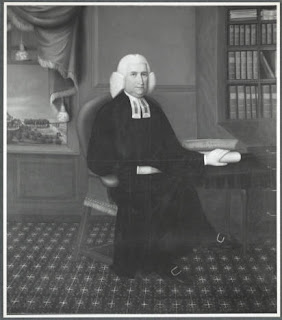
Portrait ot Wheelock at his deskNone of Wheelock’s biographers, nor any of the historians of the College, ever mention Wheelock’s youth, other than to note his piousness and his attendance at Yale. This may not be surprising considering how thin the documentation for this part of Wheelock’s life appears to be. The earliest letter by Wheelock in Rauner’s collection is from December of 1733 shortly after his graduation from Yale.

But lurking in Wheelock’s papers is an account book that details Wheelock’s debts and credits for the years 1726 to about 1752. This makes the account book the earliest documentation of Wheelock’s life created by him. It would appear that the account book has been overlooked for some 250 years. This is not really unusual; accounts and finances are often viewed as ancillary when it comes to the historical record and it is true they do not shed light on the thoughts and dreams of individuals the way a letter or a diary might. What accounts do provide is a picture of how businesses or individuals managed their affairs, how labor was compensated, and what work a particular person was engaged in. In addition, they can be used to trace purchasing patterns, or document the everyday activities of a particular person or business.

In the case of Wheelock’s account book, it reveals some surprising things about his early life.

Two-pae spread of Wheelock's account book
18th-century account books were laid out as a two-page spread with the debit column on one side and the credit column on the other. The debit side recorded money received, or at least owed to the owner of the account book and the credit side recorded money the owner of the account was paying out for services or goods.

Let’s start with an entry from 1726 in the debtor’s column.
to one quart of roume 2-6 tow yard chinse      1 4s 9p
to tow boys hats      15s
to tow yards of silk at     8p 6s
to one gallon of molasses     8s
The items listed are just a partial transcription of a much longer inventory and they reflect goods that Wheelock must have been selling to the individual named in the account. The account book for the years 1726 to about 1730 consists of hundreds of lists like this in the debtor column.

Page of Wheelock's account book
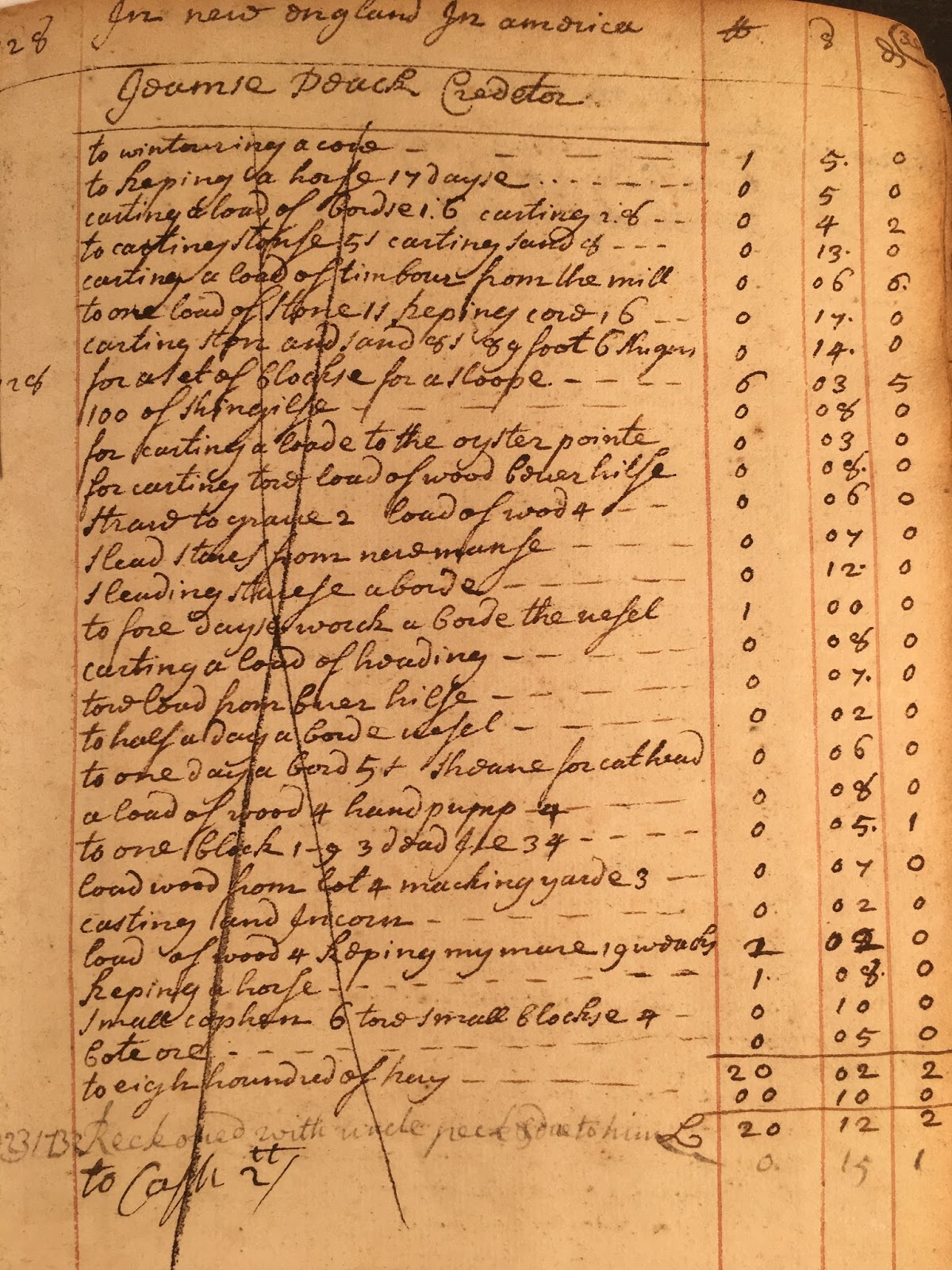
In the creditor column, we find evidence that indicates that the young Wheelock was running a sloop back and forth between New Haven and (possibly) Oyster Bay, New York. Entries from 1726 to 1730 reference purchases he made to outfit the vessel and payment to individuals who were working on board the boat. Entries such as this one:
Jeames Douck Ceditor
1728
for a set of blockse for a sloope
to fore days work a bord the vesel
a half day a bord e vesel
Wheelock, who was born in 1711, would have been a mere 15 years old in 1726. The account book indicates that Wheelock was in New Haven, Connecticut, during this time period. This places him away from home, which would have been his father’s farm in Windham, Connecticut, three years before he is said to have enrolled at Yale. New Haven, which is about 68 miles from Windham, would have been a long day’s ride, or more, by horse, so it is unlikely that Wheelock was commuting on a frequent basis.

So, what the account book tells us is that Eleazar Wheelock was living in New Haven engaged in the shipping and merchant business prior to and into the early years at Yale.

This is just one piece of the picture from this resource. Other evidence that can be derived from the account book include a sense of his income over time, how his activities changed when he entered the ministry, and how he made money off of slave labor, but those topics are for future posts.

To take a look at the account book, ask for MS-1310, Box 38.