Here in Rauner, there will be plenty of good cheer in December. Next week we will put up a small display featuring Christmas lore created by two Dartmouth alumni: Dr. Seuss's How the Grinch Stole Christmas and Robert May's Rudolph, the Red-Nosed Reindeer. Both stories--one a bit saccharine, the other more acerbic--are sure to put you in the spirit the of the season.
Friday, December 1, 2017
Getting into the Spirit
Here in Rauner, there will be plenty of good cheer in December. Next week we will put up a small display featuring Christmas lore created by two Dartmouth alumni: Dr. Seuss's How the Grinch Stole Christmas and Robert May's Rudolph, the Red-Nosed Reindeer. Both stories--one a bit saccharine, the other more acerbic--are sure to put you in the spirit the of the season.
Tuesday, November 28, 2017
Sated
Feeling stuffed after your Thanksgiving dinner? Our latest digitized collection, David Brainard's Diary, may make you appreciate that overly-full feeling. In 1881, Lieutenant Adolphus Greely led an expedition into the Arctic as part of the First International Polar Year. After a period of relative comfort and success, bad luck hit the expedition and they were forced to retreat southward to Ellesmere Island to await rescue. From March 1st to June 21st, 1884, young Sargeant David Brainard kept a meticulous diary. At the start, there were 25 living crew members; in the end, only six survived--most died from starvation (one was shot for stealing food from the others). At least some who survived resorted to "the last dread alternative," a euphemism for cannibalism.Brainard's diary, now housed here in Special Collections, elides the incidents of cannibalism, but he carefully documents the daily life and struggles of the crew as they slowly perished. Independent scholar Laura Waterman transcribed Brainard's diary and she has allowed us to put up her transcriptions side-by-side with the scanned page images. Laura also provided an essay that introduces Brainard's story and the diary. The diary is a harrowing read: Brainard had a talent for writing, and the diary puts you on Ellesmere Island with him. It will make this winter's weather seem like nothing, and it may inspire you to make good use of those holiday leftovers.
To see the actual diary, ask for Stef MSS-189.
Wednesday, November 22, 2017
For What We Are About to Receive
The fall term is almost done, except for perhaps a few final projects, and we are looking forward to the holiday season that will begin on Thursday. To get us in a festive mood for Thanksgiving, we looked through our various collections of Dartmouth student letters that are in the archives to see if we could find something suitable for the occasion. As expected, the archives did not disappoint. Among the numerous letters written to and by students, we found a great little note from Charles B. Sylvester, class of 1905, to his sisters at the family home near Haverhill, Massachusetts, north of Boston near the New Hampshire state line.
In the letter, written on October 29th, 1901, during his first semester in Hanover, Sylvester is quick to encourage his sisters to send him "a box for Thanksgiving, as good a one as you can, and we will have a spread." Although he won't be able to be
home for the holiday, he reminds them that he'll see them again a few weeks after Thanksgiving is over. The letter continues by relating various stories of college life, among them stealing a number of apples from an apple orchard and the prospect of sharing a large box of fudge with a friend. He concludes by asking his family to send him photographs and any local news.
Sylvester went on to be a well-liked teacher of mathematics and Latin and then principal at various high schools in New England. In his later life, he experienced multiple hardships, including the contraction of a serious case of polio in 1916 that left
him partially crippled for the rest of his life. In 1933, his wife of only two years, Eleanor Stonestreet, died while giving birth to their daughter, Nancy, and Sylvester went on to raise her as a single parent while continuing his work. As is so often the case with stories of our alumni, learning about their lives and their experiences never fails to inculcate a sense of admiration for their perseverance and a feeling of gratitude, or thankfulness (if you will), for the many ways in which we have been blessed.
To read through Sylvester's letters from his freshman year through his junior year, come to Rauner and ask for the Charles B. Sylvester Student Letters (MS-853).
In the letter, written on October 29th, 1901, during his first semester in Hanover, Sylvester is quick to encourage his sisters to send him "a box for Thanksgiving, as good a one as you can, and we will have a spread." Although he won't be able to be home for the holiday, he reminds them that he'll see them again a few weeks after Thanksgiving is over. The letter continues by relating various stories of college life, among them stealing a number of apples from an apple orchard and the prospect of sharing a large box of fudge with a friend. He concludes by asking his family to send him photographs and any local news.
Sylvester went on to be a well-liked teacher of mathematics and Latin and then principal at various high schools in New England. In his later life, he experienced multiple hardships, including the contraction of a serious case of polio in 1916 that left
him partially crippled for the rest of his life. In 1933, his wife of only two years, Eleanor Stonestreet, died while giving birth to their daughter, Nancy, and Sylvester went on to raise her as a single parent while continuing his work. As is so often the case with stories of our alumni, learning about their lives and their experiences never fails to inculcate a sense of admiration for their perseverance and a feeling of gratitude, or thankfulness (if you will), for the many ways in which we have been blessed.
To read through Sylvester's letters from his freshman year through his junior year, come to Rauner and ask for the Charles B. Sylvester Student Letters (MS-853).
Friday, November 17, 2017
Seeing Saint Petersburg
This week, we had a visit from a book group hosted by Norwich Public Library that was reading and discussing Fyodor Dostoevsky's Crime and Punishment. We pulled out all the stops for them, including a number of atlases from the seventeenth, eighteenth, and nineteenth centuries; an Everyman's Library copy of the novel that once belonged to the English poet Rupert Brooke; and several travel narratives about St. Petersburg in the 1860s.
One of these narratives in particular drew our interest: Spectacles for Young Eyes: St. Petersburg, by Sarah West Lander. The book describes the Russian city through the eyes of the Hamiltons, an American family whose father "has been sent as engineer to this strange country, where there were no railroads until recently, and the children came with him." The children promise to tell the reader all that they saw, if he or she will only listen. Alongside stories of brutal winters and frozen streets are a number of interesting images depicting daily Russian life in the beautiful port city.
This volume is one of a series of juvenile travel books by Sarah West Lander that totaled eight volumes in all and were centered on important cities around the globe: Boston (which is where our book was printed), St. Petersburg, Pekin (sic), Moscow, Zurich, Berlin, Rome, and New York. Not much is known about Lander other than she was born in Salem, Massachusetts. The series was very popular at the time and saw publication by a number of successive companies.
If you're willing to brave the recently chilly days here in Hanover, come over to Rauner and read more about what life in a Russian city was like over a hundred and fifty years ago. Ask for 1926 Coll L35. We also have the Boston, Moscow, Zurich, and Peking volumes, if you'd like to settle down for a long spell in our reading room. Just ask for them at the desk.
One of these narratives in particular drew our interest: Spectacles for Young Eyes: St. Petersburg, by Sarah West Lander. The book describes the Russian city through the eyes of the Hamiltons, an American family whose father "has been sent as engineer to this strange country, where there were no railroads until recently, and the children came with him." The children promise to tell the reader all that they saw, if he or she will only listen. Alongside stories of brutal winters and frozen streets are a number of interesting images depicting daily Russian life in the beautiful port city.
This volume is one of a series of juvenile travel books by Sarah West Lander that totaled eight volumes in all and were centered on important cities around the globe: Boston (which is where our book was printed), St. Petersburg, Pekin (sic), Moscow, Zurich, Berlin, Rome, and New York. Not much is known about Lander other than she was born in Salem, Massachusetts. The series was very popular at the time and saw publication by a number of successive companies.If you're willing to brave the recently chilly days here in Hanover, come over to Rauner and read more about what life in a Russian city was like over a hundred and fifty years ago. Ask for 1926 Coll L35. We also have the Boston, Moscow, Zurich, and Peking volumes, if you'd like to settle down for a long spell in our reading room. Just ask for them at the desk.
Tuesday, November 14, 2017
Trilbymania
When George du Maurier's Trilby came out in 1895, it took England and the United States by storm. "Trilbymania" struck, and the sensational novel introduced the world to the bohemian lifestyle--illustrated by du Maurier's drawings.Because the novel was first serialized, the publishers knew they had a hit on their hands. To cash in, they issued the regular trade edition plus an extra deluxe copy, numbered and signed by the author. We have copies of both, but our deluxe edition is even more special--it has a contemporary binding in sculpted leather by Cedric Chivers. The depiction of the character of Svengali as a spider descending on the unsuspecting Trilby is almost as creepy as the novel by du Maurier's daughter that would come out 43 years later.
To take a look ask for Sine D87Tril.
Friday, November 10, 2017
East of the Sun and West of the Moon
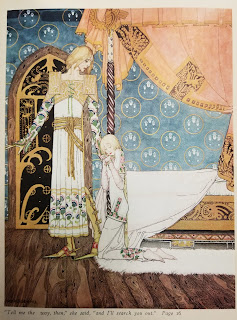
Even though many people today see fairy tales as nursery stories, folklore has a surprising and somewhat uncanny way of proving itself relevant and pervasive in human society. The titular story of this collection, “East of the Sun and West of the Moon,” is a Scandinavian fairy tale about a young girl who agrees to live in an enchanted castle with a talking white bear so that her poor family may become rich. Every night, a mysterious stranger comes and sleeps on the other side of the young woman’s bed, though she never sees who it is. Eventually, the young woman visits her family, and is persuaded to smuggle a candle back with her, so she can catch a glimpse of the person who shares her bed each night. When she does, she discovers that he is an incredibly handsome prince, but accidentally drips candle wax on him and wakes him. He laments that if she had held only out a year, he would have been free from the spell that trapped him as a white bear, but now he is instead doomed to be taken to live with his wicked stepmother, who is, incidentally, a troll. He can only tell the young woman that his troll stepmother is taking him to a place east of the sun, and west of the moon, before he and the enchanted castle are gone. Following this impossible clue, our young heroine undergoes a lengthy journey and multiple trials only to find him about to be married to the troll princess. Through some clever trickery, the young woman manages to meet alone with the prince, and together they devise some more clever trickery involving competitive laundry to free the prince from the trolls’ clutches, and allow him to marry our heroine. All the trolls are so angry that they explode, and everyone else lives happily ever after.But wait! This sounds oddly familiar…at first you were probably thinking “Beauty and the Beast.” Towards the end, though, you may have shifted more towards Greek mythology, and thought “Cupid and Psyche.” Indeed, “East of the Sun and West of the Moon” is remarkably like both stories, even though all three come from distinct cultures and periods of history. Finding common elements in fairy tales, or even almost identical fairy tales, in wildly distinct parts of the world is actually pretty common; some form of the story “Cinderella” has appeared in hundreds of variations around the world! Whether the universality of some of these stories hints at international trading of folklore and mythology, allowing these tales to travel globally as different societies intersect, or of some deeper insight these stories provide into the human experience that prompts them to arise out of cultures on different sides of the world, fairy tales seem to offer a depth of possibility worth exploring long after we leave the nursery.
Kay Nielsen’s stunningly illustrated East of the Sun and West of the Moon: Old Tales from the North, includes both this tale and other Scandinavian folk stories (many featuring trolls). Nielsen’s artwork lends an even more haunting feel to the fairy tales, evoking the stark yet unearthly beauty of the Scandinavian landscape. Whether these somewhat obscure northern stories resonate with the folklore you are familiar with or not, you may find something unexpectedly fun, fascinating, or profound within these pages. At the very least, you’ll be able to enjoy Nielsen’s striking illustrations! To see the book, come in and ask for Rauner Illus N554a.
Tuesday, November 7, 2017
Picturing David
A powerful man, a king in this case, lustfully looks down on a woman in her bath--a woman whom he will sexually molest. A powerful man, again a king, handing a letter to a man who will not be complicit in his sin--a letter that instructs the man's commanding officer to abandon him in the heat of battle and guarantee his death. A powerful man, penitent for his sins, composing psalms in praise of the lord, passages that are among the most beautiful in the Bible. This is, of course, the story of David and Bathsheba. What is fascinating here is the three very different ways David and his victims are depicted in these three 15th-century Books of Hours. But what is so troubling is how utterly poignant and timely all three are.
David was the hero of his nation and adored by his subjects. This is Michaelanglo's paragon of masculinity, larger than life, slayer of giants, father of Solomon, founder of the House of David and progenitor of Jesus. Yet, as so many have done through history, he took advantage of his power to abuse a woman, then killed a man to cover it up before being confronted by the prophet Nathan. He probably would have gotten away with it if that single courageous soul hadn't stood up to him.
These images constitute a base for constructing a usable past. They give us the opportunity to look back and find moments that we can learn from and build upon for productive use today. If we can trace an historical narrative, we can help to justify and argue for the social changes we want to affect. We can use the past to create the future we desire. This is the active, forward thinking form of the dire warning, “whoever forgets the past is doomed to repeat it.” Instead, we argue that "whoever looks to the past can create the future he or she wants." In this case, don't be complicit, instead take action and change the culture.To see it all for yourself, ask for Codex MS 001598 (lustful David); Incunabula 154 (vengeful David); and Codex MS 003141 (penitent David).
Subscribe to:
Posts
(
Atom
)


