Friday, September 1, 2017

Extra Illustrated Lincoln

SIgnature of Jefferson DavisIf you are a collector of stuff related to someone like Abraham Lincoln, how do you go about saving it and displaying it to its best advantage? A little scrap of paper with Jefferson Davis's signature is easy to lose, but it is likely to be one of the prizes of your collection. Framing it on the wall is a bit over the top, so why not tuck it into a book about Lincoln in an appropriate spot? Or better, bind it in, so it will never slip out and get lost.

That is exactly what one early 20th-century collector did. He took dozens of paper artifacts of Lincoln and had a copy of a finely printed Abraham Lincoln: A Biographic Essay disbound then reassembled with relics interspersed. There are images of Lincoln, scraps of manuscripts and other artifacts bound into the book.

Boradside concerning the Fugitive Slave Bill
Our favorite is a broadside issued somewhere in the northern states in response to the passing of the Fugitive Slave Act. It contains the text of the act, bordered in black to symbolize a nation in mourning.

"Black List" calling out Northern Congressmen who voted for the bill
But in the corner is a calling out of the votes cast in favor of the act by congressmen from free states, thirty in all. It is is like a precursor to social media shaming of elected officials for their votes--though here the social media was a piece of paper pinned to a board in a public place.

To see it ask for Rare E459.8 S37 copy 2. The broadside is in part 1, between pages 72 and 73.

Friday, August 25, 2017

The Demolition of Dartmouth

Opening stanza to Freneau's On the Demolition of Dartmouth CollegeFor one of the most iconic views of the College, Dartmouth Hall has quite a fraught history.  Though many people know that the old College Hall, as the building used to be known, burned down twice, few are aware that its first restoration actually occurred in the late 18th century, after students tore the structure down late one night. Ephraim Smedley, class of 1793, wrote in his diary that “The demolition of the old Hall happened on Dec. ye 3 A.D. 1789 about 7 o'clock in the evening there were seventy five of students, in number who combined for that purpose.” Apparently, the buildings were in such terrible shape that they were almost a danger to the members of the College. Work to restore the old College Hall had been frustratingly slow, and the students took it upon themselves to incentivize more rapid progress.

Interestingly, most of the story can be pieced together by looking at small references to the event in a number of different sources; Smedley includes only the one sentence in his journal entry for that day, instead focusing on the readings he had completed and other details of his schoolwork. Another letter similarly includes only one brief inquiry into the events. A student’s historical exploration of the history of Dartmouth Hall briefly recounts the students’ motivations for their “nocturnal visitation,” concluding that “not even the College officers were sorry to see it go,” and that the students’ actions had the desired effect of speeding up the restoration process.

Detail of letter to John Wheelcock asking about the destruction of the College
Our favorite retelling of the event is Philip Freneau’s poem “On the Demolition of Dartmouth College.” By no means the most reliable account (Freneau wasn’t even present that evening) it is certainly the most fun! Freneau adds some (possibly imagined) elements to the story, including the ringing of the College bells to call students to action, and an impassioned speech from the reluctantly awakened “reverend man that college gentry awes” that was largely ignored by students more focused on their mission. In a testament to its playful humor and clearly fantastically imagined nature, the poem concludes “So, three huzzas they gave, and fir’d a round,/Then homeward trudg’d—half drunk—but safe and sound.”

Closing stanza to Freneu's On the Demolition of Dartmouth College
To trace the story of the Demolition of the College Hall yourself, come in and ask for MS 789558, MS 790159, D.C. Hist. LD1440 D3 L4, and Val 815 F88 L2.

Tuesday, August 22, 2017

Dartmouth Republicans

A portrait of Amos Tuck taken in 1859, when he was 49 years old.
Last week we blogged about an influential Dartmouth alum, Salmon P. Chase, who was a member of Abraham Lincoln's cabinet as the Secretary of the Treasury from 1861 through 1864. He later went on to become the sixth Chief Justice of the United States. This week, we found a fascinating document connected to Chase hiding among the papers of another famous Dartmouth alum and lawyer, Amos Tuck. A member of the class of 1835, Tuck was elected to the New Hampshire House of Representatives in 1842. Originally a member of the Democratic party, he rejected their pro-slavery stance and was disavowed by the party. He then proceeded to run, and win, as an independent before gathering a convention to support an anti-slavery congressional candidate named John P. Hale.

This convention was the spark that was ultimately responsible for the creation of the Republican
Amos Tuck's naval commission signed by Abraham Lincoln and Salmon ChaseParty in New Hampshire. In 1853, Tuck convened a secret meeting of men who were opposed to slavery and suggested that they create a party called  the "Republicans." Following on the heels of this successful meeting, Tuck assisted in the formal creation of the state party in 1856. Soon after, he served as a delegate to the Republican National Conventions in 1856 and 1860. Some historians assert that Abraham Lincoln, a personal friend of Tuck, would never have received the presidential nomination if not for his efforts.

A portrait of an old Amos TuckAfter leaving politics, Tuck received a naval officer's commission and was stationed in Boston during the Civil War. Here at Rauner, we have the document itself, which was signed by both Abraham Lincoln and Salmon P. Chase. One wonders how much of the war really reached Tuck in Boston, although there were riots in the city in 1863 over the attempt to draft large numbers of Irish immigrants into the Union Army. Regardless, Tuck knew enough of the horrors of war to persuade his son Edward, who graduated from Dartmouth in 1862, to pay a fee to avoid being conscripted. After the war, Amos would go on to make a fortune in the railroad business; Edward would later use railroad stock to found the Amos Tuck School of Administration and Finance at Dartmouth College in honor of his father.

To learn more about Amos Tuck, come to Rauner and explore the Tuck Family Papers (MS-442) and Amos Tuck 1835's alumni file.

Friday, August 18, 2017

"Why I Must Say No, Again"

Front cover of the May-June 1960 issue of Rights magazine, including a photograph of protestors on the sidewalk holding signs with messages of support for Uphaus. In November 1950, Willard Uphaus, religious educator and executive secretary of the National Religion and Labor Foundation was invited to attend the World Peace Congress in Warsaw as a member of the US delegation. A committed pacifist, Uphaus had been warned that subversive elements, i.e. Communists "were cynically exploiting the passionate desire for peace to gain world domination" and that they would be dominating the Congress. Uphaus, however, disagreed. He knew that churchmen, like himself, would be there as well as many others who, despite being labeled "subversive," had a “deep and genuine desire for peace.” The Congress went well and at the end of it, Uphaus and others had the opportunity to visit Moscow through the Soviet Peace Committee. The trip was an eye-opener for Uphaus, confirming in him the desire to work even harder to foster American and Soviet friendship. Unfortunately, when he returned to the States he found himself "the spinning center of a tornado, one of the tornados spawned in the panic storm that culminated in what has become known to the world as McCarthyism."

An excerpt from the Saturday edition New Haven Evening Register, April 16, 1960, explaining who Dr. Uphaus is, what the World Fellowship is, and fundraising requests for the Fellowship and for Uphaus's legal fees.As a result of his trip to Moscow, Uphaus was forced to resign from the National Religion and Labor Foundation. He soon found another outlet for his peace activism when he became the co-director of the American Peace Crusade. Over the next several years he was “caught up in this great movement, with the war in Korea "lending a terrible urgency” to his cause. And then the World Fellowship of Faiths knocked on his door. Finding their mission completely in sync with his own, he and his wife became co-directors of the World Fellowship Center in Conway, New Hampshire in 1953. It was then that his trip to Russia came to haunt him.

The red and black cover of a publication titled "Excerpts relating to Willard Uphaus and World Fellowship Inc., from Subversive Activities in New Hampshire. Report of the Attorney General to the New Hampshire General Court. January 5, 1955.The case began with two critical articles about the Center in the Manchester Union Leader in September 1953; "Pro-Red Takes over New Hampshire Fellowship Group," proclaimed one. In response, New Hampshire's Attorney General Louis C. Wyman began to investigate the Center and in particular Willard Uphaus under the Subversive Activities Act of 1951. Uphaus was subpoenaed twice in 1954. During his second round of questioning he was asked to turn over the Fellowship's 1954 guest list and the correspondence with prospective speakers. He refused: "I told the Court that I could not in good conscience comply since doing so would be in violation of biblical teachings against false witness, our Bill of Rights which protects freedom of religion and assembly, and the teachings of my church against 'guilt of association'."
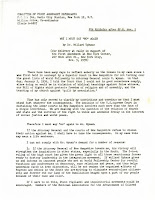
A press release by Uphaus for delivery at a rally in support of the First Amendment New York Center on Nov. 5, 1959. It is titled "Why I Must Say 'No' Again."
Uphaus felt that handing over the names "would make him a contemptible talebearer against people who, to his knowledge, had never done anything to injure the state or the country." For a while it looked as if the case could be resolved based on jurisdiction since Uphaus was a resident of Connecticut. However, on December 14, 1959, after several appeals, Uphaus was charged with contempt of court and sentenced to one year in in Boscawan Jail in Merrimack County, New Hampshire. He was released on December 11, 1960.

To learn more about Willard Uphaus’ legal fight and activism, his work with the Fellowship of Faiths, the National Religion and Labor Foundation, and the American Peace Crusade ask for the Willard Uphaus papers (MS-1077).

Tuesday, August 15, 2017

Delineating the Eclipse

detail from delineation of eclipse showing local time199 years ago, here in Hanover, a student displayed his mastery over mathematics and astronomy by delineating a solar eclipse as it would appear in Hanover on August 27, 1821. Unlike the total eclipse North America will experience next week, it was an annular eclipse, so there would have been a ring of fire around the moon as it almost blocked out the sun.

Document illustrating the angle of the eclipseBut like the eclipse next week, the one in 1821 would have only been a partial eclipse here in Hanover. The full force of it cut across the southern states as it moved out into the Atlantic. Event here in the North, it still provided a teachable moment that required computational and drafting skill. In this particular case, it was also an excuse to show off impeccable handwriting.

Detail of delineation of eclipse giving attribution to Nathaneal Cogswell
To view this solar eclipse, you don't have to travel far, just ask for MS 818416.1.

Friday, August 11, 2017

Vermont's Appeal...

Textual title page to Vermont's Appeal...well, this time of the year it is the weather and the blueberries, but Stephen Bradley had something different in mind in 1779. At the time, the newly independent states of New Hampshire, New York, and Massachusetts all had various claims on chunks of land in Vermont. It had not been one of the original colonies, but was being actively settled and contested, and of course was the site of several major Revolutionary War battles.

Inscription by Stephen Bradley to Colonel Sims of VirginiaBradley advocated for Vermont's standing as an independent state and the arguments laid out in this pamphlet were instrumental in Vermont's eventual admittance to the Union as the 14th state in 1790. Our copy is inscribed by the author to Colonel Charles Sims of Virginia, a lawyer with considerable political clout in the new republic whose support Bradley would need.

To see our copy, ask for McGregor 23.

Tuesday, August 8, 2017

The Attorney General of Fugitive Slaves

scribbled note by Salmon Chase reading "Can Congress make wrong right?" followed by his signature.
With Congress taking a break for August after a series of failed efforts to legislate, we thought the following note especially apropos. Written by Salmon P. Chase in 1873, it says very simply, "Can Congress make wrong right?" Chase famously was the Secretary of the Treasury during the presidency of Abraham Lincoln and will be familiar to anyone who has read Doris Kearns Goodwin's Team of Rivals: The Political Genius of Abraham Lincoln. After winning the election of 1860, Lincoln reportedly said, "The very first thing that I settled in my mind was that two great leaders of the [Republican] party should occupy the two first places in my cabinet -- Seward and Chase." At the time, Chase was a newly-minted United States senator from Ohio who had been one of Lincoln's chief competitors at the Republican National Convention.

A photograph of Salmon P. Chase seated looking off to the right with his hands folded in his lap and his legs crossed.Before Chase became Secretary of the Treasury and then Chief Justice of the Supreme Court, he was simply a local boy from Cornish, New Hampshire. The town, now associated with Augustus Saint Gaudens and the Cornish Colony, was originally settled by Chase's grandparents. When Chase was sixteen years old, he enrolled at Dartmouth College as a junior and graduated two years later at the age of eighteen as a member of the class of 1826. Eventually, he would move to Cincinnati and be pejoratively known as the "Attorney General of Fugitive Slaves" because of his fierce anti-slavery views and willing defense of fugitive slaves. He went on to organize the Liberty and Free Soil parties in Ohio and eventually became governor of that state.

Here at Rauner, we have a small collection of correspondence from Chase as well as an alumni file.
One of the letters, written to a Judge Smith in August of 1860, several months after Chase's defeat at the convention, states that he holds no ill will for any of the people who voted for Lincoln. Rather, he prefers "the triumph of the cause to the success of any body, whether myself or another." He goes on to say that "the characters and abilities of Mr. Lincoln " provide some measure of hope for the party and its goals. Roughly a year later, he would join Lincoln's team of rivals.

First page of letter from Chase to SmithSecond letter of Chase to Smith

To explore the Salmon P. Chase letters, come to Rauner and ask for MS-103. You can also have a look at his significant alumni file while you're here.