Friday, May 5, 2017

A Starry Messenger

Frontispiece to Galileo's Dialogo showing three characters in 17th century Italian robes in heated discussion Italian mathematician, astronomer, engineer, and philosopher Galileo Galilei played an incredibly vital role in the scientific revolution of the 17th century, especially through the publication of Dialogo sopra i due massimi sistemi del mondo (Dialogue Concerning the Two Chief World Systems). This work rigorously examines the astronomical observations of Copernicus and Ptolemy and seeks to answer the question of the true position of Earth amongst other celestial bodies in the universe – fixed at the center, or orbiting elliptically around the sun.

Although we take for granted that the latter has become established as the best-supported astronomical model for our solar system today, Galileo’s defense of heliocentric theory during the Roman Inquisition was met by enormous opposition from the Catholic Church and the papal administration. Found “vehemently suspect of heresy” for his Dialogue critiquing the geocentric view held by the Church via literal interpretation of the Holy Scripture, Galileo was forced to recant his support for heliocentric theory and condemned to house arrest for the remainder of his life.

However, his trial catalyzed an enormous scientific movement, which grew to champion empirical observation and experimentation in the pursuit of new knowledge, abandoning blind faith in the philosophies and idealizations of Greek and Roman antiquity.

The dialogue features an impassioned debate between three fictionalized characters as they critically analyze the merits and shortcomings of both hypotheses, providing diagrams, calculations, marginal notes, and an enormous wealth of conversational rhetoric to support their respective views.

Join the Dialogue by coming to Rauner to thumb through Galileo’s prose! Ask for Val 520 G133d.

Posted for Jerrel Catlett '18.

Tuesday, May 2, 2017

Case Study in a Fully Functioning Government

Situated remotely in Bretton Woods, New Hampshire, the Mount Washington Hotel opened its doors in July, 1902, boasting that it could accommodate "a family of eight hundred." Families could travel by rail or motor roadway to spend their summers in the White Mountains, “an ideal environment” that boasted weather “cool enough to enjoy outdoor exercise practically every day throughout the season.” Yet only three decades later, the Mount Washington Hotel experienced severe financial difficulties brought on by the Great Depression. Then, shortly after the United States entered the World War II, the hotel closed for several years. It reopened in 1944 under new ownership, but its future was uncertain.

It was in this context that an unusual group requested rooms for some 730 guests in the summer of 1944. But unlike most visitors, “mountain interests” were not of “first importance” to this group. Rather, these were delegates of 44 Allied nations gathering at Bretton Woods for the United Nations Monetary and Financial Conference. The express purpose was to construct the post-war international monetary system. In the words of New Hampshire Senator Charles Tobey, “We lived together for a little over three weeks, as we hammered out the Bretton Woods Agreements into shape. There before us was the world in miniature…”

As a delegate of the United States to the Bretton Woods conference, Senator Tobey was determined that international cooperation would serve two purposes in the post-war world. First, immediate financial assistance and lowered trade barriers would “create conditions in which” people living in war-torn communities across the world could “be secure, and prosperous and free.” The financial difficulties during the interwar period, brought on by the Great Depression and compounded by protectionist trade barriers, obstructed economic security. People whose basic needs were not met looked inward toward leaders who would protect national interest at the expense of global peace. Multilateral institutions could achieve this end. The World Bank lent money to nations afflicted by war and poverty for reconstruction, and the International Monetary Fund (IMF) set stable exchange rates for member states to coordinate monetary policies and prevent “economic war [from engulfing] the world.” Second, international cooperation and American engagement would underwrite global security for future generations. Along with other multilateral institutions such as the United Nations and North Atlantic Treaty Organization, the Bretton Woods system gave teeth to the lofty idea of “permanent world peace.”

At the conference, Senator Tobey and the architects of the Bretton Woods system were trying to avoid the mistakes of the First World War that failed to prevent the current global conflict. American leaders believed they could not “withdraw within" as they had after World War One. A new era of global politics would require American engagement rather than immediate retrenchment. Also, Senator Charles Tobey and other delegates to the Bretton Woods conference remembered when the United States Senate did not ratify the League of Nations charter nearly three decades earlier. American leaders recognized that President Woodrow Wilson, a Democrat, signed the charter’s death warrant in excluding Republicans from the negotiating process. In reaching out to leadership from across the aisle, President Franklin Roosevelt hoped to avoid this fate. Senator Tobey, a long time Republican, was instrumental in achieving his party’s approval of the Bretton Woods system. Treasury Secretary Henry Morgenthau confirmed this view when he wrote to Senator Tobey before the bill went before the Senate floor: “I know that your enthusiastic support of the Bretton Woods proposals will serve to promote non-partisan consideration… I fully appreciate the enormous efforts that you have made to keep this legislation from becoming a party issue.” Senator Tobey indicated his ready cooperation toward this achievement when he proclaimed, “The battle for the future of our whole generation is being fought in the Senate of the United States - the battle against both political and economic isolation.”

To learn more, ask for ML-3, Box 108. And for more goodies from Tobey's papers, see our blog post on Crackpots and Cranks.

Posted for Drew Leonard '19

Friday, April 28, 2017

Your Next Travel Dictionary: The All-in-One Guide for the "Speedy Learning of the Italian Tongue"

Frontispiece to Florio's Queen Anna's New World of Words. Floio is depicted in Elizabethan clothing in an oval frameIf you’ve ever wondered how to say “mouthful” in Italian, you might want to consult John Florio’s Queen Anna’s New World of Words, a hefty Italian-English dictionary written in 1611. There you’d be delighted to find that the 17th century Italians called it a “boccata,” which Florio translates as:
A mouthful, a mouthing. Also a word used when one is about to tell a thing and knows not what it is, or that a scholar would feign read his lesson and cannot, and we by some sign or voice would let him know that is out, and says he wots not what, we use to say Boccata, as in English, Tush, yea in my other hose, jump as Germans lips, and such other phrases.
What a mouthful! In defense of Florio’s verbosity, this definition is a significant improvement from the 1598 edition, which includes “you are as wise as a Waltam’s calf” as an acceptable alternative to “mouthful.” I hesitate to recommend the 1598 edition in fear that, if you did in fact call someone as wise as a Waltam’s calf, you might be accused of being behind the times. To avoid the unpardonable blunder of outmoded usage, the updated 1611 edition is the only way to go—and, what’s more, it comes with a complete guide to Italian grammar, which Florio borrowed (plagiarized) from his father! If it’s good enough for Queen Anne and the English cosmopolitan élite, it’s good enough for you. If you weren’t wondering how to say mouthful in Italian, Queen Anna’s New World of Words has 74,000 other fascinating Italian words, translated into beautiful, albeit long-winded, English.

John Florio, son of a Protestant Italian émigré during the Roman Inquisition, was a linguaphile, polyglot, translator, and high-profile language instructor who lived in London. His English translations of Montaigne’s Essays and Boccaccio’s Decameron from French and Italian are canonical, and his groundbreaking bilingual dictionaries confirmed his status as cultural mediator. He considered himself an Italian, though he never set foot on what today would be considered Italian soil. He snobbishly turned his nose up at English culture (not recommended for beginning travelers), which he considered barbaric and uncouth. Italian, in Florio’s day, was a sort of lingua franca, an all-access-pass to European culture and courtesy. Florio penned two dictionaries, two language pedagogy books (also recommended), and numerous translations, marking the beginnings of Italian language acquisition as a symbol of status and refinement in England. His dictionary is said to have influenced Shakespeare, who set many of his plays in Italy. Some scholars even suggest that Florio was Shakespeare’s ghostwriter—a rumor I encourage you to spread. Within the 700 pages of Florio’s tome (pocket-size edition not currently available), you’ll find risqué words collected from the Index of Forbidden Books, curse words, insults, numerous words to talk about dogs, food words (buon appetito!), idioms, and cultural insights: everything you need to keep your Italian hip… in a Baroque way. So the next time you need to say “mouthful” in Italian, check out Florio’s Queen Anna’s New World of Words, or just point and gesture like all the other tourists.

Quote from "To All Readers" section of the preface. "To be a Reader, requies understanding; to be a Critike, judgement. A Dictionarie gives armes to that, adn takes no harme of this, if it mistake not. I with thee both, but feare neitehr; for I stil rest Resolute. John Florio"
Ask for Rare PC1640.A2 F6 1611.

Posted for Joseph Waring '18

Tuesday, April 25, 2017

Audubon's Prospective Patrons

The cover page of Audubon's Birds of America prospectus: "Under the particular patronage and approbation of his most gracious majesty. Birds of America, from drawings made during a residence of twenty-five years in the United States and its territories by John James Audubon, citizen of the United States...
Tomorrow marks what would have been John James Audubon's 232nd birthday. Our copy of the famous naturalist's Birds of America, which once belonged to Daniel Webster, is the only item in our collection that is on permanent and prominent display in the Rooke Reading Room. Still, while the beautiful images of birds that fill this set of books are indisputably his most popular and memorable achievements, we here at Rauner hold another Audubon item that is a rarer bird than his well-known magnum opus. In 1826, Audubon had arrived in England to look for an engraver for his avian images. At that time, he began to give thought to the creation of a prospectus in order to advertise his book and acquiring dedicated subscribers to each successive number of plates. Audubon's plan was to create five numbers of five plates per year, for a total of twenty-five birds annually. Ultimately, he would issue four hundred and thirty-five plates over the span of eleven years.

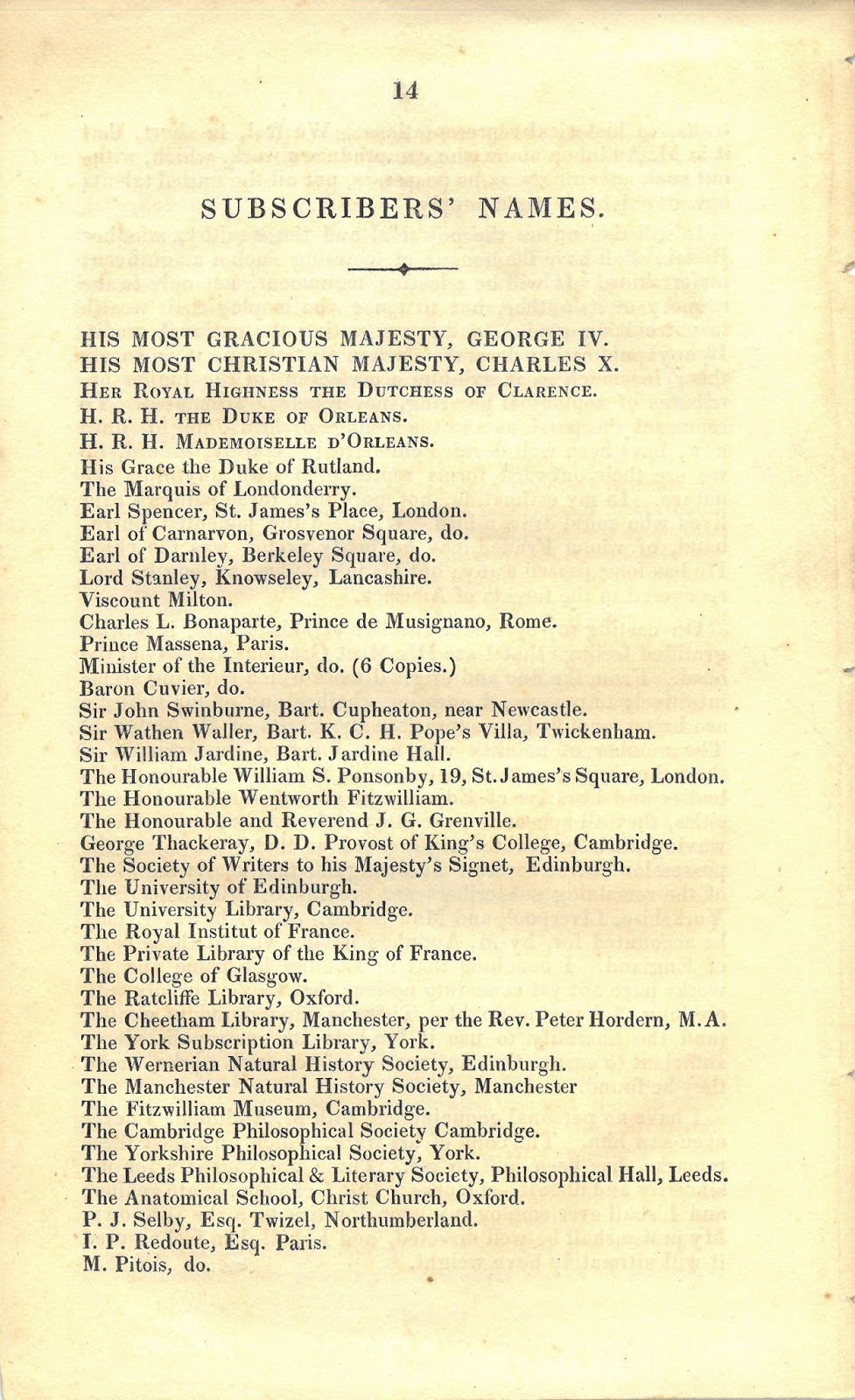
Page 14 of the prospectus, listing numerous subscribers to the publication beginning with George IV and Charles X.At present, there are one hundred and twenty known surviving copies of Aubudon's Birds of America. However, the prospectus is itself much scarcer. An old source, Waldemar Fries's The Double Elephant Folio (Chicago: American Library Association, 1973), states that at the time of its printing there were only sixteen known extant copies of the prospectus, which was published in six editions over the course of several years. Rauner's copy is not one that Fries lists so it must have surfaced some time between 1973 and 1993, which is when its online catalog record was created. Our version is the fourth edition, or Edition D, which wasn't dated but most likely printed in early 1829 after ten numbers, or fifty plates, and been printed and distributed. In the back of the prospectus, Audubon lists the current subscribers who include King George IV of the United Kingdom and King Charles X of France, as well as numerous university libraries such as Edinburgh, Cambridge, and Oxford.

To see Rauner's copy of the fourth edition of Audubon's prospectus, come in and ask for Rare Book QL674 .A9 1827a. To see Audubon's Birds of America, walk into the Reading Room and take a look in the glass display case. For a special treat, come by on Friday mornings when we turn the page to reveal the new bird for the week (we call it the Friday Fowl).

Friday, April 21, 2017

Wheelock's Demise

Image of Eleazar Wheelock. He is older, with grey hair and has on a dark cloth shirt with a white tie. Historians agree that Eleazar Wheelock met his end on April 24, 1779, but that’s about where agreement ends. Some record his age as 68 and others as 69. Most simply skip over the details and only report the date.

David McClure, the most contemporary of the writers, in his 1811 Memoirs of the Rev. Eleazar Wheelcok, D.D. Founder and President of Dartmouth College, is the only historian to provide any detail. He notes that at the beginning of April 1779, Wheelock’s health went into rapid decline. From there McClure paints an almost perfect bedside death where Wheelock, surrounded by family, declares that he does not fear death, repeats the 23rd Psalm, and expresses a desire to “depart and to be with Christ.” He records Wheelock’s last words, as “Oh my family be faithful unto death.” He then notes that Wheelock “expired without a struggle or a groan. The peace and joy of his mind, in the moment of death, impressed a pleasing smile on his countenance.”

Image of handwritten title page to Dewey's notebookThis is how death was supposed to play out in the 18th century, particularly for a devout man of the cloth like Wheelock. But is this really how he died? Until earlier this year, we had no reason to think otherwise, but recently a staff member discovered an alternative account while researching deaths in Hanover. This alternative account was recorded by William Worthington Dewey. According to Chase’s History of Hanover and Dartmouth College, Dewey arrived in the area at the age of two years in 1779 when his father, Benoni Dewey, came here to run the blacksmith shop. William W. Dewey appears to have run a temperance house for a period of time, built several local houses and may have been a farmer. In addition to these varied trades, he also had a strong interest in local history that tended toward the macabre. During his lifetime, he compiled a set of notes of deaths in Hanover and the surrounding area. One of the first death’s he discusses is that of Eleazar Wheelock. Dewey’s description of Wheelock’s last moments was clearly gleaned from his father. Here is his father’s account:
His decease was instantaneous. About 9 O Clock AM He was at my Fathers shop in apparent good health & took from thence an article for a Goldsmiths use & went & deposited it on the western side of the common & without stopping took a borrowed saddle & carried to another house some forty rod distant & carried it to the attic && returning on the stairs remarked that he was faint & dropped down & never breathed afterwards – A very few minutes only intervened from the time he that left our house & the news of His decease.
Handwritten notation of above quotation on Wheelock's death from Dewey's notebook.
This rendition of Wheelock’s final moment stands in stark contrast to that given by McClure, but has, in its simplicity, the ring of truth. Unfortunately, until we discover another account that conflicts with or verifies one or the other of these versions, we will never be able to determine what actually transpired.

To read William Worthington Dewey’s account of Wheelock’s demise, or to just read his interesting account detailing the deaths of Hanover residents between 1769 and 1859, come to Rauner and ask to see MS-1264, Box 1, Folder 2: "List of deaths in the vicinity of Dartmouth College, including likewise the hamlet usually called Greensborough from AD 1769 to 1859"

Tuesday, April 18, 2017

A Magnificent Map

Map of Bermuda showing coastlne and divisions of the island into plots.At the height of the mid-17th century Golden Era of the Dutch Republic, a distinct cartographer by the name of Joan Blaeu surpassed the work of all his contemporaries (such as Janssonius and Frederick de Wit) by releasing the stunning Atlas Maior – an eleven-volume exploration of earth’s geography as it was known to Dutch merchants in the 1660s.

Blaeu’s impressive magnum opus adopts the typical stylistic aspects of Baroque-era excess and ornamentation. Its 594 hand-painted maps and illustrations, ostentatious two-foot vertical dimension, and effusive Latinate braggadocio amounted to the most expensive and physically largest book of the entire seventeenth century (with a modern equivalent price of about $18,000).

detail of Bermuda map cartouche shown Neptune holding his trident and an ship over a verbal description of the map.I analyzed the eleventh volume (the Americas) for a final project in Italian 23 (17th Century Italian literature), translating parts of Blaeu’s Latin text. Notable subjectivities and mercantilistic slants are evident both in the physical, cartographic representations of America as well as in his anthropological, textual descriptions: Blaeu had close ties to the Dutch West Indian Company and the lucrative business they conducted through what many modern commenters would consider exploitation of indigenous people.

The map of Bermuda offers a neutral example of such subjective distortion of reality. The shockingly accurate coastline of the fifteen-mile-wide Atlantic island is portrayed as lying a mere stone’s throw from the idealized American east coast, with “Virginia,” “Cape Cod”, and “New England” separately dragged hundreds of miles from their true position for conceptual emphasis of the island’s general relative location. A quaint juxtaposition of cartographic realism and subjective idealization results.

To see it, ask for volume 11 of Blaeu's Geographia, Rare G1015.B48 1662.

Posted by Paul Maravelias ‘17

Friday, April 14, 2017

From Bondage to Conscription

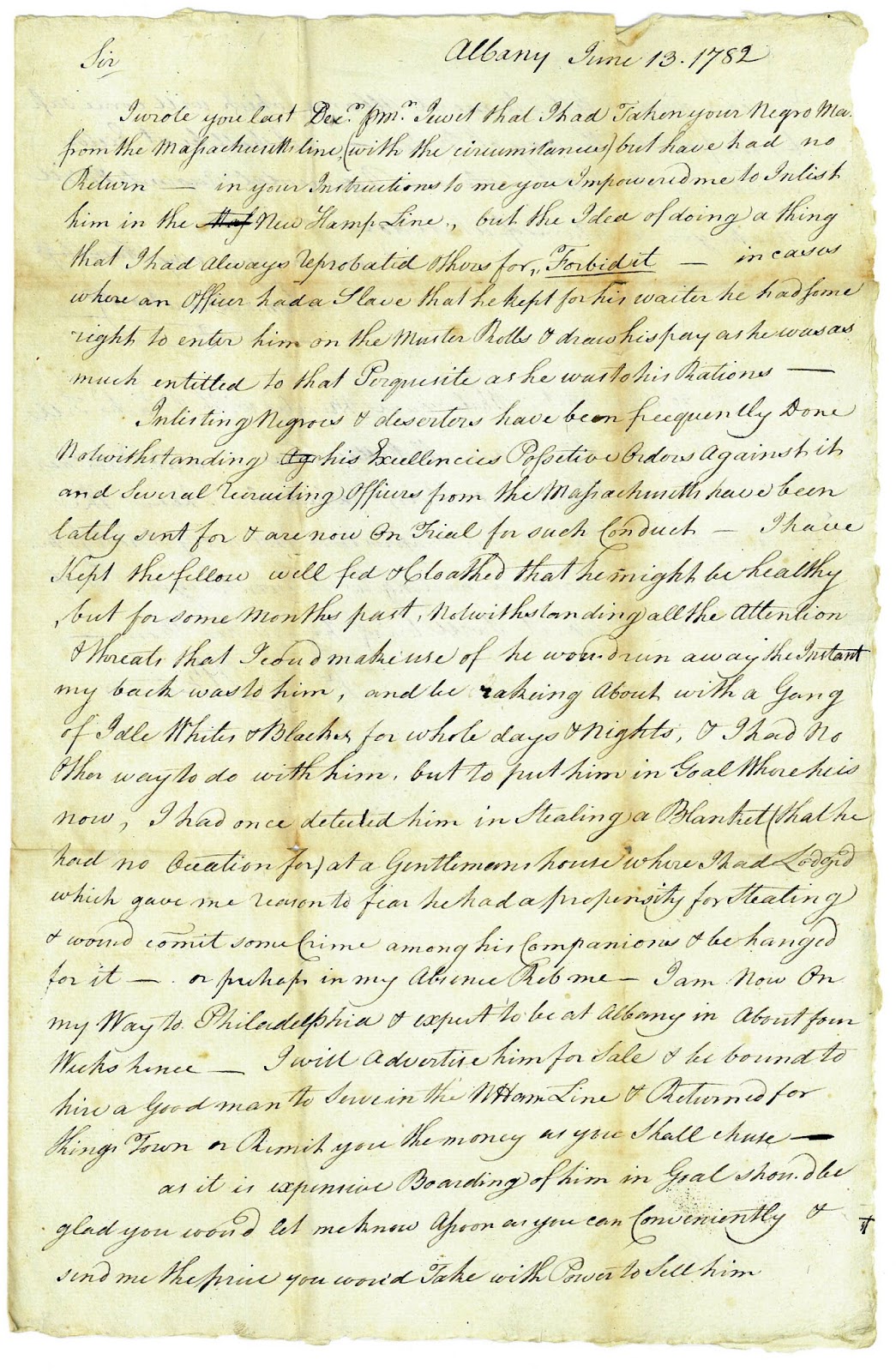
Letter; Blanchard to Bartlett; June 13, 1782; first pageOn June 13, 1782, James Blanchard, who had served in the 3rd New Hampshire Regiment as quartermaster and paymaster from 1776-1781, wrote to Josiah Bartlett, then a member of the New Hampshire State Supreme Court. In the letter Blanchard replies to Bartlett's request to have one of his slaves conscripted into the revolutionary forces: “in your instructions to me you empowered me to enlist him in the New Hampshire Line.”

The enlistment of slaves during the Revolutionary War was not unusual. New Hampshire enacted a law in the fall of 1777 that allowed owners to enlist their slaves as substitutes for themselves or their relatives or in return for their enlistment bounty. However, by the end of 1777, Congress, in an attempt to appease southern slave owners, discouraged this practice. On the loyalist side, Lord Dunsmore, the royal governor of Virginia had enacted a law in April 1775, that promised slaves owned by rebels their freedom if they fought on the side of the British. 

Blanchard was not happy about Bartlett’s request “of doing a thing that I had always reprobated others for.” Instead he tells Bartlett that he should sell him because Blanchard believed the slave “had a propensity for stealing.” Throughout the letter, the name of the slave is not revealed. However, in a postscript he is referred to as Peter, which is interesting because two years later there are two additional letters from Blanchard to Bartlett regarding the escape of a slave named Peter. In those insistences, Blanchard, tasked by Bartlett to recover said Peter, relays a saga that involves Peter being illegally sold by some shadowy characters to a man “at Livingston Manor … by the name of Alkenburg (a Tory),” and then declaring himself a free man. Blanchard informs Bartlett that during the course of his investigation, he had a “very considerable expense in employing men to look for the black dog,” and that he plans to sue the Tory and the other men involved, one of whom he calls “an itinerant horse Jockey.”

Letter; Blanchard to Bartlett; April 12, 1784; first pageLetter; Blanchard to Bartlett; May 8, 1784; first page

Unfortunately, we may never know what happened to Peter, but Blanchard became an advocate for veterans, serving as agent for several veterans pursuing claims against Congress. Josiah Bartlett, who was a signer of the Declaration of Independence, became the 4th Governor of the State of New Hampshire.

Blanchard's letters to Bartlett are contained in a small but rich collection of letters that are part of MS- 181, the Josiah Bartlett papers. Other correspondents include Bartlett’s co-signer of the Declaration of Independence William Whipple, as well as John Langdon and Nathanial Peabody.