Friday, March 25, 2016

Envelope of Death

Postcard addressed to William M. ChaseMost of the time we work with old things here in Rauner. Sometimes it can get a little eerie, because the people who made so many of our books and documents are no longer with us, and, as one astute archivist once said, "their papers really are their last remains." We are pretty hardened to it, but the tales of woe and death sometimes get to us.

Postcard reporting death of "Clasmate Livingston"This week we opened up an envelope stuffed with postcards from the early 1900s. All of the cards were written to William M. Chase, Class of 1858 and College Trustee, from Samuel C. Beale, Secretary to the Class of 1858. Each card simply records the death of another classmate. Most are terse:
Grafton 30 Sept 1911
Classmate Livingston died at Peacham, Vt in Aug 1911.
Sam'l C Beane
or
Classmate Hayes. B.S. died Sept 28 1915 at his summer home in Madbury, N.H.
S. C. Beane
Sec 1858
A few show a little more emotion:
Our beloved classmate Chadwick died at his home Sat 11 of pneumonia. Funeral tomorrow, Tuesday. I have been asked to take part in the services.
Sam'l C. Beane
Grafton 13 March 1911
The matter-of-fact reportage of these and the sheer number is profoundly odd. Reported by one classmate, and saved as a packet of death by another, as each measured their days.

Tuesday, March 22, 2016

Serialized Hate

Mein Kampf in exhibition case
The German copyright for Mein Kampf (My Struggle), Adolf Hitler's autobiography and master plan, has finally expired, and German scholars have just released a critical edition. But we have a copy that turned Hitler's propaganda back on itself: an unauthorized, war-time translation for a wary British public fretting over German expansion to the East. It is part of our current exhibition Light and Shadow in the Thirties.

In the early 1930s, Hitler refused to authorize an unexpurgated translation, allowing only a few positive abridgments. As Hitler's policies escalated with the annexation of Austria and the invasion of Czechoslovakia, English-speaking audiences demanded a full translation. The publication history is long and complicated -- there was a lawsuit, threats, and, for translator James Murphy, a narrow escape from Nazi Germany.

Rauner has James Murphy's translation, issued by the London firm Hurst & Blackett in eighteen parts. Our copy was probably published during World War II. Each cover boasts that the proceeds will benefit the British Red Cross -- not Hitler's German publishing house Eher Verlag. Mein Kampf became a bestseller in English, even after the war's outbreak, as Britains sought to understand their enemy's convoluted and hate-filled ideology.

The pamphlets use Hitler's face on every cover and stock photos of German sites fill the interior pages, showing how cheap and popular books depended on photography to increase their intellectual and cultural cache. "Illustrated" was just another selling point, just like the "Binding Cases" advertised on the back cover.

For Rauner's Mein Kampf in parts, see Rare Book DD247.H5 A326 1939, currently on display in the Class of 1965 GalleriesThe exhibition comes down on April 3, 2016, as we install an exhibition by the first year seminar Anthropology 7: Values of Medicine.

To learn more about the publication history, check out James J. Barnes and Patience P. Barnes' Hitler's Mein Kampf in Britain and America: A Publishing History, 1930-39 (Baker Berry DD247.H5 A3426).

Friday, March 18, 2016

Churchilliana

Cover page - Military Aspects of the Continental ProblemIn 1911, Winston Spencer Churchill, then First Lord of the Admiralty, wrote a secret memorandum entitled Military Aspects of the Continental Problem in which he stated "a decision has been arrived at to employ a British military force on the Continent of Europe." Showcasing his "foresighted statesmanship," this document is only one of several in a small but robust collection of Churchill memorabilia given to Rauner in the 1990s by Frederick Forsch, Dartmouth Class of 1937. Forsch, a passionate collector of Churchilliana, had amassed one of the best private collections of Winston Churchill material that included letters to prime minister David Lloyd George, journalists Adam Marshall Diston and Henry Lucy, and many others as well as extensive correspondence with Admiral Sir Roger Keyes.

Churchill letter to "Sambo"Some of the letters are more personal, such as the one addressed to "Sambo," Churchill's Indian servant. In October 1899, when Churchill was twenty-four and on his way to cover the Boer War as special correspondent of the Morning Post, he responds to a request from Sambo "to come to the war" by advising him how to travel to South Africa. However, it appears that Sambo did not meet up with Churchill in the end, as there is no mention of him in any of Churchill's writings about that time.

Another exciting part of this collection is the pen and ink political cartoons of Winston Churchill by prominent cartoonist of the time, including Ernest H. Shepard, Sydney Strube, Edmund Dulac, David Low and Vicky, which appeared in the magazine Punch and the Morning Leader, Daily Express, Pall Mall Gazette and News Chronicle.

Adolf  in Blunderland cartoonA particularly good example is this cartoon by Baron Benjamin entitled Adolf in Blunderland which depicts Hitler as Alice, astonished at the pack of cards bearing the names of such battles as El Alamein and Naples rising up into the air, with Goebbels as the knave on the left and a be-swastika'd white rabbit in the front. The cartoon was published in the Egyptian Mail newspaper on November 6, 1943.

Two Historians CartoonThis cartoon by Ernest H. Shepard entitled Two Historians depicts Churchill seated at a desk engaged in writing. Besides the desk is the figure of Julius Caesar holding a volume lettered "De Bello Gallico." It appears that Churchill must be working on the second volume of The Second World War, as the first volume, The Gathering Storm, is already on the shelf. The caption reads, "Do you ever wonder what a treat this is going to be for the schoolboys of 4000 A.D.?"

H Bomb cartoon
Another cartoon by Benjamin entitled H Bomb, for a cover of Punch magazine in 1954, depicts Churchill as Punch seated pen in hand at an easel where Uncle Sam appears on the canvas. The cartoon satirizes the fact that in the House of Commons on March 30, 1954, then Prime Minister Winston Churchill made a speech supporting the United States' development of the hydrogen bomb.

To see these and other items in the collection ask for MS-788, the Forsch collection on Winston Churchill.

Tuesday, March 15, 2016

Typographic Humor

Cover to "The Advertiser's Typographic Manual"Typographers tend to be a humorless lot when it comes to matters of design, but they love to have fun with the ostentatious excesses of their craft. Case in point: display advertising and the adman's gimmicks.

This book, The Advertiser's Typographic Manual, which sports such an aesthetically pleasing gold-stamped cover, is from the book collection of Dartmouth's legendary Ray Nash. Nash founded the Graphic Arts Workshop (now the Book Arts Workshop) and trained generations of talented typographers in the basement of Baker Library. We opened the book to see what advice it had to offer would-be advertisers and discovered a completely blank book. At first we figured it was a publisher's dummy (a mock up for a book) but then saw what a good joke it must have been for Nash. The complete typographic knowledge of the advertising world could be summed up with a book that contained absolutely nothing. You can just picture Nash pulling it off of a shelf and handing it to a student interested in advertising, and saying "Here's all you need to know."

Interior "text" to Advertiser's Typographic Manual
Of course we could be all wrong--it could be a mock up for a book that never made it into print, and we are just reading into it an elaborate joke. But, really, why would Nash keep it?

We are still trying to figure out how to catalog this one, but when we do, we'll add a link to the catalog record so you can see it yourself. [August 23, 2016: we figured it out. Ask for Rauner Nash HF5825 N374 1940z].

Friday, March 11, 2016

Channelling Downton Abbey

The Ideal Home - Tea-Table settingThe doors of Downton Abbey are now closed forever. And if you, dear readers, are of a like mind to the present writer, you may be feeling a bit wistful and nostalgic for that lost world. But help is at hand and Rauner Special Collections Library has the perfect tome to help you channel the world of Downton in your very own home. The Ideal Home: How to Find It, How to Furnish It, How to Keep It, was published in London in 1914, so it is exactly contemporary to the beginnings of the Downton Abbey series (1912). It was written by one Matilda Lees-Dods, whose credentials are specified on the title page (Diplomee of the National Training School of Cookery, South Kensington, Certificated Teacher in Laundry Work, Dressmaking, Dairy Work, Poultry Rearing, and First Aid). At 976 pages (and eight pounds in weight) it is a very substantial volume indeed.

Thirty-eight chapters cover every possible aspect of the domestic arts. Some of our favourites are “How to Deal with Servants,” “A Chapter of Don’ts,” “Mysteries of Soup Making,” “New Fashions in Dinner Parties,” and the ever- so important “Carving and Serviette Folding.” One certainly would not want the serviettes folded in a less than perfect manner. Carson would not approve.

First aid, living within a budget, prices, food preparation, legalities, are all covered by Miss Lees-Dods.

The Ideal Home - Savoury of Shrimps With Tangerines

This manual is lavishly illustrated with lovely water colours, and practical black and white images.

One cannot help but wonder if Mrs. Hughes had her very own copy in the housekeeper’s office at Downton. One suspects she did.

The book came to Dartmouth thanks to the generosity of Edward P. Sine, Class of 1951, who amassed a large collection of illustrated books in different genres and on many different topics during his long years of collecting.

Ask for Sine Illus T28ide. And recreate a bit of Downton in your very own home.

Tuesday, March 8, 2016

J'Accuse...!

Frontpage of L"AuroreWe just acquired an original issue of L'Aurore from January 13, 1898: that is the issue with what must be one of the most famous headline's in the history of French journalism: "J'Accuse...!"  The article is Émile Zola's famous open letter damning the French government for its handling of the Dreyfus Affair. So much has been written about the importance of Zola's attack and the international protests it inspired, that we won't try to add anything here.

But, what is so cool about having the original artifact is the ability to see Zola's words in context. After all, it was just another day in Paris, and the mundane, while pushed off of the front page, is still well represented.
Announcement of motorcycle race
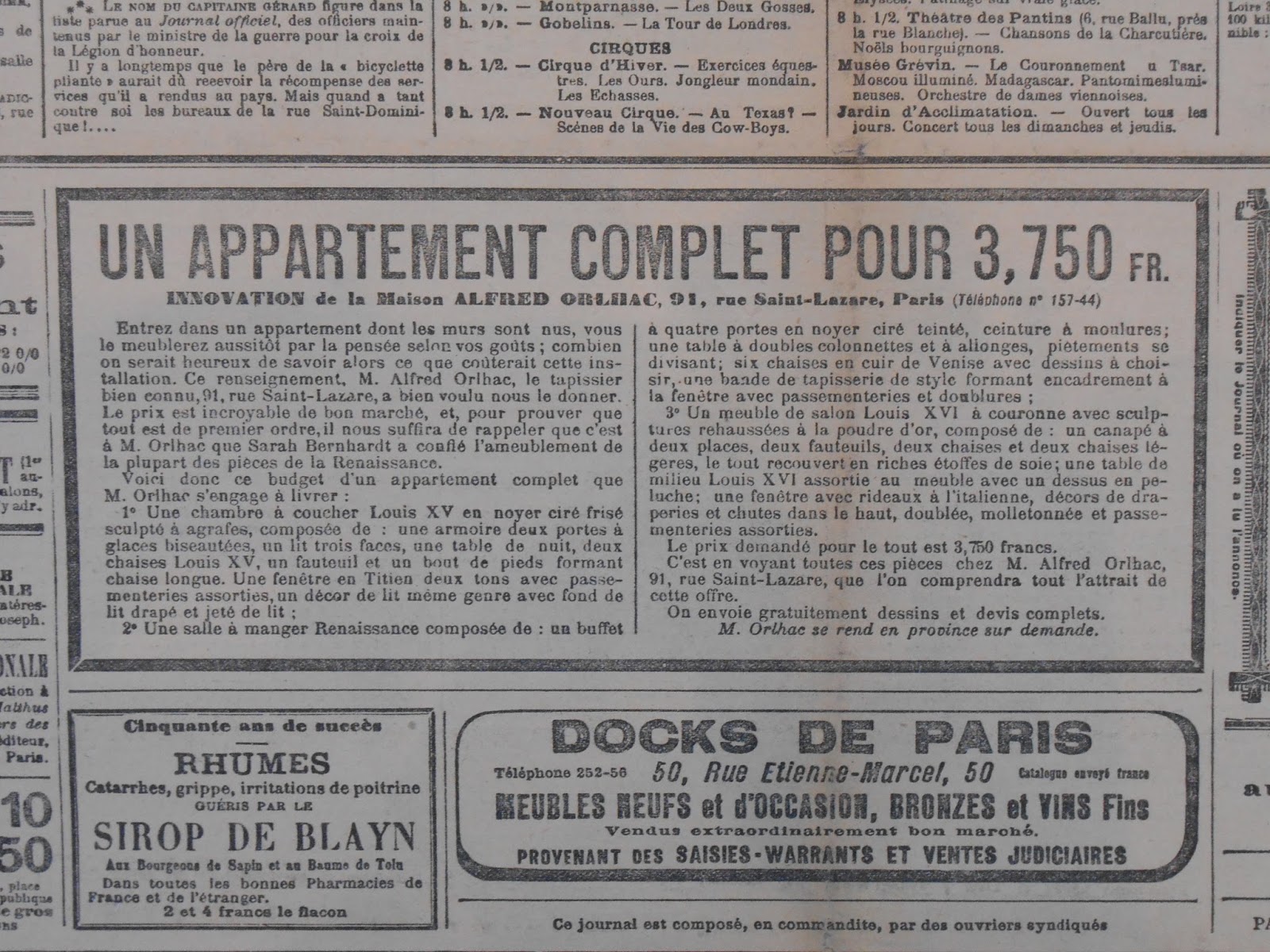
There are various announcements, reviews, news from the financial markets, a commentary on a bicycle race, and another on a motorcycle race. There are ads for booksellers, patent medicines, and a wine merchant. And, best of all, you could rent a well appointed apartment on the rue Saint-Lazare for 3,750 francs.

Ad for apartment for rent
To see for yourself, ask for Rare DC354.Z86 1898.

Friday, March 4, 2016

The Rise and Fall of the "Queen of Snows"

Carnival Girl from CosmopolitanLong before Dartmouth opened its doors to female students, coeds from up and down the East Coast flocked annually to the little village of Hanover to celebrate the culmination of the winter sports season. In a history of carnival by past DOC Executive Director, John Rand reported that for the first winter weekend in 1910, “nearly 50 fair guests were invited to Hanover for the occasion, and the Outing Club ball in Commons was a social triumph.”

Manuscript history of Winter CarnivalWhat began as an attempt “to awaken the campus from its winter hibernation…” snowballed into an intercollegiate competition hosting competitors and guests from around the world. Nearly thirty years after its founding, “From Nome to Norway by way of Ecuador, one thousand and ninety-nine girls flock[ed] to Hanover…” reported The Dartmouth in 1938.

The popularity of the weekend was in large part due to the social events, which accompanied the competitions. Musical concerts, skating exhibitions, and the opportunities for snowshoeing and hot cocoa almost effortlessly set the scene for weekend romances. The annual revelry became so popularized that in 1941 the short story, “Carnival Girl” by Isabel Moore was featured in Cosmopolitan Magazine. The love story employs the allure of Winter Carnival as the backdrop for a reunion of past lovers.

Ultimately, the highlight of the weekend was the crowning of the "Queen of Snows" during Friday’s Outdoor Evening. The event, a contest of beauty, kicked off the festivities and offered up an opportunity for the male hosts to ogle the girls that had been selected as the prettiest of all the dates. The “snatches,” aka members of the student body, were tasked with selecting the candidates upon their arrival to campus.
List of "Snatches"Fifteen Prominent members of the Dartmouth student body are selected to choose Carnival Queen candidates. Each man has three invitations to give out during Thursday and Friday...The girls selected... are interviewed and appraised by a Judging Committee consisting of students and honorary judges.
The objectification of women at carnival nonetheless proved thrilling for the hosts and at least some of their dates.

Photo of Winter Cranival Queen contestants

1972 Winter Carnival Queen and dateMargee Russell, a freshman at Colby-Junior College in New London, NH, called her crowning experience “the greatest thrill of my life.” Russell will go down in carnival history as the last queen in a 43-year long reign. The tradition, which began in 1928 died in 1972 at the 62nd annual Winter Carnival.

The onset of coeducation, shortly followed by the fielding of women’s winter sports teams contributed to the end of the old tradition and gave birth to a new competition based upon athleticism, skill and talent.

Dartmouth Women's Ski Team
The history of the queen competition, the sensation of winter carnival in popular culture and the rise of a new era of queens of the snow are featured in our exhibit, The Rise and Fall of the ‘Queen of Snows’: Women at Winter Carnival. The exhibit is on display in Rauner Library’s Reading Room from February 29th-April 15th.

To see the documents included in this post see:
DO-1, Box 6134 Dartmouth College Outing Club Records, Folder: “Carnival History
DO-1, Box 6142 Dartmouth College Outing Club Records, Folder: “Carnival Publicity”
“Carnival Girl.”,Rauner D.C. History PZ3.M789 Ca
“Winter Carnival Queens 1930s” photo file
“Winter Carnival Queens 1960s and 1970s” photo file
“ Skiing-Women’s 1970s” photo file