Friday, June 12, 2015

The Last Full Measure of Devotion

The cover for a miniature edition of the Gettysburg Addressed, positioned next to a paperclip for scale.In a belated recognition of Memorial Day (or, an early acknowledgement of the Battle of Gettysburg’s anniversary), I scrolled through the catalog in search of items related to the Gettysburg Address. After clicking on Lincoln’s Gettysburg Speech, I was surprised to see that the book only measured about 1.25" x 1.75". Curious, I decided to find out more.

This tiny text is the work of Bernhardt Wall, an American illustrator and etcher of the mid-20th century known for his quintessentially American postcards--usually lighthearted scenes of patriotism and cowboys. He was also a historian, interested in the biographies of interesting and impactful people, and he would chronicle his subjects’ lives in etchings. Wall was incredibly dedicated to his art--he handcrafted all 200 copies of Lincoln’s Gettysburg Speech himself, and he printed every page from an etched plate including the text. One can only imagine the patience it required to make so many tiny volumes, but Wall soon outdid himself--he went on to spend ten years etching an 85 volume pictorial biography of Lincoln.

A portrait of Lincoln.
With Lincoln’s Gettysburg Speech, Wall packs a lot of context into a tiny book. He prefaces the address with the invitation that Lincoln received to speak at Gettysburg, and he follows it with praise from publications like Harper’s Weekly, who called it “the most perfect piece of American eloquence.” Perhaps Wall’s most engaging additions are the illustrations--he intersperses the text with delicate etchings in black, brown and green ink. He not only includes scenes from Gettysburg, like the train station and the President speaking from the stage, but also other transcendent moments in American history, like the signing of the Declaration of Independence. On one particularly powerful page, in tiny lettering on an image of a graveyard, Wall highlights the central point of the Gettysburg Address and the holidays on which we remember it: “Remember the Hero Dead.”

With a book this small, you have to look closely and turn the pages slowly--which gives you the time to think carefully about the words and images inside. To see for yourself, ask for Miniature 121.

Posted for Emily Estelle ‘15 (Happy Graduation!)

Tuesday, June 9, 2015

Owners of the Green

A map with space marked "Governor's Lot" and "Doctor Wheelock."One of the anecdotes of the fragmentary oral tradition amongst Dartmouth students holds that the Green, while used by the College, is owned by the town of Hanover. This is often couched in a warning to first-year students not to be publicly intoxicated on the Green, lest they be arrested by the Hanover Police. However, a recent discovery in the meeting minutes of the College Trustee calls this assumption into question – it is quite possible that Dartmouth does, in fact, still own the Green.

A handwritten page.In 1770, New Hampshire governor Sir John Wentworth granted 500 acres of land to Dartmouth, of which the area now known as the Green was a part. The minutes from a meeting of the College Trustees in August of 1779 delineate the dimensions and location of this land. The record also includes a list of the lands “disposed of” by the College between 1770 and 1779 and who their specific recipients were. The first entry on the list concerns the “seven acres and a half opened for a green.” (Today, the Green measures 2.88 acres – documentation of the original boundaries of the space has yet to be uncovered.) It does not indicate a transfer of ownership from the College to any specific entity.

A handwritten page.Later Trustee minutes seem to confirm College ownership. The August 1807 meeting of the Board appointed a committee to “inquire into the propriety and expediency of taking up at the present time any part of the College green for the accommodation in the college.” Just a year later, they announced that the Green should be “plowed, leveled, properly seeded with grass,” and also to ensure that it is “handsomely fenced and suitably ornamented with walks and trees.” The most recent policy found in the Archives regarding use of the Green is from March 1986. It stipulates that the “College Green and campus grounds are reserved primarily for informal use… by students, faculty, staff, and guests of the College. Other events and activities will be limited to those staged primarily for the Dartmouth community and sponsored by College-recognized organizations and College departments.” While not an ultimate confirmation of ownership, these regulations and changes seem to strongly imply it.

To further explore the history of the Green, ask for the Vertical file, “Green, The” and Trustee’s meeting minutes, DA-1, Box 2115.

Posted for Emily Rutherford '16

Friday, June 5, 2015

The Tenth Muse of Spanish America

A title page for "Inundación castálida."“Like men, do women not have a rational soul? Why then shall they not enjoy the privilege of the enlightenment of letters? Is a woman’s soul not as receptive to God’s grace and glory as a man’s? Then why is she not able to receive learning and knowledge, which are the lesser gifts? What divine revelation, what regulation of the Church, what rule of reason framed for us such a severe law?”

Sor Juana Inés de la Cruz, a seventeenth-century nun, self-taught scholar and acclaimed writer of the Latin American colonial period and the Hispanic Baroque penned this reproach in a letter to the Bishop of Puebla in 1690. In this letter, she defended and ardently advocated for the right of women to education and intellectual pursuits. Sor Juana spent most of her life in Mexico City, the heart of the autocratic and theocratic viceroyalty of New Spain. Her uncompromising stance on the issue of women’s rights is remarkable when considering that women’s subordination to men and the Church was almost absolute in colonial Spanish America.

A photograph of a book with a limp vellum binding.

As literary translator Alan S. Trueblood stated in his introduction to A Sor Juana Anthology, “Of all the memorable Hispanic voices of the later half of the seventeenth century—and they were not lacking in those dominions on which the sun never set—Sor Juana most clearly pierces constraints to proclaim the will and the right of the individual—and particularly of the individual woman—to realize herself intellectually, artistically, and emotionally.”

Sor Juana is celebrated in many intellectual circles today as the “First Feminist of the New World.” At Rauner, we have the first publication of Sor Juana’s poetry, a volume grandly called the Inundación castálida de la única poetisa, Musa Décima, sor Juana Inés de la Cruz (The Overflowing of the Castalian Spring, by the Singular Poetess, Tenth Muse, Sor Juana Inés de la Cruz), published in Madrid in 1689.

A printed two-column redondilla.
Sor Juana’s poetry chronicles the rigid gender relations and double standards that pervaded seventeenth century society. Recurrent themes include love and indiscretion, individual honor, and, her favorite dichotomy, female vanity versus female intellect. Her ideological stance on women’s rights is nowhere clearer than in her most famous redondilla that begins “Hombres necios que acusáis.” This philosophical satire is an indictment that criticizes men for manipulating women, and reprimands women for their passivity and submission to men. The redondilla begins with three powerful stanzas:
     Silly, you men—so very adept
at wrongly faulting womankind,
not seeing you’re alone to blame
for faults you plant in woman’s mind.
     After you’ve won by urgent plea
the right to tarnish her good name,
you still expect her to behave—
you, that coaxed her into shame.
     You batter her resistance down,
and then, all righteousness, proclaim
that feminine frivolity,
not your persistence, is to blame.
To read the redondilla in its entirety and more of Sor Juana’s brilliant poetry, ask for Rare Book PQ7296.J6 A6 1689.

Tuesday, June 2, 2015

Text on a String

The margins of a printed page, with a drawn hand holding a string attached to one of the lines. We see lots of manicules in our collections--those little fingers pointing to important bits of text.  Usually they are added in by readers, but sometimes they are printed with metal type. They are usually a simple drawing of a hand with the index finger extended. Sometimes there is a fashionable shirt cuff visible.  But the reader of this 1496 edition of Petrarch's Opera Latina (Basel: Johann Amerbach) had a distinctive style. His or her manicules don't point out the text, they tie it up with a string and hold on tight.

The margins of a printed page, with a drawn hand holding a string attached to one of the lines.
You can see it yourself by asking for Incunabula 95.

Friday, May 29, 2015

Prime Fowle, a Man of Handsome Color

A page printed with "Portsmouth, Printed by D. Fowle" with the handwritten addition "& Prime Fowle a man of handsome color; 1760." Yesterday, while pulling some 18th-century broadsides to show how the popular press functioned, we came across a curious inscription on "An Account of the Terrible Fire which Happened in Boston" from 1760.  After the horrific account, the printer's name is set in type: "Portsmouth, Printed by D. Fowle."  But under that, written in an 18th-century hand, is "& Prime Fowle a man of handsome color; 1760."

Who was Prime Fowle, and why is his name added? Colonial printing is pretty well documented, so this wasn't hard to look up. Daniel Fowle established the first newspaper in colonial New Hampshire, and it turns out his pressman was his slave, Primus, also known as Prime. Primus was a well-known person in Portsmouth at the time. When he died in 1791, still a slave and disfigured from a lifetime of pulling a hand press, the local paper printed tributes and a commemorative poem in his honor.

A three column account of the "Terrible Fire."
To learn more about Primus's life, see Black Portsmouth: Three Centuries of African-American Heritage by Mark Sammons and Valerie Cunningmham (Durham: University of New Hampshire Press, 2004), pages 33-35. To see an example of his presswork, ask for Broadside 760221.

Tuesday, May 26, 2015

The Medical Humanities

A flyer for "The Great Issues of Conscience in Modern Medicine."One of the joys of working in the archives is finding a moment of Dartmouth history that just blows your mind. The Dartmouth Medical School (now the Geisel School of Medicine) stopped granting degrees early in the 20th century because they feared they were about to lose their accreditation. The 1910 Flexner Report doomed most rural medical schools because it argued that students in rural areas could not be exposed to the variety of cases necessary for a well-rounded medical education. But, by 1960, medical training had changed, and Dartmouth was again poised to grant medical degrees.

A photograph of C.P. Snow.
To celebrate the re-establishment of a fully operational medical school, Dartmouth hosted a three-day convocation on "The Great Issues of Conscience in Modern Medicine." For such an event, you would expect a series of congratulatory, optimistic and forward-looking speeches by leaders in the medical community. But Dartmouth took a very different path: among the speakers invited were C. P. Snow and Aldus Huxley. Just the year before, scientist and novelist C. P. Snow had shaken the academic world with his famous "Two Cultures" talk at Cambridge. He outlined a course of history that had driven a wedge between the sciences and the humanities and left the two areas of intellectual pursuit incapable of communicating even on a basic level. This divide, he charged, had dangerous consequences for the future of civilization.

A photograph of three men seated at a panel.
His dire warnings paled next to the damning critique of science and medicine offered up in Aldus Huxley's Brave New World. In a tragic dystopian future, medicine was simply a tool in the hands of a totalitarian state stripped of any humanity. Not only that, but Huxley was also gaining new fame for his explorations into hallucinogenic drugs.

These are the people you invite to celebrate the grand reopening of the medical school? A scholar who believed the entire system of knowledge generation was broken and a mescaline eating novelist who foresaw a joyless future predicated on eugenics? Wow, that is pretty cool.

To see the proceedings of the convocation, ask for D. C. Hist R111 .D3 1960.

Friday, May 22, 2015

World Peace Through World Law

A set of four books in various languages."Dr. Einstein, why is it that when the mind of man has stretched so far as to discover the structure of the atom we have been unable to devise the political means to keep the atom from destroying us?" "That is simple, my friend. It is because politics is more difficult than physics."

Grenville Clark quoted this memorable exchange in a tribute he wrote for Einstein published in the New York Times following Einstein's death in April 1955. Clark had overheard this conversation at a conference about disarmament and world government that took place in January 1946, at Princeton, New Jersey, five months after the atomic bombings of Hiroshima and Nagasaki.

Clark was a prominent Harvard educated New England lawyer who was deeply involved in the world government movement. This political movement advocated two imperatives following World War II: no peace without disarmament and no disarmament without limited world government. The Princeton Conference, which Albert Einstein attended, was a continuation of a prior conference that took place in Dublin, New Hampshire, in October 1945. Clark organized this series of conferences as a way to forward proposals for a world government and amend the United Nations Charter. Clark and the conference attendees, including Albert Einstein, sought to make the United Nations a truly effective world institution for the maintenance of peace in a disarmed world governed by law.
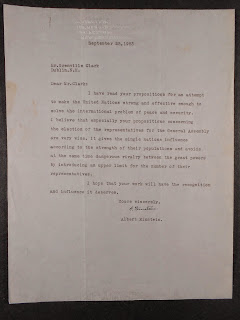
A typed letter.Throughout the 1950s and 60s, Clark worked tirelessly as a leading advocate for the world government movement. In 1953, Clark published a book titled, Peace Through Disarmament and Charter Revision: Detailed Proposals for Revision of the United Nations Charter, which Albert Einstein read and commented on in a letter he sent to Clark in September of that year. In this letter, Einstein stated how he had "read [Clark's] propositions for an attempt to make the United Nations strong and effective enough to solve the international problem of peace and security" and "hope[d] that [his] work will have the recognition and influence it deserves."

Clark's dedication to achieving world peace through enforceable world law became the subject of his major work, World Peace Through World Law, co-authored with Louis B. Sohn. In this book, Clark and Sohn proposed revisions to the United Nations Charter. This book advocated for a truly international world state, a unicameral parliament chosen on the basis of weighted population bases, a vetoless executive arm, a world court, and a world police force. Following its publication in 1958, World Peace Through World Law was translated into numerous languages and became a classic of international relations.

To see Einstein's correspondence with Clark, come to Rauner and ask for ML-7 box 160, folder 70. To see the numerous translations of World Peace Through World Law, ask for Rare JX 1977 .C554.  And lastly, if you’re interested in learning more about Grenville Clark in general, check out the full finding aid to his papers at Dartmouth.