Friday, June 5, 2015

The Tenth Muse of Spanish America

A title page for "Inundación castálida."“Like men, do women not have a rational soul? Why then shall they not enjoy the privilege of the enlightenment of letters? Is a woman’s soul not as receptive to God’s grace and glory as a man’s? Then why is she not able to receive learning and knowledge, which are the lesser gifts? What divine revelation, what regulation of the Church, what rule of reason framed for us such a severe law?”

Sor Juana Inés de la Cruz, a seventeenth-century nun, self-taught scholar and acclaimed writer of the Latin American colonial period and the Hispanic Baroque penned this reproach in a letter to the Bishop of Puebla in 1690. In this letter, she defended and ardently advocated for the right of women to education and intellectual pursuits. Sor Juana spent most of her life in Mexico City, the heart of the autocratic and theocratic viceroyalty of New Spain. Her uncompromising stance on the issue of women’s rights is remarkable when considering that women’s subordination to men and the Church was almost absolute in colonial Spanish America.

A photograph of a book with a limp vellum binding.

As literary translator Alan S. Trueblood stated in his introduction to A Sor Juana Anthology, “Of all the memorable Hispanic voices of the later half of the seventeenth century—and they were not lacking in those dominions on which the sun never set—Sor Juana most clearly pierces constraints to proclaim the will and the right of the individual—and particularly of the individual woman—to realize herself intellectually, artistically, and emotionally.”

Sor Juana is celebrated in many intellectual circles today as the “First Feminist of the New World.” At Rauner, we have the first publication of Sor Juana’s poetry, a volume grandly called the Inundación castálida de la única poetisa, Musa Décima, sor Juana Inés de la Cruz (The Overflowing of the Castalian Spring, by the Singular Poetess, Tenth Muse, Sor Juana Inés de la Cruz), published in Madrid in 1689.

A printed two-column redondilla.
Sor Juana’s poetry chronicles the rigid gender relations and double standards that pervaded seventeenth century society. Recurrent themes include love and indiscretion, individual honor, and, her favorite dichotomy, female vanity versus female intellect. Her ideological stance on women’s rights is nowhere clearer than in her most famous redondilla that begins “Hombres necios que acusáis.” This philosophical satire is an indictment that criticizes men for manipulating women, and reprimands women for their passivity and submission to men. The redondilla begins with three powerful stanzas:
     Silly, you men—so very adept
at wrongly faulting womankind,
not seeing you’re alone to blame
for faults you plant in woman’s mind.
     After you’ve won by urgent plea
the right to tarnish her good name,
you still expect her to behave—
you, that coaxed her into shame.
     You batter her resistance down,
and then, all righteousness, proclaim
that feminine frivolity,
not your persistence, is to blame.
To read the redondilla in its entirety and more of Sor Juana’s brilliant poetry, ask for Rare Book PQ7296.J6 A6 1689.

Tuesday, June 2, 2015

Text on a String

The margins of a printed page, with a drawn hand holding a string attached to one of the lines. We see lots of manicules in our collections--those little fingers pointing to important bits of text.  Usually they are added in by readers, but sometimes they are printed with metal type. They are usually a simple drawing of a hand with the index finger extended. Sometimes there is a fashionable shirt cuff visible.  But the reader of this 1496 edition of Petrarch's Opera Latina (Basel: Johann Amerbach) had a distinctive style. His or her manicules don't point out the text, they tie it up with a string and hold on tight.

The margins of a printed page, with a drawn hand holding a string attached to one of the lines.
You can see it yourself by asking for Incunabula 95.

Friday, May 29, 2015

Prime Fowle, a Man of Handsome Color

A page printed with "Portsmouth, Printed by D. Fowle" with the handwritten addition "& Prime Fowle a man of handsome color; 1760." Yesterday, while pulling some 18th-century broadsides to show how the popular press functioned, we came across a curious inscription on "An Account of the Terrible Fire which Happened in Boston" from 1760.  After the horrific account, the printer's name is set in type: "Portsmouth, Printed by D. Fowle."  But under that, written in an 18th-century hand, is "& Prime Fowle a man of handsome color; 1760."

Who was Prime Fowle, and why is his name added? Colonial printing is pretty well documented, so this wasn't hard to look up. Daniel Fowle established the first newspaper in colonial New Hampshire, and it turns out his pressman was his slave, Primus, also known as Prime. Primus was a well-known person in Portsmouth at the time. When he died in 1791, still a slave and disfigured from a lifetime of pulling a hand press, the local paper printed tributes and a commemorative poem in his honor.

A three column account of the "Terrible Fire."
To learn more about Primus's life, see Black Portsmouth: Three Centuries of African-American Heritage by Mark Sammons and Valerie Cunningmham (Durham: University of New Hampshire Press, 2004), pages 33-35. To see an example of his presswork, ask for Broadside 760221.

Tuesday, May 26, 2015

The Medical Humanities

A flyer for "The Great Issues of Conscience in Modern Medicine."One of the joys of working in the archives is finding a moment of Dartmouth history that just blows your mind. The Dartmouth Medical School (now the Geisel School of Medicine) stopped granting degrees early in the 20th century because they feared they were about to lose their accreditation. The 1910 Flexner Report doomed most rural medical schools because it argued that students in rural areas could not be exposed to the variety of cases necessary for a well-rounded medical education. But, by 1960, medical training had changed, and Dartmouth was again poised to grant medical degrees.

A photograph of C.P. Snow.
To celebrate the re-establishment of a fully operational medical school, Dartmouth hosted a three-day convocation on "The Great Issues of Conscience in Modern Medicine." For such an event, you would expect a series of congratulatory, optimistic and forward-looking speeches by leaders in the medical community. But Dartmouth took a very different path: among the speakers invited were C. P. Snow and Aldus Huxley. Just the year before, scientist and novelist C. P. Snow had shaken the academic world with his famous "Two Cultures" talk at Cambridge. He outlined a course of history that had driven a wedge between the sciences and the humanities and left the two areas of intellectual pursuit incapable of communicating even on a basic level. This divide, he charged, had dangerous consequences for the future of civilization.

A photograph of three men seated at a panel.
His dire warnings paled next to the damning critique of science and medicine offered up in Aldus Huxley's Brave New World. In a tragic dystopian future, medicine was simply a tool in the hands of a totalitarian state stripped of any humanity. Not only that, but Huxley was also gaining new fame for his explorations into hallucinogenic drugs.

These are the people you invite to celebrate the grand reopening of the medical school? A scholar who believed the entire system of knowledge generation was broken and a mescaline eating novelist who foresaw a joyless future predicated on eugenics? Wow, that is pretty cool.

To see the proceedings of the convocation, ask for D. C. Hist R111 .D3 1960.

Friday, May 22, 2015

World Peace Through World Law

A set of four books in various languages."Dr. Einstein, why is it that when the mind of man has stretched so far as to discover the structure of the atom we have been unable to devise the political means to keep the atom from destroying us?" "That is simple, my friend. It is because politics is more difficult than physics."

Grenville Clark quoted this memorable exchange in a tribute he wrote for Einstein published in the New York Times following Einstein's death in April 1955. Clark had overheard this conversation at a conference about disarmament and world government that took place in January 1946, at Princeton, New Jersey, five months after the atomic bombings of Hiroshima and Nagasaki.

Clark was a prominent Harvard educated New England lawyer who was deeply involved in the world government movement. This political movement advocated two imperatives following World War II: no peace without disarmament and no disarmament without limited world government. The Princeton Conference, which Albert Einstein attended, was a continuation of a prior conference that took place in Dublin, New Hampshire, in October 1945. Clark organized this series of conferences as a way to forward proposals for a world government and amend the United Nations Charter. Clark and the conference attendees, including Albert Einstein, sought to make the United Nations a truly effective world institution for the maintenance of peace in a disarmed world governed by law.

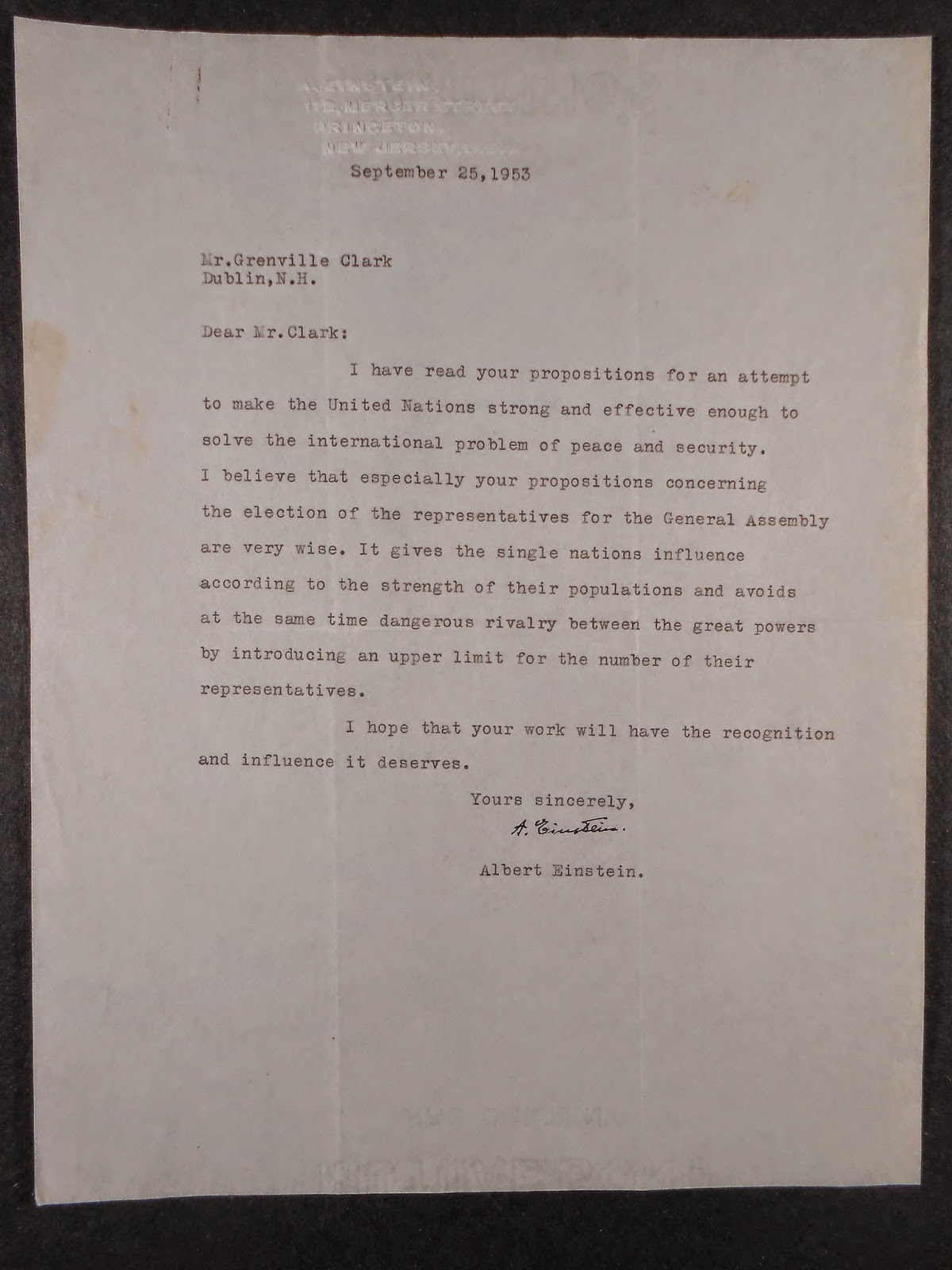
A typed letter.Throughout the 1950s and 60s, Clark worked tirelessly as a leading advocate for the world government movement. In 1953, Clark published a book titled, Peace Through Disarmament and Charter Revision: Detailed Proposals for Revision of the United Nations Charter, which Albert Einstein read and commented on in a letter he sent to Clark in September of that year. In this letter, Einstein stated how he had "read [Clark's] propositions for an attempt to make the United Nations strong and effective enough to solve the international problem of peace and security" and "hope[d] that [his] work will have the recognition and influence it deserves."

Clark's dedication to achieving world peace through enforceable world law became the subject of his major work, World Peace Through World Law, co-authored with Louis B. Sohn. In this book, Clark and Sohn proposed revisions to the United Nations Charter. This book advocated for a truly international world state, a unicameral parliament chosen on the basis of weighted population bases, a vetoless executive arm, a world court, and a world police force. Following its publication in 1958, World Peace Through World Law was translated into numerous languages and became a classic of international relations.

To see Einstein's correspondence with Clark, come to Rauner and ask for ML-7 box 160, folder 70. To see the numerous translations of World Peace Through World Law, ask for Rare JX 1977 .C554.  And lastly, if you’re interested in learning more about Grenville Clark in general, check out the full finding aid to his papers at Dartmouth.

Tuesday, May 19, 2015

Translated from the Original Equine

A green and gold cover for "Black Beauty."If a horse could tell his own story, what would he say? Anna Sewell embraced this challenge when she “translated” the story of Black Beauty in her famous novel, Black Beauty: His Grooms and Companions: The Autobiography of a Horse (London: Jerrold and Sons, 1877). The first edition, bound in green cloth and stamped in black and gold, sold quickly in Victorian England; no one had read a story from an animal’s perspective before. Since it was published in 1877, Black Beauty has become one of the world’s most popular books, selling more than fifty million copies and inspiring a slew of movies, plays, and stories told from an animal’s point of view.

Anna Sewell wrote Black Beauty with a specific purpose: improving animal rights. As she writes in the novel’s dedication, Sewell was “devoted to the welfare of others.” After growing up with injuries and diseases that limited her ability to walk, Sewell became invested in the lives of the horses upon whom she depended every day. Beauty, the narrator, may even be based on one of the Sewell family horses--an opinionated black mare named Bess. Not only does Black Beauty capture the centrality of horses in Victorian life, from the transportation of people and goods to war, style, and sport, it also gives its characters an emotional complexity that resonates with both juvenile and adult readers.

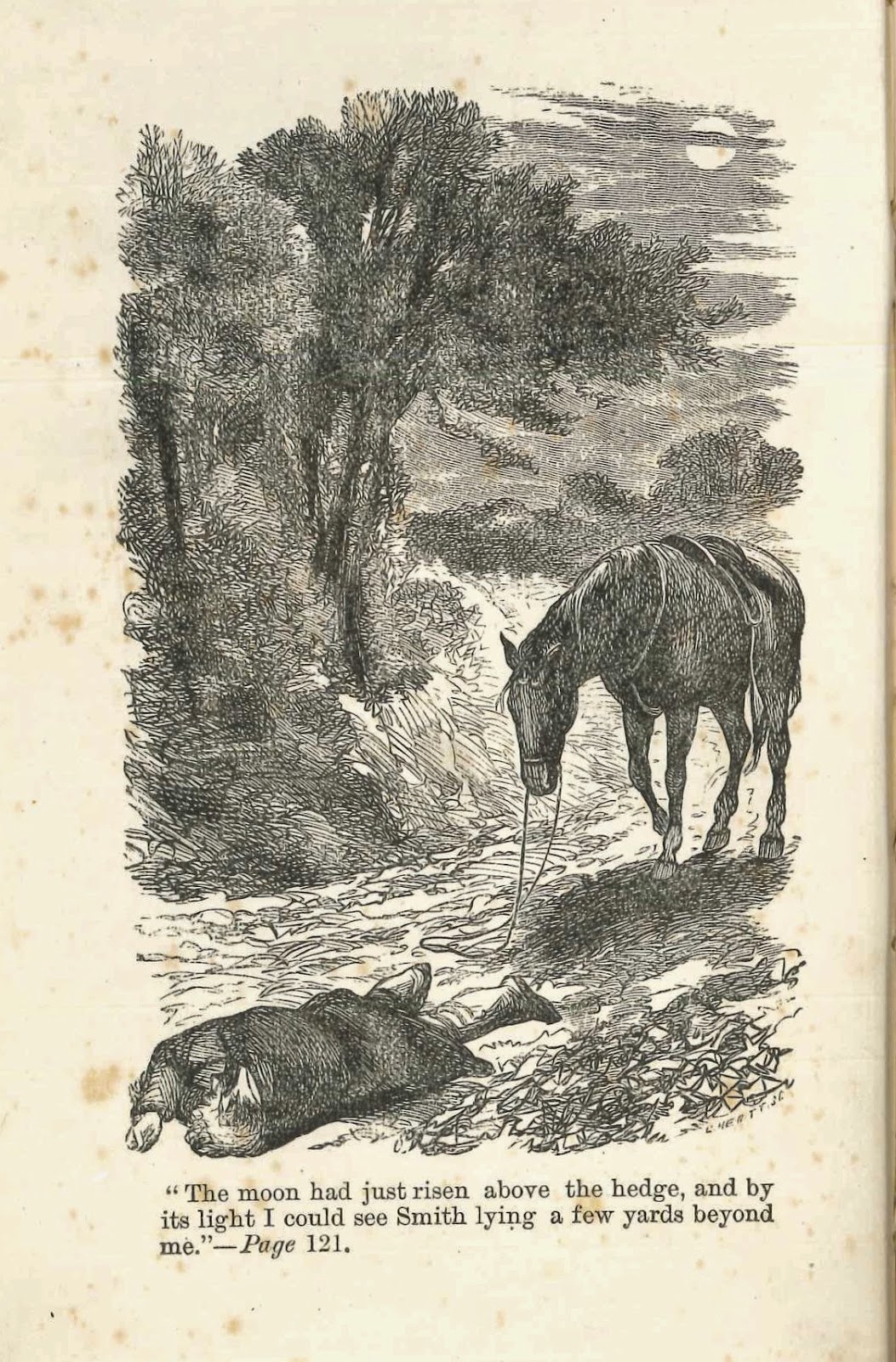
A full-page illustration of a horse and a fallen rider.
The best-selling first edition, published just five months before Sewell’s death, had a widespread impact on the early animal rights movement, both in its native England and the United States. While Sewell includes a note at the end of this edition, in which Black Beauty’s “Translator” asks the reader to learn and practice proper animal care, it is Beauty's stories that have the most impact. With both humor and heartbreak, he describes kind treatment and cruel abuse, along with practices that harmed horses for the sake of fashion, like the bearing reins that forced carriage horses to hold their heads unnaturally high. Black Beauty, and the movement it inspired, produced the first legislation that would begin to curtail practices like this, and the abuse of animals in general.
There is no religion without love, and people may talk as much as they like about their religion, but if it does not teach them to be good and kind to man and beast, it is all a sham.
--Black Beauty

To follow Beauty on his journey, ask for Rare PR 5349.S427 B6 1877.

Posted for Emily Estelle '15.

Friday, May 15, 2015

I Love Harry

 A typed cast and set list for "Archie's Electric Cupid."Harry Ackerman is one alumnus you’ve probably never heard of, but probably should have. He was a high executive at Screen Gems, a company owned by Columbia Pictures, and during his prime was responsible for up to seven popular TV shows at a time on the network. His life is documented through his papers which are all housed at Rauner. Although his correspondence and pictures are interesting, what’s really unique is the scripts that we have. The collection includes numerous pilot scripts, from flops you never knew were written to the origins of smash hits.

One of the pilot scripts is Archie by Ray Allen. Although Archie wasn't quite a hit, this 1962 script was the prelude to the 1964 movie of the same name. It’s bizarre to read the script without the visual presentation that the comic provides. Bits that would usually be resolved at the end of a strip are awkwardly connected to a larger plot. In case you were wondering, Archie doesn’t end up with Betty or Veronica this time. He takes Mildred to the dance.

Another curiosity is the pilot script for Bewitched. It turns out Samantha, the witch who charmed television screens for eight years starting in 1964, was actually originally named Cassandra. This script is from a little under a year before the air date. The title is penciled in, so it may be this copy is one of the first with the actual title “I Darrin, Take This Witch Samantha.”

Ackerman's legacy that you’re probably most familiar with is I Love Lucy. Ackerman saw Lucille Ball ad libbing on a charity show and wanted her for the part. He was an exec at the time, and in an article he wrote titled “The Legacy of Lucy,” he talks about how she was terrible during rehearsal, but completely stepped it up for the live performance. We have an early draft of the article, and it seems it was Ackerman who decided I Love Lucy had to be taped live. This, in combination with the filming style, led to the three-camera technique that has become a staple of the industry.

We also have the pilot of Dennis the Menace, which, aside from being really cool, includes a list of “don’ts” during shooting, ranging from “No drunkenness” to “No shaving or display of shaving equipment.”

The collection is housed under ML-81
For Archie, ask for Box 8 folder 24
For Bewitched, ask for Box 8, folder 40
For I Love Lucy, ask for Box 12, folders 17-21
For Dennis the Menace, ask for Box 10, folders 7-8

Posted for Maggie Baird '18