Friday, December 20, 2013

Something Pretty for the Holiday

A floriated initial G in blue, red, and yellow.Among our many medieval manuscripts is this beautiful leaf from a 16th century Italian antiphonal celebrating the Christmas Day mass. This floriated initial G leads into one of the most famous lines of Christian choral music: "Gloria in excelsis Deo."
A page from a medieval antiphonal including the floriated "G."
We hope it brightens your holiday season.

We are closed through January 1st, but after that you can see the manuscript in person by asking for MS 002091.

Tuesday, December 17, 2013

Filling in Vasari

A blank medallion frame.When Giorgio Vasari set out to illustrate his Le vite de' piv eccellenti pittori, scvltori, e architettor (Fiorenza: Appresso i Giunti, 1568) he aimed for authenticity in his depiction of each of the artists represented. But there were a handful for whom Vasari had no reliable likeness to draw on.  He placed blank medallion frames at the heads of each of their entries. Was he giving a future reader an opportunity to complete his work once a reliable image had been found? Or, by acknowledging his own ignorance, were the blanks there to bolster the integrity of the rest of his work?

In our copy, a 16th or 17th century artist took advantage of the several of Vasari's blanks and has provided beautiful pen and ink sketches to "finish" the work. This copy was owned by an 17th centry art historian, so perhaps he had access to likenesses Vasari did not and commissioned an artist to fill in the blanks.

A medallion frame containing a pen sketch of a bearded man.A medallion frame containing a pen sketch of an older man in a hat.

Come see our improved Vasari by asking for Rare N6922.V2 1568.


Thursday, December 12, 2013

Alone on Foot

A handwritten passport.For those of you who dread getting up in the morning, or have ever had to endure lengthy speeches about days of trudging to school in the snow "uphill both ways," we have an item that just may make you feel a bit better about your daily commute. Imagine leaving home by yourself and traveling hundreds of miles on foot, just for the promise of an education. For the Indian students of the Moor's Indian Charity School founded by Eleazar Wheelock in 1754, this was a reality.

This passport, discovered among the effects of William Allen, D.D., President of Dartmouth and of Bowdoin Colleges, whose wife, Maria Malleville Wheelock, was the granddaughter of President Eleazar Wheelock, documents the travels of Wheelock's Indian students on their journey from Bethel, N.J., to Lebanon, Connecticut. The passport is a sheet 15 inches long and 12 inches wide, folded into fourths and stitched together at each crease.

Two of Eleazar Wheelock's students, Delaware Indian boys John Pumshire aged 14 and Jacob Woolley, aged 11, were the first to make the long trip to Moor's. John and Jacob "left all their Relations & Acquaintances, and came alone, on foot, above 200 miles, and thro' a Country, in which they knew not one Mortal, and where they had never pass'd before" all to receive education and missionary training from a stranger they had never seen or heard of themselves.

On the top left corner of the passport reads an introduction from Aaron Burr, second President of the College of New Jersey, and John Brainerd, brother of David Brainerd, who lived at Bethel, N.J., where the Indian boys started on their journey to Lebanon, Connecticut:
Gentlemen and Christian Friends,
These Indian Boys, the Bearers of this, are upon a Journey from Bethel the Indian Town in New Jersey, to Lebanon in Connecticut, in order to be put to Learning under the Inspection of the Reverend Mr. Wheelock, with a View to prepare them for the Gospel Ministry, and a design to propagate Christian Knowledge among the Native Indians in this Land: and therefore are recommended to the Charity of Christian People as they pass through the Country.
The passport combines, on a single sheet of paper, a letter and diagonally placed travel directions. The left side of the itinerary has twenty-seven place names, beginning with Bethel at the bottom of the page and Lebanon at the top. Each place name is complemented on the right side by a name of reference, where the boys could ask for assistance, food, and shelter. Of the 28 places listed on the itinerary, all but two (Bethel and Horseneck) can be easily identified on a map today. The presence of a diagonal line between entries indicates the point at which the boys would need to cross a major river - those of which included the Raritan, Hudson, Housatonic, and Connecticut.

This passport, along with other items from the Moor's Charity School is currently on exhibit in the Class of 1965 Galleries until February 28th. Afterward, feel free to come in and request the passport by asking for Mss D.C. Hist. 754900. The manuscript was donated by Rev. Henry Goodwin Smith.

Tuesday, December 10, 2013

Mandela Hall

A black and white photograph of the campus shanty town.Last week, with the death of Nelson Mandela, the world lost an exceptional leader and dedicated crusader for human rights. He brought the light of his cause to all corners of the globe, including a small college in New Hampshire where, briefly, there stood a Mandela Hall.

Apartheid and the College's investments in companies doing business in South Africa had caused some protest at Dartmouth dating back to the 1970s. In the 1980s unrest among the students and faculty in regard to the College's investment polices increased and became organized in a serious way. Rallies, teach-ins, vigils and recommendations generated by numerous committees and groups urged the Board of Trustees to divest. In June 1985, the Board issued its first statement supporting divestment, voting to remove from its portfolio companies not complying with the Sullivan Principles during the next year.

Taking their cue from activities at other colleges and universities where shantytowns had proved to be an effective protest method, on November 16, 1985, the Dartmouth Community for Divestment constructed two shanties on the green, Biko Memorial Hall and Mandela Hall. In addition, the DCD issued two demands to the Trustees, expecting their written statement of acceptance by mid-day, November 18th.

The Trustees did not respond to the DCD demands, and a third shanty was built. Town officers, students, faculty and community members argued and debated the legality of the shanties. On November 21st, College president David McLaughlin stated that the shanties could remain as long as they served an educational purpose.
A black and white photograph of the trashed shanties. A banner reading "Racists did this" has been hung on the wreckage.

And remain they did, at least until the night of Jan 21-22, 1986, when twelve students calling themselves the Dartmouth Committee to Beautify the Green Before Winter Carnival, took sledge hammers to the structures, and sent a brief letter to President McLaughlin stating that they were "merely picking up trash off the Green." The discussions that had surrounded the legality of constructing shanties on the green were instantly replaced by debate over the violent actions of the DCBGBWC.

Over time, the dust settled, but opposition to the College's investment policies continued for a few more years following the shanty incident, until finally, in November 1989, the Trustees voted to fully divest.

To learn more, ask for the Vertical Files "Student Protests 1985" and Student Protests 1986."

Friday, December 6, 2013

A Story of Crime, Punishment and Redemption Torn from the Headlines!

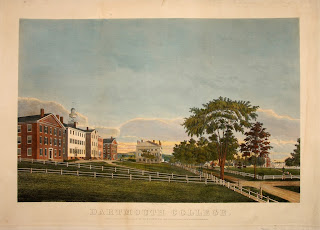
A color engraving of the College.The history of the best known engraving of Dartmouth College--how it came about, and the life of the artist who created it--is one of the more unusual tales in American print history.

Christian Meadows (1814-after 1872) was an engraver who immigrated to Boston from England in the 1830s. In early 1849, Meadows was working for W. W. Wilson of Boston, engraving plates for bank notes and dies for stamping coins. He disappeared about the same time some plates for printing bank notes were stolen from the firm. In March of that year, Meadows appeared in Wells River, Vermont, in the company of his wife, the burglar and bank robber William "Bristol Bill" Warburton, and Margaret O'Connell, a Boston counterfeiter. Meadows was suspected of passing counterfeit notes at a Wells River bank, and a search of the group's Groton, Vermont, house revealed burglar's tools, a printing press, and some of the engraved bank note plates that had been stolen from W. W. Wilson. Meadows was arrested, tried for counterfeiting, convicted, and sentenced to ten years at the Vermont State Prison in Windsor beginning in June, 1850. The story of the breaking of this counterfeiting ring was sensational enough to be carried in newspapers from as far west as Wisconsin.

The following year, three Dartmouth students--E.T. Quinby, George W. Gardner, and Charles Caverno--planned to commission an engraving of the College. The trio went to Boston in search of an engraver and learned that New England's finest engraver was imprisoned at Windsor. They asked Warden Henry Harlow to permit Meadows to work on the project. Meadows must have been a model prisoner, for Harlow allowed him to travel from Windsor to the Dartmouth campus under guard to make drawings for the engraving. Upon returning to the prison, Meadows engraved the copper plate for the print.

Meadows chose a view looking south from near the present site of Rollins Chapel to depict Wentworth Hall, Dartmouth Hall, Thornton Hall, and the whitewashed Reed Hall. The three-and-a-half story brick Dartmouth Hotel can be glimpsed through trees at the right opposite the common which is bordered by fences and crisscrossed by paths. The prominent elm in the foreground recalls the tree's popularity as an ornamental, and saplings protected by tree boxes to prevent hitched horses from damaging their trunks flank the elm and are planted around the common. Meadows' view projects order and serenity--qualities that he seems to have been unable to integrate into his life up to that time.

A engraved diploma.The print was seen by Dr. John Walker of the New Hampshire Agricultural Society who offered the jailed engraver the job of producing the Society's diploma to be awarded at the annual agricultural fair. A pastoral drawing by portrait painter Daniel G. Lamont who was then living near Daniel Webster's birthplace in Franklin, New Hampshire, was incorporated into the final image by Meadows. A copy of the engraved diploma was sent to Webster who was Secretary of State in the Fillmore administration. Upon seeing it, Webster remarked: "Who is the engraver that has done this? Where does he dwell? I have been searching for such a man. We want him at the State Department to engrave Maps."

Webster asked Vermont Governor Charles K. Williams to pardon Meadows, asking "Why do you bury your best talents in your state prisons?" The Governor declined, and a year later Webster was dead. A new Governor, Erastus Fairbanks, issued the pardon probably out of respect for Webster and his earlier effort. Meadows was freed on July 4, 1853, and he remained in Windsor until 1859 making engravings of education institutions including Appleton Academy in New Ipswich, New Hampshire, and Vermont's Thetford Academy.  Meadows moved to Buffalo, New York, the following year where he worked as an engraver, he was listed under the same occupation in Toronto city directories for 1871 and 1872, and then he disappears from the record.

To see engravings made by Meadows in and out of prison, ask for Iconography 72, 416, 735, Broadside f852590, and f862626.

Posted for Richard Miller
     

Tuesday, December 3, 2013

Body of Inquiry

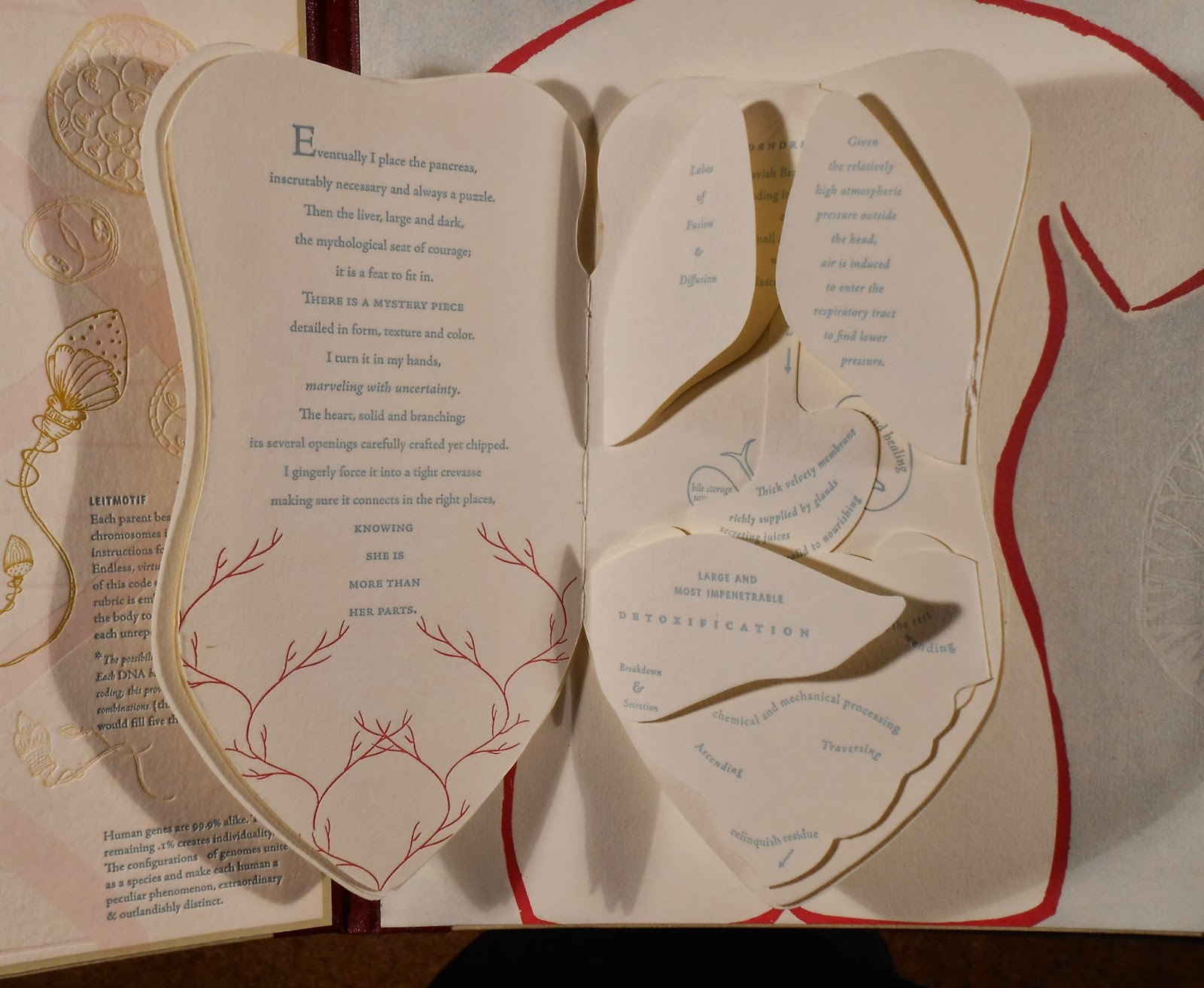
A book shaped like a torso, opened to show cut-out pages shaped like organs, bearing printed text.The last few blog posts have been a bit disturbing--first a woman being flayed alive, and then poor Molly Goosey being served up for Thanksgiving dinner. So its time for something a little more empowering: a reclaiming of the body. Inspired by an anatomical model, "Torso Woman," Casey Gardner created a stunning triptych flap-book, Body of Inquiry (Berkeley: Casey Gardner: Set in Motion Press: Still Wild Books, 2011). The book harkens back to historical flap books like this 1702 edition in our collections (Remmelin's Survey of the Microcosme, or the Anatomy of the Bodies of Man and Woman) to create a new understanding of the politics of the body.

An illustration of a woman with flaps cut out of the page.In Gardner's hands the flaps do more than reveal the basic anatomy of her subject. They provide the author with an opportunity to meditate on life, the body and its many parts, and the literal and metaphoric meanings attached to those parts.

Interestingly, Remmelin originally created his flap books for the use of "Physicians, Chyrurgeons, Statuaries, Painters, etc." Over 300 years later, an artist has successfully taken him up on his offer.

"Body of Inquiry" opened to show several panels of text and illustrations, including the central image of of a woman's head and torso, which contains several cut-out pages shaped like organs.
To see Body of Inquiry, ask for Presses S492bod. The Survey of the Microcosme is Rare QM21 .R4513.

Tuesday, November 26, 2013

The Ill-Fated Moll

A colored illustration of a seated group being served a large roast.To celebrate Thanksgiving this year we bring you a charmingly illustrated book from our Class of 1926 collection. Thanksgiving Day: or the Fate of Poor Molly Goosey (Boston: Wier & White, ca. 1850). This hand-colored children's book relates the tale of young Prince Gander's courtship with the lovely Miss Molly Goosey. The two fall madly in love and became engaged, then the troubles start:

Both looked forward, soon, to a sweet honeymoon,
A page of verse and an illustration of geese on a pond.For neither of them did remember,
That once, every year, there comes, it is clear,
A Thanksgiving day in November.

And then, I've heard say, it is a Festival day,
When people scorn beef, veal, and mutton,
By way of excuse, on a well stuffed goose,
To play the inordinate glutton.

As the lovers were walking, one morning, and talking,
O, think of the pangs they must suffer,
To hear the fat cook say, with ominous look,
"I must presently kill her and stuff her."
A page of verse and an illustration of a woman holding a goose by the neck.
At Molly our swain looked with evident pain,
For he feared Moll might be such a sinner
His young bride to choose for her Thanksgiving goose,
To be killed, stuffed, and roasted for dinner.

As the day nearer drew, more uneasy he grew,
For a kind of foreboding possessed him!
But Moll, not a whit cared for cookery or spit,
As she said,---whilst she fondly caressed him.

But oh! lady gay,---'ere that Thanksgiving day,
In fact, two or three days before it,
A chase there was seen, upon Roxbury Green,
And the lovers had cause to deplore it.

The illustration of the roast being served, now placed in the center of a page of verse.
Without more delay, then suffice it to say,
That some farmers that day met together,
Of a goose to partake, and a good dinner make,
While they talked of the markets and weather.

But the goose they extol, is the ill-fated Moll,
Whilst Prince Gander, as pale as a muffin,
Faintly uttered, "Alas!" as he saw the dish pass,
And died upon smelling the stuffing.

Ask for 1926 Collection T3544, and enjoy your TURKEY,