Friday, December 28, 2012

Dartmouth in the Rose Bowl?

An illustrated poster for a Dartmouth vs Brown game.In 1937, Dartmouth was a major college football powerhouse and was invited to play Cal in the Rose Bowl on January 1st--and Dartmouth turned it down. It is hard to imagine both sides of that sentence: Dartmouth invited to the Rose Bowl? A major college football program turning down "the granddaddy of them all"? Presumably the payout wasn't quite the equivalent of the $22.3 million that Wisconsin and Stanford will reportedly each collect for participating this year.

A typed letter.Dartmouth went undefeated in 1937 with six wins and two ties. According to the 1938 Aegis, "pre-season predictions of the gridsters went no further than the term 'dark-horse,'" but the team made up for scant experience with speed and strength.

President Ernest Hopkins response to the Rose Bowl invitation is a testament to his view of student athletes:
To carry our football season over until the first of the year and end it up with the distractions of a jaunt across the continent and return, would force us into the position where all members of the team would be penalized in lower grades, which they inevitably would get and which might endanger the academic standing of some of them, or else put us into the position of having to extend special privilege to members of the team in the consideration which should be given to them.
In other words, it might hurt the young men's studies.  The same year, Hopkins declined an offer by the Chicago Bears to play a benefit game for Chicago's Hull House at Wrigley or Soldier Field.

A typed letter.
Interestingly, the school's worry about the disruptive nature of post season athletics did not carry over to other sports: in 1942, Dartmouth reached the finals of the NCAA Basketball Tournament.

To see the letters, ask for the "Athletics" file from DP-11, Box 6980.

Friday, December 21, 2012

Not "A Christmas Carol"

An illustration of a party, captioned "Mr. Fezziwig's Ball."Everybody knows the classic tale of Ebenezer Scrooge and the three ghosts of Christmas whose visitations cause the former miser and all around misanthrope to reform. The other novellas of Christmas penned by Charles Dickens have not stood the test of time as well, perhaps due to lack of such memorable characters like old Mr. Fezziwig.

A heavily illustrated title page for "The Chimes."
The first followup to A Christmas Carol (London: Chapman & Hall, 1843) was The Chimes (London: Chapman and Hall, 1845). Despite the inevitable happy ending, this story is a bleaker, more pointed critique of social issues of the 1840s. The goblins in the tale offer the main character glimpses of his family's potential future - each an illustration of how seemingly good people can become trapped in a cycle of evil.

An illustrated title page for "The Cricket on the Hearth."The Cricket On The Hearth (London: Bradbury and Evans, 1846) is the third in the sequence. After several trials and tribulations, the spirit of the hearth cricket reminds the various characters of their potential for good and the futility of suspecting the worst of others.

An illustrated title page for "The Battle of Life."
The Battle Of Life (London: Bradbury & Evans, 1846) omits the supernatural elements of the first three tales and instead focuses on the selfless acts of the daughters of the cynical Doctor Jeddler. Their devotion and caring brings about a change in his view of the world.

An illustrated title page for "The Haunted Man."
The final novella is The Haunted Man And The Ghost's Bargain (London: Bradbury & Evans, 1848). In this story, Dickens reenlists the aid of a supernatural entity to bring about the redemption of the main character whose initial bargain with his ghostly double to remove all painful memories brings calamity on all others he interacts with as they are also shorn of any unwanted thoughts, leaving them thoughtless and cruel. The lost memories and human feeling of all are returned through the inherent goodness of Milly Swidger whose own painful memories are the source of her benevolence.

Ask for Rare Book PR 4557 .C58 1843 (A Christmas Carol), Rare Book PR 4557 .C5 1845 (The Chimes), Rare Book PR 4572 .C78 1846 (The Cricket On The Hearth), Val 826 D55 O53 (The Battle Of Life), and Rare Book PR 4557 .H3 1848 (The Haunted Man and The Ghost's Bargain).


Tuesday, December 18, 2012

Dear Dr. Seuss

A note addressed to Dr. Seuss, written in a child's hand.Like the rest of the country, we have had school children on our minds this week. We were reminded of a batch of very sweet letters in our Ted Geisel collection addressed to Dr. Seuss. It seemed like a good time to share a few, as well as one of Seuss's replies.

A note to Dr. Seuss from "the Pre-School."
A note to Dr. Seuss, written in a child's hand.A short, typed letter from Dr. Seuss, accompanied by an illustration of a painter.

To see all of the letters, ask for MS-1100, Box 1, Folder 8.


Friday, December 14, 2012

Nature Printing

An image of a green fern.Natural history in the nineteenth century strove to describe and classify everything in the living world. Museums were bulging at the seams with specimens and catalogs listing and illustrating classes of life proliferated. For some in the field, traditional illustration techniques were frustratingly inadequate for the level of precision and detail they were after: they wanted to show nature in all of her wonder. We have written before of one obsessive attempt to bring nature into book form with As Nature Shows Them: Moths and Butterflies of the United States which used the cells from butterfly wings to color the images.

We recently acquired a similarly passionate quest for botanical realism: Thomas Moore's The Ferns of Great Britain and Ireland (London: Bradbury and Evans, 1855). The book employs a process dubbed "Nature Printing" that involved pressing an actual fern into soft lead then electoplating the impression to create an intaglio printing plate. The fern itself created the illustration and the effect is stunning. The book appears to be a collection of actual fern pressed into paper, but with colors that have not faded.

A set of rectangular wood grain samples on a black background.Another book in the collection takes this hyper-realism even further. Romeyn Hough's The American Woods, Exhibited by Actual Specimens and with Copious Explanatory Notes (Lowville: By the Author, 1888-1904) uses 750 paper-thin wood samples carefully mounted in cardboard cards to show the wood grains of hundreds of native trees.

A rectangular wood grain sample.
To see a little nature in Rauner, ask for Rare QK527.M8 1855 and Rare SD536.H83.

Tuesday, December 11, 2012

Friday, December 7, 2012

“… i will burn your building so help me god”

A block of handwritten text.Sometime during the mid-1800's, a distraught wife wrote this brief note to Albert Dewey, a mill owner in Quechee, Vermont, begging him not to buy any more rum for his workers. In 1882, the New Hampshire Temperance Union urged farmers to raise better apples that were a "blessing not a peril," and to avoid making hard cider because it made "men cross, ferocious, bloodthirsty." Alcohol, its use, abuse and prohibition, does tend to evoke strong and, sadly in some cases, violent responses.

A clipping of "Cider; What it Is, What it Does."
Broadside 000064
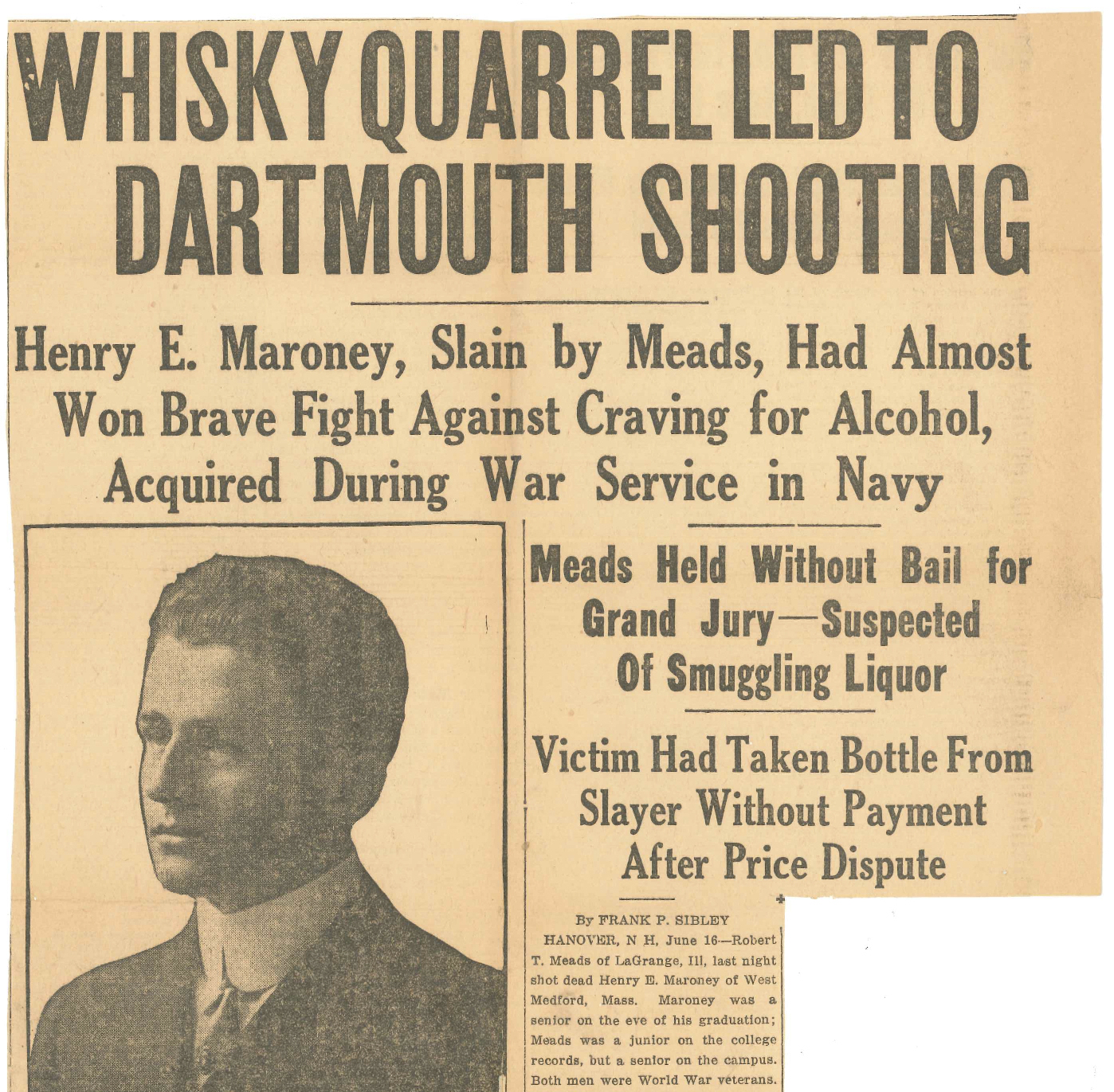
Within six months of the January 16, 1920, ratification of the 18th amendment prohibiting the manufacture, sale and transportation of liquor, Dartmouth College came face to face with its own drink-related act of violence. On June 15, 1920, after an argument over the price of a bottle of liquor smuggled in from Canada, Robert Meads, Class of 1920, shot and killed Henry Maroney, Class of 1919.

A newspaper clipping with the heading "Whiskey Quarrel Led to Dartmouth Shooting."Two days later, Dartmouth President Ernest Martin Hopkins made a formal statement to the press, denying that there had been any general system of smuggling of liquor into Hanover, and that the College authorities had, by every device available, kept watch and checked every known source of supply. He was loath to state this much, in case such diligence on the part of the College would imply an overwhelming need for such oversight, or that specific incidents would cast a bad light on the majority of students who did not partake of illegal drink.

However, in May the following year, President Hopkins was forced to admit in a letter to Matt Jones, Class of 1894, that the campus was in great trouble due to gallons of bootleg alcohol coming into town from Rutland and White River Junction, Vermont, and from New York. "I would like some real he-men with automatic revolvers and backbone who would hold up some of the suspicious automobiles that are floating around here…"

A bit of printed text reading "Dear little bar don't you cry you'll be a drug store bye and bye."
Broadside 001374
In April, 1932, Hopkins issued a statement in favor of ending prohibition, and was probably relieved that he had one less issue to worry about when the amendment repealing prohibition was passed, December 5, 1933.

Ask for ML-61, box 23, folder 25 to see the letter from the Dewey papers, Broadside 000064, Broadside 003174, and Henry Maroney's 1919 Alumni file.

Tuesday, December 4, 2012

By the Author of 'Jane Eyre'

A title page for "Wuthering Heights," being attributed to the author of Jane Eyre.A while back we blogged about the first edition of The Tenant of Wildfell Hall. The publisher promoted the book with the suggestion that it was written by Charlotte Bronte (rather than Anne).  Well, we just acquired the first American edition of Wuthering Heights (New York: Harper and Brothers, 1848) and find that the confusion over the Brontes extended into the United States. The title page of Wuthering Heights clearly states "By The Author of 'Jane Eyre.'"

The publisher had a good excuse. All of the Bronte novels were published under pen names: Acton, Ellis, and Currer Bell. Since this edition is pirated, Harpers had no contact with the Bronte sisters. The English publisher was also working to conflate the three "Bells." Harpers may not have known, or they may have been trying to cash in on the success of Jane Eyre which they had already brought out in a pirated edition.

A paperbound copy of Jane Eyre.
"Pirated" is something of a misnomer. There was no effective international copyright law in 1848, so there were no legal impediments to Harper and Brothers printing a work originally published in England. But they did not pay a cent to the author--had they paid a royalty, one has to wonder whose name would have been on the check!

Ask for Rare PR4172.W7 1848 for Wuthering Heights and Rare PZ3 .B790J for the first American Jane Eyre.