Friday, July 20, 2012

Faking It

The cover for "The Dance of Death.""DANCE, v. i.: To leap about to the sound of tittering music, preferably with arms about your neighbor’s wife or daughter. There are many kinds of dances, but all those requiring the participation of the two sexes have two characteristics in common: they are conspicuously innocent, and warmly loved by the guilty." -- Ambrose Bierce, The Devil's Dictionary

Ambrose Bierce was an American journalist, literary critic, and satirist during the end of the 19th century. Known to many as "Bitter" Bierce, he is now perhaps best known for his much-anthologized short story "An Occurrence at Owl Creek Bridge" and his satiric book of definitions known as The Devil's Dictionary.

Less well known is a work written by Bierce and his co-conspirator, Thomas A. Harcourt, called The Dance of Death. Purportedly penned by one William Herman and published in 1877, the book was a hugely successful hoax that argued for the abolition of the waltz because the dance was a "dark vortex, within whose treacherous embrace so many sweet young souls have been whirled to perdition."

The cover for "The Dance of Life."
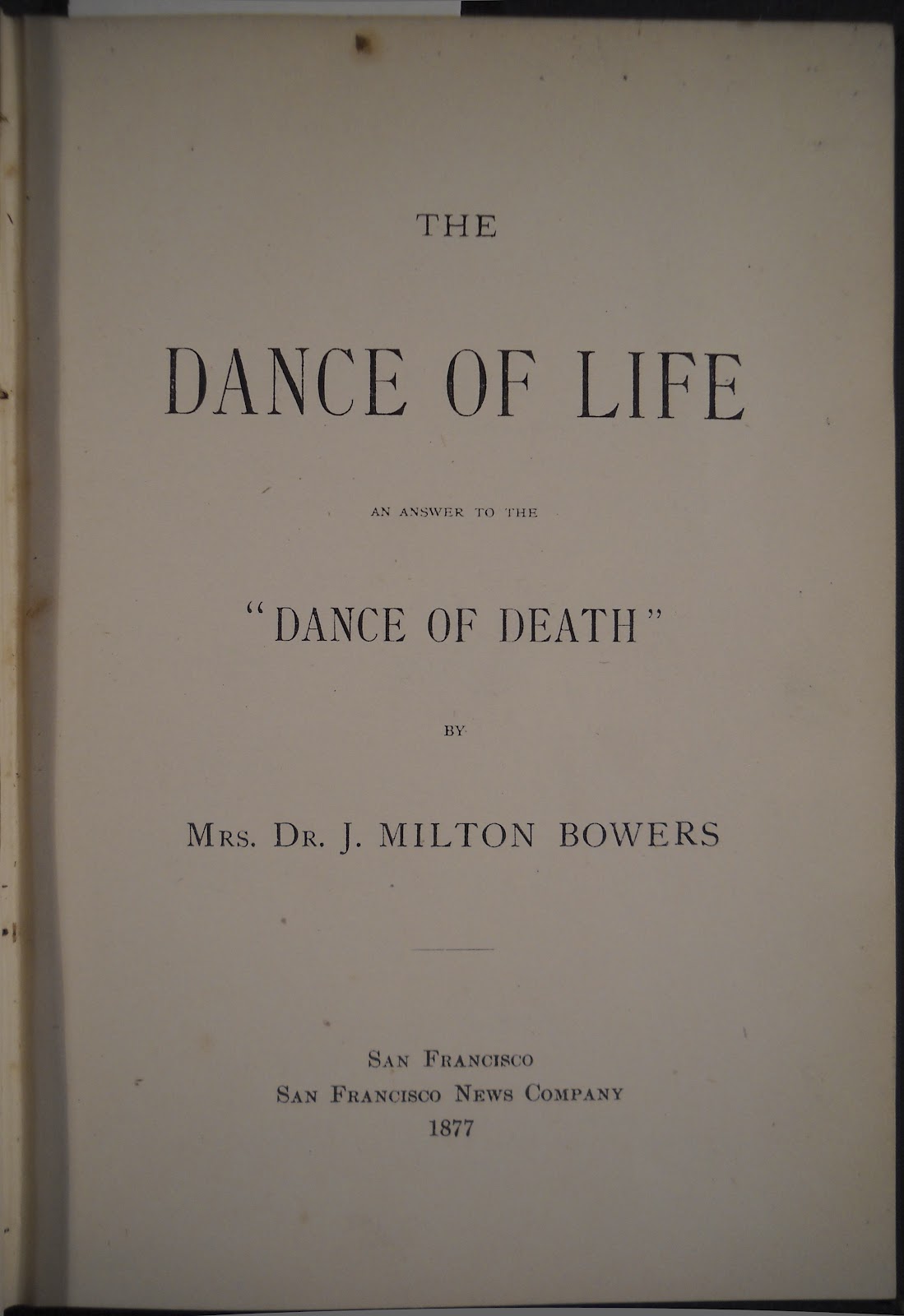
The instant popularity of The Dance of Death resulted in an impassioned rebuttal that was published the very same year. The Dance of Life, by a Mrs. Dr. J. Milton Bowers, was written "to check the insolence of a Philistine." To that end, she dissects their book chapter-by-chapter, providing strident counter-arguments throughout. Still, despite Mrs. Bowers's fiery invective (or perhaps on account of it), there are some who believe that the second book itself was also a brilliant hoax, written by either Bierce or someone who knew him.

The title page for "The Dance of Life."
Ambrose Bierce vanished some time after December 26th, 1913, while traveling as an observer with Pancho Villa’s army in Mexico, so unfortunately we'll never know whether The Dance of Life was a sincere if naïve defense or a second hoax that is still claiming unwitting victims. To see an extremely rare author’s copy of The Dance of Death, inscribed by Bitter Bierce himself, waltz over to the library and ask for Rauner Bierce 11. To see The Dance of Life, ask for Rauner Bierce 46.

Tuesday, July 17, 2012

Annus Mirabilis Papers

An open book of printed text.In 1905, during his now famous stint in the patent office, Albert Einstein published four articles in the scientific journal Annalen der Physik. This series of articles is often referred to as the Annus Mirabilis (extraordinary or miracle year) papers - reflecting their enormous impact on several key areas of modern physics.

The first article to be published was Über einen die Erzeugung und Verwandlung des Lichtes betreffenden heuristischen Gesichtspunk (June 9, 1905).  This paper discussed the photoelectric effect (electrons can be ejected from a material if a sufficiently energetic beam is focused on the material) and demonstrated how observations of the phenomena could be explained by postulating that light is composed of discrete packets or quanta whose energy is determined by the frequency of the ray.  Einstein ultimately received a Nobel Prize for this work.

The second article dealt with Brownian Motion - the movement of particles suspended in a fluid medium whose motive force is imparted by bombardment of the atoms of the fluid itself.  Entitled Über die von der molekularkinetischen Theorie der Wärme geforderte Bewegung von in ruhenden Flüssigkeiten suspendierten Teilchen (July 18, 1905) this paper strongly supported the idea that the atom was a real entity and also lent support to the field of statistical mechanics.

The third article discussed special relativity. Zur Elektrodynamik bewegter Körper (September 26, 1905) demonstrated that Maxwell's equations for electricity and magnetism and the laws of mechanics could be reconciled at speeds approaching that of light, which was a fixed constant and so the same for all frames of reference.

An open book of printed text and equations.
The final paper of the "miracle year" was titled Ist die Trägheit eines Körpers von seinem Energieinhalt abhängig? (November 21, 1905).  In this article Einstein presented one of the most famous equations of all time: E=mc2 (energy can be equated to the mass of an object times the square of the speed of light).  This energy is known as rest energy and is distinct from an object's kinetic and potential energies.

To see all the original publications ask for Rare Book QC1 .A6133 v.322 no.6 (photoelectric effect), Rare Book QC1 .A6133 v.322 no.8 (brownian motion), Rare Book QC1 .A6133 v.322 no.10 (special relativity) and Rare Book QC1 .A6133 v.323 no.13 (mass energy equivalence).

Friday, July 13, 2012

Non-Athletics

A book cover bearing a cartoon of a man in a dress and stockings on a stage, titled "Non-Athletics."While looking for something else this morning, we stumbled across this provocative illustration from the 1921 yearbook,  The Aegis. Wow, what does this say about students who were not athletes? It is easy to read a lot into this image, but it does demand some context.

Up until the 1920s the Dartmouth Players were an all male theater group (they began inviting women from other colleges to take the female roles later in the decade). On an all-male campus out in the "wilderness," cross dressing was not as uncommon as you might expect. Many of our student scrapbooks from the early part of the 20th century show pictures of male students camping it up in drag.

A printed cast of characters.
So, on one level, this is just a humorous depiction of one of the most important non-athletic extra-curricular activities on campus--the theater. On another level it is an example of the prevalent chauvinism of the era, one that was played out intensively on an all-male, elite campus.  By that reading, if you are not an athlete your masculinity is in question.

Tuesday, July 10, 2012

Elemental Style

Two blocks of printed text, one labeled "Dictionary of Modern English Usage" and the other "The Elements of Style," clash in the middle of the page in a swirl.
How do you illustrate language wars? In the May 14th issue of The New Yorker, Joan Acocella writes about the tension between prescriptive and descriptive language guides. Prescriptive manuals tell you what you ought to do to be correct, descriptive guides try to articulate current and past usage without necessarily judging correctness. Sam Winston, one of our favorite book artists, gave it a shot.

He typographically shredded two famous prescriptive guides, Strunk and White's Elements of Style and Henry Watson Fowler's A Dictionary of Modern English Usage, and set them into a vortex of devolving forms. The letters dangle and words break apart as the texts churn together.  The text is from Wikipedia entries and add to the tension. They are crowd sourced (similar to descriptive guides) while their subjects are prescriptive. Which is falling apart? It is your call.

We recently acquired a copy of Sam Winston's illustration as a letterpress broadside. It changes out of the context of the magazine. The illustration becomes a more self-conscious work of art and you pay more attention to the swirling texts. The slipcase elevates it even more, but then you realize these are just a couple of Wikipedia entries, and it is hard to take it quite so seriously.

We haven't got it cataloged quite yet, but you can see it by asking for Sam Winston's New Yorker.

Friday, July 6, 2012

A Body in Motion

A series of photographs of a horse and rider in motion.During the late nineteenth century, a hotly debated topic among horse racing aficionados was whether all four of a horse's feet left the ground during trotting and galloping. Leland Stanford - former governor of California and a proponent of the "unsupported transit" theory - hired Eadweard Muybridge to settle the issue. This was the start of Muybridge's fascination with and exhaustive study of animal and human locomotion which culminated in his famous 11 volume Animal Locomotion. An Electro-photographic Investigation of Consecutive Phases of Animal Movements (Philadelphia: University of Pennsylvania, 1887).

A series of photographs of a nude man swinging a cricket bat.

A series of photographs of a nude woman walking.

Muybridge's photographs documented specific sequences of motion - typically performed in front of a gridded background to provide for quantitative comparison. The human actions captured in these images were wide ranging: walking up and down stairs, hammering on an anvil, playing cricket, and many everyday activities. Most of these actions were performed by nude or very lightly clothed models - presumably to allow for the study of individual muscle movement. However, the often bizarre and contrived actions in some sequences (most often those depicting women) do lead to speculation that some of these images may have also been used as light erotica. Muybridge used many different models and included himself in at least one sequence swinging a pick.  His assistant Thomas Eakins was also posed for several studies.

A series fo photographs of a nude man swinging a pickaxe.

Animals were also photographed in the same deliberate fashion: typical motions of a wide range of domestic and wild fauna including horses, goats, cats, dogs, various birds, monkeys, bison, and many other species were documented.  Horse studies occupy an entire volume while the rest are split into one volume of domestic animals and one of wild.

A series fo photographs of a big cat in motion.

Ask for Rare Book QP 301 .M8 to see the entire set.


Tuesday, July 3, 2012

Live Free or...

A printed page of text with the header "Declaration of Independency."
What are the first things a newly formed state does after declaring itself no longer a colony? Establish a government and pass some laws. We have the first Acts and Laws of the State of New-Hampshire published in 1780 that codifies all of the state laws passed between July 1776 and 1780. Given current debates in Concord, it is ironic that among the first Acts passed were ones to enable the state to raise taxes and to regulate marriages.

A title page for "Acts and Laws."
But it is the title page that is most interesting. Transcribed in full, you can see the book working to establish the authority of the state and declare full independence: Acts and Laws of the State of New-Hampshire in America. By Order of the General Assembly. To which is prefixed, the Resolution of the American Congress, For Establishing a Form of Government in New-Hampshire; and the Resolve of the Provincial Congress, For taking up Government in Form. With the Declaration of Independence. America, Printed at Exeter, in the State of New-Hampshire. M.DCC.LXXX.

The Declaration of Independence casts off New Hampshire's status as a colony, and the Resolution of the American Congress appeals to broader authority. "America," referenced twice, places the state within its larger context as the Revolutionary War was waged.

Our copy is in its original side-stitched paper wrappers as issued in Exeter in 1780. To see it ask for Rare KFN1230 1780 .A22.

Friday, June 29, 2012

Printing the Unprintable

The title page for "A Collection of Poems."We've recently rediscovered a copy of an early printed work by of one of the most famously unprintable poets of the 17th century. John Wilmot, 2nd Earl of Rochester (1647-1680), was notorious in the English court for his witty, sometimes bawdy poetry, which frequently satirized the lives of well-known court figures - even King Charles II.

Before his death in 1680, only a handful of Rochester's poems appeared in print. The two poems by Rochester that appear in our copy of A Collection of Poems, Written upon Several Occasions, by Several Persons (London: Hobart Kemp, 1672) are the third appearance of Rochester's poetry in print and the first publication of his love elegies. In Kemp's compilation, both of Rochester's poems are titled "To Celia," but in modern editions they are known as "The Advice," and "The Discovery."

Also appearing in this miscellany is George Etheridge's "The Imperfect Enjoyment," which is titled identically to one of Rochester's most famous lyrics. Rochester's poem on the theme of premature ejaculation, unlike Etheridge's, was considered unprintable for centuries.

A printed page of text.
Rochester's poetry made its rounds through the English court almost exclusively in manuscript form, which means that our recent find is both quite rare and an excellent example of how scribal and print publication coexisted long after the invention of the printing press. Longhand copies, made either by Rochester himself, his friends, or professional scribes, meant that poems could circulate quickly and discreetly. At least one of these manuscript copies found its way to Kemp, who likely included it in this collection of poems without notifying Rochester (or paying him for his work).

Kemp never names the "several persons" whose works make up his miscellany; we realized the poems were Rochester's only because a previous owner inked in the authors' names at the end each work. A quick check with a modern critical edition confirmed the attribution. Ironically, because the surviving manuscript sources are sometimes conflicting and often ambiguous, the authorship of some poems attributed to Rochester is still contested.