Friday, February 3, 2012

Armed Services Editions

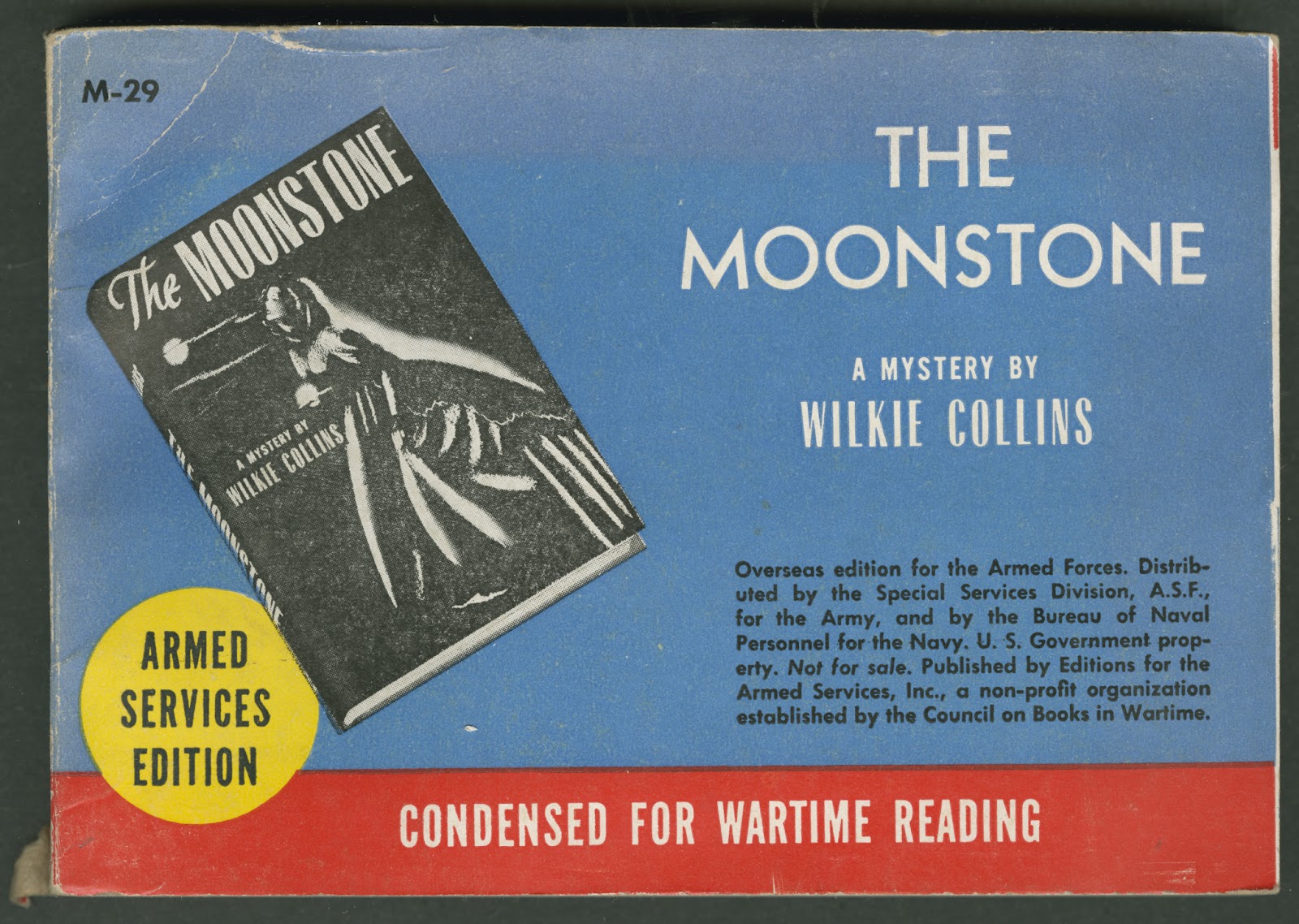
An armed services edition of "The Moonstone."Published during World War II by the Council on Books in Wartime and distributed to soldiers overseas, these downsized books were made to be  carried easily and were wildly popular among service members.  The titles ranged from classics like Wilkie Collins' The Moonstone to bestsellers of the day, nonfiction works, and genre fiction.  Though some books were "condensed for wartime reading," many were unabridged and over 100 million copies were printed and distributed for free.

Armed services editions of "Mathematics and the Imagination" and "My Life and Hard Times."
The ASEs were for the exclusive use of "members of the Armed Forces" and not to be "resold or made available to civilians." Since the Council was in part made up of commercial publishing houses, presumably this prohibition helped protect their bottom line and subsidized the cost of each ASE.  This and the low production standards helped to keep the cost per book extremely low.  The widespread adoption of the small format by GIs may also have helped promote the spread of paperback printing in the United States after the war - a boon for the publishing industry.

A list of the Armed Service Edition titles held by Rauner is available in the library.

Tuesday, January 31, 2012

Whitman on the Green

A portrait of Walt Whitman.On June 26, 1872, a bearded, robust poet of moderate fame appeared before the graduating class and faculty of Dartmouth College to deliver the Commencement poem.  Listed in the account books simply as “Poet $17.50,” Walt Whitman was not an obvious choice.  In fact, it was reported that he was invited by the United Literary Societies in an effort to offend the genteel, conservative tastes of the Dartmouth College faculty.  Whitman was also considered risqué in most American literary circles.  He had his supporters—Ralph Waldo Emerson perhaps chief among them—and he could command substantial payment for his poems by well-established literary magazines such as the Atlantic.  But to middle-class American readers, and to the faculty of most New England colleges, his expansive free verse was far too sensual and unorthodox for their liking.

Eyewitness accounts of the recitation vary: one claims a disheveled poet mumbled his way through an incomprehensible poem while another states that he gave a fine, clear reading.  Whitman himself provided the New York media with a press release that apparently was never used, though both the New York Times and the Boston Daily Advertiser had reporters on the scene to cover the Commencement exercises.

Whitman’s own account of his stay in Hanover provides a telling portrait of Dartmouth in 1872.  He reported to his longtime companion Pete Doyle:
It is a curious scene here, as I write, a beautiful old New England village, 150 years old, large houses and gardens, great elms, plenty of hills—every thing comfortable, but very Yankee—not an African to be seen all day—not a grain of dust—not a car to be seen or heard—green grass everywhere—no smell of coal tar.—As I write a party are playing base ball on a large green in front of the house—the weather suits me first rate—cloudy but no rain.  Your loving WALT.
If you are interested in Whitman, come in and ask to see our first edition of Leaves of Grass (the picture above is the frontispiece to the first edition), Val 816 W59 S8.

Thursday, January 26, 2012

Calling Cards

A photograph of Charles Fechter dressed as Hamlet.The elaborate and often arcane rules of etiquette in the nineteenth century demanded the proper use of calling cards when visiting or "calling on" an acquaintance. These cards were very like modern business cards and it was customary for a visitor to leave his or her card as a prelude to a visit. If they then received a card from the acquaintance, that meant that they were welcome to return.  No return card was a message that a visit was discouraged - an early equivalent of temporarily un-friending someone.  During the nineteenth century, the well mannered - and perhaps slightly vain - visitor might send in a carte de visite - a small, typically albumen type photograph measuring about 2 x 3.5 inches (the size of a standard calling card) mounted on thick paper, which often highlighted some important or characteristic aspect of the caller's life. This card shows actor Charles Fechter as Hamlet - a role he was famous for.

Due in part to the relatively low cost of production (eight carte de visites could be produced from one plate) and the early publication of Napoleon III's photo in this small format,  carte de visites became extremely popular.  Like more recent baseball trading cards, those of famous people were collected, traded, and displayed.  A collection of impressive carte de visites was considered to be an asset for every Victorian household and specially made albums were sold to house and display the collected images.  This small collection of forty-five cards includes those of then Prince of Wales Edward VII and Princess Alexandra, Mark Twain, Louisa May Alcott, Nathaniel Hawthorne, Charles Dickens and opera singer Christina Nilsson.
A photograph of Edward VII standing next to a seated Alexandra.
Edward VII & Alexandra
A photograph of Louisa May Alcott.
Louisa May Alcott
A photograph of Mark Twain.
Mark Twain
A photograph of Nathaniel Hawthorne.
Nathaniel Hawthorne
A photograph of Christina Nilsson.
Christina Nilsson
A photograph of Charles Dickens seated at a desk.
Charles Dickens

Ask for Iconography 1394.

Tuesday, January 24, 2012

"Safe Conduct" Leaflets

A leaflet, primarily in German.A common practice during World War II was the dropping of surrender leaflets on military troops and civilians on both sides of the conflict. By the time the Americans entered the war in 1941, the practice was already well established albeit with questionable success. The allied leaflets that were in use had no uniformity. They were of different color and size and had varying surrender instructions. Under the supervision of the United States, the Allies not only standardized the leaflets but used all their psychological warfare resources to design a "Passierschein" that was eminently more successful. For example, it was assumed that Germans would be more inclined to believe documents that looked official, so the Allies added the great seals of the United States and Great Britain, as well as Eisenhower's signature to the leaflet. The text urging Germans to surrender is in German and English. The text on the back, which quotes excerpts from the Haager Convention (1907) and from the Geneva Convention (1912) on the rights of prisoners of war, is in a font typically used by German authorities. According to an article by SGM Herbert A. Friedman (Ret.), this particular leaflet was dropped from September 1944 to March 1945.

Whereas the "Safe Conduct" leaflet leaves no doubt as to where it originated, a typical German surrender leaflet was more obscure in its origin. It is only upon reading that the source becomes clear. Delivery and execution of this type of "grey" propaganda fell to a special branch of Goebbels propaganda machine, the propaganda company (PK), whose purpose it was to disseminate positive but also misleading and false information, using the same psychological warfare methods as the allies.

A leaflet in English.
German Produced "Surrender" Leaflet
To take a look at these and other World War II propaganda materials ask for MS-995 or Broadside 001459.

Friday, January 20, 2012

Lost and Found

A colorful ornamented medieval manuscript.We made a wondrous discovery right before the holiday break. In the late 1960s, Mark Lansburgh '49, donated several medieval manuscripts to the collection, among them two stunning leaves from a fifteenth-century Breviary. The leaves were documented in a catalog of Darmouth's manuscript holdings in 1971, but then disappeared. For at least 30 years we have been tormented by the Breviary. Was it sent back to the donor? Could it have been stolen? Is it somewhere right in front of us and we are missing it? We looked and looked and looked, but to no avail.

A colorfully ornamented medieval manuscript.
Then, this December while reshelving some rare books, one of our staff members noticed an unmarked portfolio in amongst our Shakespeare collection. He pulled it off the shelf and lo and behold, there were the Breviary leaves. They had been shelved incorrectly back when Special Collections still resided in the Treasure Room in Baker Library. Some have theorized that the manuscript had been tucked in with the Shakespeare collection in the Treasure Room so it could be pulled out to impress visitors as a colorful accompaniment to our First Folio, then forgotten. Whatever the reason, finding it was a Holiday thrill for us and for Mark Lansbugh whom we called immediately.

A page of handwritten musical notation.
Beneventan Antiphony
Three columns of handwritten text.
Liber Glossarum
Two of the most celebrated medieval manuscripts in the Dartmouth College Library were donated by Mark Lansburgh. The earliest item among his gifts is a leaf of a Liber Glossarum circa 825; it is complemented by another ninth-century piece, a leaf of a Beneventan Antiphony that is perhaps the oldest known fragment containing musical notation found in the United States. Also included in the collection are a series of fourteenth-century accounts, bills, and receipts. The eclectic selection (music, a glossary, and the mundane merchant accounts) helps students piece together bits of medieval life for a deeper understanding of abstract descriptions they discuss in class.

If you want to see the long lost Breviary, come in and ask for Lansburgh 53.

Tuesday, January 17, 2012

Tight Lacing

A handwritten title page."The human system is a curious and complicated machine, wonderfully wrought by the hand of nature, composed of various organs of different textures, whose natural functions are intimately connected with the enjoyment of perfect health." So opens Jeremiah Lyford’s 1832 thesis on Tight Lacing. Lyford, a medical student at Dartmouth Medical School, goes on to list some of the ill effects on the body caused by the practice of corseting or "tight lacing" prevalent in the early 19th Century. These include diminished lung capacity, which in turn leads to contaminated blood. He also notes that pressure is placed on the heart. The stomach is also affected leading to dyspepsia and heartburn, among other maladies. But it also has a negative effect on the external body. These Lyford states are "disgusting to all admirers of real taste and beauty. It disfigures the beautiful and upright shape, which nature has given to the body…"

An illustration of woman in a tightly laced corset.
As you read this thesis it becomes clear that, while Lyford is approaching this as a medical issue, he has a strong, personal objection to this practice. In concluding he states "The habit deserves the reprobation of a virtuous community; of every individual, who would be helped through life with an agreeable companion and who would see the youth and rising generation blooming and healthy."

An illustration of a woman in wide skirts with a parasol.
This is an interesting perspective by a man of this period on a woman's fashion that would last into the early part of the next century. Lyford, and other medical students writing on this topic for their theses, open the door to some interesting research into male opinion and influence over women’s fashion in the Victorian period. Besides tight lacing, Rauner holds hundreds of medical theses (1797-1882) on a wide variety of topics, which, like tight lacing, lend themselves to historical or social research.

The theses have recently been the focus of a preservation project to disbind them to create better and easier access. This work has been done by the Library's Preservation Services Department. To learn more about this process and see images from some of these theses see Preservation Services blog post: A Look Inside: The Early Medical Thesis Disbound

Ask for DA-3, Medical Theses (1832) to see Lyford's thesis.  The images are from the Nellie Peirce Collection ML-19.
Friday, January 13, 2012

Dime Novels

A cover for "Prairie Chick."Enormously popular and critically maligned, the dime novel was one of the first forms of mass culture in the United States. The Western adventure story dominated the dime novel industry in the 1860s and 1870s. Tales of the frontier, wherever it was – upstate New York, the Great Plains, or the California gold country – defined a mythical American identity. These “Books for the Million!” justified Western expansion with mail-order myths of violent transgressions, passionate romances, and thrilling rescues.

The captivity narrative – in which a white protagonist (usually a woman) is abducted by Indians, with whom she sometimes comes to sympathize – was a popular trope in Dime Novels. In Stanley Henderson’s Prairie Chick, or, The Quaker among the Red-skins (New York: Frank Starr, 1877), the protagonist is revealed to be the daughter of a frontiersman who chose to live among the Indians; united with her white half-sister, she moves East, “where she was easily persuaded to renounce her Indian habits and attire, and become a civilized being.”

Rauner has a large collection of 19th–century Dime Novels.  You can see Prairie Chick by asking for Dime Novel 160.