Friday, March 25, 2011

The Perfect Page

A page of printed black text. There are minor blue and red accents.
An imperfect image of a perfect page
In 1470 Nicolas Jenson printed the first book to employ his new Roman type, Eusebius's De euangelica praeparatione. Jenson is believed to have come to Venice from Germany where he had learned the new craft of printing. When he set up his own printing house in Venice, he cut his type to reflect the humanist hand favored by Italian scribes. The result is the grandfather of all Roman typefaces, one that is still emulated today.

Jenson is also famous for his austere text blocks, perfect in proportion and obsessive in layout and typography. Below is T.J. Cobden Sanderson's homage to Jenson, his The English Bible (Hammersmith: Doves Press, 1903).

A page of text printed in black with no paragraph breaks.
To see Jenson's masterpiece, ask for Incunabula 54. For the Doves Bible, ask for Hickmott 94.

Tuesday, March 22, 2011

The Wheelock Succession in Chairs

A needlepoint chair cover prominently featuring the name Ernest Martin Hopkins.In addition to the presidential portrait that each member of the Wheelock Succession sits for during his presidency, the College has another tradition for honoring its former presidents: a mahogany Chippendale-style chair with a seat cover worked in needlepoint, showcasing a variety of symbols representing the president and his administration. No two seat covers are alike nor are the stories and accomplishments behind the symbols. The Ticknor Room in Rauner Library has recently become the new home of fourteen of these chairs after they spent many years serving as the dining room chairs in the President’s House.

The idea for the chairs began with Mrs. John Sloan Dickey in 1958. Using designs created by John Scotford '38 for the first twelve presidents (with the help of the College Archives), Christina Dickey worked the needlepoint covers over a period of twelve years. She completed the twelfth chair, honoring her husband, in 1970, the year of his retirement from the presidency.

A needlepoint seat cover reading "James Wright, 16th president" and showing a podium world map, among other images.
The tradition has been carried on with the newest addition of a chair honoring the 16th president of the College, James Wright. The needlepoint for the Wright chair was worked by President and Mrs. Dickey's daughter and granddaughter. That chair, coupled with the chair of Dartmouth's 15th president, James Freedman, is currently on display in the Treasure Room in Baker Library.

To see the chairs of the first fourteen members of the Wheelock Succession and to study the key to the symbols on all sixteen chairs, come to Rauner Library and ask to be directed to the Ticknor Room and to see Rauner Iconography 1282.

Photos: James Wright Chair by Joe Mehling '69; Ernest Martin Hopkins Chair by Jon Gilbert Fox

Friday, March 18, 2011

Get Katy to the Nunnery!

This color scan shows a printed page displaying information on the Select Family School in Hanover, New Hampshire.We are introduced to the town of Hillsover and Arrowmouth College in What Katy Did at School, by Sarah Woolsey, first published in 1873. Katy’s school was based on the Select Family School for Young Ladies in Hanover, which the author had attended sometime prior to her family’s move from Cleveland to New Haven in 1855.

Mrs. Peabody, widow of Dartmouth Professor David Peabody, ran the school until 1850, and Mrs. Hubbard, wife of Dartmouth Professor Oliver Payson Hubbard, continued on from 1852 until 1865. As shown in this brochure from 1861, annual tuition, room and board was listed at $250, while the same expenses at the College averaged $165 that year. The school operated in a house on the current site of Rauner Library until the Hubbards moved the institution into their own house on North Main Street.
“What’s the name of the school?” asked Katy. Her voice sounded a good deal like a sob.

“The girls call it ‘The Nunnery.’ It is at Hillsover, on the Connecticut River, pretty far north. And the winters are pretty cold, I fancy; but the air is sure to be good and bracing.  That is one thing which has inclined me to the plan. The climate is just what you need.”

“Hillsover? Isn’t there a college there, too?”

“Yes: Arrowmouth College.”
Although the descriptions are more colorful in Ms. Woolsey’s novel, town and college publications mention the distracting influence a school for young ladies had on an all male campus. John Scales writes in his sketches of the Dartmouth Class of 1863:
“The chief interest of the students in general centered on the 'Nuns' when they marched out in procession, under guard, on pleasant afternoons to get an 'airing,' and in church on Sundays.”
And John King Lord in his History of the Town of Hanover, 1929, claims that the young ladies “furnished a center of attraction and a subject of conversation of more general interest than any since enjoyed, not even excepting the athletics of modern days.”

Ask for DC History PZ 7.W887 Wha to read Katy's story.

Tuesday, March 15, 2011

Wearers of the Green

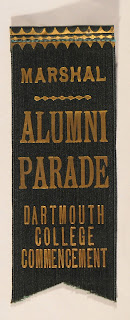
A dark green ribbon with gold text reading "Marshal Alumni Parade Dartmouth College Commencement."That would be Dartmouth Green not Irish Green, despite the time of year.  Why Green and how was it chosen? It's a question that has been asked often over the years, and, nearly as often, has elicited a different answer.

The class of 1866 claims that they were the ones who came up with the idea of a school color and were also responsible for choosing the color green. J. E. Johnson '66, wrote a short discourse in the Bema (a student magazine) in 1917, where he made the claim on the part of his class. According to Johnson, Harvard started the idea of school colors and "passed the buck Dartmouth." A committee of the senior class (the Class of 1866) was appointed to determine a color, but they could not decide. So, they asked the two "best known and best loved young women in town": Sally Smith and Kate Sanborn, the daughter of the president and a professor respectively. The two women decided promptly on green "as being the handsomest of all colors."

Green with envy the Class of 1867 refutes this saccharin story. According to an article by Professor Bartlett published in the Dartmouth Bi-Monthly, William Ketcham, '67, claims the idea of a school color was brought to Dartmouth's attention by Amherst College. He says that Amherst came up in 1866 to teach the Dartmouth men the new game of baseball and arrived flying the College colors (purple in Amherst's case). Not having a color rankled the Dartmouth team. "Sixty-six did nothing about it, however, and it was not until '67 came to the front as the senior class that anything was done."

A page printed with black and red text. A square of fabric is affixed to the page.
Frederick G. Mather, also '67, supports Ketcham's claim that it was their class who chose the color, but he has a different story about how it came about.  Mather points to their classmate Alfred A. Thomas as the "originator, promoter and executor of the idea." He claims, and a Dartmouth article from the time period bears out, that Thomas attended a regatta in 1866 where Harvard and Yale turned out with school colors (crimson and blue), but Dartmouth had no color.

None of the '67s cast much light on why they chose the color green, though there is a claim that it was the only "primary" color left (we aren't exactly sure what they considered "primary," we learned it was red, yellow, and blue in our primary school). There was no talk of symbolism or meaning behind the choice.

There is less disagreement over the shade of green. And here we have evidence to turn to. In Rauner's collection is a framed ribbon that is claimed to be the original green selected at the mass meeting in (sic) the fall 1866.

So on March 17th you can wear your green whether it is for St. Patrick's Day or because you are a Dartmouth student or alum, or both.

Ask for: Vertical File: Dartmouth Green (color); and Realia 179, The Dartmouth College Color

Friday, March 11, 2011

Fit for a Princess

A photograph of a hand holding a small leather book with gold stamping.We have a number of Books of Hours in the collection, but this is one of the smallest, with each of its one hundred and fifty six parchment leaves measuring just over three inches tall and two inches wide. This tiny illuminated manuscript was made for a little girl, probably a young French princess, sometime between 1525 and 1545.

Books of Hours contained a selection of prayers and psalms meant to be read by their owners throughout the day. The text of the prayers in this little volume is relatively large and very legible despite the tiny size of its pages, indicating that its reader, perhaps, was still very young. The amount of decoration in Books of Hours varies greatly; some are very plain while others include multiple full-page illustrations and decorated initials. This Book of Hours contains no portraits or miniatures, but nearly every page is decorated with colored inks and illuminated with gold leaf -- it's a clearly book that was meant to be pretty.

A photograph of a hand holding a small book open. The pages are handwritten with decorative initials.
Sometime in the 19th century, this book's owner had it rebound in a beautiful but very tight leather binding. The word "tight" refers to the fact that the parchment leaves are sewn together so closely that it is now impossible to open the pages flat or to see their inside margins (from a blogger's perspective, it also makes this book really difficult to photograph!).

Ask for Manuscript Codex 003197 to see this treasure for yourself.

Posted for Anne Peale '11

Tuesday, March 8, 2011

Cork: The Other Brown Paper

A colorfully printed title page on brown paper.One of the most unusual items in Rauner's collections is a lavishly illustrated and illuminated edition of Don Quixote printed on cork. Published in San Feliú de Guixols (a municipality in Catalonia, Spain) in 1955, the edition marks the 350th anniversary of the first printing of Cervantes' classic. According to the dedication, the text is taken from the 1907 edition with illustrations from the 1780 Real Academia Española edition.

This edition is actually one of several printed on cork. The first was published in 1905 - presumably to mark the 300th anniversary of Don Quixote. Other cork editions include a 1906, 1907, 1933, and a recent 2005 version printed in Portugal.

But why cork? Cork is one of Spain's most well known exports and Catalonia is one of the leading areas of production of the material. Don Quixote is the most well known literary work of the country. Perhaps this is an expression of national pride with a twist of commercialism thrown in. Spanish culture and Spanish goods in one luxury package.

A brown case with a red and gold title impressed into it.
Cork box that houses the two volume set.

Ask for Bryant PQ6323 .A1 1955

Friday, March 4, 2011

Bass on Rhus Vernix and Magnolia Glauca

A watercolor illustration of a magnolia branch, including a blossom, bud, and leaves.The College Archives collection of theses from the Dartmouth Medical School covers the years 1815 to 1882. Seth Bass' 1815 A Dissertation on the Poisonous qualities and on the Medical properties of the Rhus Vernix and on the Medical Properties of the Magnolia Glauca, includes this beautiful watercolor sketch of a Magnolia Glauca, along with sketches of other magnolias and of the Rhus Vernix. Unfortunately, most of the theses are far less decorative. They do, however, cover a wide range of medical topics and diseases, from diabetes to animal magnetism, documenting the progress of medical knowledge and practice during most of the 19th century.

A watercolor illustration of Rhus Vernix, a stem of several pointed leaves with smooth edges.
Rhus Vernix
We know very little of Dr. Bass’ life and medical career. He was born in Quincy, Massachusetts, in 1780, and received his medical degree from Dartmouth in 1815. In 1824, he was hired by the East India Marine Society in Salem, Massachusetts, to organize and oversee the Society's extensive collection of artifacts. In 1825, he became the librarian of the Boston Athenaeum, a position he held until 1846. Upon his retirement, the trustees of the Athenaeum gave Dr Bass $1,000 as an indication of their esteem and gratitude for over 20 years of service. Ultimately, Dr. Bass removed to Stow, Massachusetts, his eyesight too poor to allow the practice of medicine. He died there in December 1867.

A handwritten title page for a thesis on the poisonous and medicinal properties of Magnolia Glauca and Rhus Vernix.
Title page to Bass' thesis.
Ask for DA-3 to see this and other theses.  Box 9873 contains Bass' thesis.