Friday, June 4, 2010

Customs and Occupations of India and Ceylon

A watercolor illustration of a woman in colorful clothing and heavy jewelry, with a man in plainer clothing on either side. A handwritten caption reads "Dancing girl and her assistants."In January 1844, the Rev. Daniel Poor, Class of 1811, sent a package to his classmate the Rev. William Cogswell. At that time, Cogswell was a professor of history at Dartmouth and a member of the Northern Academy of Arts and Sciences, an organization established in 1841 to provide an opportunity for Dartmouth students, faculty and local ministers to exchange their "views on great and important subjects."

A watercolor illustration showing two figures. On the left is a woman in gold jewelry and red clothing, balancing a basket on her head. On the right is a man wearing white and red shorts, and a red headpiece or turban. He is holding a knife and a basket. The handwritten caption reads "Gardener."Rev. Poor spent his life as a missionary and educator, primarily in Ceylon. His package to Rev. Cogswell contained a selection of several items which he felt would be of interest including a grammar of the Tamil language, issues of The Morning Star (a newspaper published by the American Mission Press in Jaffna), a Tamil geography, and a volume of "native paintings." This volume contains over 90 original watercolors and depicts people of various occupations and castes in India and Ceylon.

Poor's gifts were held within the Northern Academy's library which was taken into the general Dartmouth Library collection upon the Academy's dissolution in 1904.

Ask for Rauner Codex 001971 to see the original watercolors.

Tuesday, June 1, 2010

Ahab's Bible

The title page for a 1795 edition of the Holy Bible.It is always interesting when a book transforms from a carrier of a text into an object of veneration. Most late-18th-century editions of the English Authorized Bible are not particularly rare, and in many library collections they would not be housed in Special Collections. But, sometimes something happens to a book in its life that brings it new meaning through association and turns it into a coveted, precious object. In this case, our copy of The Holy Bible (Edinburgh, 1795) once belonged to Valentine Pease, the captain of the whaling ship "Acushnet." Even with that information, this still might be meaningless, but devotees to Herman Melville know that is the ship Melville served on, and that makes this "Captain Ahab's bible."

A page of handwritten notes.I was once showing a book like this to a group of students, and one perceptive member of the class commented that the book had become "encrusted with culture." I have hung onto that phrase because it so beautifully captures the concept: the book is just an old book, but its cultural associations have given it new weight and meaning. That disappears as soon as the association is broken.

Come and take a look (and see if you can still smell the sea spray) by asking for Rauner Melville BS185 1795 .E42.

Thursday, May 27, 2010

To Those Who Served…

A photograph of Howard Buchard Lines in uniform, standing in front of an ambulance car.At the bottom of the Baker Library west stairwell, down in the basement, behind a propped open door, is a memorial that often goes unnoticed. It commemorates the service of Howard “Rainy” Burchard Lines, 1912.

After graduating from Dartmouth, Lines went on to attend Harvard Law School. When the First World War broke out it was all his friends and family could do to persuade him to finish his studies. Upon graduating from Harvard, he joined the American Ambulance Field Service (a medical service run by American volunteers) in France. From September to December 1915 he drove a Model T Ford Ambulance ferrying wounded French Soldiers from the front to a field hospital.

A photograph of the Lines Memorial in Baker Library, a board of materials behind glass.
Lines Memorial in Baker Library

In the spring of 1916 Lines was taken ill with appendicitis and was operated on a second time for an abdominal injury received from lifting wounded soldiers. He returned to service in September of 1916. In November he wrote to his friend and classmate Conrad Snow, 1912, still at Harvard, “I left Paris the middle of September at the helm of a three ton White truck with a trailer consisting of a completely equipped field kitchen. Toured France more or less thoroughly and managed to keep from sideswiping anything although the trailer had several narrow shaves.” He went on to describe his billets:
We are right on the edge of some wooded foothills and work two posts. The rest of the time there is some evacuation work but on the whole about a quarter of the cars can handle a day’s work. Our living quarters while by no means luxurious, are quite comfortable and a little ingenuity has done a lot towards covering up the worst and making the best out of the rest. I wish you could drop in and see us for our comfort goes the whole length and we have tea in the afternoon!

A handwritten letter.
A military postcard and packet.
Lines post to Snow, December 22, 1916Lines post to Snow with postcard packet from which it was removed

Soon after writing this letter Lines came down with a cold that developed into pneumonia. On December 22nd he wrote to Snow again, asking him to raise money for a hospital bed.

Dear Snowball,

Many thanks for the poster you sent; even tho’ your name was not on it the family decided it was from you. I have a pleasant little amusement for you to while away the long winter days. They are getting us a college ward in the Ambulance and we should like awfully to have a Dartmouth bed. Do you think you could collect 600 Dollars to support a bed (with a patient in it) for 1 fl. year It would then have a neat brass plate affixed to the wall behind it proclaiming Dartmouth to the world. I am so glad you are for preparedness. Merry Christmas and a happy New Year, Rainy C. Lines.

Lines posted the card, but died the next day. Snow followed Lines’s last wish and solicited his class. He had no trouble raising the $600 in memory of his friend and classmate. The French Government awarded Lines the Croix de Guerre posthumously in honor of his service.

A photograph of two men in side-by-side hospital beds.
The Dartmouth hospital bed (left) donated in Lines memory and one (right) donated by Lines parents
So the next time you’re in Baker Library, take a minute visit the basement and honor the memory of Howard Lines, one of the many Dartmouth Alumni who gave their lives in the service of their country, or come to Rauner and see Lines’s letters to Snow and other records related to his service.
  • The Conrad E. Snow papers, MS-942
  • Material relating to the American Ambulance Field Service in World War I, 1914?-1922, n.p., MS-452
Other collections documenting Dartmouth alumni who served in the American Ambulance corps:

Tuesday, May 25, 2010

Orozco at Dartmouth

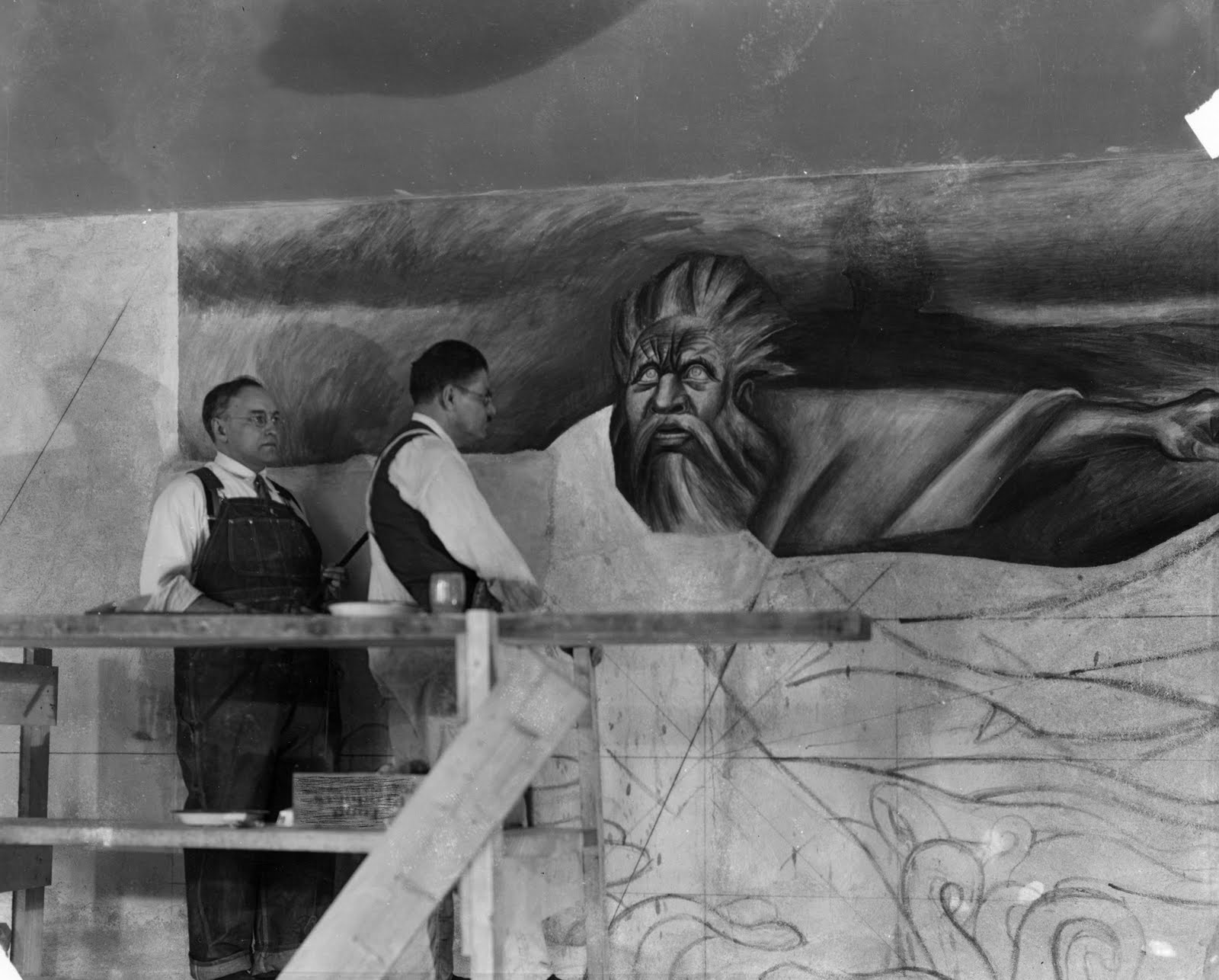
A photograph of two men examining an unfinished mural.José Clemente Orozco came to Dartmouth in 1932 at the invitation of art history professors Artemas S. Packard and Churchill P. Lathrop.  His mural The Epic of American Civilization consists of twenty panels which depict the history of the Americas, from the pre-Hispanic to post-colonial periods.  The west wing of the Reserve Corridor in Baker-Berry Library is devoted to the early rise of civilization while the east wing focuses on modern industrial society.  Taken in 1932,  this image shows Orozco and Leo Katz working on the panel The Coming of Quetzalcoatl.

A photograph of an unfinished mural.The Hood Museum's website contains additional information about the murals and the artist, as well as audio tours, a detailed brochure, and visitor guides.  Background information about the murals, including correspondence and other materials can be found in Rauner Library.

Don't miss the "test panel" located off of the west side of the Reserve Corridor titled Man Released from the Mechanistic to the Creative Life.

Friday, May 21, 2010

The Censor's Pen

A page of printed text, with a large section struck through.When someone mentions censored books, they usually think of entire texts being suppressed or offending passages expurgated from novels. However, there is a long tradition of censorship that allows the reader access to the text while still explicitly indicating its heretical or unsuitable nature.

This 1576 edition of Aristotle's Poetica was placed on the Index librorum prohibitorum not because there was a problem with Aristotle, but because Lodovico Castelvetro's neoclassical commentary offended church doctrine. Castelvetro was excommunicated from the church for his alleged protestant sympathies and his writings were subject to intense scrutiny.

A closer image of the struck-through text.The censorship resulted in the careful crossing out of all heretical statements, while keeping the book, and the text itself intact. One has to wonder how a 16th-century reader would have read this text after the censors had finished their work. Would one read the censored parts, skip over them, or, perhaps, dive deeper into those passages? A truly pious reader might encounter these sections and examine them to understand why they were heretical, and thus mentally rehearse prescribed belief. Could providing access to the text, even while condemning it, actually have helped cement established doctrine in the inquisitive reader's mind?

See for yourself by asking for Rare PN1010.A73P1 1576

Tuesday, May 18, 2010

Pokagon's Red Man's Rebuke

A cover for "The Red Man's Rebuke."At the 1893 Columbian Exposition in Chicago, Potawatomi Indian Simon Pokagon sold a booklet entitled The Red Man’s Rebuke and its second edition, entitled The Red Man’s Greeting. Each booklet measures about three and a half inches tall by five inches wide and is sixteen pages long; the text is letterpress printed directly on the bark of a white birch tree.

This description is from Dartmouth MALS student Alex Corey, who has just published an essay on The Red Man’s Rebuke, "Fair Material," in the Winter 2010 issue of the MALS Quarterly.  The following is an excerpt:

The birch bark pages are the vessel for a fiery political argument, written from the perspective of a Native American spokesman and targeting a clearly white American audience. This first sentence makes it clear that the booklets are meant as political protests against the Columbian Exposition.  Pokagon’s booklets go on to lay bare, in their 16 pages, the violent and unjust treatment of the Native Americans by white America.

A page from "The Red Man's Rebuke," featuring an illustration and a block of verse.The text argues that Europeans were initially pests and parasites to the natives, as they ‘locust-like… and like the carrion crows in spring…gobbled in our ears, “give us gold, give us gold;” “Where find you gold? Where find you gold?”’(Rebuke 3). The main text documents the evils of alcohol, and tells in strong and articulate language how “again and again [the Native American’s] confidence was betrayed”(Rebuke 11). It ends by speculating a judgment day in which God says to the white man(Rebuke 16):
I shall forthwith grant these red men of America great power, and delegate them to cast you out of Paradise, and hurl you headlong through its outer gates into the endless abyss beneath—far beyond, where darkness meets with light, there to dwell, and thus shut you out from my presence and the presence of angels and the light of heaven forever, and ever.
You can read the rest of Alex Corey's essay in the Winter 2010 edition of The MALS Quarterly and see the original birch bark book by asking for Rauner Presses E58p.

Friday, May 14, 2010

Junk in Rauner

A cover for the pulp paperback "Junkie," featuring a man wrestling a hypodermic from a woman.Sometimes Junk proves to be pretty cool. Pictured here is our first edition of William Burroughs' Junkie (New York: Ace Paperback, 1953). This book is a real rarity. Frequently a book is first printed and marketed as "a modern masterpiece sure to become a classic." But so few books do, and most that make the claim when they are first published fade quickly. In the case of Burroughs' first novel, it was originally printed and marketed as ephemeral pulp fiction dos a dos with Narcotic Agent. Burroughs himself distanced himself from the work by publishing it under the name of his alter ego William Lee (our copy is inscribed "William Burroughs for William Lee").

A cover for the 50th anniversary edition of "Junky," featuring a cartoon of a syringe with a face in it.Fifty years later, it was a modern masterpiece on its way to becoming a classic. The contrast between the first edition and the 2003 Penguin edition could not be much more stark. The "Confessions of an Unredeemed Drug Addict" had become "The Definitive Edition of Burroughs' Seminal First Novel" with lots of scholarly apparatus: an extended introduction by Oliver Harris (with footnotes!), seven appendixes, including a variant of Chapter 28, and a glossary. The spelling of the title was restored to Burroughs' original, the title page references the manuscript title "Junk" and the Burroughs' name appears prominently on the title page and cover.

The cover for the pulp paperback "Narcotic Agent," featuring a woman seated at a table covered in cigarettes and a needle, as the hands of a man come into view and place handcuffs on one wrist.It is interesting to think about how someone who had never heard of the book would approach these two editions: my guess is that if they hit a line in the 1953 edition that didn't make sense they would say, "This William Lee is a bad writer," but if they hit the same line in the 2003 edition, they might worry, "Maybe I am not smart enough to understand this book..." One privileges the reader, the other the writer.

To see the original pulp fiction "classic" ask for Rare PS3552.U75J86.