Friday, January 26, 2024

White Sheiks and Flappers

First page of letter from Eastman to WahsburnPreparing for a visit from a delegation of the Osage Nation, we made a stunning discovery in our collection: a letter written in November, 1924, from the Osage reservation by Charles Eastman, Class of 1887, to Carl Washburn, Class of 1925. Eastman was a Dakota Sioux who became a physician after he left Dartmouth. He was a life-long advocate for Indigenous rights, and frequently acted as an intermediary between the U.S. Government and various tribal nations. In 1924, the Department of the Interior sent him to Oklahoma to report on the conditions of the Osage at the height of the oil boom.

His description mirrors the opening scenes of Killers of the Flower Moon. He describes the sudden influx of phenomenal wealth and its impact on the community. He is obsessed with the cars--limos everywhere and a car for every member of the family!

Black Gold letter excerpt

He also visits Rosa Hoots, the Osage woman who owned and cared for that year's Kentucky Derby winner, the aptly named "Black Gold." Then there is his concern with the predatory behavior he sees: dope dealers and bootleggers everywhere, and "white sheiks and flappers" trying to marry into Osage families for their wealth.


Part of what makes the letter so great is its informal nature. Eastman was writing to a young friend who he had helped to get into Dartmouth. This is not his official government report, but an opportunity for Eastman to express his own amazement and concerns. If you have seen the movie or read the book, you have to take a look at this letter.

To see it, ask for MS 924110.1.

Friday, January 19, 2024

A Medieval "Book of Roots"

Original leaf written in Sephardic script on the right (ff. 264v) later replacement text written in Yemenite script on the left (ff. 265r)The Kimḥi family of Provence was a celebrated medieval Jewish family of biblical commentators and Hebrew grammarians. Rabbi Joseph Kimḥi and his two sons Moses and David were each renowned scholars in their own right, but Rabbi David Kimḥi (1160-1235 C.E., commonly known by his Hebrew acronym "Radak") was the most celebrated of all.

Rauner recently acquired a manuscript of Kimḥi's Hebrew lexicon, Sefer ha-Shorashim (literally translated as "book of roots.") First composed in the late 12th-early 13th century, the Radak's Sefer was one of the most influential Hebrew dictionaries in the medieval period. The entries are arranged alphabetically around the three-letter shorashim, or "roots," common to most Hebrew words, with quotes from religious texts and explorations of etymology.

Our handwritten copy of the Sefer was likely produced by a Sephardic Jewish scribe in Southern France or Northern Italy ca. 1370-1430 C.E., more than a century after Kimḥi’s death. Most of the pages are written in a consistent Sephardic semicursive script, on laid paper common in parts of France and Italy in the late 14th and early 15th centuries. It is possible that this scribe, like the Radak himself, was a descendant of Spanish Jews (Sephardim) who fled persecution and settled in the French region of Provence, which during the Kimḥis' time was a flourishing center of Torah scholarship known as Hachmei Provence.

By the 16th century, our copy had found its way from Provence to Yemen, where a Yemenite Jewish scribe painstakingly copied missing leaves and added some of his own marginal notes to the Radak’s text. Subsequent Yemenite owners of this Sefer also proudly scrawled their names and statements of ownership on the first and last leaves of the tome. After all, to own such an old copy of this famous work would have been quite the status symbol, testifying to the owner's material wealth, as well as his intellectual gravitas.

If you can read Hebrew but are still struggling to parse this 18th century inscription, there's a reason for that. It is partially written in Judeo-Arabic, a dialect of Arabic historically spoken by Jews in Arab countries, written using the Hebrew alphabet. Luckily, the dealer provided a translation of the message, which includes a fabulous book curse:

"I merited to purchase this Sefer ha-mikhlol through the labors of my hands. May the blessed Omnipresent give me the privilege to immerse myself in it—I, my descendants, and my descendants' descendants until the last generation. Amen, so may it be [His] will. He who takes it and does not return it—may his name and memory be obliterated from the world, and may he be bitten by a snake. But may the nation of God dwell in peace. [Signed] the humble Joseph, son of our teacher Shuker al-Sarem, may his Rock and Redeemer keep him and may his end be good."


Joseph ben Shuker al-Sarem's 18th century inscription wishing book thieves a snake bite.

To see our copy of the Sefer ha-Shorashim, come in and ask for Codex 003515.

Friday, January 12, 2024

Winter 23 Exhibit: The Whirligig of Time

Last year marked the 400th anniversary of the printing of William Shakespeare’s First Folio. To commemorate the occasion, students in Professor Matthew Ritger’s F23 ENGL 15 Shakespeare course curated seven mini-exhibitions that look through a variety of lenses at the connections between Shakespeare and Dartmouth College.

Their collaborative effort, titled “The Whirligig of Time: Shakespeare in the College Archive, 1623-2023,” is on display in the Class of 1965 Galleries here at Rauner through March 15, 2024. For more information, including a handlist of materials, exhibit case text, and a downloadable version of the exhibition poster designed by Sam Milnes, visit the website. If you'd like to see Shakespeare's First Folio, which isn't in the exhibit, come into the Reading Room and ask anyone at the reference desk.

Tuesday, January 2, 2024

Catching a Break

Rebound cover of Catcher in the Rye, red calfskin with gold toolingOn January 1, 1953, J. D. Salinger left New York City, where he was born and raised, and relocated to the small town of Cornish, New Hampshire. Coincidentally, New Year's Day was also his birthday. Salinger was known to be a private person and the enormous success of his novel Catcher in the Rye (1951) had brought him too much attention in his hometown. So, he escaped the big city to live in a tiny cabin with no heat or running water. Cornish already had a positive reputation among creatives; it had been the residence of sculptor Augustus Saint-Gaudens and the Cornish Artists' Colony before the collective's gradual dissolution in the early 20th century. Several months later, in April of 1953, a collection of his short stories, Nine Stories, was published. Salinger lived in Cornish until his death in 2010.

Here at Rauner, we have first editions of Catcher in the Rye and Nine Stories, both signed by Salinger in Hanover on December 17, 1953, nearly a year after he had made the switch to rural life. The circumstances surrounding the autographs are unclear, but we love to imagine this reclusive writer availing himself of our resources during his first year here in the Upper Valley. To see our copy of Catcher in the Rye, ask for Rare PS3537 .A426. Our first edition of Nine Stories is Rare PZ4 .S165 Ni 1953.

Thursday, December 21, 2023

Yule and Misrule

Lankes woodcut of "Yule! Yule"With the holidays incoming, we're taking a moment to share some festive illustrations from the papers of J.J. Lankes. Lankes was a 20th century American artist who worked primarily in woodcuts like the ones shown here, and illustrated the writing of authors such as Robert Frost.

Both of the prints selected here refer to older folk customs associated with the end of the year. The first shows a costumed procession, including a man on a hobby horse, playing music and holding up greenery, accompanied by the words "Yule! Yule"!" This might be a representation of a mummer's play or a wassailing group, both raucous theatrical performances conducted in England around Christmastime.

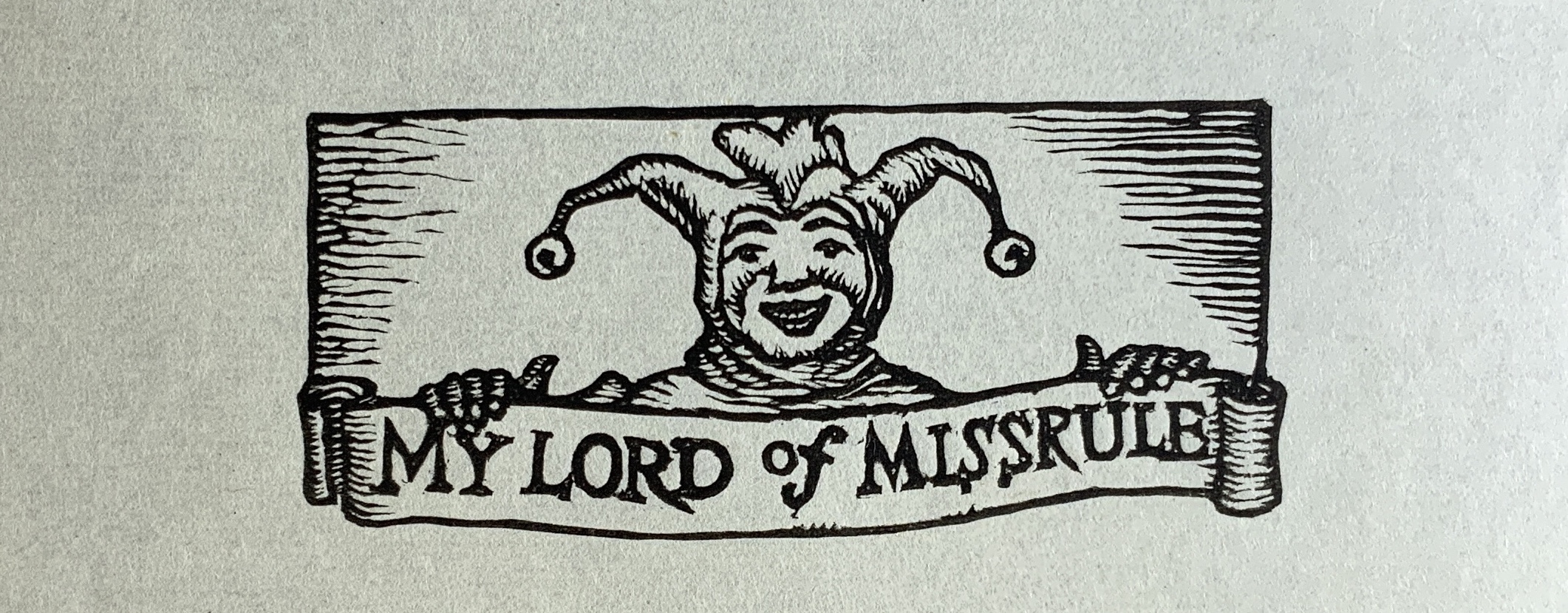
The other print we've pulled out today is "My Lord of Missrule." This little jester would have appointed, likely from the lower clergy, as a sort of officiant for the Feast of Fools, a medieval celebration conducted on the 1st of January.

Lankes woodcut of "The Lord of Misrule"

To check out these illustrations (and others!), ask for MS-1115 Box 7 Folder 6.

Friday, December 15, 2023

Captured!

Woodcut of author attempting to escape and being tortured
We have lots of various captivity narratives in our collection. They are usually sensationalized stories set in New England--stories of terror designed to frighten and titillate. There is almost always a racially charged dichotomy set up between the "savage" and the "civilized" reflecting the pervading fears of the white settlers. We just acquired a new one that is both very different and still frighteningly similar. In this second edition of Bartolomej Georgijević's De afflictione tam captivorum quam etiam sub Turcae tributo viuentium Christianorum (Worms: excudebat Gregorius Comiander, 1545), the captive is a Croatian captured and enslaved by the Ottoman Empire. The same tropes appear: a good Christian is captured by a threatening non-Christian other and forced into servitude. 

Interestingly, Georgijević was also a talented linguist and the slender volume contains a basic Latin to Turkish lexicon and a short Croatian-Latin dictionary. The book took off, as so many captivity narratives did, and served as a highly biased account of Turkish culture at a time when Europe was both fascinated and terrified of that which lurked just to the East.

To take a look (it has seven wonderful woodcuts), ask for Rare DR481 .G46 1545.

Friday, December 1, 2023

Frankenstein on Stage

Depiction of O. Samson in costume as Frankenstein's MonsterMary Shelley's Frankenstein wasn't just a hit in the bookstores. Just a few years after its publication it was adapted in 1823 as Presumption! or the Fate of Frankenstein, and then again a few years later, in 1826, as The Man and the Monster! or, the Fate of Frankenstein. The two shows appear to have competed against each other for a period of time in London. We have a set of playbills for Presumption! from the Theatre Royal, English Opera House, on the Strand, starting in 1823 and running through 1827. Then we have the script for the 1826 production of The Man and the Monster! "as it is performed at the London Theatres."

Playbill for August 15, 1823, performance of PresumptionBoth the playbill and the script give us all kinds of information about the productions. The August 15, 1823, playbill for Presumption! states it is the 16th performance and they have added new scenes. By 1827 it has a whole new ending "comformably to the termination of the original Story" with a "schooner in a violent storm." Apparently you could keep them coming back if you just kept changing the play. The 1827 playbill has the dream double feature--the evening's entertainment opened with The Vampire!, the stage adaptation of another story conceived late one night on Lake Geneva, followed by Frankenstein.

The script gives us the original cast, instructions on costuming and the basic stage set, but most importantly it shows the actor who played the monster in costume, making this the earliest depiction of the monster.

August 3, 1827, playbill for the Vampire and Presumption

When you come in to see them, be sure to ask for the 1831 edition Shelley's classic--it is the first time the Monster's image appears in the novel. You can see the script by asking for Rare PR5021 .M62 M3 1826. The Playbills are in MS-1414, Box 1, and the 1831 third edition is Rare PR5397 .F7 1831.