Tuesday, January 2, 2024

Catching a Break

Rebound cover of Catcher in the Rye, red calfskin with gold toolingOn January 1, 1953, J. D. Salinger left New York City, where he was born and raised, and relocated to the small town of Cornish, New Hampshire. Coincidentally, New Year's Day was also his birthday. Salinger was known to be a private person and the enormous success of his novel Catcher in the Rye (1951) had brought him too much attention in his hometown. So, he escaped the big city to live in a tiny cabin with no heat or running water. Cornish already had a positive reputation among creatives; it had been the residence of sculptor Augustus Saint-Gaudens and the Cornish Artists' Colony before the collective's gradual dissolution in the early 20th century. Several months later, in April of 1953, a collection of his short stories, Nine Stories, was published. Salinger lived in Cornish until his death in 2010.

Here at Rauner, we have first editions of Catcher in the Rye and Nine Stories, both signed by Salinger in Hanover on December 17, 1953, nearly a year after he had made the switch to rural life. The circumstances surrounding the autographs are unclear, but we love to imagine this reclusive writer availing himself of our resources during his first year here in the Upper Valley. To see our copy of Catcher in the Rye, ask for Rare PS3537 .A426. Our first edition of Nine Stories is Rare PZ4 .S165 Ni 1953.

Thursday, December 21, 2023

Yule and Misrule

Lankes woodcut of "Yule! Yule"With the holidays incoming, we're taking a moment to share some festive illustrations from the papers of J.J. Lankes. Lankes was a 20th century American artist who worked primarily in woodcuts like the ones shown here, and illustrated the writing of authors such as Robert Frost.

Both of the prints selected here refer to older folk customs associated with the end of the year. The first shows a costumed procession, including a man on a hobby horse, playing music and holding up greenery, accompanied by the words "Yule! Yule"!" This might be a representation of a mummer's play or a wassailing group, both raucous theatrical performances conducted in England around Christmastime.

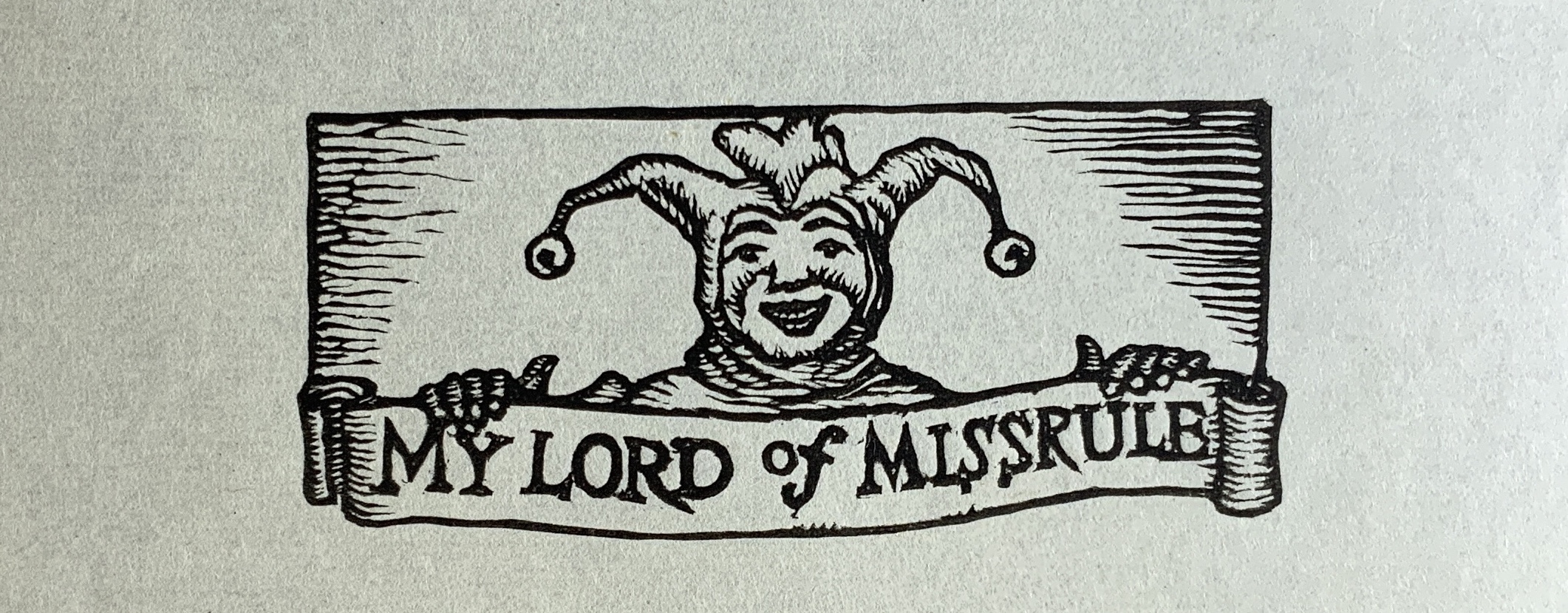
The other print we've pulled out today is "My Lord of Missrule." This little jester would have appointed, likely from the lower clergy, as a sort of officiant for the Feast of Fools, a medieval celebration conducted on the 1st of January.

Lankes woodcut of "The Lord of Misrule"

To check out these illustrations (and others!), ask for MS-1115 Box 7 Folder 6.

Friday, December 15, 2023

Captured!

Woodcut of author attempting to escape and being tortured
We have lots of various captivity narratives in our collection. They are usually sensationalized stories set in New England--stories of terror designed to frighten and titillate. There is almost always a racially charged dichotomy set up between the "savage" and the "civilized" reflecting the pervading fears of the white settlers. We just acquired a new one that is both very different and still frighteningly similar. In this second edition of Bartolomej Georgijević's De afflictione tam captivorum quam etiam sub Turcae tributo viuentium Christianorum (Worms: excudebat Gregorius Comiander, 1545), the captive is a Croatian captured and enslaved by the Ottoman Empire. The same tropes appear: a good Christian is captured by a threatening non-Christian other and forced into servitude. 

Interestingly, Georgijević was also a talented linguist and the slender volume contains a basic Latin to Turkish lexicon and a short Croatian-Latin dictionary. The book took off, as so many captivity narratives did, and served as a highly biased account of Turkish culture at a time when Europe was both fascinated and terrified of that which lurked just to the East.

To take a look (it has seven wonderful woodcuts), ask for Rare DR481 .G46 1545.

Friday, December 1, 2023

Frankenstein on Stage

Depiction of O. Samson in costume as Frankenstein's MonsterMary Shelley's Frankenstein wasn't just a hit in the bookstores. Just a few years after its publication it was adapted in 1823 as Presumption! or the Fate of Frankenstein, and then again a few years later, in 1826, as The Man and the Monster! or, the Fate of Frankenstein. The two shows appear to have competed against each other for a period of time in London. We have a set of playbills for Presumption! from the Theatre Royal, English Opera House, on the Strand, starting in 1823 and running through 1827. Then we have the script for the 1826 production of The Man and the Monster! "as it is performed at the London Theatres."

Playbill for August 15, 1823, performance of PresumptionBoth the playbill and the script give us all kinds of information about the productions. The August 15, 1823, playbill for Presumption! states it is the 16th performance and they have added new scenes. By 1827 it has a whole new ending "comformably to the termination of the original Story" with a "schooner in a violent storm." Apparently you could keep them coming back if you just kept changing the play. The 1827 playbill has the dream double feature--the evening's entertainment opened with The Vampire!, the stage adaptation of another story conceived late one night on Lake Geneva, followed by Frankenstein.

The script gives us the original cast, instructions on costuming and the basic stage set, but most importantly it shows the actor who played the monster in costume, making this the earliest depiction of the monster.

August 3, 1827, playbill for the Vampire and Presumption

When you come in to see them, be sure to ask for the 1831 edition Shelley's classic--it is the first time the Monster's image appears in the novel. You can see the script by asking for Rare PR5021 .M62 M3 1826. The Playbills are in MS-1414, Box 1, and the 1831 third edition is Rare PR5397 .F7 1831.

Wednesday, November 22, 2023

Springtime Dreams

A handwritten letter from Robert Frost.

In the winter of 1956, Robert Frost made inquiries about acquiring apple trees for his home in Ripton, Vermont. Ira Glackens, a farmer with an orchard in New Hampshire, was only too happy to provide:

It would be a signal honor for me to supply some scions to Robert Frost, -- I am almost tempted to write to Mr. Frost myself, so many years have I been devoted to his poetry. And he wrote, ‘Goodby and Keep Cold’, my favorite poem about Apple trees. 

I can offer, but not in large quantities in most cases, the following which you name; Red Astrachan; Porter; August Sweet (which is the same as Sweet Bough); and Sops of Wine (Sopsevine). A neighbor has the Old Peach, or Montreal Peach. I cannot supply the original Duchess, but only the later sub-variety, Red Van Buren. I do not have Gravenstein, as I lost both trees I set out.

Frost’s response is enthusiastic: “Your letter fills my hibernation with springtime dreams…” The two go on about his aspirations for apple trees, more thoughts on different varieties, and the best way to get new trees started and producing fruit early.

To read the whole of this correspondence, ask for MS-1178, Box 15 Folder 1. To read the first appearance of "Good-by and Keep Cold" in print, ask for MS-1178, Box 32 Folder 17.

Friday, November 10, 2023

The First Bartender's Guide

How to Mix Drinks Preface image of man holding a drink as a muse emerges from a bottle
Drinking has been around pretty much forever, but it took some time before anyone got around to creating a guide for the budding mixologist. In 1862, the publisher Dick & Fitzgerald stepped in to fill the void with How to Mix Drinks, or, The Bon-Vivant's Companion. It has one of those title pages that tells you everything--practically a table of contents. There is an introduction that carefully distances the author, Jerry Thomas, from advocating for the consumption of ardent spirits, but the details inside, as well as the illustration of the sot with a muse emerging from a bottle tell us otherwise.

Title page of How to Mix Drinks
There are lots of great recipes, but we were taken by the list of other publications of the firm with titles like: Hard Words Made Easy; The Mother's Medical Advice; The Art of Conversation; The Ladies' Guide to Beauty; and Every Woman her own Lawyer. Dick & Fitzgerald created a self-help wonderland for the young and naive seeking to make their way in the world. But perhaps the most fitting companion volume to How to Mix Drinks is the must-read Blunders in Behavior Corrected, because, you know after you've been drinking, you might need to correct the blunders in your behavior.

Cover of How to Mix Drinks showing a well-dressed man holding a drink

The binding is a stunner, and this particular book resides in our Bindings Collections. Just ask for Bindings 178 to see it.

Friday, October 27, 2023

The Devils at Dartmouth

Program cover for Whiting's The Devils
“This play is based upon historical fact.” So begins the text of a program we found recently for a play written by John Whiting and produced by Dartmouth in 1974. “The Devils,” itself an adaptation of a book by Aldous Huxley, tells the story of the Loudun possessions, in which a 17th-century convent of nuns claimed en masse that they were being possessed and harassed by demons. These declarations led to the trial and execution of a local priest, Urban Grandier. Huxley’s book asserted that the accusations against Grandier were motivated by the Mother Superior’s own personal obsession with him.

Huxley’s book (and John Whiting’s play) served as the basis for a controversial 1971 film also called The Devils. Rendering the story as an epic drama filled with sexuality, violence, blasphemy, and a depiction of the Catholic Church as deeply corrupt, The Devils was largely panned, heavily censored, and condemned by the Vatican as “an insult to cinema” and “a crude lynching of the Church of yesterday, of today, of all time, as a political instrument of oppression."

As such, we’re a little surprised to find that the play, though somewhat separate from the film, was put on at Dartmouth three years later. Notably, and perhaps as part of an effort to create something more careful in its depiction of the Church, the program thanks multiple members of the clergy for their assistance with the play. The director’s note consists, in its entirety, of a quote from William Peter Blatty’s The Exorcist, which had been adapted into its own controversial film the year before. The director, Robert Pridham ’74, stated “I know it sounds like we’re climbing on the ‘Exorcist’ bandwagon, but I’ve actually wanted to do this play since my freshman year, which was before the ‘Exorcist’ was even published.”

It’s difficult to find much more information, with the exception of some photos from the production and a couple of favorable reviews in the Dartmouth student newspaper. When referenced there, the film is described only as “widely hailed.”

To see the program for “The Devils” and a press release, ask for DA-694 Box 4082 Folder “The Devils.” To see photographs, ask for DO-60 Box 6560 Folder 9. If you want to do a deeper dive, you can find our copy of Whiting’s play (Williams/Watson PL4413) and Huxley’s book (Huxley BF1517.F5 H8 1952). If you want to see the film, you’ll have to look elsewhere.