Friday, April 15, 2022

A Woven Prayer Book

An open book with grey and black pages. The lefthand page illustrates a nativity scene.
We recently added a book to our collections created using an unconventional piece of technology: the loom. Livre de Prières tissé debuted at the 1889 Paris World's Fair as a stunning example of the artistry and technological merit of Lyon's silk-weaving industry. Ours is one of only fifty or sixty copies, all woven on a Jacquard loom.

The Jacquard loom, invented earlier in the 19th century, was a partially automated weaving machine that simplified the production of intricately patterned textiles. The weaving of individual designs would depend on a sequence of punch cards, each of which would direct mechanized hooks to lift threads as a worker sent their own thread back and forth. This mechanism is considered by some to be a precursor to early programming hardware and it's useful to imagine the loom as a computer printer, building an image one row of pixels at a time. The creators of this woven prayer book - produced in Europe's silk capital of Lyon - capitalized on the Jacquard technology to effectively "print out" 58 individual pages of text and illustrations. 

Modeled on the medieval book of hours, each page of Livre de Prières tissé is a marvel of precisely woven silk thread. While finely detailed, the Jacquard technology creates an effect that strikes the modern eye as almost pixelated, imparting a visual dissonance that only grows when examined. In The Woven Prayer Book: Cocoon to Codex, Matthew J. Westerby describes this uncanny quality as occupying a place "of both familiarity and discomfort, rooted in the way it blends the look and feel of the illuminated manuscript with the tactility and luster  of woven silk, all made possible by a complicated technology." It's an odd and lovely little book, and we recommend that you come see it for yourself! 

To see Livre de Prières tissé in person, ask for Rare Book BX2113 .A1 1886. To read more about its production and sister copies in The Woven Prayer Book, ask for Rare Book BX2113 .W47 2019.


Monday, April 4, 2022

Collective Genius

The myth of the self-made man is strong here in the United States, where it is inextricable from the American Dream. We often are tempted to idolize and then mythologize individuals who appear to have improved their own situation in life through hard work and true grit. The truth is, most of our iconoclastic heroes have relied upon a long line of minor innovations and discoveries by other people who came before them. Benjamin Franklin, Ralph Waldo Emerson, Thomas Edison, and a host of other figures have become integral threads in the fabric of our national identity based upon self-reliance.

But rarely do these myths hold up when one starts to pick at them. A great example is that of Albert Einstein. Although a brilliant theoretical physicist, Einstein relied upon other brilliant minds to support him and collaborate with him in his research. One such mind was a research assistant named John Kemeny. Kemeny, a grad student in mathematics at Princeton in the 1940s, had emigrated from Hungary because of the war. He later went on to become a professor of mathematics at Dartmouth College, where he would invent the BASIC computer programming language with colleague Thomas Kurtz. In 1970, John Kemeny became president of Dartmouth College and ushered in co-education as well as other initiatives meant to diversify the student body.

Here in Special Collections, we have evidence of the fact that it often takes teamwork, and not individual genius, to accomplish great things: an incorrect mathematical proof written out by Albert Einstein that has been dutifully corrected by Kemeny. To see it, come to Rauner and ask for MS-988, Box 22, Folder 1.

Thursday, March 31, 2022

A Subway for Hanover?

Photo of the broadside, "A Subway for Hanover?"Recently, I found this gem in our “Transportation II” vertical file, entitled “A Subway for Hanover?” Dated 1976, it lays out plans for a rural subway system that would transport Hanover denizens on such lines as the “WART,” the “CHORT,” and the “BOPFAFA-LOOP.” Between these silly names and suggestions like holding discos in the subway stations for revenue, it seemed too good to be true. But it also seemed too detailed to be fake: it includes a New York Times article, a proposed map, and even the name of the planning group. I had to know how much, if any of it, was real.

The supposed New York Times article lists various obstacles to the subway project, including that New Hampshire governor Meldrim Thomson wanted to block funding for it, and speculated to the Union Leader newspaper that “ex-convicts” could be involved. This article appears nowhere in the real New York Times archive, but I suspected that these details were satirizing something else. It turns out that in 1975, just a year before the “Subway for Hanover,” the liberal Franconia College requested a federal grant for an experimental education plan, and Thomson and the conservative Union Leader attacked the college for this plan as well as for its alleged support of “ex-convicts.”

Also according to the “NYT” article, the subway project originated at Brown University, and the broadside credits the plans to the “Carberry Research and Planning Group.” A Brown tradition, beginning with a fake lecture announcement in 1929, claimed that “Josiah Carberry” was a professor who never appeared for his speaking engagements. For decades after, Carberry’s name frequently appeared attached to joke news items. If there was still any doubt that this was intentional, the date on the bottom of the broadside fell on Friday the 13th, which would have been observed at Brown as “Carberry Day.”

But this still doesn’t answer the question: who would put so much effort into these fake Hanover subway plans? Clues are scarce, but there is one interesting coincidence. When the (legitimate) New York Times reported on the Franconia College situation, it mentioned that Arthur E. Jensen, a former professor and dean at Dartmouth College, had criticized Governor Thomson’s actions and endorsed Franconia’s plan. Even though it wasn’t much of a lead, I decided to check Jensen’s affiliate file. Imagine my shock when I opened the file to find it full of articles about the mythical Professor Carberry—because Jensen himself had made the fake posting that started it all in 1929.

Does this prove Jensen is behind the “Subway for Hanover”? Not really. And there’s a long list of other questions that remain tragically unanswered. To those who were here in 1976, we implore you to contact us with any tips you have about this mysterious broadside. In the meantime, we can rest easy knowing no one seriously planned a subway line called the CHORT.

If you want to see everything for yourself, come to Rauner and ask for the “Transportation II” vertical file or Arthur E. Jensen’s affiliate file. Or if you just want to spend a few hours solving a mystery like this one, there are plenty to be found here.

Friday, March 25, 2022

It's Not Personal, It's Business!

This year, The Godfather turns 50. Mario Puzo's Oscar-winning film adaptation of his best-selling novel, directed and co-written by Francis Ford Coppola, has mesmerized film-goers for half a century with its epic portrayal of the Corleone crime family. Some have argued that the film should have by all rights been a bomb, in part because of the questionable reputations of its director and lead actor, as well as a cast list of virtual unknowns. Instead, The Godfather exploded onto the cultural scene. It was the top-grossing film of 1972 and went on to win three Oscars that year: Best Picture; Best Adapted Screenplay, which went to Puzo and Coppola; and Best Actor, which went to Marlon Brando.

Ironically, Brando nearly lost the opportunity to play the part of Don Vito Corleone because the producers considered him a has-been whose justifiable reputation for on-set antics was too high a price to pay for his talent. In a now often-told story, Coppola was eventually able to win the studio executives over by recording an impromptu video at Brando's house of him in character as Vito Corleone. Mario Puzo also had hoped to cast Brando in the lead role but wasn't able to leverage the studio in the same way as Coppola. In a letter from the Mario Puzo Papers, held here at Rauner Library, the author and screenwriter tells Brando that the producer, Al Ruddy, was "very cool" about the idea of Brando as Corleone. He also says that he still thinks that the attempt was a "good idea" and that he's sorry to have wasted his time.

The American Film Institute has ranked The Godfather as the second-greatest film in the history of American cinema and its cinematic and well as cultural legacy still persists, even fifty years later. Now, we're going to make you an offer you can't refuse: come in to Special Collections and take a look at the Papers of Mario Puzo (MS-1371) whenever we're open. One thing, though: be sure to leave the cannoli at home.

Read the 2018 Dartmouth News story about how Rauner acquired the Mario Puzo papers here.


Friday, March 18, 2022

Lady Byron's Presence

Two-page spread of George Ticknor's diary, June 20, 1815
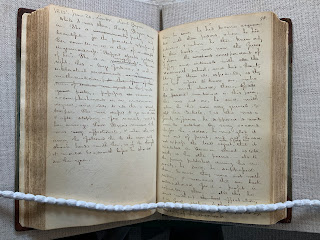
On June 20th, 1815, George Ticknor (Dartmouth Class of 1807) paid a visit to Lord Byron in London. His account, written out that evening, is fabulous. It is an excellent first-hand recording of Byron's mood as news from Waterloo was breaking. Ticknor had a cool way of writing in his journal. He would only write on every other page, leaving the recto pages blank for later reflection or additions. Opposite the third page of his entry on visiting Lord Byron, he recounts a brief encounter with Lady Byron that reveals young Ticknor didn't know how to handle her dazzling brilliance.

What makes the entry so odd is all of his self editing. Here is a transcription, pay special attention to the words and phrases he crossed out as he wrote:

While I was there Lady Byron came in. She is uncommonly pretty—not beautiful—for the prevalent expression of her countenance is that of a simple ingenuousness. “Report speaks goldenly of her”. She is a marchioness baroness in her own right, she’s a large fortune, is rich in intellectual endowments, an extraordinary a mathematician, (so that few of their men of science are equal to her) writes good poetry, possesses all common accomplishments in an uncommon degree, and adds to all this, a sweet temper. She was dressed to go and drive and after stopping a few moments, when to her carriage. Lord Byron’s manner to her was affectionate, and when she went away he followed her to the door and shook hands with her, as if he thought it would be a months before he should see her again.

Wow, those are some serious modifications. It appears at first he was awestruck: "uncommonly" pretty; "an extraordinary" mathematician on the level of the "men of science"; a "good" poet. But then he crossed out all of those qualifiers and reduced her to a pretty mathematician who writes poetry. Well, okay, but what changed from first draft to second? Perhaps he simply couldn't abide by the fact that a woman chould be so accomplished and on the level of a man. Or perhaps the force of her personality hit him with one impression that was then tempered by time. He should have been impressed with her mathematical skill--she taught her daughter Ada, who would later be credited with creating one of the first computer programs. Regardless, it is clear that Ticknor was conflicted and had difficulty coming to terms with a woman of her standing.

To see the full entry on visiting the Lord Byrons take a look in his journal by asking for MS-983, Box 2, Folder 1.

Friday, March 11, 2022

A Diary of 'Endurance'

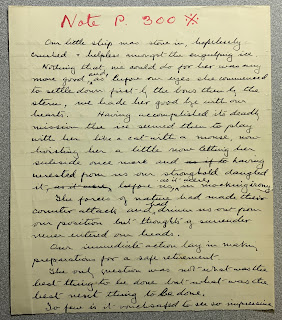
Earlier this week, a search expedition successfully located the intact wreck of Endurance, a ship sunk in the Weddell Sea in 1915 during the course of Ernest Shackleton's Imperial Trans-Antarctic Expedition. This seems as good an excuse as any to show off one of our favorite items in the collections: the diary of one Thomas Orde-Lees, kept during his time as a member of Endurance's crew. 

Endurance never met its mission of landing at Vahsel Bay in order to launch a march across the Antarctic continent. Instead, the ship became trapped in ice and drifted for months, eventually being crushed and sinking under the pressure exerted by the ice. Its crew took to their lifeboats when the ice no longer supported their stranded camp, managing to reach the uninhabited Elephant Island. From there, Shackleton and five others took one of the lifeboats out onto the open ocean to retrieve help. Amazingly, they made it and the entire crew was rescued. Orde-Lees' diary contains many notes on the weather, encounters with wildlife, the expedition's food stores, and other everyday facts of the crew's bid for survival.

His entry for the October 27th 1915 recounts the actual breaking of the ship:

"Our little ship was stove in, hopelessly crushed and helpless amongst the engulfing ice. Nothing that we could do for her was any more good, and as before our eyes she commenced to settle down first by the bow then by the stern, we bade her good bye with our hearts. Having accomplished its deadly mission the ice seemed then to play with her like a cat with a mouse, now hoisting her a little now letting her subside once more and having wrested from us our stronghold dangled it before us, as it were, in mocking irony... For the first time it came home to us that we were wrecked - that we had abandoned our ship; but we were not beaten." 

It's been 106 years since it sank, but the Endurance has been found again! Come take a look at this firsthand account of its fate in the Antarctic by asking for Stefansson Mss-185

Friday, March 4, 2022

Republicans Versus Fascists

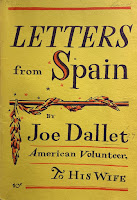
Image of the front of Letters From Spain, by Joe DalletThe Spanish Civil War, which lasted from 1936 until 1939, is often now regarded as the precursor to World War II. Left-leaning Republican forces fought futilely to defend their young government against a fascist Nationalist force led by Francisco Franco. The term "Nationalist" in connection with this group was in fact coined by Nazi Minister of Propaganda Joseph Goebbels, whose regime generously supported Franco and his fascist insurrectionists. The Republicans were supported in their efforts by the Soviet Union, who supplied them with arms and also encouraged members of the Community Party to come from all over the globe to fight the fascists.

Joe Dallet, a non-graduating member of the class of 1927, was one of those members. Born in Cleveland, Ohio, Dallet grew up in a well-to-do conservative family on Long Island before coming to Dartmouth After two and a half years of schooling, he decided that it wasn't for him. He left and worked for a while in the insurance business before leaving to become a longshoreman in order to earn his wages through productive labor. He joined the Communist Party in 1929 and became a union organizer for steel workers and other laborers who had been crushed by the Great Depression.

In 1937, when the call went out for men of conviction to fight against fascists in Spain, Dallet answered. After sneaking across the border from France, Dallet joined nearly forty thousand other men and women in their fight alongside Spanish Republican forces. These fighters were divided into military units set up by the Communist International and known collectively as the "International Brigades." Dallet served with the Mackenzie-Papineau Battalion, a unit comprised of both Canadians and United States citizens. Only a few months after making it to the front, Dallet was killed in action on October 13, 1937, during the battalion's first engagement with fascist forces at Fuentes De Ebro. According to eye-witnesses, he was mortally wounded while leading his men in an advance and then died after refusing to allow medics to approach him because of his extremely exposed position.

In the six months leading up to his deployment, Dallet wrote letters to his wife Kitty, describing his experiences in Europe. They were published as a small pamphlet a year after his death. To read more about this fascinating individual, come to Rauner and ask to see Alumni D164l.