Tuesday, March 15, 2016

Typographic Humor

Cover to "The Advertiser's Typographic Manual"Typographers tend to be a humorless lot when it comes to matters of design, but they love to have fun with the ostentatious excesses of their craft. Case in point: display advertising and the adman's gimmicks.

This book, The Advertiser's Typographic Manual, which sports such an aesthetically pleasing gold-stamped cover, is from the book collection of Dartmouth's legendary Ray Nash. Nash founded the Graphic Arts Workshop (now the Book Arts Workshop) and trained generations of talented typographers in the basement of Baker Library. We opened the book to see what advice it had to offer would-be advertisers and discovered a completely blank book. At first we figured it was a publisher's dummy (a mock up for a book) but then saw what a good joke it must have been for Nash. The complete typographic knowledge of the advertising world could be summed up with a book that contained absolutely nothing. You can just picture Nash pulling it off of a shelf and handing it to a student interested in advertising, and saying "Here's all you need to know."

Interior "text" to Advertiser's Typographic Manual
Of course we could be all wrong--it could be a mock up for a book that never made it into print, and we are just reading into it an elaborate joke. But, really, why would Nash keep it?

We are still trying to figure out how to catalog this one, but when we do, we'll add a link to the catalog record so you can see it yourself. [August 23, 2016: we figured it out. Ask for Rauner Nash HF5825 N374 1940z].

Friday, March 11, 2016

Channelling Downton Abbey

The Ideal Home - Tea-Table settingThe doors of Downton Abbey are now closed forever. And if you, dear readers, are of a like mind to the present writer, you may be feeling a bit wistful and nostalgic for that lost world. But help is at hand and Rauner Special Collections Library has the perfect tome to help you channel the world of Downton in your very own home. The Ideal Home: How to Find It, How to Furnish It, How to Keep It, was published in London in 1914, so it is exactly contemporary to the beginnings of the Downton Abbey series (1912). It was written by one Matilda Lees-Dods, whose credentials are specified on the title page (Diplomee of the National Training School of Cookery, South Kensington, Certificated Teacher in Laundry Work, Dressmaking, Dairy Work, Poultry Rearing, and First Aid). At 976 pages (and eight pounds in weight) it is a very substantial volume indeed.

Thirty-eight chapters cover every possible aspect of the domestic arts. Some of our favourites are “How to Deal with Servants,” “A Chapter of Don’ts,” “Mysteries of Soup Making,” “New Fashions in Dinner Parties,” and the ever- so important “Carving and Serviette Folding.” One certainly would not want the serviettes folded in a less than perfect manner. Carson would not approve.

First aid, living within a budget, prices, food preparation, legalities, are all covered by Miss Lees-Dods.

The Ideal Home - Savoury of Shrimps With Tangerines

This manual is lavishly illustrated with lovely water colours, and practical black and white images.

One cannot help but wonder if Mrs. Hughes had her very own copy in the housekeeper’s office at Downton. One suspects she did.

The book came to Dartmouth thanks to the generosity of Edward P. Sine, Class of 1951, who amassed a large collection of illustrated books in different genres and on many different topics during his long years of collecting.

Ask for Sine Illus T28ide. And recreate a bit of Downton in your very own home.

Tuesday, March 8, 2016

J'Accuse...!

Frontpage of L"AuroreWe just acquired an original issue of L'Aurore from January 13, 1898: that is the issue with what must be one of the most famous headline's in the history of French journalism: "J'Accuse...!"  The article is Émile Zola's famous open letter damning the French government for its handling of the Dreyfus Affair. So much has been written about the importance of Zola's attack and the international protests it inspired, that we won't try to add anything here.

But, what is so cool about having the original artifact is the ability to see Zola's words in context. After all, it was just another day in Paris, and the mundane, while pushed off of the front page, is still well represented.
Announcement of motorcycle race
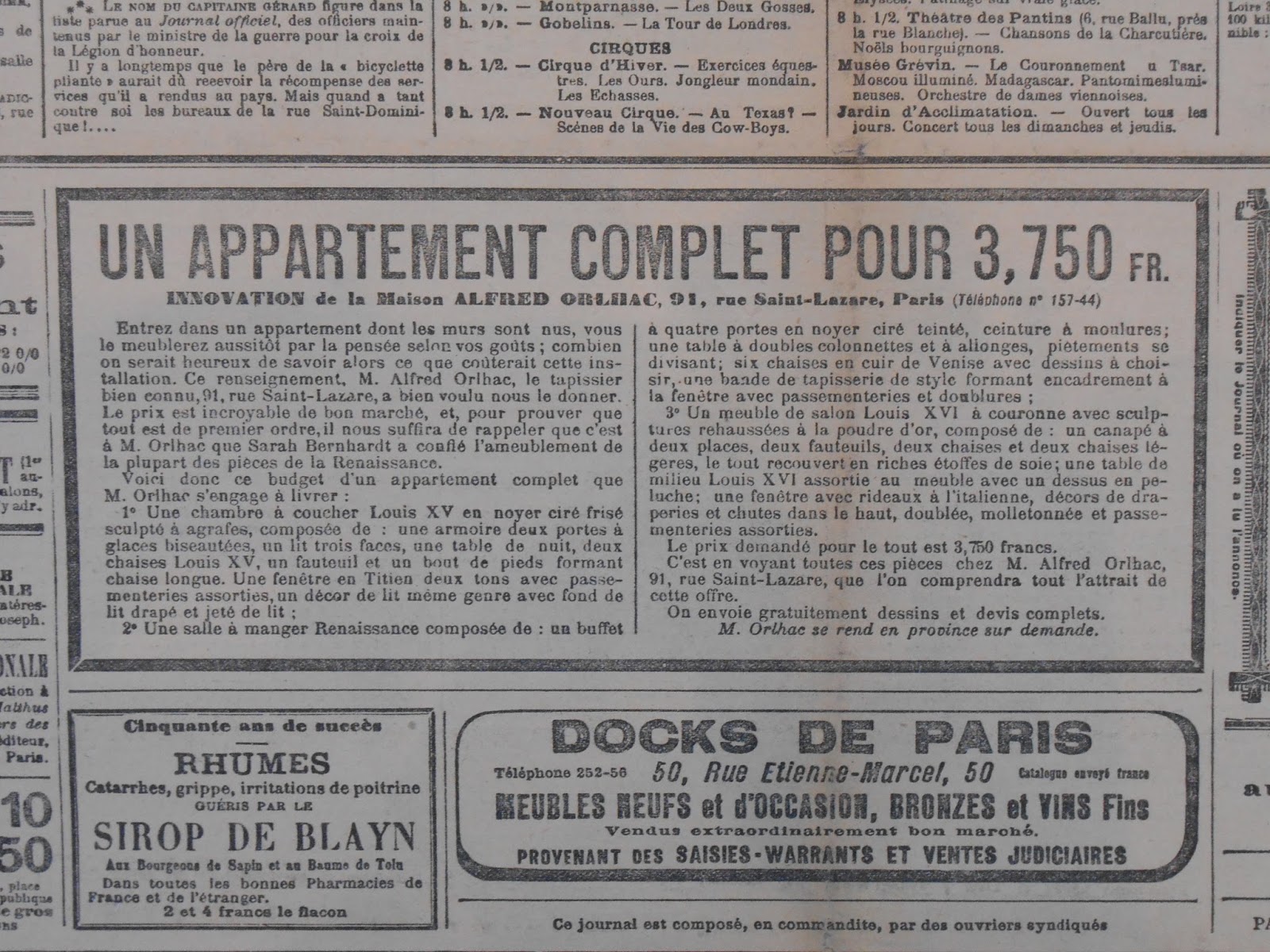
There are various announcements, reviews, news from the financial markets, a commentary on a bicycle race, and another on a motorcycle race. There are ads for booksellers, patent medicines, and a wine merchant. And, best of all, you could rent a well appointed apartment on the rue Saint-Lazare for 3,750 francs.

Ad for apartment for rent
To see for yourself, ask for Rare DC354.Z86 1898.

Friday, March 4, 2016

The Rise and Fall of the "Queen of Snows"

Carnival Girl from CosmopolitanLong before Dartmouth opened its doors to female students, coeds from up and down the East Coast flocked annually to the little village of Hanover to celebrate the culmination of the winter sports season. In a history of carnival by past DOC Executive Director, John Rand reported that for the first winter weekend in 1910, “nearly 50 fair guests were invited to Hanover for the occasion, and the Outing Club ball in Commons was a social triumph.”

Manuscript history of Winter CarnivalWhat began as an attempt “to awaken the campus from its winter hibernation…” snowballed into an intercollegiate competition hosting competitors and guests from around the world. Nearly thirty years after its founding, “From Nome to Norway by way of Ecuador, one thousand and ninety-nine girls flock[ed] to Hanover…” reported The Dartmouth in 1938.

The popularity of the weekend was in large part due to the social events, which accompanied the competitions. Musical concerts, skating exhibitions, and the opportunities for snowshoeing and hot cocoa almost effortlessly set the scene for weekend romances. The annual revelry became so popularized that in 1941 the short story, “Carnival Girl” by Isabel Moore was featured in Cosmopolitan Magazine. The love story employs the allure of Winter Carnival as the backdrop for a reunion of past lovers.

Ultimately, the highlight of the weekend was the crowning of the "Queen of Snows" during Friday’s Outdoor Evening. The event, a contest of beauty, kicked off the festivities and offered up an opportunity for the male hosts to ogle the girls that had been selected as the prettiest of all the dates. The “snatches,” aka members of the student body, were tasked with selecting the candidates upon their arrival to campus.
List of "Snatches"Fifteen Prominent members of the Dartmouth student body are selected to choose Carnival Queen candidates. Each man has three invitations to give out during Thursday and Friday...The girls selected... are interviewed and appraised by a Judging Committee consisting of students and honorary judges.
The objectification of women at carnival nonetheless proved thrilling for the hosts and at least some of their dates.

Photo of Winter Cranival Queen contestants

1972 Winter Carnival Queen and dateMargee Russell, a freshman at Colby-Junior College in New London, NH, called her crowning experience “the greatest thrill of my life.” Russell will go down in carnival history as the last queen in a 43-year long reign. The tradition, which began in 1928 died in 1972 at the 62nd annual Winter Carnival.

The onset of coeducation, shortly followed by the fielding of women’s winter sports teams contributed to the end of the old tradition and gave birth to a new competition based upon athleticism, skill and talent.

Dartmouth Women's Ski Team
The history of the queen competition, the sensation of winter carnival in popular culture and the rise of a new era of queens of the snow are featured in our exhibit, The Rise and Fall of the ‘Queen of Snows’: Women at Winter Carnival. The exhibit is on display in Rauner Library’s Reading Room from February 29th-April 15th.

To see the documents included in this post see:
DO-1, Box 6134 Dartmouth College Outing Club Records, Folder: “Carnival History
DO-1, Box 6142 Dartmouth College Outing Club Records, Folder: “Carnival Publicity”
“Carnival Girl.”,Rauner D.C. History PZ3.M789 Ca
“Winter Carnival Queens 1930s” photo file
“Winter Carnival Queens 1960s and 1970s” photo file
“ Skiing-Women’s 1970s” photo file

Tuesday, March 1, 2016

Elixir Proprietatis

Title page to Every Man His Own DoctorThe market is flooded with medical self-help books: there is a cure for whatever ails you, be it a medication, a mind/body connection, or any number of supplements. The genre has a long history, as we discovered last week when looking at John Archer's Every Man His Own Doctor (London: Printed for the Author, 1673). The title page promises practical and simple advice for preventing disease, and there is an extended herbal attached listing the various healing powers of common English flora. There is even an "Infallible Secret" to prevent the Pox.

But, if everything else fails, there is an entry at the end of the book for "Elixir Proprietatis" that will cure pretty much anything. It is made from the "Quintessence of the best of Vegetables" and cures:
all Agues or Feavers, quartan, tertian or quotidian; also all astmahs, Palsies, Convulsions, Falling sickness, Consumptions of the Lungs, all decays in the vital and noble Parts, resisting Corruption, Crudities....

Advertisement for Elixir Proprietatis
It goes on for quite a while longer. Now, every man might be his own doctor, but don't expect a recipe for the Elixir Proprietatis. To get this wonderful cure, you will need to find your way to Dr. Archer's house in Winchester Street, "being the Sign of the Golden Ball near Broad Street, London," to buy it.

To learn learn the secret for preventing the Pox, ask for Rare R128.7.A37.

Friday, February 26, 2016

Sawdust Men

Page 47 from 'Professional Criminals of America' describing Sawdust Men's strategyWe have all been recipients of a certain type of e-mail, usually from someone claiming to be the heir to a sizable fortune or the representative of a financial institution based in Nigeria. Predictably, they all need help to transfer a significant amount of money in a covert and speedy fashion and promise a tempting percentage for whomever assists them. Although the technology is relatively new, this sort of swindle is at least over a hundred years old. Back in the late nineteenth century, con artists called "sawdust men" cast a similar net for unsuspecting victims by mailing out flyers, or circulars, to individuals they had identified as being particularly susceptible to these kinds of offers. The circulars offered to sell the recipient a large amount of counterfeit money in exchange for a smaller amount of actual cash. Once the sucker had been shown the funny money and had paid for it, the sawdust men would distract him or her while exchanging the bag full of counterfeit currency for one filled with nothing but sawdust. Much later, after the trick was discovered, the victim was usually left without recourse; to incriminate the sawdust men would be to reveal that they themselves had also planned to conduct illegal activity.

Mug shot of Charles 'Doc' Smyth and other criminals
The details of this scam, along with many others, is described in Professional Criminals of America, a 1886 publication written by Thomas Byrnes.  Byrnes, the NYPD Detective Bureau chief from 1880 until 1895, ostensibly published his book "pro bono publico" in order to keep members of the public from falling prey to less scrupulous members of society. His tome is filled with all manner of interesting facts about the criminal underground, including the habits and strategies of bank robbers, pickpockets and even fradulent horse salesmen. In addition to criminal methodology, Byrnes includes many photographs and biographies of notorious criminals who have apparently been in the business for quite some time. For example, he warns us about Charles Smyth, alias Doctor Smyth, alias Harrison, who is considered a "clever hand" at the "confidence and sawdust game," despite having been arrested and imprisoned for twelve months earlier that year.

Description of Charles 'Doc' Smyth from 'Professional Criminals of America'
It is fascinating to think that the pool of usual suspects in the New York City area would have been so small as to be able to fit them all into a single volume. The power of the photograph was such that the appearance of these ne'er-do-wells' pictures in a popular book apparently was considered sufficient remedy against future deception. What is more likely is that Byrnes was attempting to leverage his national renown into a profitable publishing venture. He had garnered national recognition in 1878 after solving a challenging bank heist, and he continued to grow in fame throughout his fifteen-year stint as the head of the city's detective unit.

However, despite his popularity, Byrnes also had a shady reputation himself; his interrogation rooms
photograph entitled 'The Inspector's Model' from 'Professional Criminals of America' showing police officers torturing a suspect
were more like torture chambers, and Byrnes is claimed to have coined the term "third degree" in reference to his information-extracting behavior. Ultimately, in 1895, he was firmly encouraged to retire as a move to rid the police force of corruption by none other than Theodore Roosevelt, who at the time was the president of the NYC Police Commission.

To learn more about how to protect yourself from the trickery of nineteenth-century scam artists, come to Rauner and ask to see Rare HV6785 .B9.

Tuesday, February 23, 2016

Antarctica in My Mind

Photo of Ike Taylor
Ike Taylor
In 1955, Dr. Isaac “Ike” Taylor, a then professor of medicine at the University of North Carolina School of Medicine, husband and father of five, left his civilian life behind and volunteered for “Operation Deep Freeze” a mission dedicated to exploration and scientific research in Antarctica

Taylor assumed active duty as lieutenant commander in the U.S Naval Reserve Medical Corps and served as Chief Medical Officer at McMurdo Sound, Antarctica from 1955-1957. The airbase established at McMurdo Sound was constructed as part of the International Geophysical Year.

The Durham Morning Herald reported in 1957, “The year has been set up in order that simultaneous observations may be made over the entire world in such sciences as astronomy, meteorology, oceanography, geology, glaciology and others. Scientists from 55 nations are taking part in the program.”
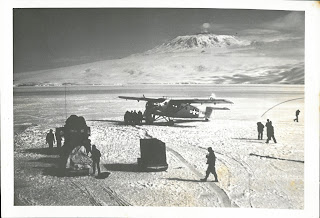
Image of one of the first planes to be flown in 1955
"One of the first planes to be flown in ('55) with Erubus in background steaming 12/55"

Taylor’s previous research on the physiological effects of low temperature on tissue and his interest in Antarctic explorations led him to volunteer for the mission. For close to two years he studied hypothermia, the effects of cold weather on personnel, performed research and tended to the medical needs of the 60 men stationed at McMurdo Sound.

Almost half of his papers (Isaac Taylor papers Mss-219) are comprised of family correspondence. Throughout the entirety of his service in Antarctica Taylor exchanged hundreds of letters with his wife Trudy and their five children: Alec, James, Kate, Livingston, and Hugh. Taylor’s letters home include descriptions of his work, the landscape, newly constructed buildings and Naval equipment and vessels. From a letter dated January 10, 1956 Taylor writes to his two eldest sons:

Letter from Ike Talyor to his children
Dear Alec and James: Can you imagine what I am doing now? You would love it if you were here…We are camped on a small beach of black gravel and sand formed from the lava of the volcano, Mt. Erebus, which lies 14 miles away. No lava has come from the volcano in many years though we can see smoke and steam coming from the top.

It is evident that Taylor’s descriptions of his adventures in Antarctica and the general mystery surrounding such a far off place sparked the artistic minds of his children. You can see the product of their young imaginations and artistry in the drawings and paintings of Antarctica that accompany their letters back to Taylor.

Painting by James Taylor

This painting by his son James, shares a close resemblance to the volcano that Taylor described in his letter from January.

Painting by Alex Taylor
The painting by his son, Alec seems to depict “Operation Deep Freeze” and the men at McMurdo Sound, including Admiral Richard Byrd.


Letter from Kate Taylor
Despite being thousands of miles away or as Taylor wrote: “The Antarctic is about as far away from Chapel Hill as it is possible to go.” The family maintained a connection through words and images.  As Taylor would describe his life and work in Antarctica, his wife and children would share descriptions of their everyday lives in North Carolina including: travel, weather, illnesses, holidays, homework assignments, and Christmas lists.

Personally, the letters and artwork so obviously represent the unwavering love between father and his children and the influence of his narrative and on their imaginations.

Photo of the Eastwind, 1956
“East Wind USCGC at ice ridge, McMurdo Sound, Summer 1956”
Initially my interest in Taylor’s papers was piqued due to the extensive amount of family correspondence, especially the paintings by his children. In digging a little deeper into the collection, an exciting discovery was unearthed. James, Taylor’s second eldest son is in fact famed singer-songwriter James Taylor. Up until a few weeks ago the familial connection between Isaac and James Taylor was unbeknownst to Rauner Library staff members. It goes to show that the opportunity for discovery is ever present here at Rauner Library and continuously adds to the excitement of our day!

The Isaac Taylor papers (Mss- 219) are a part of Rauner Library’s Stefansson Collection on Polar Exploration, which features the papers of many polar explorers in addition to published materials, photographs, and vertical files. If you would like to learn more about “Operation Deep Freeze” and the Taylor family you can request Mss-219 at the reference desk.