Friday, November 8, 2013

Mystical Text

An illuminated page of Arabic text.Preparing for a class this week, we came across a tantalizing manuscript that we know little about: a Sufi devotional text created in the mid to late 18th century. It takes the same form as most Islamic manuscript prayer books of the time. It is in a wallet binding with the text framed in gold. Glossed instructions and comments radiate away from the text at angles defined by blind pressed grid lines. Decorative floral patterns luxuriously fill the empty spaces to create a surprising and satisfying page layout.

An open page showing two enclosed and illuminated illustrations of single roses.
But this text has something special. About a third of the way through the prayers, there is a two-page illuminated spread. Two images of a rose set into an intricate border mirror each other.  When the book is closed, they come together as a single rose, complete only when not seen. The opening, so different from the rest of the book, offers a moment to ponder Sufi mysticism: it encompasses light/illumination, unity/division, and a completeness that cannot be seen--only experienced in the mind.

To see it, ask for Codex MS 001883.

Tuesday, November 5, 2013

In the Shadow of the Ivory Tower

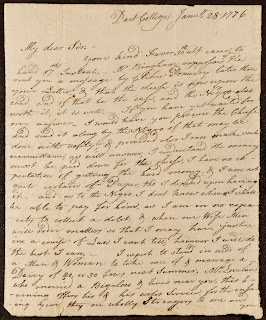
The first page of a handwritten letter.In January of 1776, in the midst of the Revolutionary War, Eleazar Wheelock, the founder and first president of Dartmouth College wrote to Captain Asa Foot regarding the purchase of a cheese and a Negro. Lest there be any doubt about Wheelock's intent, he states "as to the Negro, I don't know when I shall be able to pay for him…"

While it should come as no surprise that Dartmouth College was founded, in part, on the backs of slaves, it is not something that gets discussed on a regular basis. Nor is Dartmouth alone. Craig Wilder's new book Ebony & Ivy: Race, Slavery, and the Troubled History of America's Universities brings out the role that American colleges and universities have played in aiding and abetting the institution of slavery. Wilder's research specifically mentions Dartmouth and it is important to note that Wheelock owned at least eight or nine slaves. When he came to Hanover to carve the College out of the wilderness, he brought some of these slaves with him and it seems likely that they performed much of the hard labor needed to clear the land and establish the College.

The last page of a handwritten letter, signed by Eleazar Wheelock.Dartmouth's complex relationship with slavery does not end with Wheelock. In the 1830s Dartmouth had both an Abolitionist Society and a Colonization Society, while at the same time sporting a pro-slavery president, Nathan Lord.

To learn more about Wheelock and the College's early relationship to slavery, come to Rauner and request any of the manuscripts listed below:
  • 757157 Bill of sale, William Clark to Eleazar Wheelock; for "Ishmael, being a servant for life"
  • 760276 Bill of sale, Peter Spenser to Eleazar Wheelock; for "Negro manservant named Brister"
  • 761477 Bill of sale, Timothy Kimbal to Eleazar Wheelock; for "a certain Negro man named Sippy" [name mis-transcribed, but unclear]
  • 762313 Bill of sale, Ann Morrison to Eleazar Wheelock; for "a Negro man named Exeter…a Negro woman named Chloe…and a Negro male child named Hercules.
  • 765554.2 Occom to Wheelock; re: needs use of Negro and oxen
  • 768675 Benjamin Bill to Exeter; re: complaint that Exeter abuses his wife
  • 768675.1 Benjamin Bill to Wheelock; re: complaint against Exeter
  • 769240.1 Theodora Phelps to Wheelock; re: lending one of his slaves
  • 769365 Jacob Johnson to Wheelock; re: death of his Negro
  • 769474.2 Eleazar Wheelock to John Wheelock; is going to Albany for his health and taking Brister along to wait on him
  • 772167 Buckingham to Wheelock; re sale of slaves Nando and Hagar
  • 773306 Wheelock to Captain Moses Little; will buy slave Ceasar for £20
  • 775157 Wheelock to John Hubbard; agrees to pay Thomas Devine's debt and obtain release from imprisonment. Devine to be indentured to Wheelock. [likely white indentured servant, but not clear]
  • 775673 Wheelock to Gideon Buckingham; Owes the one hundred pounds expected from the addressee and is in difficulty because he cannot pay the money. Offers to give Nando 20 acres of land and his freedom if heirs agree to send him and Hagar to writer who thinks God is displeased at the heirs for allowing Nando to treat his wife as he has.
  • 776128 Eleazar Wheelock to Asa Foot; "procure the cheese and send it along with the Negro if that may be done with safety"…"and as to the Negro, I don’t know when I shall be able to pay for him"
  • 779252.6 Wheelock will; which leaves all interest in his servants to his son John; to his servant boy Archilaus his freedom when he reaches the age of 25 years and if he is judged to be of good moral character, and also gives him 50 acres of land in Landaff or some other of his outland
  • 786424 "Chloe, Negro of Hanover;" issues a complaint that Andrew Boynton has stolen a shirt off her fence

Friday, November 1, 2013

Always With You

An image of an Arabic scroll from above.If we wanted to we could assemble an amazing cabinet of curiosities. Here is a favorite example. This is the entire text of the Koran executed in a miniature Arabic hand on a parchment scroll that is only 3 inches wide and 48 inches long. It can only be read with the aid of a magnifying glass, and rolls up small enough to be worn as an amulet.

An image of the scroll from the side.The scroll, which was produced in 1101 A.H. (1689 A.D.), leaves off the titles of the 114 Suras and elides any indications of the verses to concentrate the text into as small a package as possible. Other than some gold leaf, all of the decorative elements are created by leaving gaps between words. Creating this manuscript was almost surely an act of devotion demanding tremendous patience and skill.

The scroll photographed through a magnifying glass, showing an abstract pattern created by the negative space in the text.
It is amazing.  Ask for Codex MS 689940. We have a magnifying glass you can use.

Tuesday, October 29, 2013

"Don't Fail to See It"

A black and white photograph of a highly ornamented stone archway. Before the novels and the Pulitzer, Edith Wharton made her mark by writing about garden design, interior decoration and what constituted good taste. Her first published book was The Decoration of Houses (New York: Charles Scribner's Sons, 1897) in which she tastefully railed against Victorian decorating sensibilities and advocated for the use of more open spaces that emphasized the room, not the furnishings.

A black and white photograph of a treed garden space.Wharton's next non-fiction work was a lavishly illustrated book about the architecture and surrounding gardens of Italian villas aptly named Italian Villas and Their Gardens (New York: Century, 1905). The book included numerous drawings and photographs, primarily by Cornish Colony artist Maxfield Parrish. In Rauner's collection of Parrish's papers are correspondence with Wharton about the book as well as some of the original plate negatives used as inspiration for his illustrations.

A handwritten letter.One particularly interesting letter "sums up" Wharton's impressions of the various villas in Florence. The Villa Medici gets a nod of approval - "Open certain days. Don't fail to see it." The Villa Albani is dismissed as "Hard to see and not worth while." The Villa d'Este in Tivoli is "Wonderful of course. Always open." Entries on other sites contain additional information about permits, whom to obtain them from and when to visit to avoid complications due to school calendars or other potential hazards.

Ask for ML-62, box 3, folder 43 to read the correspondence and Illus P249wha for the first edition of Italian Villas. The negatives are extremely fragile and are housed in Box 13 of the Parrish collection. A guide to the Parrish collection is available.

Saturday, October 26, 2013

Pirates!

An illustration of a mustachioed man named Francis Lolonois.Thinking of dressing up like a pirate this Halloween? If you want the classic look popularized in the 19th century, Howard Pyle is the place to go. But, if you want a more authentic take on the style, try The Bucaniers of America: Or, a True Account of the Most Remarkable Assault Committed of Late Years upon the Coasts of the West-Indies by the Bucaniers of Jamaica and Tortuga, Both English and French (London: William Crooke, 1684). Not only will you find some good costume ideas, but you can read about the exploits of the campus favorite Captain (Henry) Morgan.

A n illustration of Captain Henry Morgan.Originally published in Dutch in 1678, this 1684 English translation added to Alexander Exquemelin's first hand accounts of his encounters with pirates in the Caribbean. It helped to popularize the romantic and sensational tales of privateers and pirates and built the modern mythology surrounding their exploits.

An illustration showing the "towne of Puerto del Principe taken and sackt."
Just ask for Rare F2161 .E75 1684.


Tuesday, October 22, 2013

Shape up!

A book with a novelty cover shaped like Little Red Riding Hood with the wolf curled around her feet.Prang's inexpensive color lithography technique revolutionized advertising and made color greeting cards commonplace. His work appeared in millions of scrapbooks in the the late 19th century. He also made novelty books like this shaped book of Little Red Riding Hood.

In the original Perrault telling of Little Red Riding Hood, our young heroine is eaten by the wolf. It is a cautionary tale about the wolves of the world that stalk young women. But the story has become much nicer over time. But in this 1863 edition, Little Read Riding Hood is saved at the last minute by a hunter--not even her grandmother dies. It still has a cautionary moral at the end, but it only reminds the young to shape up and obey their mothers.

The book opened. On either page is a small block of illustrated text. The illustrations on this section include a snaring, bonneted wolf, a crying child, a shotgun, and a broom.
Eerily, when you open the book, it looks remarkably like a tombstone.

Come see it by asking for 1926 Collection V489.

Friday, October 18, 2013

Haute Couture for Books

The cover of a book bound in blue leather, pressed with star-like designs in other colors.
Bindings 69
In high fashion there's often a disconnect between the world of the practical and that of "just because I can." Over-the-top or outlandish designs, often for the sake of the splash of the design itself, also find their way into the world of bookbinding. Sometimes this is deliberate and sometimes it's an honest effort to reflect the nature of the text that just spiraled out of control.

Rauner holds numerous examples of bindings that clearly reflect this decorative dominance and one of our first blogs was about our jewel-bound Rubáiyát of Omar Khayyám. Today's selections incorporate ivory, enamel, wallpaper, velvet, jewels, precious metals, hand-stitching and other materials and techniques intended to enhance the visual appeal of each book and make it stand out from the crowd. You be the judge of which designs qualify as high fashion for books. Do any of them actually reflect the nature of the text or enhance it?

A cloth book cover stitched with the image of a tulip.
Bindings 59
A cover of metal worked into a botanical pattern. On top of it are five portraits in the style of a medieval manuscript.
Bindings 52

A blue velvet cover with worked metal elements.
Bindings 49
An embroidered blue cover.
Bindings 47

An elaborately patterned leather binding with gold-stamped patterns.
Bindings 243
A binding with a floral pattern.
Bindings 104
An ivory cover with a bird decoration.
Bindings 96
Ask for the following items:
Bindings 47
Bindings 49
Bindings 52
Bindings 59
Bindings 69
Bindings 96
Bindings 104
Bindings 243