Wednesday, May 8, 2013

A Beautiful Manuscript

An open, miniature book of hours with densely painted and illuminated illustrations. Today, we thought we would just treat you to a moment of beauty. These images are from a manuscript Book of Hours produced in Florence in the late 15th century. It is on uterine vellum made from the skin of unborn sheep or calves, and was illuminated in Attavante's atelier. Each miniature is a lovely Renaissance painting that fits in the palm of your hand.

An open, miniature book of hours with densely painted and illuminated illustrations. An open, miniature book of hours with densely painted and illuminated illustrations.
Come see it by asking for Codex Manuscript 001054, and there is a little more information on our "Script to Pixels" website.

Friday, May 3, 2013

Typographic Sound

A paper book cover.Vladamir Maiakovsky's poems were meant to be read aloud; in fact, the title of this book, Dlia Golosa (Berlin : R.S.F.S.R. gosudarstvennoe izdatelʹstvo, 1923) translates to For the Voice. El Lissitzky applied his Constructivist aesthetic to the book. Drawing primarily on display types and decorative devices common in printing shops he illustrated the poems and created emphasis. You have to wonder, if the book is meant to be heard rather read, why the lavish typographic attention?

Lissitzky delineates each the poems with a tab. The layout and decoration of the book gives it the feel of a medieval litergical book--albeit one with a radically modernist aesthetic. The tabs steer the reader through the text making it simple to select a poem at a glance, and the typographic designs act as decorated initial letters to stir the reader into the proper oratory mood. The mission was similar--read out to the congregation, the texts were meant to inspire their souls. The final product is a masterpiece of Constructivist book design and a great example of early Soviet experimentation in the arts.
An open book of designs.
You need to see this book to really appreciate it. Ask for Rare PG3476.M3 D57.


Tuesday, April 30, 2013

The Unfriendly Arctic

An engraved silver tray.Shipwrecks capture the imagination with epic tales of tragedy and heroism. From Robinson Crusoe to Life of Pi, shipwrecks have provided readers stories of life and death they just can’t put down. While Rauner has endless books on shipwrecks, it also has its own relics of a voyage gone wrong. Over the years, a number of tokens from the last voyage of the HMCS Karluk have washed up on Rauner's shelves.

A handwritten letter.
Viljhalmur Stefansson, who taught at Dartmouth from 1947 to 1962, organized the Karluk's voyage to explore the area north of the Canadian coast. Karluk began its journey in June 1913. The Executive Council of British Columbia presented Stefansson with a silver salver upon his departure. However, the crew would soon need more practical goods than an engraved tray. By September 10th, Karluk was ice-bound for the winter. Stefansson became separated from the ship: Karluk began to drift through the ice while he was on a hunting trip with five other members of the expedition. Though Stefansson claimed the separation was accidental, some of the remaining crew saw his departure as the abandonment of a mission he suspected would fail. Stefansson did not return from the trip until 1918 after an extensive exploration that included the discovery of new Islands, but the Karluk sunk after months of drifting on January 10th, 1914.

A handwritten letter.
The sinking of Karluk left twenty-two men, one woman and two children stranded on what would become known as "Shipwreck Camp." Divisions between the shipwrecked soon arose on the ice camp. Two parties set out in attempt to reach Wrangel Island and set up a more permanent site on land. These parties overestimated how close they were to the island and the ease with which they could set up a new camp. Both perished in the Arctic conditions. Finally, the main party managed to reach Wrangel Island in March. The captain, Robert Bartlett, and an Inuit hunter, Kataktovic, continued on in search of a means to alert the rest of the world of the fate of Karluk. The rest of the group set up camp, desperately awaiting rescue. Finally, on September 7th, a walrus hunting ship accompanied by Bartlett picked up the fourteen remaining survivors.

An open book with a map on the left page and text on the right.
Six survivors would publish first-hand accounts of "the last voyage of the Karluk." Bartlett went on to lead many more Arctic voyages. Stefansson lectured widely on "the Friendly Arctic," organized another ill-fated expedition to Wrangel Island and eventually became the Director of Polar Studies at Dartmouth. You can find much more about the Karluk and practically anything else related to the polar regions by exploring the Stefansson Collection on Polar Exploration.

Posted for Kate Taylor '13

Friday, April 26, 2013

Polar Players

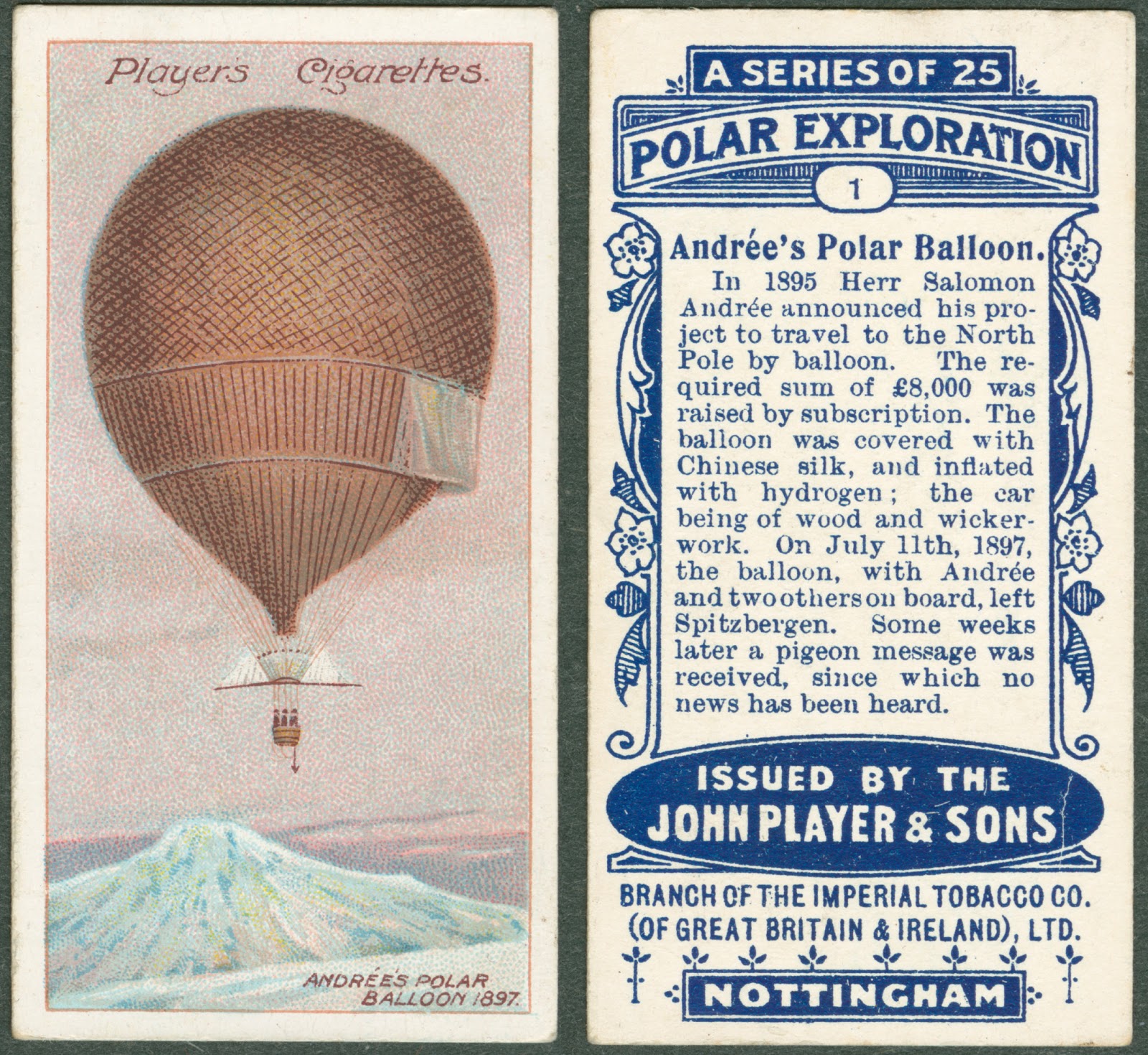
A card with an illustration and text block on Andree's Polar Balloon.Sometimes, as we get older it is easy to forget the excitement of mystery, but in Rauner we have countless items that recapture that childhood imagination—like the Player's Cigarette Cards.  The cards, which came with Player's Cigarettes, each feature a different representation of Arctic exploration: from explorers to ships and the formation of Icebergs, every card tells a short story about the frozen ends of the Earth.

A card with an illustration of the northern lights over a snowy cabin.
One of my favorite of the cards features "Andrée's Polar Balloon." It describes Herr Salomon Andrée, who raised money for his Polar hot air balloon, made from Chinese silk and filled with hydrogen. A few weeks after his departure, a pigeon message was received, after which nothing was heard from him again.

A pile of illustrated cards.
The mystery lies not only in each story, but also in the story of the cards' circumstance: who collected these cards? Were they meant for kids, despite their being contained in cigarettes cartons? What is the connection between cigarettes and polar exploration?

A card bearing an illustration of a group of men smoking, drinking, and playing music together.
If you come by Rauner and ask for Realia 536 you can find out the answers to some of these questions, but even more importantly, you can look at these beautiful cards and discover questions of your own!

Posted for Lucy Morris '14

Tuesday, April 23, 2013

Waste Lands

A title page for "The Waste Land."
We have three "firsts" of T.S. Eliot's The Wasteland. Two variant copies of the first American edition, each with typographical oddities of interest to obsessive collectors, and the first English edition. They are all fascinating in their own right but two things jumped out when we had them pulled for a class last week.

One of our American editions published by Boni & Liveright in 1922 still has its original dust jacket--a rarity in itself--but also a bookseller's advertising tag attached. On the bottom corner of the back cover is simple ad for the original seller of the book, The Old Corner Bookstore in Boston. At the time, it was the largest retail book outlet in the country. It was known as the haunt of Boston's literary elite, but was also famous for innovative sales gimmicks--this being one.
A paper cover for "The Waste Land."The back cover.

The first page of "The Waste Land."
The first English edition will give you goosebumps. It was published by Leonard and Virginia Woolf at the Hogarth Press in 1923. Virginia Woolf herself hand set all of the type (she said her hands were shaking when she finished). The Woolfs had impeccable taste as publishers, but they were not the best printers the world has seen. The type was unevenly inked in the printing process giving the page a blotchy look. In a way, that just makes Virginia's work more apparent and heightens the aura of the book. You can see the handmade quality.

Come see all three by asking for Rare PS3509.L43 1922 copies 1 and 2, and Val 817 E42 Y512.


Friday, April 19, 2013

Finding Neptune

The title page for "An Explanation."
Uranus, the seventh planet, was officially discovered in 1781 by William Herschel and at that time was thought to be the farthest planet from the sun. However minor variations from its observed orbit and that predicted by computation indicated that an additional body might be present further out that was responsible for the perturbations. The challenge of calculating the hypothetical orbit of such a body and thus pinpointing its location for observation was independently taken up by Urbain Le Verrier and John Couch Adams. Unfortunately for Adams, Le Verrier published first.

Adams presented his findings to the Royal Astronomical Society on November 13, 1846, approximately two and half months after Le Verrier's calculations had been made public at a meeting of the Royal Academy of Sciences in Paris. In his paper An Explanation of the Observed Irregularities in the Motion of Uranus: On the Hypothesis of Disturbances Caused By a More Distant Planet; With a Determination of the Mass, Orbit, and Position of the Disturbing Body (London: W. Clowes & Sons, 1846) Adams discussed his own interest in the problem and attempts to resolve the issue but ultimately credited Le Verrier and Johann Galle with the discovery of what we now know as the planet Neptune.
I mention these dates merely to show that my results were arrived at independently, and previous to the publication of M. Le Verrier, and not with the intention of interfering with his just claims to honours of the discovery; for there is no doubt that his researches were first published to the world, and led to the actual discovery of the planet by Dr. Galle, so that the facts stated above cannot detract, in the slightest degree, from the credit due to M. Le Verrier.
Adams then goes into details of his attempts to calculate the orbit and the various methods that he employed. This was a tedious process of testing various hypotheses and then calculating the predicted orbit from those equations and comparing the predictions to observed data.

Rauner's copy of Adam's paper is a presentation copy from the author to a Lieutenant W. S. Swafford, R.N. Ask for Rare Book QB 681 .A32 1846.

Tuesday, April 16, 2013

Small, Smaller, Tiny

A hand holding a miniature, gold stamped book.
In Rauner, books come in all shapes and sizes. Indeed, some of our most interesting items can easily fit in the palm of your hand. Rauner's miniature books show that with some creativity and a small enough typeface, you can cram just about anything into a tiny book.

A hand holding a miniature book in Arabic.
The smallest of the miniature books is a Koran approximately the size of someone's thumbnail. Written in Arabic, the words and designs within are impossibly small. However, the miniature book solves the problems inherent to its size through packaging. The book is enclosed in a small metal locket with an inset magnifying glass: a perfect fusion of style and practicality. It's owner, none other than Lawrence of Arabia, would have needed to travel light as he crossed and re-crossed the forbidding deserts of the Middle East during the First World War.

A hand holding a miniature book open to the title page: "The Fairy Annual."
Another one of Rauner's smallest books explains its diminutive size through fantastic origins. Robin Goodfellow, "Attendant Sprite to Their Majesties Oberon and Titania," published the Fairy Annual in 1838. Inside lies a series of stories, poems and illustrations of fairies and other magical creatures. The book is almost too small for a human to read. However, elegantly bound in brown leather, the book would look perfect on the bookshelf of a fairy about one twentieth of our size.

The Diamond Etiquette of Courtship and Marriage (pictured above), conversely, is clearly intended for human use. Published in 1845, the pocket-sized book seems to be written on the concept that one never knows when they may need advice regarding their love lives. The book walks the reader from courtship (one must avoid being seen as a flirt) to marriage (and the associated end of intimacy with one's "bachelor friends.") The miniature nature of the book was likely more for show than practicality. However, the image of a nineteenth-century lady or gentleman pulling The Diamond Book of Etiquette from their sleeve upon a proposal of marriage demonstrates the usefulness of miniature books in urgent etiquette situations.

A miniature book of marbled paper with a pop-out block of text.
A final miniature book that could come in handy if discretely tucked away is I've Called You All Together… A Book of Toasts. I may not need The Fairy Annual or The Diamond Etiquette on me at all times. However, the extremely portable size of the Book of Toasts makes it ideal for every occasion. While the other items resemble normal books shrunk down several magnitudes, I've Called You All Together is styled for readability. The book uses accordion style binding to publish a series of toasts. Snippets include, "May we look forward with pleasure, and backward without regret," and "May your children have rich parents." The book is one of only fifty, so your dinner companions will think you have the most original toasts at the table when you subtly pull this out. Rauner has hundreds of other miniature books for all occasions, whether you want to have the Gettysburg Address or Humpty Dumpty in your pocket at all times.

Check out Rauner Miniature 117 for The Diamond Book of Etiquette, Presses P389iv for I’ve Called You All Together, Miniature 77 for The Fairy Annual, and Lawrence BP130.4 .K57 for the Koran.

Posted for Kate Taylor '13.