Friday, April 12, 2013

Plat, Plot, Survey, Chart

A hand-drawn map of Meriden.
Meriden, New Hampshire
Who doesn’t love a map? There is something about the ability to see objects laid out in relationship to each other; that broad overview of things we normally only see from our grounded vantage point necessitated by laws of gravity. Even in an age when you can view the world from satellite in photographic reality, old maps can still amaze. They give us insight into a previous world, roads that no longer exist, buildings that have moved. So it is with these hand-drawn maps by Dr. Elias Frost of Meriden, New Hampshire.

A hand-drawn map of Uxbridge.
Uxbridge, Massachusetts
Frost, who was born in Milford, Massachusetts and later moved to Uxbridge and then to Meriden, drew a series of maps, from memory, of each of the towns he lived in as part of his manuscript titled the Chronicle of the Frost Family. It is hard not to be drawn into these maps with their careful, folk-art renderings of the buildings accompanied by notes about changes, inhabitants or moments in his life related to a particular place. Relationships and scale can tell us other things about the creator. For instance, it is clear that the church in Meriden was a large and important part of Dr. Frost’s life since it dwarfs the structures around it.

To enjoy Dr. Frost’s maps in person, or read the chronicle of his family, ask for: Rauner Codex: 853310.

Tuesday, April 9, 2013

Getting Back to Knopf

A typed letter.
Imagine establishing yourself in business in rural Vermont as a commercial printer dedicated to impeccable design and the craft of book making and getting a letter like this. Alfred Knopf, at the time the most distinguished publisher in America, and a man who revolutionized the look and feel of trade books, personally taking the time to scold you for failing to follow through after a meeting with his production manager.  But Roderick "Rocky" Stinehour '50, managed to make the most of the situation. His reply convinced Knopf to send a job his way.

It is always a bit of a shock to learn about a small company obsessive over a pursuit that seems like something out of the past—a craftsperson's obsession—that is able to turn a profit and keep up to forty people gainfully employed at any given time. Stinehour Press evolved out of a small commercial printing operation that served a community. After Rocky's introduction to printing he came to Dartmouth and trained in design. His great contribution was an unfailing belief that good design and attention to detail could be done economically and that good design did not need to be sacrificed for profit. Alfred Knopf had expressed a similar idea years earlier, when he said that a well-printed and well-designed book could be produced almost as inexpensively as most commercial books. The Stinehour Press carried that theory through five decades of quality printing and design including this work for Knopf.

A black and white photograph of a small group of people.
To learn more about Rocky and his legacy, come hear David Godine '66, on Thursday, April 11 at 4:00 in Baker Library.  There is also an exhibit in the Baker Library Main Hall, Designed and Printed at Stinehour Press, that is on display through May 31st.


Friday, April 5, 2013

Books from Blocks

Two pages of printed text and illustrations.
Fragments from the Biblia Pauperum
Netherlands, ca. 1460-1470
Wood has been used as a method of communication for time out of mind, typically by expressing an artistic ideal through the the grain and texture of the material. However, as printing evolved, the use of wood to express both a literal and figurative meaning at the same time became more prevalent. The inclusion of both text and imagery on the same block was initially most widespread in Japan, China and other Asian regions, though in Europe it actually flourished most widely at around the same time as movable type was developed. These "block-books" eventually fell into decline and wood came to be employed mainly for creating imagery to accompany the text.

A carved woodblock.
Leaves By The Wayside
Title page block for first book
printed in the Graphic Arts
Workshop at Dartmouth College, 1948.
The process of creating a woodblock for printing is a fairly simple one in concept. The desired image or text is drawn onto the block surface, but reversed from the way it will eventually appear on the paper or other page material and the "white space" is removed with a variety of woodworking tools. The remaining wood surface is then covered in ink and a sheet of paper is pressed onto it. The ink transfers from the wood to the paper, but only on those sections that have not been removed. The thickness of the woodblock is typically matched to the height of the type so that a full page can be printed in one step.

A printed page of Japanese characters.
Prajnapamita Sutra
Japan, ca. 14th century
The more elaborate the design the more care must be taken in executing it.  The wood itself must be chosen and prepared with care to minimize cracking and warping due to the wood's natural movement as it interacts with its environment and the stresses that the block undergoes in the printing process. Even a small press can produce a tremendous amount of force. An example of a block which cracked can be found in our collection of Barry Moser's Alice in Wonderland.

The examples pictured here are taken from various collections. Ask for Val 898.1 D14 U7 (Prajnapamita Sutra), Rare Book Z 241 .B6 (Biblia Pauperum) and Lansburgh 30 (Leaves By The Wayside title page illustration).

Tuesday, April 2, 2013

"Trembling for the Relics of Their Dead"

A handwritten letter.
In 1810, a group of Dartmouth Medical School students was caught removing a body from the Norwich, Vermont, cemetery. Bodies for dissection were hard to come by at the time and grave robbing was not as uncommon a practice as one might think. Normally, medical schools obtained bodies from prisons as condemned criminals were often further punished by having their bodies given over to science. However this offered only a limited supply of cadavers for study. The same year Dartmouth opened its medical school, the state of New Hampshire stiffened the penalties for grave robbing knowing that there would be increased demand for the dead.

This letter of apology is telling of the students' attitudes toward the public. In their apology, stated "with the most pungent sensations" they put the burden back onto the people of the town:
Painful considerations force themselves upon us, with increased effect, when we contemplate our fellow citizens, in the neighboring villages, trembling for the relics of their dead, which, they have long been educated, to hold sacred; the unlawful removal of which, in their view, can be nothing short of sacrilege.
A page of handwritten text.
The villagers are reduced to trembling, uneducated peons who seem unable to differentiate between the relic and the reality. It seems the medical students are not so much sorry about what they did, but that the superstitious townspeople believe it wrong.

There are gruesome stories in the Archives. This letter is featured in the current exhibit, The Body: Depressed, Flayed, and Stolen from the Grave curated by members of Sienna Craig's "The Values of Medicine" class.  It will be on display through June 20th, after which you can ask for Mss 810900.6.

Friday, March 29, 2013

Harriet Burleigh Janes

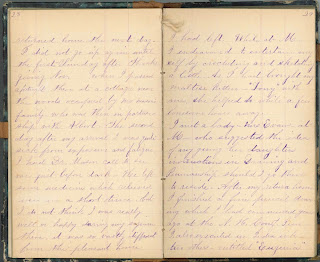
An open book of handwritten text."I had Dr. Mason call to see me first--before dark--He left some medicine which relieved me in a short-time, but I do not think I was really well or happy during my sojourn there. It was so vastly different from the pleasant home I had left. While at Mo__ I endeavored to entertain myself by crocheting and sketching a little. As I had brought my maltese kitten--'Tony' with me, she helped to while a few lonesome hours away."

This quotation appears in diary we just acquired by Harriet Burleigh Janes. Janes was a Laconia, New Hampshire, native who wrote fiction under the name Effie Ray. Born May 27, 1845, Harriet Burleigh was writing and illustrating hand-sewn miniature books by the age of seven. At 18, her work was in print; A Letter From Effie Ray was published in the Trumpet and Freeman: A Universalist Magazine in 1863. Over the next several years, her short stories appeared in The Yankee Blade and The American Union. She was working on a novel, Leander, or The Haunted Manor, at the time of her death at age 30.

The diary will join her papers housed in Rauner Library. The collection includes her miniature books, drawings and other manuscripts. Perhaps the most curious part of the collection is the "spirit writings," many purportedly by Harriet Janes, that her grieving family received after her early death.

To learn more about this little known writer, ask for MS-844.

Tuesday, March 26, 2013

Calligraphic Emblems

An emblem featuring a floral wreath and doves.
We have a strong collection of emblem books that try to create a visual vocabulary of classical themes and emotions and we also have another collection that documents 19th-century calligraphy. So, you can imagine how pleased we were to find this little gem of a book, Arabesques mythologiques (Paris: Charles Barrois, 1810) which combines the two ideas in one.

An emblem including clouds.
Illustrated with 54 hand-colored emblems representing the characters of Greek and Roman myth, the book was a kind of primer for children to learn the classical gods and the myths surrounding them. The visual clues create more lasting memories than text alone and each emblem tries to capture the essence of the actors. But, unlike other emblem books, there is text intertwined into each image. Turn them sideways, and you find the names beautifully scripted into the images--each is an elegant design loaded with cultural meaning.

An emblem including snakes and botanical elements.

The snake emblem turned sideways.
Ask for Rare BL725 G4 1810.

Friday, March 22, 2013

Trains, Trains and Railroads

The cover for a booklet of time tables.
Trainspotting can be something of an acquired taste, but for the true aficionado we present the Chase-Streeter collection. Formed mainly from gifts made by Judge William Martin Chase, Dartmouth 1858, and Thomas W. Streeter, Dartmouth 1904, the collection focuses primarily on the early history of New England railroads. It consists of over fifteen hundred items ranging from charters, annual reports of the various railroads to their stockholders, broadsides, and surveys of railroads, many with maps, to hearings before legislative bodies and pamphlets concerning legal disputes.

The collection also contains some more unique items such as a series of photographs documenting damage done to the Central Vermont Line during the 1938 hurricane. These images are eerily reminiscent of similar havoc caused by Hurricane Irene.

A black and white photograph of a damaged railroad, covered in debris.

Other ephemeral items include a small set of timetables for various railroads, including several western lines, and a sampling of stock certificates for the New York Central Railroad and it's subsidiaries.

A stock certificate.

Search the Library catalog for all of the cataloged items in the collection. The items highlighted here are from Chase-Streeter New England C42 18 (hurricane damage), Chase-Streeter N45 1 (stock certificates) and Chase-Streeter U.S. General 10 (timetables).