Friday, January 6, 2012

The World of Tomorrow

An accordion book showing a scene of people in a park.The 1939 New York World's Fair, "Building the World of Tomorrow," was a grand spectacular celebrating progress. It optimistically looked forward to a future where science and technology would usher in a world of ever growing prosperity and peace. World War II, concentration camps, and the atomic bomb would chill this notion, but in 1939, as the Great Depression waned, the fair's theme resonated with the American public.

This souvenir peepshow created by Elizabeth Hale and the famous type designer Warren Chappell, offers the viewer a glimpse of the utopian future: the fair itself. The book's structure allows it to collapse then fold out like an accordion to create depth.

The accordion book from a side angle.
Come take a peep by asking for Rare GV1525.H3 W6 1939

Tuesday, January 3, 2012

Association Copies

A Charles Dickens bookplate.Sometimes a book is exciting not so much for its contents but because of its past: the places it has been or the hands that once held it. This copy of John Bunyan's Pilgrim's Progress (London: John Murray and John Mayor, 1830) is in our collections not because it is a particularly rare edition, but because its bookplate makes it highly collectable: it belonged to Charles Dickens.
The title page and frontispiece for a copy of "The Pilgrim's Progress."
In other cases, rare editions, valuable in their own right, take on a magical quality because of a simple bookplate or signature. Here is Henry James' copy of the first edition of Swift's Gulliver's Travels (London: Benj. Motte, 1726), and William Morris' copy of The Story of the Moste Noble and Worthy Kynge Arthur (London: Wyllyam Copland, 1557). While it is easy to think of Morris enjoying Malory, it is more challenging to imagine how Dickens read Bunyan or James dealt with Swift.

The signature of Henry James.
A title page and frontispiece for "Travels into Several Remote Nations of the World."
A William Morris bookplate.
A title page for "The Story of the Moste Noble and Worthy Kynge Arthur."
You can see them all by asking for Val 826D55 FB9 (Bunyan) Rare PR3724.G7 1726c (Swift), and Rare PR2043.W5 1557 (Malory).

Friday, December 30, 2011

...And a Polar New Year

A photograph of a handwritten diary page, beginning with the date January 1st, 1882.George W. Rice sounded hopeful in his diary on January 1st, 1882. As photographer to the 1881-1884 Lady Franklin Bay Expedition lead by Adolphus Greely, he had just finished "an excellent New Year's dinner" of turkey. It had been a relaxing day. He noted that many of the party took "a siesta... as they were somewhat exhausted from marching the Old Year out and the New One in."  The 31st had been "a cool and pleasant day--the evening was given over to Bacchus and Terpsichore."  "Cool" is relative: he recorded the temperature at 34.1 to 46.2 degrees below zero.

A photograph of a handwritten diary page including entries for December 30th and 31st, 1881.
Greely's Lady Franklin Bay Expedition is one of the most harrowing on record. Only seven members of the party survived after a series of disasters left them stranded in the arctic. Rice's daily diary continues until August 2nd, 1883. Later that week, Greely ordered the men to abandon all unnecessary items (including this diary) in an attempt to reach Littleton Island where rescue was more likely. Rice survived until April 1884, two months before a rescue party reached the seven survivors.

To see the diary and learn more about Rice, ask for Stef MS 186.

Thursday, December 22, 2011

An Arctic Christmas...

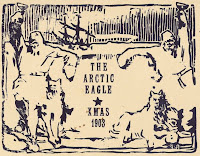
A card for the Arctic Eagle, Christmas 1903.On Christmas Day, 1903, Anthony Fiala lifted a holiday toast to his crew at Camp Abruzzi on Crown Prince Rudolf Island. The expedition, funded by William Ziegler, had departed in June from Norway on an expedition to discover the North Pole. The crew was in good spirits this first Christmas in the Arctic, and they dined well on Creamed Alaska Salmon, Yankee Chicken Croquettes, and Danish Grouse. The meal ended with ice cream, served at "30 below."

Anton Vedoe record the evening's festivities in his diary:
A photograph of a man accompanied by text describing a 1903 Christmas banquet.
The banquet itself was a great success and seldom has in the Arctic been seen a happier assemblage than at our prettily decorated table full of the most delicious eatables and all kinds of wine. Several essays by different members on different subjects relating to arctic research amongst Mr. Tafel and Mr. Porter attracted much amusement and interest. Poems and songs were delivered by Mr. Shorkley and Rilliet and some verses composed and sung by John caused much laugh. Toasts for Mr. Ziegler, Champ, Mr. Fiala, the Geographical Society etc were drank. Our commander gave a speech thanking us for the help and for the work we so far accomplished and although we lost the ship here and now had to deal with many difficulties, he still had hopes for the outcome and success of the expedition. It was 2 o'clock when we finally departed, everyone in the best of humor and I can safely say that a more successful Christmas banquet never was seen in the Arctic. The temperature was -20.
A printed menu for the Christmas banquet.
The dinner came at a time of uncertainty for the ill-fated expedition. Their ship, the America, had broken up in a storm the previous month and taken with it their coal and many of their provisions. A successful push to the pole was unlikely, though several attempts were made. To keep busy while they awaited rescue, they conducted extensive survey work. It was not until June of 1905 that the Terra Nova arrived to bring them out of the Arctic.

To learn more about the expedition ask for Anton Vedoe's papers, Stef MS 233.

Tuesday, December 20, 2011

Team Spirit

A football poster.Even though the season has ended for the Dartmouth football team, it's not too late to indulge in some nostalgia over past victories.  Leaf through programs from the earliest days of sport in the 19th century through the present.  Not only can you catch up on your stats, but you can also watch the evolution of advertising and cover art design.

In addition to the programs, Rauner also has photographs, memorabilia, and the records of the Athletic Department.  Ask for D.C. History GV 957 .D3 D37 to see the programs and DA-169 for the records of the department.  There are also many football related photo files containing additional images.

A poster for a 1957 game against Harvard.
1957, vs. Harvard

A poster for a 1911 game against Harvard.
1911, vs. Harvard

A poster for a 1931 game against Holy Cross.
1931, vs. Holy Cross
Come on in and show your team spirit.

Friday, December 16, 2011

The Well-Tempered Synclavier

A black and white photograph of a man at a piano.In the late 1970s, the New England Digital Corporation based in Norwich, VT, released the Synclavier. Primarily an FM synthesis based sound module, the original Synclavier did not come with a keyboard and was only programmable via a computer supplied with the system. The system evolved and in 1979 the Synclavier II (shown here with Jon Appleton) was released, complete with a keyboard and four simultaneous voices or synthesis channels. Later models introduced the first commercially available systems for sampling to disk and direct to disk recording and helped solidify the role of the now ubiquitous "tapeless" studio.

A page of typed text an a diagram of the Synclavier control panel.
Early manual for the Synclavier.
Jon Appleton was a professor of Music at Dartmouth at the time and was influential in the development of the Synclavier, starting with the prototype called the Dartmouth Digital Synthesizer. Working together with Sydney Alonso and Cameron Jones ‘74, Appleton helped pioneer modern synthesis and electro-acoustic music. Included in his papers are business records and correspondence related to the Synclavier and N.E.D., as well as scores, recordings and information related to the Bregman Studio at Dartmouth which Appleton helped found.

To see Appleton's papers, ask for MS-727. A finding aid is available.

Tuesday, December 13, 2011

English 79: Writing for the Motion Pictures

A poster for the exhibit "Literary Gentlemen and Girl Like I." In 1936 prominent and successful movie producer Walter Wanger '15 suggested to Dartmouth President Ernest Hopkins that Dartmouth could become a leader in the film industry by producing a new generation of writers. Hollywood's biggest problem was a dearth of quality screenplays, and Wanger theorized that an institution like Dartmouth was poised to improve the industry by teaching screen writing skills to English majors.

The English Department was game to take on the initiative, but only if they would be able to secure a large collection of screenplays for the students to critique. Wanger used his influence in Hollywood to convince each of the major studios to deposit copies of their scripts at Dartmouth. The scripts came right out of the Producers' Association notorious "Hays Office," the official censors for the film industry.

The English Department began offering a separate screen writing class in 1938. We do not have a record of how many people who took the class went on to pursue a career in the movies, but Dartmouth has maintained a long and close connection with the entertainment industry.

You can see a handful of the scripts from the collection in our current exhibition, "Literary Gentlemen and a Girl Like I," a look at screenwriter Anita Loos's 1925 best-selling novel Gentlemen Prefer Blondes. The exhibit also features the Motion Picture Code as issued by the Hays Office. The exhibit will be up through February 2012 in the Class of 1965 Galleries here in Rauner.

A page of typed text.

You can search the catalog for other plays.