Showing posts with label 17th Century. Show all posts

Friday, September 4, 2026

Brahe's Universe--What the Hell Was He Thinking?

Illustration showing Brahe's cosmologyAfter Copernicus laid out his fancy new theory placing the Sun at the center of the universe, and then Galileo argued so forcefully for it, you would think that any self-respecting astronomer would acquiesce and admit the Earth no longer held primacy in the universe. But Tycho Brahe was a stubborn cuss, and a stickler for good observation. He figured with the more accurate observations he could make with his state-of-the-art observatory, he could prove Copernicus and Galileo to be fools for doubting the long-held dogma that the Earth was the center of everything. Years of careful observation gave Brahe a trove of data.

Illustration showing Brahe's cosmpoligyThen came the hard part: fitting it all into his preconceived notions. There was no way to argue that some of the planets didn't revolve around the sun, but that didn't stop him from keeping the Earth in the middle. His elaborate scheme placed the Sun and Moon in orbit around the Earth, while Saturn, Mars, Jupiter and Venus circled the Sun. Jupiter retained its cluster of moons. The math behind all of this is way more complicated than what Newton would later come up with, but Brahe made it all fit. The two images pictured here are representations of Brahe's imagined universe from Andrea Cellarius's Harmonia macrocosmica (Amsterdam: Apud Gerardum Valk et Petrum Schenk, 1708). In his book, Cellarius non-judgmentally lays out all of the competing cosmographies and leaves it to the reader to decide their comfort level with heresy and science.

To see it in person come on in and ask for Rare QB41 .C39 1708.

Friday, June 19, 2026

Little Office with Bold Strokes

Title page from Coton's L'OfficeThis edition of L'Office de la Vierge Marie (1619), or The Office of the Virgin Mary, was written by Pierre Coton, a French Jesuit who was more famously known during his lifetime as the confessor to King Henry IV and then later to his son King Louis XIII. The Office of the Virgin Mary, often referred to as the "Little Office", was the core of a genre of popular lay religious texts known as books of hours. It was a shortened version of the Church's official daily prayer or "Divine Office" that focused on the life of the Virgin Mary. By the 1300s all clergy were required to use it and this tradition continued until the Council of Trent removed this obligation in 1545; in fact, in Coton's edition he notes that it has been revised to reflect the changes instituted by the Council.Image of Saint Matthew

Still, despite any theological changes regarding the Little Office from the 1300s to the 1600s, it is clear from a brief examination of Coton's 1619 edition that one tradition continued with little interruption. The book is filled with gorgeous hand-painted illustrations of Mary and various saints, the colors leaping off the pages where brilliantly gifted artists have skillfully applied deft brushstrokes atop the printed engravings in work that is reminiscent of the height of late medieval manuscript book production.

To witness these vivid masterpieces, request Rare Book BX2024 .A1 1619 online and then come to Rauner to marvel at them in person.

Friday, April 10, 2026

Exhibit: "Reading Sentences: Prison Libraries and Literature"

Beyond punishment for social wrongs, imprisonment has long functioned to silence or remove voices from the public forum. As we have seen with figures from Cervantes to Martin Luther King Jr., however, prison can also give inmates copious time to articulate their thoughts and the fame or notoriety necessary to draw attention to them.

This exhibit examines both the literature consumed and produced by prisoners as well as the evolving depiction of the prison in popular culture. Its scope spans hundreds of years and thousands of miles, from the chivalric romances dreamed up by imprisoned knights (and aspiring knights) of the medieval and Renaissance eras to the cheap, sensational prison dramas peddled to the working classes and the reformist prison library catalogs whose titles sought to educate and equip inmates with secular knowledge and employable trade skills in late nineteenth- and early twentieth-century New England. It highlights the electrifying prison manifestos of several prominent civil rights leaders and concludes with contemporary artist and children’s books which grapple with the psychosocial impact of incarceration.

The exhibit was curated by Sophie Chadha, Edward Connery Lathem '51 Special Collections Fellow at Rauner Special Collections Library. The poster was designed by Chadha and Max Seidman, Exhibits and Graphic Arts Designer for Dartmouth Libraries. It will be on display in Rauner Special Collections Library's Class of 1965 Galleries from April 6 through June 19, 2026.

Friday, December 19, 2025

New Additions to our Collections!

In addition to our current collections of phenomenal books and manuscripts, we are always collecting new amazing items that we know will be used eagerly by students in our classrooms. The breadth and depth of our teaching across the curriculum is represented in the following list of recent acquisitions, all of which were added to our shelves over the last three or four months. If you'd like to visit us to see any of them in person, place a request via the linked catalog record and then come to Rauner!

Codex 003545: A 17th-century manuscript scroll containing the Lotus Sutra, one of the most important texts of the Mahayana branch of Buddhism.

Incunabula 171: A single sheet from a 1483-84 almanac printed by Johannes Angelus, a prominent physician/astrologer/astronomer who practiced his trade in Vienna in the late 15th and early 16th centuries. This particular page provides advice on how to pair medical treatment with beneficial astrological signs  for the coming year.

Presses L876lokn: Book artist Angela Lorenz created this volume, titled Known no-bodies, in 2025. The work displays seven original watercolor paintings of "portrait-like figures, each with aspects of a face and a body with various fanciful modifications".

Rare CT3202 .B4 1804: Matilda Bethany's Biographical Dictionary of the celebrated women of every age and country was printed in 1804 and contains short biographies of famous women from antiquity to the present day, organized alphabetically.

Rare RM184.5 .K45 1753: A book printed in 1753 and written in Chinese with Japanese reading marks that explains the locations and relations of fourteen meridians and acupuncture points using woodcut illustrations.

Rare PA6801 .A2 1502: The 1502 Strasbourg printing of the works of Virgil, sometimes known as the "Grüninger Virgil" after the name of its printer. The work contains 137 original full-block woodcuts that were influential for artists and printers across Germany, Italy, and France for several centuries.

Rare G2355 .N577 1666b: Japan's first atlas published in Kanbun 6 (1666), consisting of 1 preface and 16 provincial maps. The accompanying text describes routes on the maps and includes such information as statistics for rice production and distances between various points by land and sea.

Friday, March 3, 2023

Cymbal Scion

Photograph of Robert Zildjian examining a cymbalFour hundred years ago, in the city of Constantinople, an alchemist named Avedis discovered a revolutionary means of treating alloys. Avedis belonged to a family of metalsmiths and cymbal-makers, and his innovative process immediately became a closely-guarded secret that was passed down from father to son over the centuries. Today, the family business is thriving: it is the oldest manufacturer of musical instruments in the world, one of the oldest continuously operating global companies still in existence, and the largest cymbal and drumstick maker in the world. The organization is still family owned and operated, and does business under the surname originally bestowed upon Avedis by the Sultan of the Ottoman Empire: Zildjian or, in Armenian, "Family of Cymbal Smiths". Numerous legendary 20th-century drummers use or have used Zildjian cymbals, including such musical luminaries as Buddy Rich, Gene Krupa, Ringo Starr, Keith Moon, Neal Peart, Dave Grohl, and many others.

Interestingly enough, one of the scions of the house of Zildjian attended Dartmouth College before returning to the family business. Robert Zildjian was a member of the class of 1945, where he majored in History and Philosophy, was a member of Chi Phi fraternity, and participated in Le Cercle Francais. In 1981, after a dispute with his brother over the company, Robert left the Avedis Zildjian Company and founded Sabian Cymbal in New Brunswick, Canada. Sabian Cymbal is today considered one of a handful of dominant cymbal makers, alongside Zildjian, Meinl, and Paiste. To read more about Zildjian, both the company and the man, come to Rauner and ask to see the alumni file for Robert Zildjian '45.

Friday, January 6, 2023

Awe-some Bibles

Aitken bible perched atop the King James Bible
This week the New York Times published an article about how experiencing awe might be good for your mental and physical health. Well, we just acquired a few awe-inspiring books if you want to get a dose of this wonder drug: a first printing of the King James Bible from 1611; and a copy of the “Aitken Bible,” from 1782, the first English Language bible printed in America. It is hard to overstate the importance of the King James Bible to the religious lives of the English-speaking world, but also to its literary and cultural realms. Setting this book next to our copy of Shakespeare’s First Folio from 1623, you can see the sources for so many of the common idioms of the English language, as well as understand the literary significance of this translation. Similarly, when it's placed next to our first printings of the Geneva Bible and the Great Bible, you can see the development of the Protestant Reformation in England. It is a truly monumental work.

First chapter of Genesis from King James Bible
Title page from Aitken bible
The Aitken Bible, so much smaller in stature, has a great story behind it. Great Britain had a monopoly on English-language Bibles in its colonies, but the Revolutionary War cut off the supply and the warring colonies found themselves with a shortage of Bibles. So, in 1781, Robert Aitken petitioned the Continental Congress to allow him to print a Bible. The book, issued as a defiant act of independence, helps us better understand the publishing world in colonial America, but also helps situate our copy of the earlier Eliot Bible (
the first Bible printed in the new world, notable because it is a translation into an Indigenous language and was printed nearly 120 years before the Aitken Bible) as the unique artifact that it is. 

To be awed ask for the King James Bible at Rare BS185 1611 and the Aitken Bible at Rare BS185 1782 .P5.


Friday, December 2, 2022

Predicting the Plague (and curing it!)

Diagram of solar eclipse with a biblical quotation Daniel 2:21-22
In 1652, one of London's most successful and esteemed physicians turned his attentions to the heavens to ponder the total eclipse of the sun that occurred on March 29. Nicholas Culpeper was one of those "gentlemen scientists" of the day. He dabbled in everything, because in his worldview, everything was connected and part of God's plan. So the blocking out of the sun, even though he could offer a clear scientific explanation, was still cause for concern--especially in London in the mid 1600s.

Just three years earlier, Charles the I was executed. Everything was turned on its head, and something big was afoot. Culpeper deduced that the eclipse heralded the second coming, so he wrote a pamphlet explaining the eclipse and issuing his dire warnings. Among his many predictions were a great plague and a fire. He got that right, but he was a little quick on the trigger. In 1665 London was hit by the Black Plague, and the following year, ravaged by the Great Fire.

As a physician, Culpeper was ready to help. He died in 1654, but he left behind a truly bizarre cure for the plague that you can read about here.

To read about the eclipse and its threats, ask for Nicholas Culpeper's Catastrophe magnatum: or, The Fall of the Monarchie. A Caveat to Magistrates, Deduced from the Eclipse of the Sunne, March 29 1652 (London: T. Vere and Nathe, 1652).

Friday, September 16, 2022

Representing Lust (and Chastity!)

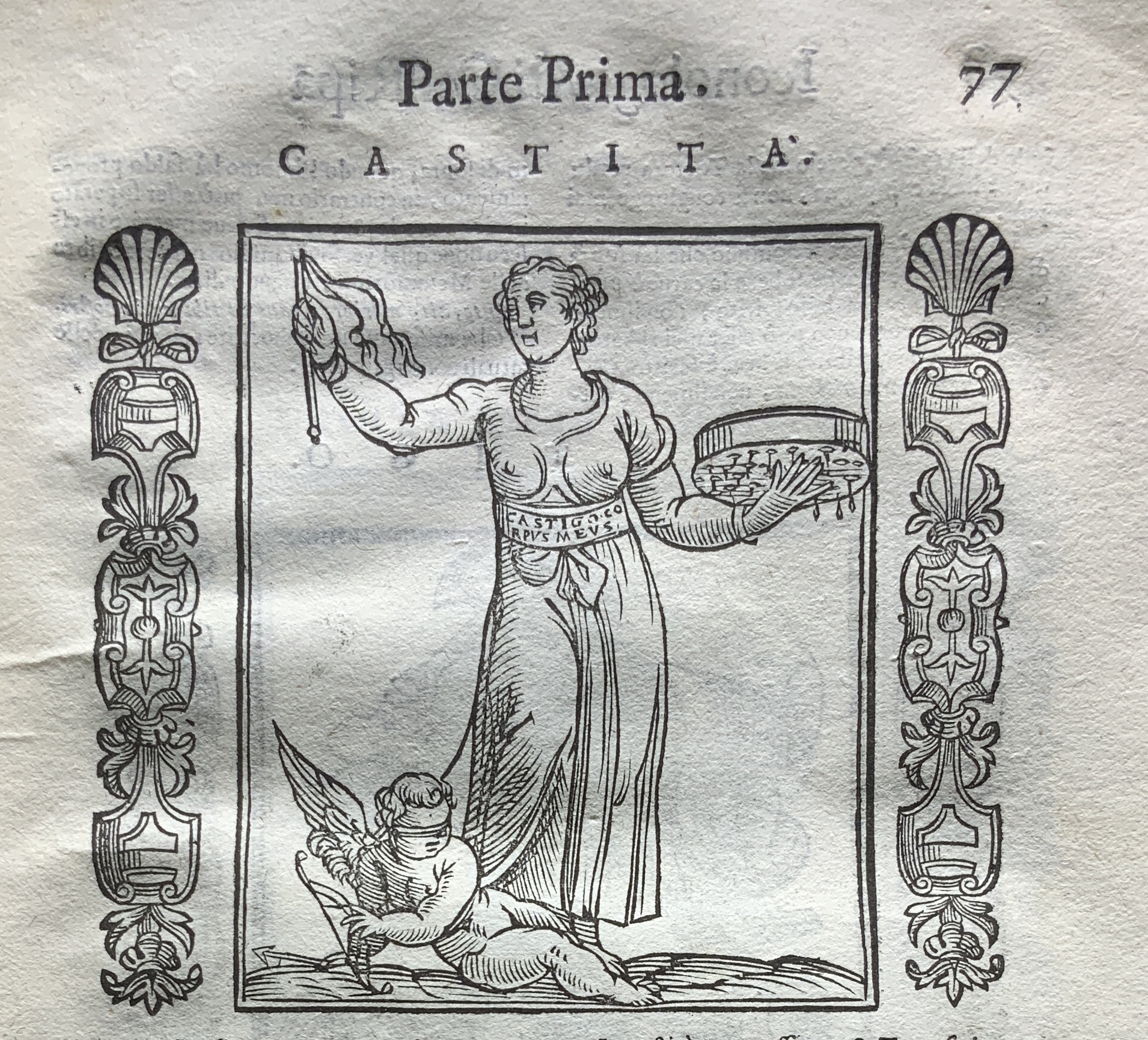
Woodcut image of ChastityThe use of emblems was popular during the Baroque time period in Italy and Europe in general, serving as a guide and source of inspiration for artists, poets, and sculptors when they were looking to creatively represent virtues, ideas, or even animals.

Cesare Ripa’s Noua Iconologia, printed in 1618, takes an encyclopedia-like format, alphabetically categorizing his emblems in multiple sections: Main Images (in 3 parts), More Notable Things, Animals, Colors and Metals, Gestures and the Human Body, Artificial Objects, Fish, and Plants. With each emblem description, Ripa also includes allegorical interpretations and references famous philosophers and writers of the time, whose interpretations of a particular object or virtue influenced his depiction of it.

Take the examples of Lust (Libidine) and Chastity (Castità). Ripa writes that the woman that symbolizes Woodcut image of Libidine Chastity in his emblem dresses in white to represent “the purity of the spirit, which maintains this virtue” (“Vestesi questa donna di bianco per rappresentare la purità dell'animo, che mantiene questa virtù.” (77).) and we see an association of colors with the value of chastity, but even more importantly, there is a suggestion that chastity leads to strength and truthfulness of character, as though someone who isn’t chaste is deceitful. Similarly, the emblem of Lust uses a particularly large amount of animal imagery, from beaks to panthers, all of which Ripa says symbolize lust, whose beauty “devours time, money, fame, body, and soul and spits it out becoming a slave to sin and the devil” (“Il che molto è simile alla Libidine, la quale con la bellezza ci lusinga, e tira, poi ci divora, perché ci consuma il tempo, il dannaro, la fama, il corpo, e l'anima istessa ci macchia, e ci avvilisce, facendola serva del peccato, e del demonio.” (312)). This, therefore, adds an element not just of deception, but of monstrosity and of sin, bringing in a religious element as well. Lust, according to Ripa, derives in women not even solely on a sexual level but also on the pursuit of fame and money.

All of this is to say that the use of emblems both had an impact on the time period’s interpretations of virtues, people, and things in the moment, as well as a longer lasting impact when the allegorical interpretation of these virtues are still seen in the present day depictions of values and morality.

To explore the woodcuts of Lust, Chastity, and many more, come to Special Collections and ask to see Rare N7740.R52 1618.

This post was originally written by Diana Alvarado '22 for Nancy Canepa's Italian 23 class, "17th and 18th Century Italian Literature".

Friday, July 1, 2022

All Wrong, but So Right

Engraving of fireworks at Versailles
This is silly. This book is 100 years too old, it was created to honor a monarch, it is from France, and it was owned by a member of the British court, "Henry Duke of Kent." So why pull it out on Independence Day? Well, fireworks!

Les plaisirs de l’Isle enchantée: Course de bague; collation ornée de machines; comedie, meslée de danse et de musique; ballet du palais d’Alcine, feu d’artifice: et autres festes galantes et magnifiques (Paris: Imprimerie Royale, 1673) is a pretty amazing book. Commissioned in 1673 to document a lavish celebration of Louis XIV at Versailles, it depicts food, parties, elaborate spectacles like papier-mache sea monsters in the pools, and even the staging of one of Moliere's plays. It has all the trappings of royal extravagance and excess, and has nothing to do with a colonial rebellion. We could say featuring it this week on the blog is some kind of subtle indictment of American complacency and decadence (a party is a party), or perhaps just another example of our willingness to appropriate anything, but really, we are just into the imagery and it put us in the mood for a Fourth of July barbecue and day in the park.

Engraving of fireworks at VersaillesEngraving of sea monsters at Versaille


Engraving of fireworks at VersaillesEngraving of banquet table at Versailles

To see the book (it is so worth your time), ask for PQ1840.P2 1673.

Friday, May 27, 2022

An Ice-Free Arctic

Map from the front of Moxon's pamphletThe possibility of an efficient trade route from Europe to East Asia was an idea that gripped the imaginations of European explorers for centuries after Columbus's discovery of the American continent. In 1697, a member of the Royal Society and hydrographer to Charles II, published the second edition of a popular self-authored pamphlet that recommended a new approach to this puzzle.

In the aptly named "A Brief Discourse of a Passage by the North-Pole to Japan, China, Etc.," Moxon spends six pages to explain why he believes that pursuing a course through the Arctic is the most likely strategy to succeed. Moxon says that he has been "credibly informed by a steersman of a Dutch Greenland ship" that the North Pole is actually a warm and open sea. Based on this expert advice, Moxon goes on to say that he is convinced that the ice encountered by ships only appeared near land masses; if that narrow band of Arctic ice could be traversed, then it would be free and warm sailing across the top of the world and down to Japan.

Moxon's hypothesis was eagerly embraced by other reputable Northwest Passage enthusiasts, who further developed his idea to the point that in 1776, Captain Cook embarked on his third voyage to the Pacific with the goal of finding a way through the Arctic to the Atlantic. As you might already know, one of Cook's crewman on that trip was John Ledyard, a non-graduate of the class of 1776.

To skim Moxon's pamphlet and look at his map which shows what was known of the Arctic Circle at the time, come to Rauner and ask for Stefansson G640 .M69 1697.


Tuesday, August 31, 2021

The Agency of Death

Text of "Epitaph on a Sailor"One of the most exciting aspects of our collections is the way that Dartmouth students interpret primary sources to create new ideas within the context of the classroom. On Tuesdays this summer, we are publishing posts that were originally written by students in Michael Chaney's Literary History survey course during the Winter 2021 term. Each student essay comparatively examines two poems, one from the Dartmouth student newspaper and the other by a canonical American or British author. Today's poems are "Lycidas" by John Milton and "Epitaph on a Sailor" published in the Dartmouth, the student newspaper, in the 1840s.

An analysis of “Epitaph on a Sailor” through the lens of natural immortality introduced by Milton’s “Lycidas” offers a new reading of the poem. While both works speak of death as a physical phenomenon, “Epitaph” conveys it as a final destination. The farmer is reduced to dust, and all who are dead reduce to sediment “beneath the land and sea” (Anonymous). “Epitaph” conveys multiple dualities – between land and sea, between “remain” and “contain,” between immortality and death. The “urn” represents a duality between earth and aquatics, as it can refer to a vessel “ used by various peoples…to preserve the ashes of the dead” (urn 1) while it can also mean “ an oviform pitcher or vessel for holding water” (urn 4.a). These binaries illuminate the distinctions between life and death as separate entities, suggesting immortality as an impossibility.

In contrast to the stationary description of deaths of the mariner and farmer in “Epitaph,” such as the depiction of dust in an urn or at the bottom of the ocean, Lycidas lives on as an individual through nature. “Lycidas is not dead” Milton says -- he elementally reappears as “in the forehead of the morning sky” and in “groves and other streams” (Milton). He lives on through the lamenting of nature. Milton’s lens of natural immortality provides a reading of “Epitaph” that places it in conversation with “Lycidas,” -- a means to express life beyond death.

Applying the immortal qualities of “Lycidas” illuminates the importance of the order of words in “Epitaph.” The last line, which reads “alike, beneath the land and sea,” suggests potential for the dead to live through earthly phenomena. This line also reverses the order of “mariner first, farmer second,” (the order in which they appear in the poem). Placing the land before the sea suggests concrete life after death. It favors the stable land of the farmer over ethereal vastness of the ocean. Milton’s lens also calls to attention the pattern of verbiage associated with each person. The mariner “remains,” while the farmer is “contained” -- the former being passive and the latter more active. “Remains” means “to continue to belong to a person” (remains 1.a), while “contains,” means “to restrain… to hinder (from an action) (contain 1a). The shift from passive to active verb suggests the Miltonic theme of death taking on more agency in “Epitaph.” There is more life to death, as suggested in “Lycidas,” when the hero collects not just as dust, but as sediment “sunk though he be beneath the wat'ry floor” (Milton). “Lycidas” provides a lens through which “Epitaph” can be read to have more of an immortal view as opposed to a reading which conveys death as absolute.

Written by Julia Robitaille '23


"Epitaph on a Sailor"

HERE rest in death a mariner’s remains—
That other urn a farmer’s dust contains:Thus Pluto’s dark dominions be Alike
beneath the land and sea.
(Published in the Dartmouth, Volume 2, 1840-1841)

"Lycidas", lines 165 – 177, or 10th stanza

Weep no more, woeful shepherds, weep no more,
For Lycidas, your sorrow, is not dead,
Sunk though he be beneath the wat'ry floor;
So sinks the day-star in the ocean bed, And yet anon repairs his drooping head, And tricks his beams, and with new spangled ore Flames in the forehead of the morning sky:
So Lycidas sunk low, but mounted high
Through the dear might of him that walk'd the waves;
Where, other groves and other streams along,
With nectar pure his oozy locks he laves,
And hears the unexpressive nuptial song,
In the blest kingdoms meek of joy and love.
(Written by John Milton in 1637)

Friday, January 15, 2021

Many Times Removed

Frontispiece of the Fourth Folio with an engraving of Shakespeare and the "To the Reader" poem by Ben JonsonAs just about everyone here at Dartmouth knows, we have a copy of Shakespeare's First Folio, published in 1623 by friends and fellow troupe members of the playwright and poet. It's probably our most requested item, just after our first edition of the Book of Mormon. And, as we've blogged about before, we also have two Second Folios (1632), three Third Folios (1662), and two Fourth Folios (1685). Some of these folios are what we sometimes call "Frankenstein Folios," in that they've been pieced together from the remnants of multiple partially-destroyed originals. Others have had specific pages removed or severely damaged, to the extent that pen and ink facsimiles have been pasted in to fill the gap. They're all technically still originals, sorta, but maybe not in the eyes of bibliographic purists. In addition to those "complete" Folios, we also have a decent number of fragments from all four Folios, including a complete Timon of Athens from the First Folio and King Lear from the Second Folio. There's even a cleverly bound book titled The English Historical Plays of William Shakespeare, which is really just the "Histories" chunk of the Fourth Folio.

Title page of Timon of Athens from the First FolioTitle Page of King Lear from the Second Folio

To get a list of all of the Folios in all their various conditions so that you can come in and look at them, follow this link to a search query in the library catalog. There's a 20th-century spoiler in that list, but otherwise (I think!) the rest of the Folios are there.

Wednesday, December 2, 2020

Combating a Plague

Title page and frontispiece to Culpeper
You thought bleach was weird, check out this "cure" for the plague prescribed by the esteemed physician Nicholas Culpeper:

Take a Cock chicken, pull off the feather till the Rump be bare, then hold the bare fundament of the Chicken to a Plague Sore and it will attract the Venom to it from all parts of the body and dye; when he is dead, take another and use likewise; you may perceive when all the Venom is drawn out, for you shall see the Chicken no longer pant nor gape for breath; the party sick will instantly recover.

Got it--now we just need to find some chickens...

To see this cure and many others, as for Culpeper's School of Physick (London: Obadiah Blagrave, 1678), Rare R128.7 .C84 1678.

Thursday, October 29, 2020

Illustrating Bluebeard


Bluebeard's wife looks around as she begins to unlock the door.
Here’s a horror story for you: a French nobleman seeks a bride, but struggles due to his unsightly blue beard and a string of missing wives. Eventually, he is able to woo a young woman and bring her back to his estate as his new wife. After a month of marriage, he declares that he must go away on business, leaving her with a ring of keys and an interdiction. She can go wherever she likes and entertain to her heart’s content, but she must not use the littlest key on the ring. It opens a closet on the ground floor and nothing awaits her there but her husband’s “just anger and disappointment.” After some time, the young bride is overcome by her curiosity and unlocks the door, where she finds the bodies of her murdered predecessors. When her husband discovers that she has failed his test, she is only spared their fate by some stalling and the timely arrival of her brothers, who kill her husband in turn.
Bluebeard, a fairy tale first published in Charles Perrault’s 1697 Histoires du temps passé, ou, Les contes de ma Mère l'Oye, better known as Mother Goose, has been retold over and over again, deeply affecting the development of the gothic and horror genres. Its influence pervades classics like Daphne du Maurier’s Rebecca, Fritz Lang’s The Secret Beyond the Door, as well as more recent texts, including Crimson Peak and Ex Machina.
A caricature of Bluebeard handing the keys to his wife.
Rauner Library’s collection of illustrated versions of Bluebeard also highlights a curious trend: how Bluebeard, a French fairy tale, became increasingly Orientalized over time. When the first literary version was published, the accompanying illustrations showed its characters in European dress. They were also largely unnamed, with the exception of the “Bluebeard” moniker and the new bride’s sister Anne. At some point in adaptation, however, the bride gains the Arabic name Fatima, and the story begins to take on an exoticized aspect. In an 1805 English language version, the entire story is relocated to an ambiguously Eastern setting. In others, like William Makepeace Thackeray’s The Awful History of Bluebeard (1924), Bluebeard himself is the focus of the change, while everything else remains fairly European. Edmund Dulac (1882-1953), one of the great artists of the Golden Age of Illustration, also had to have his two cents. His take on Bluebeard, featured in The Sleeping Beauty and Other Fairy Tales from the Old French, is located “in a city not far from Baghdad.” Even Arthur Rackham, whose work is overall less interested in the Orientalism of his peers, was apparently unable to resist the racist allure of imperiling a beautiful woman in an imagined East. 

Bluebeard brandishes a scimitar.
This translocation by tale-tellers and illustrators leaves a lot to be desired. The inconsistent mish-mash of European design sensibilities with an interest in and fear of the Orient is by no means exclusive to Bluebeard, but it is a specific and somewhat puzzling case study. The standard lineup of historical figures cited by folklorists as possible influences on the oral folktale, like Gilles de Rais and Henry VIII, is not exactly foreign. And while the story is gruesome enough that it could have made some uncomfortable to think of as so close to home, Bluebeard is no more horrific than many other fairy tales that didn’t receive the same treatment.What do you think? Check out some of the Rauner’s many illustrated variants, including Rare Book PQ1877 .C513 1785, Sine Illus D86sleb, Sine Illus C366fai, Illus R115 afb, 1926 Coll B587n 1805, and Sine Illus C527fai.


Monday, September 21, 2020

College in the time of COVID

Foldout record of the deaths from the front of Hodges's book
As the first full term of the pandemic begins here at Dartmouth College, we are taking the opportunity to reflect back on the somewhat morbid but always fascinating history of global pandemics that our collections harbor. In particular, we've been thinking about the London plague of 1665, the smallpox outbreak in the American colonies during the Revolutionary War, and the misnomered "Spanish" flu of 1918. Although the bubonic plague ravaged London a mere one hundred and three years before Dartmouth was founded, the smallpox and flu outbreaks are "recent" enough to have had an effect on student life in Hanover.

Our post today isn't so much original content as it is a looking back to previous blog entries about these diseases and a glance forward into the possibilities of the current term. Daniel Defoe's Journal of the Plague Year, while a fascinating read, also relied heavily upon the writing of Nathanial Hodges's Loimologia: or an Historical Account of the Plague in London in 1665. In addition to narrative accounts, we also have a gathering of weeklybroadsides that indicate the number of deaths per week and their causes during 1665, when the plague was at its height.

Prescription for a purgative in preparation for inoculation from the late 1700s
With regard to pandemic impact upon the Dartmouth campus, we have correspondence related to a group of students seeking inoculation from the virus, a risky venture given the possibility of actually succumbing to the terrible disease. More than a century later, Clifford Orr, a member of Dartmouth's class of 1918, would write home to his mother about how the flu was sweeping across campus. While thinking about these past virulent visits, we wondered about what sorts of experiences current students might document during this coming term, and whether any of those documents might make their way into the archives as well some day.

With that in mind, this post is also a bit of self-promotion. Today, September 21st, I'll join Sarah Smith, from the Book Arts Workshop, for a fascinating look at journals created during times of crisis and pandemic. First, I'll showcase some books from Rauner Library that recount the London plague, then follow with original manuscripts that Dartmouth students wrote during the colonial smallpox outbreak and the 1918 flu. Then, Sarah Smith will help students make their own journals using materials from around the house. Instructions for making a simple book are found online on the Book Arts Workshop’s resource guide here. Feel free to make your own journal using her advice and start writing down your own journal of a plague year.

Friday, February 28, 2020

Pozzo's Lasting Perspective

A diagram of a twisted vertical column
On Monday, students from Elizabeth Kassler-Taub's Early Modern Art History class made their second visit to Rauner. During their visit, they had the chance to look at a variety of early modern architectural treatises, including a sumptuous 1719 edition of Andrea Pozzo's Perspectiva Pictorum et Architectorum. Pozzo, who lived from 1642 until 1709, was the definition of a Renaissance man (although he technically operated within the Baroque period): Jesuit brother, architect, painter, and stage set designer were but a few of his identities. His Perspectiva is a stunning example of his skill with and comprehension of the visual arts. The manual was one of the first to provide instructions on how to accomplish realistic perspective in painting and satisfying proportions in architectural design. The book went on to be a huge success; it was printed in at least six languages and new editions continued to come out well into the 19th century.

A diagram of a structural dome

To explore the beautiful engravings on perspective that accompany Pozzo's writing, or to read it for yourself if you can, come to Special Collections and ask for Rare NC749 .P8 1719.

Tuesday, February 25, 2020

Real Character

Taxonomy of maggots
This book is something else. It is titled An Essay towards a Real Character and a Philosophical Language, by John Wilkins of the Royal Society and printed in 1688. From the title, you would think it is about language and materiality, maybe with a bit of a metaphysical twist. But then you open it up and realize it is trying to do so much more. It seems to be an attempt to get the whole of creation tamed and under control in some sort of analytical system.

Taxonomy of discourseTaxonomy of herbs

Everything is broken down and sorted in cascading charts of creation. We are talking about EVERYTHING--comets, rainbows, garden cress, dog-fish, and even clauses and sentences.

As an added bonus, there is a fairly long analysis of Noah's Ark thrown in--makes sense, I guess, when you think of what the author was trying to do.

Diagram of Noah's Ark
Come take a look by asking for Rare P101 .W4 1668.

Friday, January 31, 2020

Set your Sundial for Success


Map of New England
Here in Special Collections, we have a lovely little volume written in 1687 by Richard Blome titled The Present State of His Majesties Isles and Territories in America. This book, along with Ogilby's America, had a profound influence upon British emigration to the American colonies. Numerous maps of various islands are painstakingly reproduced in beautiful engravings, including a decent one of New England.

Sundial instruction sheetDespite the fascinating cartographic efforts that the book contains, our favorite detail is found on the very last page of the text itself (before the list of other books that the seller is trying to hawk). An engraving of various sundials demonstrates to the reader how to properly align their garden sundial, depending upon which of the British territories they live in. New England, Barbados, Jamaica, Virginia, and Carolina all have different instructions for alignment. As we move into February, when the days are growing longer, if not warmer, it's interesting to reflect on how important the sun was for early settlers for more than just heat and light.

To see Blome's book, come to Special Collections and ask for Rare E162 .B65 1687.

Friday, January 24, 2020

Creepy-Crawlies

Engraving of a scorpion
If you like old tomes and creepy-crawlies, then do we ever have the book for you. In preparation for an anthropology class on bestiaries, we discovered an edition of Jan Swammerdam's Historia Insectorum Generalis that was printed in 1685. Inside, a cornucopia of detailed engravings of insects are lovingly tipped in. The high quality of the images is almost reminiscent of Vesalius's anatomy of the human body, which makes sense once one learns that Swammerdam initially trained as a physician. In fact, his love of insects derailed his father's plans for him to become a wealthy and prominent doctor. In anger, his father withdrew financial support and Swammerdam was forced to practice medicine in order to make enough money to continue his entomological research.

In 1669, Swammerdam published his Historia, which disproved the prevailing Aristotelian perspective that insects were inferior creatures which lacked any sort of internal anatomy worth mentioning. Additionally, Swammerdam argued that insects came from eggs instead of spontaneous generation, which was a widely-held Christian notion at the time. Swammerdam is today often cited as ushering in a natural theology that took hold in the 1700s, wherein the glory of God was revealed by careful scientific examination of his various creatures. He also was an innovator with regard to scientific techniques for working with scientific specimens, both insect and human.

Engraving of a mosquito

To explore the amazing world of insects contained within the first Latin edition of Swammerdam's work, come to Special Collections and ask to see Rare QL463 .S8.

Tuesday, October 1, 2019

Still in the News

Title page to Volume 2 of The Federalist.Originally published in the New York Packet in March of 1788, Alexander Hamilton's Federalist 65 and 66 were compiled along with the rest of the "Federalist Papers" in April and May of that year and published in two volumes by J. and A. McLean as The Federalist: A Collection of Essays in Favour of the New Constitution. The McLeans only printed 500 copies, but even that proved to be far too many for the market. Today, it is one of the most sought after first editions in American political history because it so clearly lays out the original intent of the framers of the Constitution.

Title to Federalist 65 "A further View of the Constitution of the Senate, in Relation to its Capacity as a Court for the Trial of Impeachments."
The world is paying particularly close attention to Federalist 65 and 66 right now because that is where Hamilton defined the power of the Senate in matters of impeachment. You can come in and see his original words in their first compiled form by asking for McGregor 56.