Showing posts with label 21st Century. Show all posts

Saturday, February 7, 2026

The Wonderful Winters of Old

Three Wizard of Oz-themed Winter Carnival posters from 1972, 2002, and 2026.  

As students are bundling up for a chilly ‘Blizzard of Oz’ Winter Carnival this weekend, we thought we’d take a trip back through the wizardly festivities that Hanover has seen over the years, from ‘The Winterland of Oz’ in 1972 to ‘There’s Snow Place Like Home’ in 2002, to try and answer the question: what continues to draw Dartmouth students to the story and setting of L. Frank Baum’s quintessential American fairy tale? 

As a member of the 2002 Winter Carnival committee explained to The Dartmouth, “obvious connections between the Emerald City and Dartmouth” gave them lots of material to riff off of to play up the theme of the event. Beyond the visual synchronicity and a fervent love of the color green, both the citizens of Oz and Dartmouth students suspend their notions of reality for a bit. Since its inception, Winter Carnival has promised an escape: from coursework for Dartmouth students, and into Hanover’s snowy woods for the guests who joined them.

Despite the magical theme and a towering snow sculpture of the Emerald City, complete with staircases and a slide, the 1972 Winter Carnival arrived amidst a flurry of change, controversy, and anticipation; as the final Carnival held before co-education and the last to host a Queen of the Snows competition, students were abuzz with speculation about the women who would be joining the undergraduate population in the coming academic year. When asked whether the admissions office would be taking beauty into consideration for female applicants, Admissions Director Edward Thoyt Chamberlain stated that scholastic achievement would be the “most heavily weighted” factor for all prospective students and dismissed the feasibility of physical assessment, telling The Dartmouth, “‘You can’t trust pictures they send us. We all know that’” (February 11th, 1972). 

Just days earlier, on February 8th, the college newspaper published a brief article entitled “Sexism: Carnival Council Seeks Dumb Broad” to announce the Winter Carnival Council’s decision to remove the “intelligence criteria” for the Queen of the Snows contest; by February 14th, the paper had dubbed the newly elected Queen “brainless and beautiful.” While Kappa Kappa Kappa member Bill Farnum celebrated his fiancĂ©e’s coronation with her in front of the Emerald City, his fraternity’s snow sculpture, ‘Eleazar Goes Broad-Minded,’ depicts the founder of the College leaning down towards a young woman splayed on the ground and inviting her to attend the school. Echoing early imagery of Wheelock gesturing towards a seated Native American student, the sculpture points to the varied response of Dartmouth students to the nearing onset of co-education.

A large snow sculpture of a castle with many towers.Though the majority of students polled supported the shift to admit women, anti-coeducation sentiment during this period was palpable. Several of the early female Dartmouth students reported feeling particularly unwanted and out of place during Winter Carnivals, as women from the Seven Sisters colleges continued to be preferentially invited as dates for the weekend’s festivities. Beneath the Oz-themed spectacle, the Carnival became a site where broader cultural shifts – and the discomfort surrounding them – played out in very public ways.

Want to see these images for yourself? Head over to Rauner and request Iconography 1647: Photographic files"Snow Sculpture 1972" to explore the 1972 Winter Carnival, or DA-671, Objects 50 and 80 to view the 1972 and 2002 Winter Carnival posters.

You can also check out the ‘Baum-y Weather: Blizzard of Oz Strikes Campus’ exhibit in Rauner’s main entrance to learn more about L. Frank Baum’s beloved children’s novel, its many sequels, and various artistic, musical, and cinematic adaptations. While you’re here, stop by the reference desk and peek at our ‘Something Cool’: a photo of the child actress who played Dorothy in the iconic 1939 film adaptation shooting pool on campus with her short-lived Dartmouth fiancĂ© at Alpha Theta fraternity in 1967!  


Friday, December 19, 2025

New Additions to our Collections!

In addition to our current collections of phenomenal books and manuscripts, we are always collecting new amazing items that we know will be used eagerly by students in our classrooms. The breadth and depth of our teaching across the curriculum is represented in the following list of recent acquisitions, all of which were added to our shelves over the last three or four months. If you'd like to visit us to see any of them in person, place a request via the linked catalog record and then come to Rauner!

Codex 003545: A 17th-century manuscript scroll containing the Lotus Sutra, one of the most important texts of the Mahayana branch of Buddhism.

Incunabula 171: A single sheet from a 1483-84 almanac printed by Johannes Angelus, a prominent physician/astrologer/astronomer who practiced his trade in Vienna in the late 15th and early 16th centuries. This particular page provides advice on how to pair medical treatment with beneficial astrological signs  for the coming year.

Presses L876lokn: Book artist Angela Lorenz created this volume, titled Known no-bodies, in 2025. The work displays seven original watercolor paintings of "portrait-like figures, each with aspects of a face and a body with various fanciful modifications".

Rare CT3202 .B4 1804: Matilda Bethany's Biographical Dictionary of the celebrated women of every age and country was printed in 1804 and contains short biographies of famous women from antiquity to the present day, organized alphabetically.

Rare RM184.5 .K45 1753: A book printed in 1753 and written in Chinese with Japanese reading marks that explains the locations and relations of fourteen meridians and acupuncture points using woodcut illustrations.

Rare PA6801 .A2 1502: The 1502 Strasbourg printing of the works of Virgil, sometimes known as the "Grüninger Virgil" after the name of its printer. The work contains 137 original full-block woodcuts that were influential for artists and printers across Germany, Italy, and France for several centuries.

Rare G2355 .N577 1666b: Japan's first atlas published in Kanbun 6 (1666), consisting of 1 preface and 16 provincial maps. The accompanying text describes routes on the maps and includes such information as statistics for rice production and distances between various points by land and sea.

Friday, January 24, 2025

"Pretty Thoroughly Browned Off"

We've posted in the past about the 1945 controversy over Dartmouth President Ernest Hopkins' comments regarding Jewish quotas in college admissions. This week we ran into the thoughts of one alum in particular. John Martin Mecklin, Class of 1939, became a war correspondent in Europe in the last years of World War II, and his letters make for some pretty stupendous reading. Not one to mince words, Mecklin says that Hopkins' words have him "pretty thoroughly browned off":

"I had been aware, of course, that there was such a policy, but to say so for publication showed incredibly bad taste. In thinking about the thing it has occurred to me that Dartmouth never has made its position very clear on exactly what it represents. I'm tempted to reply to the next appeal for donations to the alumni fund simply by mailing them a clipping of the president's remarks. As a matter of fact this clinches something I've been considering for a long time---that if I ever have a son I won't send him to Dartmouth. 

There's no place in the world today for an educational institution unwilling to face the fact that an entire new philosophy of life has been born in this war. I don't know what Dartmouth is doing about the war and revisions in its curriculum---nothing has been said about that in any of the alumni communications I've seen---but I'm skeptical that it will be big enough to face the challenge. This war and its terrible climax in the atomic bomb has put before us the simple choice of making the values we say we represent stand up or of suicide. I didn't learn about values in Dartmouth, not the ones that count and I'm beginning to suspect the learning simply wasn't available there.

I didn't understand freedom of speech, for instance, until I came over here and saw what happens when it doesn't exist. I learned about equality of opportunity in Germany, not in Dartmouth. I learned about economics in starving Berlin, not in Hanover. Perhaps it's impossible to understand such things as a student, but I don't think you have to be as dismally ignorant as I was. Of this I'm certain: the war caught Dartmouth 100% unprepared either for it or its repercussions. Will Dartmouth be caught unprepared for the peace in the same way? Hopkins' latest pronouncement certainly indicates that the answer is yes."

This is in a letter to his parents, by the way. The updates Mecklin sends home during his time as a war correspondent are filled with thoughts along these lines, a combination of sharp observations about other people alongside seemingly unaware references to his own prejudices. After all, to him the quotas weren't an issue until acknowledged publicly.

To read this and other letters, ask for ML-28 Box 2 Folder 24.


Thursday, November 7, 2024

Today is World Digital Preservation Day!

Wax Cylinder from the Charles Furlong papersToday we celebrate World Digital Preservation Day, which occurs on the first Thursday of every November. The day is meant to celebrate digital preservation and raise awareness of the challenges inherent in the task of recording human memory that exists in a digital format.

An interesting case for digital preservation exists in the Charles Furlong papers (Mss-197). Charles Wellington Furlong was the first American to explore the southernmost part of the Americas, the interior of Tierra del Fuego, in 1907 and 1908; we've blogged about him before. While there, he made wax cylinder recordings of the Onas and Yahgan peoples talking and singing. Obviously, there is no easy way to play a 100+ year old wax cylinder recording in the modern world. Even if there was, it is possible that the fragile, decaying media would only have one play left before it disintegrates, so one had better be prepared to capture the audio when it is being played. There is also a chance that the attempt at playing the item would destroy it before any audio could be heard.

Close-up of wax cylinderInstead of potentially damaging the wax cylinders by playing them, we sent them to a specialist who digitized the recordings by taking extremely-high resolution photographs of the cylinders using a laser, and then played the digital file from the high-resolution digital images! Although the audio quality is scratchy and echoey, the recordings can now be heard.

The digital files for this collection include hundreds of files, including exotic file formats like .bri (used for 3-D modeling) and .trk files (used for workflows tied to proprietary and unique software packages). However, the images of the cylinders are also saved as more accessible .jpg and .tif files while the audio recordings are also available as .mp3 files. We have made all of the files, like this one for example, available online to researchers. The files are checked for viruses, re-built from scratch (in a process called recharacterization), and given a checksum by Preservica, our digital preservation system, which also synchronizes the files with our description system. 

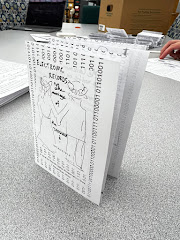
In honor of World Digital Preservation Day, a lighthearted look at the world of intangible zeroes and ones is available by way of a physical object: a photocopied zine! They are available at Rauner Special Collections, the circulation and welcome desks of Baker-Berry library, and the Book Arts Workshop. If you'd like to examine an actual wax cylinder, come to Rauner and ask to see one from the Charles Furlong papers (Mss-197).           

                    Cover of the zine

Friday, February 16, 2024

Breaking Bread: The Development of Kosher and Halal Dining at Dartmouth

Brightly colored brochure advertising the Pavilion station and showing its location on a map

“[A] joint Halal-Kosher dining venture on campus … would significantly advance Dartmouth’s vision for its future.”

1999 was an important year in the history of food inclusivity at Dartmouth. President emeritus James Wright and the Board of Trustees introduced the Student Life Initiative (SLI) in February of 1999. The main goal of this initiative was to make Dartmouth’s campus more socially inclusive and welcoming, and administrative leaders found that centralizing dining and renovating campus dining facilities would help them achieve this objective. Jewish and Muslim student leaders similarly determined that the creation of a Halal-Kosher dining facility would advance the SLI’s inclusivity mission.

Jewish and Muslim students in the late 20th and early 21st centuries began working together to research the logistics for creating a Kosher-Halal-friendly dining option. They eventually formed a committee, which included the President of Dartmouth Hillel, the President of the Al-Nur Muslim Student Association, and former Dartmouth Rabbi Edward Boraz. This committee collaborated with Dartmouth Dining Services (DDS) to determine what was possible for the future of a more inclusive dining experience. The committee finalized their research in a report titled “The College Committee’s Report on Kosher and Halal Dining.”

Final page of the committee report on Halal and Kosher dining, signed by three committee members

The committee determined that a “dedicated dining facility that would meet the needs of Muslim and Jewish students” would “[e]nable those with religious dietary requirements to feel more at home.” It would “creat[e] a better sense of inclusivity for those who wish to observe these [religious dietary] laws.” Other students who do not follow these requirements would also benefit. A Halal-Kosher facility would “[a]dd to the array of dining options and thus encourage the development of cross-cultural interaction among students.”

In the late 90s and early 2000s, Kosher and Halal dining options at Dartmouth were flawed, limited, or non-existent. The student committee reported that “there [were] no Halal products presently available.” Committee leaders acknowledged the efforts of DDS and Hillel but relayed that “existing facilities [did] not satisfy orthodox standards of Kashrut.” Barring “religious holidays and Friday evening services, Kosher dining [at Dartmouth was] marginal at best.” Dartmouth offered “Kosher sandwiches and microwavable dinners,” but the use of non-Kosher products in microwaves “render[ed] both the microwave and food subsequently warmed in it to be unfit.”

Students adhering to Kosher policies faced additional barriers during religious holidays, despite the Roth Center for Jewish Life serving Kosher-compliant food. Dartmouth Hillel, in response to the “increased demands for improved quality and greater supervision” of Kosher food, “retained Andrew Wiener Catering Service of Boston, an orthodox certified kosher caterer, to provide meals for Rosh Hashanah, Yom Kippur, and post-fast meals.” However, the “dramatic increase in costs” forced Dartmouth Hillel to “charge half of its cost to the students’ meal plans.” In other words, there were economic obstacles that made dining less accessible for students with certain dietary needs.

Dartmouth administration, working towards inclusivity, began focusing on resolving these issues and accommodating more dietary needs. A Student Life Initiative planning document shared that in November 2000, the College announced that “‘Muslim and Jewish students forge[d] a ground-breaking agreement for a joint Halal-Kosher dining facility’ to be located in Thayer Hall.” This dining facility would later become known as the Pavilion, which still serves Kosher and Halal food options today. The SLI document also stated that College leaders advocated for this dining outlet’s placement in the Collis Center, Robinson Hall, or Thayer Hall: they found that it should reside in a “primary campus dining venue.” Administrators wanted those with these dietary requirements to feel fully integrated into the campus community. This indicates the College’s efforts to make dietary needs — and religious identities — welcome at Dartmouth.

To read the “The College Committee’s Report on Kosher and Halal Dining,” visit Rauner Library and request “The College Committee's Report on Kosher & Halal Dining” in Box 30887 from collection DA-798. For access to the Student Life Initiative planning document, ask for folder “SLI Social Dining” from Box 30373 from collection DA-8.

Posted for Thomas Corrado '25, recipient of a Historical Accountability Student Research Fellowship for the 2024 Winter term. The Historical Accountability Student Research Program provides funding for Dartmouth students to conduct research with primary sources on a topic related to issues of inclusivity and diversity in Dartmouth's past. For more information, visit the program's website.

Friday, March 3, 2023

Cymbal Scion

Photograph of Robert Zildjian examining a cymbalFour hundred years ago, in the city of Constantinople, an alchemist named Avedis discovered a revolutionary means of treating alloys. Avedis belonged to a family of metalsmiths and cymbal-makers, and his innovative process immediately became a closely-guarded secret that was passed down from father to son over the centuries. Today, the family business is thriving: it is the oldest manufacturer of musical instruments in the world, one of the oldest continuously operating global companies still in existence, and the largest cymbal and drumstick maker in the world. The organization is still family owned and operated, and does business under the surname originally bestowed upon Avedis by the Sultan of the Ottoman Empire: Zildjian or, in Armenian, "Family of Cymbal Smiths". Numerous legendary 20th-century drummers use or have used Zildjian cymbals, including such musical luminaries as Buddy Rich, Gene Krupa, Ringo Starr, Keith Moon, Neal Peart, Dave Grohl, and many others.

Interestingly enough, one of the scions of the house of Zildjian attended Dartmouth College before returning to the family business. Robert Zildjian was a member of the class of 1945, where he majored in History and Philosophy, was a member of Chi Phi fraternity, and participated in Le Cercle Francais. In 1981, after a dispute with his brother over the company, Robert left the Avedis Zildjian Company and founded Sabian Cymbal in New Brunswick, Canada. Sabian Cymbal is today considered one of a handful of dominant cymbal makers, alongside Zildjian, Meinl, and Paiste. To read more about Zildjian, both the company and the man, come to Rauner and ask to see the alumni file for Robert Zildjian '45.

Friday, September 23, 2022

Exhibit: A Fighting Tradition

Exhibit posterThe Dartmouth College community has been involved in every one of the country's major military engagements, from as far back as the Revolutionary War all the way up to the recent conflicts in the Middle East. For centuries, Dartmouth men and women have carried on a storied tradition of valiant wartime service to the United States of America, serving all around the globe and in all branches of the military.

During the 2022 fall term, an exhibit curated by Ryan Irving '24, current president of the Student Veterans Association, explores this tradition. "A Fighting Tradition: Dartmouth in American Wars" will be on display in Rauner Special Collections Library's Class of 1965 Galleries until December 3rd.

As Irving's exhibit illustrates, this tradition has evolved over the years, as has the college's identity and the nature of its student body. In the first decade of Dartmouth's existence, its connection to war was primarily through alumni involvement. Over the course of the next two centuries, the college's participation in war efforts grew in scope and variety: it saw the creation of student military societies, facilitated the training of soldiers on campus, sponsored military support services, and allowed students to put their college years on pause to enlist.

National unrest over the country's involvement in the Vietnam War was reflected on campus by the formal elimination of ROTC sponsorship due in part to student protest. However, in the early years of James Wright's presidency, and because his influence at a national level, Dartmouth was afforded the opportunity to support the war effort in a new way: by welcoming veterans to campus as students, along with the wealth of experience and diversity that they brought with them.

To see the exhibit while it's on display, come by Webster Hall and visit the exhibit space on our mezzanine. To read more about the exhibit online, visit its website.

Friday, February 19, 2021

Dartmouth Dining Association staff and the "Dartmouth Experience"

“One would not expect that the woman who scans students’ I.D.s at Food Court and the man who sprinkles sand on the icy sidewalks would have a voice on Dartmouth campus” – Erin Loback ’99, News Editor, The Dartmouth

Dartmouth is a large and ever-changing entity. While the “Dartmouth Community'' is something that is often talked about around campus, there is not much consensus on who this “community” encompasses. During my term of residence at Rauner, I continue to wonder whether the staff of Dartmouth College are widely considered to be part of this community. Quotations like the one above lead me to believe that they are not.

For example, Local Union 560 has been present on Dartmouth’s campus since 1966 and is composed of the service workers at the college, such as those who work in Dining Services, FO&M, and other service departments. Those who make up these departments are often from areas outside of the Upper Valley and come from working class backgrounds, sometimes hailing from a familial line of Dartmouth staff. Over the course of 55 years the union that represents these workers has achieved fair pay and benefits for those who keep the campus running, but not without trial or tribulation. Despite these advancements, those who are in the union are some of the lowest paid staff at Dartmouth and yet they are often the first to receive the blows from an economic crisis.

Following the 2008 market crash, Dartmouth announced a $100 million budget cut and, as a result, would be laying off staff in the near future. The proposed layoffs fueled a debate on campus about what exactly was the “Dartmouth Experience”. President Kim emphasized “preserving the most important aspects of ‘The Dartmouth Experience’” whilst conducting cuts and layoffs. Students Stand with Staff, an unrecognized student organization that stood in solidarity with the service union, launched a poster campaign in response to both the layoffs and the capital campaign. The posters displayed a picture of a Dartmouth student with a staff member with the phrase “This is __ and they are a part of my Dartmouth experience.” While this campaign was met with mixed response, it called into question a lot of the issues that I have identified in my research this winter. Dartmouth, in its most recent iterations, does not seem to think that the people who labor to keep the college alive are integral to the Dartmouth experience.

Dartmouth Students for Staff "This is __" campaign poster
As a fellow, I have focused on those who work in Dining Services because, of all the service staff, they often have more time to build meaningful relationships with students. Dartmouth Dining has evolved greatly over the last two centuries and, through my research, I have noticed a shift toward commercialization and automation that coincides with similar trends in the American economy. Despite these changes, Dartmouth Dining employees still pride themselves on catering to students' needs and playing a role in their wellbeing. For example, in 1994, Union President Earl Sweet told The Dartmouth that the union decided against a sick-out because “we [the union] work for the students. We don’t want to do work stoppages or do anything to hurt the students.” It is clear through this interview and others that many Dartmouth staff members deeply care about the student population that they are serving and often form meaningful long lasting relationships. If Dartmouth service workers are not only providing the services outlined in their job descriptions, but also emotional support to students, why are they not seen as integral to the Dartmouth experience?

To examine the Dartmouth Students Stand with Staff records, ask for MS-1239.

Posted for Londyn Crenshaw '22, recipient of a Historical Accountability Student Research Fellowship for the 2021 Winter term. The Historical Accountability Student Research Program provides funding for Dartmouth students to conduct research with primary sources on a topic related to issues of inclusivity and diversity in the college's past. For more information, visit the program's website.

Friday, January 22, 2021

Watching January Unfold


Photograph of the four volumes in the wooden slipcase
We've blogged before about one of our artists' books that was printed by the Janus Press. In fact, the artist and the founder of the press are the same person, Claire Van Vliet. Although she found the Janus Press in 1955 in San Diego, in 1966, Van Vliet moved the press to the tiny town of Newark, Vermont, where it still resides and continues to produce stunning collaborations by gifted book artists, writers, papermakers, and printmakers. Since she relocated to Newark, Van Vliet has won a John D. and Catherine T. MacArthur Foundation Prize Fellowship, often colloquially called a "genius grant" because it is awarded to creative individuals of significant ability without any strings attached.

Van Vliet's artistic prowess and creative intellect is evident in the many innovations in book design that the Press has generated over the last sixty-five years. We've found another little work of beauty by Van Vliet that we want to share with you today called Four Months / Four Seasons. Printed in 2010, the multi-volume work is the first of a series on the seasons by various artists. The four small books, titled January, April, October, and May, are contained with a simple but masterfully made wooden slipcase.The accompanying brochure states that "each of these four books is printed from seven carved linoleum blocks onto multiple sheets of paper. The sheets subsequently are attached to each other and folded to created seven accordion openings that together form a panorama".

The image below is from the January volume and, although it's hard to convey the true experience of unfolding this wintry panorama in person, we hope that you'll enjoy them all the same. If you'd like to see all four panoramas in person, come to Rauner when we're open and ask to see Presses J268fifo.

Image of the January volume partially unfolded


Wednesday, September 2, 2020

Mise en Abyme: Zooming in on Visual Pleasure

You Are Not Alone drawing from Social Me by Sofia Szamosi
Szamosi, Sofia.
Social Me

"There is the satisfaction of being able to look at the image without flinching. There is the pleasure of flinching." (Regarding the pain of others / Sontag, Susan)


Social Me - cover

"My social media box set documents my various attempts over the last two years to understand my complicated relationship to social media and the hidden forces that drive it." (Szamosi, Sofia. Social Me : Sofia Szamosi's Social Media Box Set. New York, New York: Sofia Szamosi, 2018.)

Instagram drawing from Social Me
"Drawing instagram posts is a way for me to re-contextualize and digest images that intrigue or confuse me. I change the medium to give new light and space to these images and words, and unlock layers of meaning."

Food image from Social Me
"Many of the women featured in the Girls on Instagram series are friends who volunteered their posts. Many others are strangers who I found searching through hashtags."

"The word 'girl,' so often pejorative and infantilizing, I use purposefully - the women in my collections are performing girl-dom on a platform that validates their performance. I am interested in the many ways of being and performing 'girl' within the context of social media, how those performances are encouraged and propagated, and how they may be limiting, empowering, or something in between." 

Covers for Girls and Their Food, Girls and Their Bodies, and Girls Making Faces

See also: Szamosi, Sofia. #Metoo on Instagram : One Year Later.  New York, N.Y: Sofia Szamosi, 2018.

Image frm Snitch by Shan Agid
Agid, Shana. Snitch

"Snitch is a pop-up book about surveillance. More specifically, it is about the ways people talk about it and how. This continues even as many people resist some forms of surveillance. We help it operate every day. While the explosion of new surveillance in recent years is daunting, this book focuses on long-standing, common-sense ideas about what we should be afraid of, and how that helps sell the idea that expected forms of surveillance make us safer." (Booklyn website)

Wednesday, August 26, 2020

Bad Boys & Girls: Neither Outsider Art nor Marginal Art

Image of Kim Kardashian with white overlay
Cancelled Kim

Tebbe, Felice and Kardashian, Kim. Not Once : I Am Selfish. New York: Booklyn, 2017. 

"This is about a theft of a book from an exhibition at a not-for-profit for book arts. This book was stolen. It was in an exhibition honoring its publisher. The question here is, who is the artist of Kim's selfish book? Is it the lady who belabored 509 pages? Or is it the surgeon who made the first & the latest cuts into Kim's skin? Or, was it her domineering mother/manager, or the magazine editors, a.k.a., Anna Wintour? Is she the cutter of Kim's skin? Or, is it Kim's own thirst for fame? Who is the true designer of her surgeries? Kim is a cutter of her own skin, she just hires surgeons to cut her." -- Felice Tebbe, 2017 (Booklyn website).

Kim Kardashian, Paris Hilton and others with white overlays

.........

Images from Homoerotic Art of Pavel Tchelitchev

Tchelitchew, Pavel, and  Leddick,David. The Homoerotic Art of Pavel Tchelitchev, 1929-1939 . United States : Asphodel Editions, 2000.

"Certain acts dazzle us and light up blurred surfaces if our eyes are keen enough to see them in a flash, for the beauty of a living thing can be grasped only fleetingly. To pursue it during its changes leads us inevitably to the moment when it ceases, for it cannot last a lifetime. And to analyze it, that is, to pursue it in time with the sight and the imagination, is to view it in its decline, for after the thrilling moment in which it reveals itself it diminishes in intensity. I have lost that child's face." -- Genet, Miracle of the Rose.

.........

Let's Play!: Composite image with three pages - title page, A Creative Genius, Fun For Everyone

Duyck, Chip. Let’s Play! : Coloring and Activity Book, Based on the Life of Jean Genet . New York: Picture Books, 2005.

"An unlikely character for a coloring book, Jean Genet has never looked more friendly and approachable than he does in Let's Play!. Drawn in the simplified cartoon style of so many "educational" books for children, the robberies, prison stints, gambling tables, beggars, lice, and tattoos pictured on these pages teach children about a world beyond the reach of their scribbling scrabbling crayons." See also: Off coloring book.

.........

Title Page and first page of My Thieving

Duyck, Chip. M[y] Thieving [journal] : a Story of Jean Genet. New York: Picture Books, 2005.

"Jean Genet has spoken to me with surprising lucidity about life, love and morality. He saw beauty in the grotesque and elevated it to the status of a diamond. When I look through this diamond, I see life with a unique clarity and brilliance." -- Chip Duyck (Booklyn web site)

Wednesday, June 24, 2020

Vanishing: Making of an Extinction Crisis

Poster from the exhibit featuring animals and scientists related to the issue of extinction
The last mass extinction, leading to the destruction of the dinosaurs, was caused by an asteroid colliding with earth around 66 million years ago. The blame for the next one lies much closer to home - with us. Soon, all that might be left of some of the planet’s 1 million species at risk of going extinct in the next century are specimens, photographs, and memories contained within archives and museum collections. As human actions lead to the extirpation of an increasing number of the world’s plants and animals, the burning question remains: what do we really lose when a species disappears, and is there anything we can do to slow or halt extinction in the age of the Anthropocene?

An online exhibit curated and designed by Alexander W. Cotnoir ’19, the 2019-2020 Edward Connery Lathem ’51 Special Collections Fellow, seeks to answer some of these complex questions, including how we arrived at where we are today using historical examples. Hopefully, by learning from the past we can change our direction in the future.

You can visit the exhibit online here: https://exhibits.library.dartmouth.edu/s/vanishingexhibit/page/intro

Friday, June 5, 2020

Protest: Through A Child's Eyes

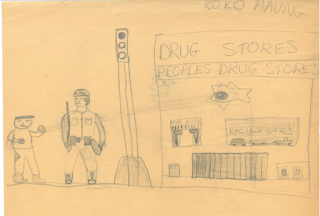
Drawn by a 4th-grader, this map scene, drawn in pencil and crayon, may have had its inspiration from newspaper maps published at the time of the 1968 riots showing areas most damaged by fire. “Those who cannot remember the past are condemned to repeat it” wrote Italian philosopher, poet, and essayist George Santayana (1863 - 1952). At Rauner Library, we often come across historical items and artifacts that speak to the reality behind Santayan’s words - demonstrating shocking parallels between current and historical events. This week, amid widespread protests, one such group of items captured our attention - John Matthew’s collection of political protest drawings and ephemera, which we previously highlighted on the Rauner blog back in 2015. Alongside political posters, student newspapers, flyers, banners, pamphlets and ephemera related to civil rights protests between 1968 and 1969, the collection also contains 23 original drawings depicting riots in Washington DC following Reverend Dr. Martin Luther King Jr.’s assassination in April of 1968. The drawings - created by Black school children ages 8 to 16 who lived in neighborhoods most affected by the protests - strike a particular cord given their similarity to recent events unfolding in Washington D.C. and cities across the U.S. like Minneapolis and Chicago, where protestors have mobilized following the death of George Floyd.

Norman W. Nickens, the assistant superintendent of D.C.’s Model School Division at the time of Martin Luther King Jr.’s death, was the impetus for creating this unique record of the Washington protests as recounted through the eyes of schoolchildren. As President Lyndon B. Johnson quelled demonstrations and looting using federal troops, Nickens instructed his teachers to have the students use a variety of creative forms to express their feelings about the turmoil they’d experienced, including in-class discussions, compositions and finally - drawings.

Many of the drawings depict burning buildings, ruined storefronts, and imposing crowds of helmeted federal troops amid figures with comic-strip balloons crying “help me!” or “stop!” Although some drawings focus solely on police and federal troops confronting Black protesters and others depict store looting, they all convey a sense of fear and a feeling that the world was spinning out of control. As the author of one of our drawings - a 5th grader - said at the time, “I thought the world was coming to an end… I felt like a man in a house fire.”

Pencil drawing by an junior high school student depicting a Black protester hurling a rock through the front window of a store in front of an armed military personel.During what has since been called the “Holy Week Uprising” of 1968, crowds of as many as 20,000 overwhelmed Washington’s 3,100-member police force, and President Lyndon B. Johnson dispatched some 13,600 federal troops, including 1,750 federalized D.C. National Guard troops to patrol D.C.’s streets. By the time the city was considered “pacified” on Sunday, April 8, some 1,200 buildings had been burned, including over 900 stores. Across the country, over 40 protesters died and over 2,500 were injured.

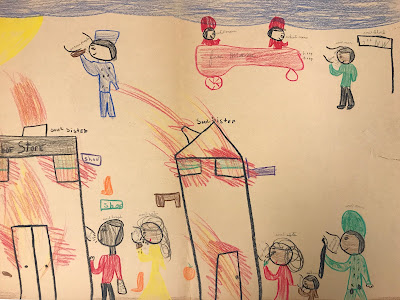
As some of the children’s drawings show, Black store owners across Washington D.C. wrote “soul brother” or “soul sister” across their storefronts so that looters would spare their stores. What did the phrase mean? To some of the interviewed children, being a soul brother or soul sister meant “being proud of being Black”, but to others - including a 7th-grader who drew one of the protest drawings - “A soul brother is a person who treats his neighbor as he would want his neighbor to treat him.” One group of Black second-graders wrote “Soul Sister” across their white English teacher’s blackboard the day after Dr. King was assassinated, even “advising her to go home early because the streets were unsafe” according to a New York Times article written by education reporter John Mathews, who had access to some of the material that had been created by the children. As the teacher recounted, her young pupils were “unusually affectionate and protective” amid the violence, having recognized her as what we would call an “ally” today- someone who stands up for others, even when they feel scared, and acknowledges and transfers the benefits of their privilege to those who lack it. These, along with many other stories of shared humanity and kindness - comprise the largely untold narrative behind an overwhelmingly violent collection of illustrations.

Colorful crayon drawing, authored by an elementary student, depicts Black community members mourning the loss of their stores and a police vehicle with occupants labelled as "white men". Notice the tops of the storefronts, which read "soul sister" and "soul brother."

Despite the fact that inscribing “Soul Brother” generally provided insurance against damage, the children’s drawings also show that not all destruction was strategically planned. For instance, some of the drawings depict stores owned by white community members, engulfed in flames, with Black families living above them trapped and burned out of their own homes. Such illustrations depict the disproportionate impacts of the Holy Week Uprising felt by predominantly Black communities following the protests, despite the initial strategy of targeting white businesses.

Three part crayon drawing by an elementary student depicting what the student's block looked like before, and after the riots broke out across Washington D.C., and what the students thought their neighborhood would look like in the future. In the future, the street looks largely the same, save for all the stores are brimming with goods.In addition to reflecting upon their past experiences during the four days of unrest, the  younger children were asked to draw pictures of their neighborhoods on Friday  - the day after MLK’s assassination; on Monday - after the largest riots had occurred - and visions of what they believed it could look like in the future. The Friday scenes usually show fires, looting, and skirmishes with police, whereas the post- riot illustrations show shells of smoldering buildings, shattered windows, and militarized occupation by federal troops. Although these pre and post-riot illustrations are interesting, it is perhaps the children’s’ depictions of the future that are most illuminating… Many of these drawings depict city blocks completely transformed into a pastoral suburbia of single-family homes, with beautiful trees, families walking together, and blooming flowers.

Other pictures show the same city block, but with all the stores opened and the shelves brimming with food and supplies. These images speak to the shared hopes each of these children held for the future even amid experiencing some of the worst civil unrest during the Civil Rights movement - the desire for safety - a loving family-like community, and plentiful food and shelter. Today, although protests have taken different forms, these same desires inspire activists. The same hopes and dreams that brought thousands to the streets in 1968 still pulse in the hearts and minds of protesters today.

To view these striking snapshots of history through the eyes of the children who were living it, I encourage all those who are interested to request “MS-1335” the next time you visit Rauner Library.

Thursday, April 23, 2020

Earth Day 2020: Reflections from Special Collections

Photo of the cover of Rauner Library's first edition of Silent Spring.
Cover of the first edition of Silent Spring
On April 22nd, we celebrated the 50th anniversary of Earth Day. Since 1970, Earth Day has increased awareness of the incredible planet we live on and encouraged people to learn more about pollution, habitat destruction, the plight of endangered species, and many other environmental issues. What began as a demonstration spearheaded primarily by college-aged anti-war protesters amid the Vietnam War, has since grown into the largest secular observance in the world, marked by more than a billion participants every year as a day of action to change human behavior and provoke policy changes for the collective good of our planet. Since its inception in 1970, Earth Day has given a voice to an emerging public consciousness about the state of the natural world, epitomized today in a new generation of environmental leaders, such as global climate activist Greta Thunberg or Jasilyn Charger of the Cheyenne River Sioux Tribe, whose One Mind Youth Movement sparked national protests against the Dakota Access Oil Pipeline. In honor of this milestone, and in anticipation of an upcoming digital exhibit supported by Dartmouth’s Rauner Special Collections Library titled Vanishing: Making of an Extinction Crisis, today we are highlighting an unassuming, but incredibly important book that not only helped ignite the modern Environmental Movement, but holds timely lessons for how we should interact with the environment today.

The book in question - the first edition of Rachel Carson’s Silent Spring, published in 1962, was revolutionary in how it translated complex chemical and ecological relationships into easily comprehensible arguments, its popularity, and its appeal to the general public. Due to a combination of these factors, Carson’s investigation of the potentially adverse impacts of widespread synthetic pesticide use - in agriculture and by the U.S. government in pest eradication programs - led to widespread concern about environmental and human health impacts, environmental policy change, and the emergence of the modern Environmental Movement. Today, Silent Spring continues to provide a valuable lesson about how we should interact with our fragile planet: proceed cautiously and think long-term

Prior to the publication of Silent Spring in late 1957, Rachel Carson was a distinguished marine biologist, author of the widely acclaimed novel The Sea Around Us, and the second woman hired by the U.S. Bureau of Fisheries (later the U.S. Fish & Wildlife Service). Through her friendships with fellow biologists, Carson closely followed a rising number of federal proposals for widespread pesticide spraying; including the United States Department of Agriculture's (USDA) plans to eradicate fire ants, gypsy moths, and other insects using chlorinated hydrocarbons and organophosphates. After nearly ten years of investigation and research, Carson published Silent Spring to raise environmental consciousness among the American public about what she saw as potentially dangerous synthetic pesticides, including the notorious substance known as DDT (Dichloro Diphenyl Trichloroethane). In the course of 250 pages, Carson translated ten years of ecological and chemical research into a narrative detailing how America’s addiction to pesticides would severely harm human health, the environment, and future generations’ ability to control increasingly resistant insect pests.

Amid the turmoil of the 1960s, USDA officials, farmers, and chemical-producing companies applauded the efficacy and safety of synthetic pesticides at killing insect pests. At a time when air, water, and soil pollution were mere afterthoughts in the minds of many industry leaders, Carson’s Silent Spring made two bold assertions; first, that synthetic pesticides like DDT could be carcinogenic and thus harmful to humans, and second, that chemicals like DDT can have huge negative environmental impacts, accumulating in the food chain until they interfere with biological processes and ecosystem functioning. In chapter 3 - famously titled “Elixirs of Death” - Carson presented considerable evidence for the toxicity of a wide array of synthetic pesticides, noting that “for the first time in the history of the world, every human being is now subjected to contact with dangerous chemicals... they occur virtually everywhere.” Although the chapter reads more like a gripping detective crime novel, Carson based her findings on research completed by National Cancer Institute researcher and environmental cancer section founding director Wilhelm Hueper, who had begun to classify many pesticides as carcinogenic - or cancer causing - for both animals and humans. With the help of her research assistant Jeanee David and NIH librarian Dorothy Algire, Carson found evidence to support the pesticide-cancer connection, much to the chagrin of chemical companies and many peers from the scientific community who reviewed Silent Spring. This finding was in sharp contrast to the general perception of chemicals like DDT at the time, which was sprayed readily across parks, beaches, and lawns to control mosquitoes, oftentimes while people were present. Later, in chapters titled “And No Birds Sing” and “Needless Havoc,” Carson reported that many synthetic pesticides readily accumulated in the environment, exponentially increasing in potency as animals lower in the food chain (i.e. fish) were consumed by animals higher in the food chain (i.e. eagles). Carson reported that this process - known as bioaccumulation - had significant negative impacts on many animals, most famously on birds. Carson discovered that birds ingesting DDT tended to lay thin-shelled eggs that would break prematurely, resulting in population declines of more than 80 percent. With continued use of synthetic pesticides like DDT, Carson predicted a grim future where birdsong would be largely absent - hence the title of her book.
Photograph of the opening chapter page from chapter seven titled "Needless Havoc". The illustration depicts a group of woodland animals to emphasize the chapter's focus on chemical accumulation in natural food webs.
Illustration from the opening page of chapter seven, highlighting the harmful impacts of chemical accumulation in food webs.
Given Silent Spring’s radical claims, the book caught the eye of agrochemical companies, industry leaders, and government officials; many of whom stood in favor of liberal synthetic pesticide use either due to their effectiveness at destroying insect pests or because they hoped to safeguard their own economic interests. As with most revolutionaries who have prompted society to question established institutions, industries, or ways of thinking, Carson received considerable criticism from the aforementioned groups following the release of her book. American biochemist Robert White-Stevens and former chemist Thomas Jukes were among Silent Spring’s most aggressive critics, especially of Carson's analysis of DDT. According to White-Stevens, "If man were to follow the teachings of Miss Carson, we would return to the Dark Ages, and the insects and diseases and vermin would once again inherit the earth." Others went further, even attacking Carson's scientific credentials, arguing that her training in marine biology rather than biochemistry left her inept to discuss synthetic pesticides. White-Stevens labeled her "a fanatic defender of the cult of the balance of nature,” while former U.S. Secretary of Agriculture Ezra Taft Benson, in a letter to former President Eisenhower, reportedly concluded that because she was unmarried despite being physically attractive, she was "probably a Communist.” Soon, even large agricultural and chemical companies joined in protest, trying to discredit the validity of Carson’s science while warning the public about the dangers of “questioning pesticides.” For example, agro-chemical giant Monsanto published 5,000 copies of a Silent Spring parody called "The Desolate Year" (1962) which projected a world of famine and disease caused by banning pesticides. Although critics repeatedly asserted that Carson was calling for the elimination of all pesticides, Silent Spring does not call for a complete ban of pesticides, but rather a cautious and careful approach to pest management and agricultural production; an approach considering all the environmental and human-health impacts of man’s actions prior to pursuing a “one size fits all” strategy. As evidenced by the slew of protests, Silent Spring was revolutionary in its critical examination of America’s love of pesticides.

Despite all the criticism, a growing body of scientific evidence has since supported Carson’s assertions. For example, in 2015, the International Agency for Research on Cancer classified DDT as a “probable carcinogen to humans”, with exposure leading to higher rates of both pancreatic and skin cancer. In addition, according to the EPA, “a relationship between DDT exposure and reproductive effects in humans is suspected.” Meanwhile, the detrimental impact of DDT on wildlife has also become evident through rebounding populations of previously endangered aquatic and avian species that Carson believed were negatively impacted by DDT. According to recent estimates, a ban on DDT and other pesticide reductions have allowed for the comeback of the bald eagle, peregrine falcon, brown pelican, and many other species once facing extinction in the contiguous United States. As a New York Times science article published on March 11th, 1982, described:
Since the ban (on DDT), the brown pelican, one of the most threatened species, has increased to an estimated 5,000 pairs along the Atlantic Coast, up from a low of about 1,100 to 1,200 breeding pairs in the 1960's. Ospreys, or fish hawks, had fallen to about 100 breeding pairs from 1,000 on the coastline between New York and Boston. Biologists are now hopeful the species will return to higher levels by the end of the century.
As a growing body of evidence has since proven Carson’s premonitions, her call to proceed with caution in environmental matters, echoed throughout Silent Spring, becomes increasingly poignant. Carson encouraged Americans to question the logic of broadcasting potentially dangerous chemicals into the environment with little prior investigation of their environmental and health effects - but her powerful message, to question the indirect consequences of our actions on other organisms and future generations, extends well beyond pesticides. Were Carson alive today, she’d likely encourage us to approach practices in our everyday lives that we’ve accepted as “normal” - from industrial-scale cattle farming to ordering copious amounts of Amazon products - with a similar dose of caution and criticism. Silent Spring reminds us that only by proceeding cautiously and thinking about future generations, can we enact positive environmental change.
Opening illustration to Chapter 10 of Rachel Carson's Silent Spring, depicting an airplane spraying DDT over a suburb.
Opening illustration to Chapter 10 of Silent Spring.
Despite its “radical-ness” as one reviewer called it, the first edition of Rachel Carson’s Silent Spring is a rather unassuming book. Beautiful pencil illustrations resembling playful images in children’s books about woodland animals or planes accompany the opening to each chapter, whereas Carson’s prose reads more like a poetic nonfiction crime novel than a scientific call-to-action. Looking at these features, it’s hard to believe that Silent Spring lit the match that ignited that fire that helped fuel the modern Environmental Movement. Yet these features help explain why Silent Spring appealed to such a broad audience, and therefore elucidate how it left such an enormous impact on public opinion. Thanks to Carson’s blend of carefully crafted data and moral-based arguments, in addition to her approachable writing style, the book became an enormous success. Silent Spring was named America’s “Book of the Month” following its release, landed a spot on the New York Times bestseller list (not an easy feat for a scientific work authored by a woman to achieve at the time), and sold more than 520,000 copies in 24 countries.

In addition to Carson’s engaging and approachable writing style and the sheer number of copies sold, Silent Spring was especially impactful due to the composition of the audience it reached. Silent Spring was particularly well-received by middle-class readers in addition to scientists and political elites, many of whom weren’t from traditional scientific backgrounds. As Carson said following the nomination of her work as the book-of-the-month, she hoped to "carry (Silent Spring) to farms and hamlets all over that country that don't know what a bookstore looks like—much less The New Yorker." Indeed, the book achieved something rare at the time; for a narrative based on ecological, chemical, and oncological research, it was read ravenously by farmers, small business owners, and Americans from various educational backgrounds across the U.S.

By prompting readers to confront their reliance on chemicals and by presenting them with the reality that their everyday habits might have unexpected consequences for future generations, organisms aside from pests, and their own health, Carson in turn provided a launchpad for Americans to be more critical of how they interacted with the environment on a daily basis. Silent Spring bolstered growing frustrations that young Americans felt toward governments and industries amid the Civil Rights Movement, the Vietnam War, and environmental catastrophes such as the massive 1969 oil spill in Santa Barbara, California, and channeled those feelings toward a mechanism for change (i.e. environmental policy). In doing so, Carson inadvertently fanned the flames for environmental action to spread like wildfire in areas beyond synthetic pesticides. Today, the founders of Earth Day recognize the large role that Silent Spring played in the establishment of their own environmental movement. As EarthDay.org notes, “the stage was set for change with the publication of Rachel Carson’s New York Times bestseller Silent Spring in 1962. The book represented a watershed moment as it raised public awareness and concern for living organisms, the environment and the inextricable links between pollution and public health.”

Chapter 3 "Elixirs of Death" opening page, with an illustration of a cluster of chemical bonds.
The paradigm shift in environmental thought started by the publication of Silent Spring had an enormous and measurable impact upon the environment and human health beginning in the 1960s. As readers began to concern themselves with the accumulation of potentially hazardous chemicals in the environment and in turn their own bodies, increasing pressure was placed on legislators, agrochemical companies, and landowners to enact change. The positive impacts of Silent Spring are perhaps best observed in the significant decline in the use of DDT-based pesticides in the United States following the book’s publication. As the U.S. Environmental Protection Agency (EPA) describes in their Brief History and Status of DTT publication:
The U.S. Department of Agriculture, the federal agency with responsibility for regulating pesticides before the formation of the U.S. Environmental Protection Agency in 1970, began regulatory actions in the 1960s to prohibit many of DDT's uses because of mounting evidence of the pesticide's declining benefits and environmental and toxicological effects. The publication in 1962 of Rachel Carson's Silent Spring stimulated widespread public concern over the dangers of improper pesticide use and the need for better pesticide controls.
Indeed, Carson’s challenge - to not only consider the efficacy of pesticides in ridding of pests, but to critically examine the long-term and indirect impacts of chemicals before building agricultural systems reliant upon these substances -  led to the establishment of the EPA and a subsequent ban on DDT’s agricultural use across the United States in 1972. After President John F. Kennedy read her book, Carson was called to testify before his Science Advisory Committee, which was in turn summoned to critically investigate DDT and other synthetic pesticides’ potential negative impacts.
Rachel Carson testifying before the Senate Government Operations subcommittee studying pesticide spraying on June  4th, 1963.
Carson testifying before the Senate subcommittee.
The committee issued its final report largely backing Carson's scientific claims on May 15, 1963, leading to a landslide of pro-environmental legislation echoing Carson’s call for caution in matters of the environment. In the 30 years prior to being banned in 1972, a total of 1,350,000,000 pounds of DDT had been sprayed across agricultural lands in the United States. In the 30 years since 1972, this number was cut to essentially zero. And the most amazing part? Agricultural production did not collapse with stricter regulation of synthetic pesticides as companies that had heavily opposed Silent Spring’s publication originally predicted.

In conclusion, despite fierce opposition from chemical companies, Silent Spring inspired a generation to stand up for the health of the environment and helped ignite the modern Environmental Movement which continues today in the process. Following Silent Spring, those inspired by the text reversed federal pesticide policy, enacted a nationwide ban on DDT in agriculture, established the Environmental Protection Agency, and founded Earth Day. Silent Spring was revolutionary for condeming short-sighted tampering with the environment that was pervasive during the Cold War, challenging farmers, companies, consumers, and the U.S. government to consider the long-term side effects of their actions. Aside from Carson’s radical message, Silent Spring is a remarkable testament to the power of translating science in an engaging manner to diverse audiences, particularly those from non-scientific backgrounds. Without Silent Spring, and hence the ban on DDT and ensuing protections on many species, bald eagles and dozens of other bird species would have likely disappeared from the continental U.S., and humans would be facing higher rates of cancer and other adverse health effects.

Were Carson alive today (she passed in 1964), she’d be happy to learn about efforts that have been made to safeguard our waterways and species diversity, but she would also challenge us to go further. Today, Carson would reiterate Silent Spring’s timely lesson about how humans should interact with our fragile planet: we must proceed cautiously and think about long-term resilience. In an age where we’ve become increasingly aware of the myriad of ways in which chemical, biological, and sociocultural systems are interconnected, we must devote an adequate amount of time to science before committing ourselves to a single course of action, in order to understand the ramifications before it’s too late. In addition to proceeding with caution, we must be continually critical of established practices, in order to identify unintended consequences whose impacts couldn’t previously be measured. Just as Carson used animal trials and long-term observation to examine the true cost of our insatiable appetite for pesticides, we need to think of potential indirect effects and future impacts before committing ourselves to a singular course.

To read the first edition of Silent Spring for yourself, request "Depository SB959 .C3" the next time we're open!

Friday, October 25, 2019

Lies Hunt In Packs

Cover of Van Vliet's book Greed  The word GREED is printed in bold black letters down the golden spine and all over the golden cover of this stunning little square book. Inside, the pages are filled with lithographs made by Claire Van Vliet and printed by Eystein Hance-Olsen at SKHS in Oslo on Zerkall Butten paper. Published by the Janus Press in Vermont in 2013, this handsome volume is one of many that belong to Rauner Library's Presses collection. The collection itself is truly amazing, spanning nearly the entire history of printing in the West, from the Aldine Press in the late 1400s to artists' books printed this very year.

Propagandists lithograph and printed text
Van Vliet's book is an artistically powerful tour de force that decries the sort of greed and corruption that caused the Great Recession. The book contains four lithograph portraits, each representing a group of people intertwined with power, wealth, and exploitation: Propagandists, Lobbyists, Bankers, and Joe Public. On the facing page, various adages and details outline the vices that have perpetuated the suffering of the 99%. Some of the quotations that seem especially relevant to our current political situation are found on the page for Propagandists: "A lie said often enough becomes truth" and "Lies hunt in packs" are particularly apropos.

Joe Public lithograph and accompanying text

To look at Greed, come to Special Collections and ask to see Presses J268vagr.