Showing posts with label Religion. Show all posts

Friday, September 4, 2026

Brahe's Universe--What the Hell Was He Thinking?

Illustration showing Brahe's cosmologyAfter Copernicus laid out his fancy new theory placing the Sun at the center of the universe, and then Galileo argued so forcefully for it, you would think that any self-respecting astronomer would acquiesce and admit the Earth no longer held primacy in the universe. But Tycho Brahe was a stubborn cuss, and a stickler for good observation. He figured with the more accurate observations he could make with his state-of-the-art observatory, he could prove Copernicus and Galileo to be fools for doubting the long-held dogma that the Earth was the center of everything. Years of careful observation gave Brahe a trove of data.

Illustration showing Brahe's cosmpoligyThen came the hard part: fitting it all into his preconceived notions. There was no way to argue that some of the planets didn't revolve around the sun, but that didn't stop him from keeping the Earth in the middle. His elaborate scheme placed the Sun and Moon in orbit around the Earth, while Saturn, Mars, Jupiter and Venus circled the Sun. Jupiter retained its cluster of moons. The math behind all of this is way more complicated than what Newton would later come up with, but Brahe made it all fit. The two images pictured here are representations of Brahe's imagined universe from Andrea Cellarius's Harmonia macrocosmica (Amsterdam: Apud Gerardum Valk et Petrum Schenk, 1708). In his book, Cellarius non-judgmentally lays out all of the competing cosmographies and leaves it to the reader to decide their comfort level with heresy and science.

To see it in person come on in and ask for Rare QB41 .C39 1708.

Friday, August 14, 2026

“Brave, Unselfish, Venerable Man”: The Private Champions of Nathan Lord’s Defense of Slavery

Part of a letter by Joel Parker praising Nathan LordOn July 24, 1863, Rev. Nathan Lord resigned the presidency of Dartmouth College, an office he had held for thirty-five years. He gave it up rather than retract his defense of slavery: a defense he had grounded in Scripture rather than morality, and one that had made him a liability to the College in the eyes of the Dartmouth Board of Trustees and a favorite target of the abolitionist press. In the Northern public, Lord had become a pariah for his regular defences of slavery throughout the 1850s and an outright villain by the middle of the Civil War through his belief that Northern abolitionists had caused the conflict with their heresy and hypocrisy. However, in the period after his resignation, Lord was commended by some privately as a martyr. Over the following months, letters and money arrived from friends, former Dartmouth colleagues, and admirers who saw his resignation as a display of noble principle.

Lord had not always been slavery’s champion; in an 1839 letter he called it a “moral and political evil” and stated that it was the “obligation of all men to attempt the immediate and entire removal of it.”1 By the 1850s, though, he had become perhaps the most prominent clerical apologist for slavery in New England. The trustee Amos Tuck, a Dartmouth graduate and a founder of the Republican Party in New Hampshire, brought before the Board’s 1863 annual meeting the resolutions of the Merrimack County Conference of Churches, which regretted the “popular prejudice” that Lord’s views had drawn and urged the trustees to consider a change in the presidency; Tuck then chaired the committee whose report reaffirmed the college’s loyalty to the Union. When the Board adopted it, Lord produced a resignation he had drafted a week earlier, read it to the members, and walked out.

Part of a letter by Benjamin Douglass praising Nathan LordLord had, in a sense, seen this outcome in advance. Four years earlier, in a letter on John Brown’s raid at Harper’s Ferry that was printed in the Richmond Whig, Lord had written that the Northern men who reasoned about slavery’s divine right as he did were “frequently maligned” and so “retire, for the most part, to their secret places, and wait to be justified.”2 This characterization would later be reaffirmed as prophecy through his own experience with the Board and Northern press, but also by the quiet support which he received after his resignation.

The first to write was Joel Parker, the Harvard law professor and former New Hampshire Chief Justice, who had himself recently left the Dartmouth board. Days after the resignation, Parker congratulated Lord on being “well out of the concern” of an institution he expected only to “grow worse and worse.” The trustees, he wrote, were “a miserable board” now handed to “radical politicians, and radical ministers,” and Tuck in particular was “an ambitious party politician” and “a very coarse man besides.”

Two days later, writing from Hamilton, Canada West, an admirer by the name of Benjamin Douglass expressed “profound indignation” at the action that had forced the resignation and wrote to “honor your determination to stand fast by God’s truth.” Noting that friends in New Hampshire were already arranging “to free you from pecuniary cares,” Douglass offered more than sympathy: “I beg you would do me the honor to accept the small amount enclosed as a slight token of my esteem and affection.”

Part of a handwritten letter by Franklin Pierce praising Nathan LordThat support soon became organized, and it drew in the most eminent of Lord’s defenders. In November 1863, former U.S. president Franklin Pierce wrote to Samuel Morse, the inventor of Morse code, asking him to contribute to a life annuity fund for Lord and his wife. Lord’s situation, Pierce urged, “constitute[d] the strongest possible appeal”: here was “the only eminent and aged clergyman” who had “firmly withstood the onslaught of that fanaticism which had brought ruin upon our country,” a man who had staked his office and livelihood “for the maintenance of truth and the Constitution.” That stand had made him “a shining mark for abolition insolence and detraction” and, to Pierce, a “Brave, unselfish, venerable Man.” The following January, a Boston committee presented Lord and his wife with an annuity of twelve hundred dollars, raised, its organizers wrote, “with remarkable cheerfulness and hearty good will.”

These letters complicate the tidy story of the college’s removal of a pro-slavery president. Lord’s arguments were indefensible, and the trustees who eased him out stood on the right side of the war. But the correspondence shows that Lord did not experience his resignation as a reckoning. Supported by men who called his stubbornness courage and his defeat a sacrifice, Lord was proud to resign his office rather than his beliefs, writing to his nephew that he was “as free and happy as a bird, except for regret at seeing Dartmouth prostituted to a vile idolatry.” While the public record remembers a president forced out for defending slavery, the private record preserves the network of respectable men who made certain he paid as little as possible for it, and who were sure that history would prove him right.

You can view the letters from Parker (Mss 863454), Douglass (DP-6, Box 6625), Pierce (Mss 863456.1), Lord (Mss 863429), and the Boston committee (MS-510, Box 1, Folder 43); the 1863 Board of Trustees' meeting minutes (DA-1, Box 2117); Amos Tuck's report (Mss 863940); and Nathan Lord's pro-slavery manifesto, A True Picture of Abolition (MS-510, Box 1, Folder 27), by requesting them online and then visiting Rauner Library.

Posted for Bradley Edington '27, recipient of a Historical Accountability Student Research Fellowship for the 2026 winter term. The Historical Accountability Student Research Program provides funding for Dartmouth students to conduct research with primary sources on a topic related to issues of inclusivity and diversity in Dartmouth's past. For more information, visit the program's website.

1 Nathan Lord, letter to the editor, Vermont Chronicle (Bellows Falls, VT), July 10, 1839, https://www.newspapers.com/image/489365266/.

2 Nathan Lord to J. M. Conrad, December 1, 1859, printed in Richmond Whig (Richmond, VA), December 16, 1859, https://www.virginiachronicle.com/?a=d&d=RWH18591216.1.1

Friday, July 24, 2026

Faith in the Desert

Cover of the Posto-1 Christian Church bulletinIn 1944, Dr. Agnes Bartlett left Hanover to serve as a medical officer at the Poston Internment Camp in southwestern Arizona, one of the largest concentration camps for Japanese-Americans that was run by the United States during World War II. Bartlett was the granddaughter of Samuel Colcord Bartlett, eighth president of Dartmouth, and the daughter of missionaries to Japan. Her parents, Samuel Colcord Bartlett Jr. and Fanny G. Bartlett, were living there when Agnes was born in Kyoto on March 18, 1911. We have a small collection of papers that belonged to Dr. Bartlett, including manuscript stories, personal correspondence, and publications related to Poston as well as Manzanar, another of the internment camps where Bartlett volunteered to serve as a physician.

While preparing for a class on Asian American history earlier this year, one document in particular caught our eye: a bulletin from the Poston-1 Christian Church. The Poston Internment Camp was so large that it was subdivided into three separate camps, Poston-1, Poston-2, and PostBack of the Poston-1 Christian Church bulletinon-3, which were known by the inhabitants as "Roastin'", "Toastin'" and "Dustin'." The bulletin for the first camp's church is for the Sunday night service on February 25th, 1945; its simple and matter-of-fact contents provide a vivid picture of a community of faith that is committed to its members and to its beliefs despite the suffering that it is currently experiencing. The last page contains a poem written by Dr. Toyohiko Kagawa titled, "The Burden". Kagawa was a Japanese Christian and pacifist was incarcerated in Japan at the time for his opposition to Japanese militarism.

Interestingly enough, on the same page, there is an excerpt from a letter written to the Poston community from a Private Minoru Ito who says that "Life really isn't as bad as I expected here at Ft. Douglas." Fort Douglas, Utah, was a critical processing center for Nisei soldiers, or second-generation Japanese Americans who were born in the US and had enlisted or were drafted to serve in the army.

To explore the rest of the many pamphlets, correspondence, and publications related to the War Relocation Authority, request Box 1 of the Agnes Bartlett papers (ML-43) online and then come to Rauner.

Friday, January 9, 2026

Middle English Printing's Infancy

First page of Vitas PatrumLately our Rare Book and Manuscript Metadata Librarian has been spending a portion of his time reviewing our incunable collection and, as a result, we have the opportunity to learn more about the volumes in our collection. An incunable, as you may already know, is the term commonly used to identify a book that was printed on a printing press using moveable type in 15th-century Europe. The name is derived from the Latin word for "cradle"and is meant in this context to refer to the infancy of printing in the West. We currently have nearly two hundred copies in our collection out of roughly thirty thousand individual editions that were printed during the period.

Frontispiece from Vitas PatrumMost incunables were printed in Latin, which makes sense considering that this was the language of the intelligentsia of the time. Today, however, we're showing off a rarer breed of book. Only about a quarter of all incurables were printed in the vernacular instead of Latin, and of those perhaps around fifty editions were printed in Middle English. And we have one of them here at Rauner.

The first Middle English vernacular edition of Vitas Patrum, or Lives of the Fathers, was printed in London, England, in 1495 by Wynken De Worde. Vitas Patrum is a compilation of narratives and sayings associated with the early patriarchs of the Christian Church that was originally transcribed from Greek into Latin in the late 4th century. Over a thousand years later, William Caxton translated the book into Middle English. Caxton was the first person to introduce the printing press to England (1476), and De Worde was his protégé. One of the most interesting details of this edition, in our opinion, is the way in which the typeface has clearly been designed to imitate English vernacular handwriting of the era.

To see one of the earliest books ever printed in English, come to Rauner and ask for Incunable 65.

Friday, October 3, 2025

The Hammer of Witches

We've got an evil one this week, both in terms of a book's subject matter and its impact in the world. Back in the fifteenth century, European Christians were developing a new understanding of how Satan worked on Earth: that he could bestow demonic powers onto humans so that they could commit harm through magic and undermine faith in God. This, among other factors, prompted the prosecution of those accused of practicing this diabolic witchcraft and the onset of the European witch hunts. Lasting from approximately 1420 to 1780 but concentrated most heavily in the period of 1560 to 1640, the trials led to the execution of somewhere between 40,000 and 60,000 individuals. 

One influence on these witch hunts was the Malleus Maleficarum, or The Hammer of Witches. We have a first edition, published in 1486 or 1487 in Speyer, Germany. Its authorship is somewhat contested but generally attributed to Henricus Institorius and Jacobus Sprenger, two Dominican friars. Institorius is the one who had practical experience persecuting the accused -- at one point in his life he claimed to have had 48 women executed. In terms of influence, it seems that the Malleus did a lot to formalize and disseminate the newer theories of diabolic witchcraft and structures for dealing with witches: its three sections are focused on 1) proving that witchcraft is real, 2) explaining how witchcraft operates and how it can be counteracted, and 3) how practitioners should be prosecuted. It also focused on witchcraft as something practiced by the lower classes and by women more frequently than men, which was certainly consistent with trends in who was prosecuted in most countries during the witch hunts.  

Our copy is pretty tidy, save for some staining on the initial pages and a few handwritten notes in the second section. The marginalia is intriguing -- we think we can pick out the words "exorcismus" and "rebaptismus." Certainly it seems like the reader was considering proposed treatments for the accused or their victims.  Whether or not they bought in, it's hard to say.

To look at the Malleus Maleficarum yourself, request Incunabula 170.  

Friday, June 20, 2025

The Angling Nudist

Letter from Huntington to Stefansson, 5/28/1935Anyone who has spent some time either in our reading room or following our blog will recognize the name Viljhalmur Stefansson. Stefansson was a Canadian explorer born to Icelandic immigrants in 1879. After numerous Arctic expeditions, he became a renowned lecturer and advocate for the Arctic. Stefansson was a lecturer at Dartmouth from 1947 until his death in 1962, and the college acquired his significant collection of polar exploration materials in 1952.

Among the many collections we acquired was a 96-box collection containing Stefansson's personal and professional correspondence over a 67-year period. We are always finding new gems within these boxes, and this week turned up another winner. On May 28 of 1935, Stefansson received an unsolicited request from Henry S. Huntington, the brother of an acquaintance. In it, Huntington says that he would like to come over and talk with Stefansson about "the Eskimos from the 'nudist' angle". After a period of profound silence, Stefansson eventually responded to Huntington on June 14th, admitting that the idea of  "Eskimos from the nudist angle" had "somewhat startled" him and was likely the reason that he had taken so long to reply.

Huntington was a Yale graduate and Presbyterian minister who in 1933 had co-founded The Burgoyne Trail in Otis, Massachusetts, one of the country's first nudist colonies. His promotion of the lifestyle was firmly based in its health benefits and its ability to free people from obsessing about sex. When he met later with Stefansson in July, it was with an eye toward recruiting the charismatic public speaker to give a presentation at the International Nudists Conference in August of the same year.
However, despite Huntington's well-meaning intentions, the potential for negative PR was too great a risk for Stefansson. The explorer responded tersely to a series of initially unanswered letters from Huntington by saying that he had decided against participating "on the principle that there is no point in getting eaten by lions except for what you think is a supreme cause." Subsequent letters from Huntington are marked in pencil with "No Ans", suggesting that for Stefansson the conversation was over.

To hunt for similar gold nuggets with Stefansson's correspondence, request a box online from MSS-196 and then come to Rauner to start digging.

Saturday, May 17, 2025

Um, I have a lot going on that week...

Manuscript letter on vellum from Mary Tudor
Many people dream of a hand-delivered official summons from the Queen for a private appointment. Sounds pretty exciting, but each of the ten nobles summoned with this letter refused to attend on the appointed date. Some of them wouldn't even allow Lord Paget, Keeper of the Privy Seal, anywhere near them to deliver the invitation. You see, this particular letter was from Mary Tudor to a group of English nobles living in exile in 1556. They had fled their home county when Mary assumed the throne. All of them had helped either Henry VIII or Edward VI bring about the English Reformation, and many had received lands from Henry when he dissolved the monasteries as reward for their loyalty and support.

There is a reason Mary earned the nickname "Bloody Mary." During her short five-year reign she attempted to reverse the Reformation and restore property back to the Roman Catholic Church. This, naturally, involved killing a lot of people, as sensationally documented in Foxe's Actes and Monuments of the Latter and Perillous Dayes (more commonly called Foxe's Book of Martyrs). This formal invitation wasn't to the kind of party anyone wanted to attend.

The intended guests didn't have to wait much longer in exile. Mary died two years later and Elizabeth I assumed the throne and made it safe for these particular nobles to visit court again.

Seal from Mary Tudor letter

We are still cataloging the letter, but we will put a link here when it is ready. It pairs nicely with our 1563 first edition of Foxe's Book of Martyrs--just ask for Presses D334f.

Friday, February 7, 2025

The Family that Reads Together

Title page to Coffin's IndexIt has long been known that reading aloud confers numerous benefits upon not only the reader but the listeners. Doing so can expand the vocabulary of the reader and the listeners as well as strengthen the bond between them and spark creativity and imagination. In young children, reading aloud can help them lengthen their attention spans, improve their listening skills, and stimulate cognitive development. Reading aloud, especially within the context of a family, allows children and adults who aren't literate the chance to hear stories and gain knowledge that they otherwise would not be able to access.

In our society today, we are fortunate to have access to any number of texts, whether because of the ubiquity of digital content online or local public libraries. But several hundred years ago a book was a precious commodity whose cost was beyond the means of most working-class people, and texts were regularly passed down as heirlooms from one generation to the next. If a family in19th-century America was fortunate enough to own even one book, it was probably a Bible. And so if the members of a family in 19th-century America read aloud to each other, it was probably from the family Bible.

However, this could potentially pose a problem. Christian parents may have wanted their young children Index page containing Song of Solomonto read aloud from the word of God, but they didn't necessarily want them to read every word aloud. Sex and violence abound in the Old Testament, in particular, and it is hard to think of anything worse than having to explain to little Timmy what "loins" are during a family read-a-thon. Thankfully, in 1809 Mark Coffin wrote and distributed his Index to the Bible, an indispensable tool for parents seeking to avoid "considerable embarrassment" from the inadvertent reading aloud of "expressions rather improper to be read in mixed company". Coffin bravely spent months combing through the Bible in order to identify and document every unseemly word. His resulting index flagged every questionable chapter so that parents could relax during their children's nightly reading from the Holy Scripture. As you might have guessed, the entire Song of Solomon is a no-go.

To reverse-engineer an exhaustive list of naughty Bible verses, come to Rauner and ask to see Chapbook 51A.

Wednesday, December 25, 2024

Vulgar Customs, Ceremonies, and Superstitions

The first page of a section titled "Of the Word YULE, formerly used to signify Christmas."
This week's book is John Brand's Observations on Popular Antiquities: Chiefly Illustrating the Origin of Our Vulgar Customs, Ceremonies, and Superstitions (1813). Originally published in 1777, then edited and rearranged by Henry Ellis, the two-volume set lays out the British calendar year and its accompanying popular antiquities, now better known as folklore. It devotes about 60 pages to Christmas traditions, some still familiar and others rather unrecognizable.

One custom Brand lists is the hunting of the wren on the Isle of Man: "'On the 24th of December, towards evening, all the servant in general have a holiday; they go not to bed all night, but ramble about till the bells ring in all the churches, which is at twelve o'clock: prayers being over, they go to hunt the wren; and, after having found one of these poor birds, they kill her, and lay her on a bier with the utmost solemnity, bringing her to the parish church, and burying her with a whimsical kind of solemnity, singing dirges over her in the Manks language, which they call her knell; after which, Christmas begins.'" This tradition took place in other parts of the British Isles as well. It continued in various iterations long past Brand's lifetime and died out in the first half of the 20th century, before being revived more recently using a fake bird.  

To read about this and other holiday traditions, ask for Ticknor LEH B73o.


Friday, October 18, 2024

Happy Sukkot! / Chag Sukkot Sameach!

This year, the Jewish holiday of Sukkot begins at sundown on October 16 (Tishrei 14 in the Hebrew calendar.) If you're not sure what Sukkot (pronounced "soo-coat") is, Rauner happens to have a text that explains it in vivid, poetic detail. Written by Henry Ware, Jr., and published in 1837, "The Feast of Tabernacles: A Poem for Music" is set in ancient Jerusalem during the Temple period on the final day of Sukkot. Ware prefaces his poem with a short "Advertisement" in which he lays out his intentions for writing the poem and explains the holiday for a gentile audience:

The Feast of Tabernacles was one of the three great festivals of the Jewish people... It took place in the autumn, at the gathering-in of the corn harvest and the vintage, and continued for seven days; during which time the people dwelt in booths, formed of branches of trees, to commemorate their ancestors' dwelling in tents in the wilderness.

Though Ware writes in the past tense, Sukkot still is very much a major Jewish holiday that takes place in the harvest season and involves temporarily living in a sukkah or booth.

"The Feast of Tabernacles" describes the scene at the Temple on Sukkot, with the ancient Israelites waving symbolic plants, burning incense, and preparing an animal sacrifice:

Wave the willow and the palm !
Bow the knee, and chant the psalm !
Throng the holy altar round !
Bid the lofty courts resound !

Now let the morning sacrifice begin !
Fire the rich censer ! Let the incense rise
In rolling clouds of fragrance, till it fill
The Holy Place

Another book of ours includes depictions of some Sukkot customs. Printed by the Stinehour Press in 1995, Maḥzor = Mahzor Corfu is a partial facsimile of an illustrated 18th century prayer book produced by the Jewish community of the Greek island of Corfu, containing the liturgies for the three major festivals (Passover, Shavuot, and Sukkot) and Shabbat. It also contains some charming illustrations of Sukkot scenes. On the left is a man holding a lulav (palm, willow, and myrtle branch) and etrog (citron). On the right are four men sharing a meal under the thatched roof of a sukkah.

Illustration from Mahzor = Mahzor Corfu

To see "The Feast of Tabernacles," come to the reading room and request Smith J pam.vol. 35:12. To see Maḥzor = Mahzor Corfu, request Presses B667mahz

Friday, March 17, 2023

Llull's "Ladder of Understanding"

Woodcut of Llull's "Ladder of Understanding"This striking woodcut is found in the 1512 edition of Ramon Llull’s Liber de ascensu et descensu intellectus (Book on the Ascent and Descent of Understanding, written ca. 1305) that was printed in Valencia. It represents the “Ladder of Understanding” (scala intellectus) that Llull elaborates in this work. The particulars of Llull’s system are abstruse, but behind them lies the assumption that humans can, using their senses and intellect, understand the links between the created world and divine reality (Note: A full transcription and translation of the words found in this woodcut can be found at the bottom of this post).

The extraordinary Ramon Llull (c. 1232 - c. 1315) was born in Majorca. By his own account, he lived as a licentious troubadour before a series of visions convinced him to abandon his worldly life to serve God. Llull was particularly inspired to convert Muslims. He learned Arabic and deepened his knowledge of philosophy and other branches of knowledge.

It was on a mountain, the story goes, that God once again inspired him to write a book that would convert non-believers. “[Llull] came down from the mountain and … began to plan and write the book in question, calling it at first the Ars major, and later on the Ars generalis. Within the framework of this Art he then wrote many books … in which at great length he explained general principles by applying them to more specific things.” (Ramon Lull, A Contemporary Life, ed. And trans. Anthony Bonner (Barcelona / Woodbrige 2010).

This little book is one of the many expressions of Llull’s Art (largely logical in nature) – he wrote over one hundred works, including novels to alchemical works. His logical works, however, have sometimes earned him the status of pioneer in computational theory.

Description of the Woodcut:

There are three ladders depicted in the woodcut. The professor (bottom left), with a banderole that reads “Combined understanding,” has one foot placed upon the bottom step of the first ladder, and points to it with his right hand. With his left hand, he holds up the second and third ladders (the two concentric circles).

The first ladder:

Stepping from the bottom to the top, our intellect ascends (in understanding) first through stone, then fire, the plants, then animals, then man, then the heavens, the angels and, finally, God. The hierarchy is clear: the stone is most simple, and God is most complex.

The second and third ladders:

To understand the properties each of the steps on the first ladder, the professor holds up the second and third ladders (the two concentric circles), each subdivided into “steps” with words. 

It is perhaps easiest to understand these words as forming a conceptual rubric through which one can classify the properties belonging to a created thing. A stone, for example, might be classified as “cold, inert, passive,” and so on.  Using the conceptual rubric of the second and third ladders, one can range up and down the first ladder. Without using the proper concepts, Llull says, the intellect is ineffective in understanding. 

If we use the Llull’s Ladder of Understanding, we can enjoy serene contemplation in the Mansion that Wisdom Built for Herself (Sapientia edificavit sibi domum).

Llull’s conception of a chain linking the simple to the complex is not unique to him. See Great Chain of Being. To see our copy of Llull's Liber, come to Special Collections and ask to see Rare Book PA8360.L93 D4 1512.

This post was written by Daniel Abosso, Research & Learning Librarian for Humanities.


*****

Transcription and Translation for Woodcut:

Top banderole: Sapientia edificavit domum. Wisdom has built a home for herself. (Proverbs 9:1, paraphrased)

Bottom banderole (magister): Intellectus coniunctus. Complete understanding.

Scala i(n)tell(ectu)s — Ladder of understanding

Lap(is) - stone
Flam(m)a - fire
Planta - vegetable
Brutu(m) - animal
Homo - man
C[a]elum - heaven
Angelus - angel
Deus - god

Circular Diagram:

At center: Scal(a)e intellectus — Ladders of understanding

Outer circle (=second ladder), clockwise:

Ac(cide)ns - accident
S(ubs)t(an)tia - substance
Natura - nature
Actio - action
Passio - passivity (being acted upon)
Act(us) - actuality
Ens - being (existence)
Gen(us) - genus
Spe(cie)s - species
I(n)divi(duu)m - individual
(Com)positu(m) - compound
Simplex – simple

Inner circle (third ladder), clockwise:

Dubita(bi)le - Doubtable
Imagina(bi)le - capable of being apprehended by the mind
Sensibile - capable of being apprehended by the senses
Intellegi(bi)le - understandable
Credibile - believable

Friday, January 6, 2023

Awe-some Bibles

Aitken bible perched atop the King James Bible
This week the New York Times published an article about how experiencing awe might be good for your mental and physical health. Well, we just acquired a few awe-inspiring books if you want to get a dose of this wonder drug: a first printing of the King James Bible from 1611; and a copy of the “Aitken Bible,” from 1782, the first English Language bible printed in America. It is hard to overstate the importance of the King James Bible to the religious lives of the English-speaking world, but also to its literary and cultural realms. Setting this book next to our copy of Shakespeare’s First Folio from 1623, you can see the sources for so many of the common idioms of the English language, as well as understand the literary significance of this translation. Similarly, when it's placed next to our first printings of the Geneva Bible and the Great Bible, you can see the development of the Protestant Reformation in England. It is a truly monumental work.

First chapter of Genesis from King James Bible
Title page from Aitken bible
The Aitken Bible, so much smaller in stature, has a great story behind it. Great Britain had a monopoly on English-language Bibles in its colonies, but the Revolutionary War cut off the supply and the warring colonies found themselves with a shortage of Bibles. So, in 1781, Robert Aitken petitioned the Continental Congress to allow him to print a Bible. The book, issued as a defiant act of independence, helps us better understand the publishing world in colonial America, but also helps situate our copy of the earlier Eliot Bible (
the first Bible printed in the new world, notable because it is a translation into an Indigenous language and was printed nearly 120 years before the Aitken Bible) as the unique artifact that it is. 

To be awed ask for the King James Bible at Rare BS185 1611 and the Aitken Bible at Rare BS185 1782 .P5.


Friday, December 2, 2022

Predicting the Plague (and curing it!)

Diagram of solar eclipse with a biblical quotation Daniel 2:21-22
In 1652, one of London's most successful and esteemed physicians turned his attentions to the heavens to ponder the total eclipse of the sun that occurred on March 29. Nicholas Culpeper was one of those "gentlemen scientists" of the day. He dabbled in everything, because in his worldview, everything was connected and part of God's plan. So the blocking out of the sun, even though he could offer a clear scientific explanation, was still cause for concern--especially in London in the mid 1600s.

Just three years earlier, Charles the I was executed. Everything was turned on its head, and something big was afoot. Culpeper deduced that the eclipse heralded the second coming, so he wrote a pamphlet explaining the eclipse and issuing his dire warnings. Among his many predictions were a great plague and a fire. He got that right, but he was a little quick on the trigger. In 1665 London was hit by the Black Plague, and the following year, ravaged by the Great Fire.

As a physician, Culpeper was ready to help. He died in 1654, but he left behind a truly bizarre cure for the plague that you can read about here.

To read about the eclipse and its threats, ask for Nicholas Culpeper's Catastrophe magnatum: or, The Fall of the Monarchie. A Caveat to Magistrates, Deduced from the Eclipse of the Sunne, March 29 1652 (London: T. Vere and Nathe, 1652).

Friday, November 4, 2022

What in the Blazes?

First page of the statutes of the Society of Self-WatchersIn my work I often come across curious or odd organizations. They are usually created by men who are trying to exclude and/or control other members of society. The one I came across today, however, was created so that its members could police their own behavior. Let’s hear it for the "Society of Self-Watchers". What are they watching themselves for, you may ask? Profane swearing, which is defined as "swearing that constitutes sin and shows a lack of respect for all things held sacred".

There is actually a long history in the West of legalistic attempts to protect society from blasphemous utterings. Laws were put in place beginning with the Profane Swearing Act in England in 1694, and followed by the Profane Oath Act in 1745, which was not repealed until 1967. The United States had similar laws that fined people for profane swearing in public. The state of Virginia, for example, did not repeal its profanity law of 1792 until 2020.

The Society of Self-Watchers was founded in Hanover, New Hampshire on February 16, 1856. The group created a preamble and resolutions that declared that "the sin of profane swearing is a vice so mean and so low that every person of sense and character will detest and despise it".

In addition, they resolved to:
...acknowledge the higher authority of him who has commanded “Thou shall not take the name of the Lord thy god in vain for the Lord will not hold him guiltless that take his name in vain.”and feeling the need of every possible restrained and protection against and unmanly and sinful habit so sadly formed, we do together agree to form ourselves into an Association of principle and practice opposed to the sin of profane swearing and do take for our watchword and motto, the precept of Christ our Savior, “Swear not at all”.

Ten specific resolutions follow this preamble that advise the members to be vigilant of their own behavior, including:

Resolved, that should we ever hear of one of our company using deliberately or hastily a profane word we will kindly remind him of our agreement by repeating to him our watchword "Swear not at all".

Resolved, that we will receive kindly any similar report from our companions or from any other persons if we ourselves in any matter violate the principles we hear profess.

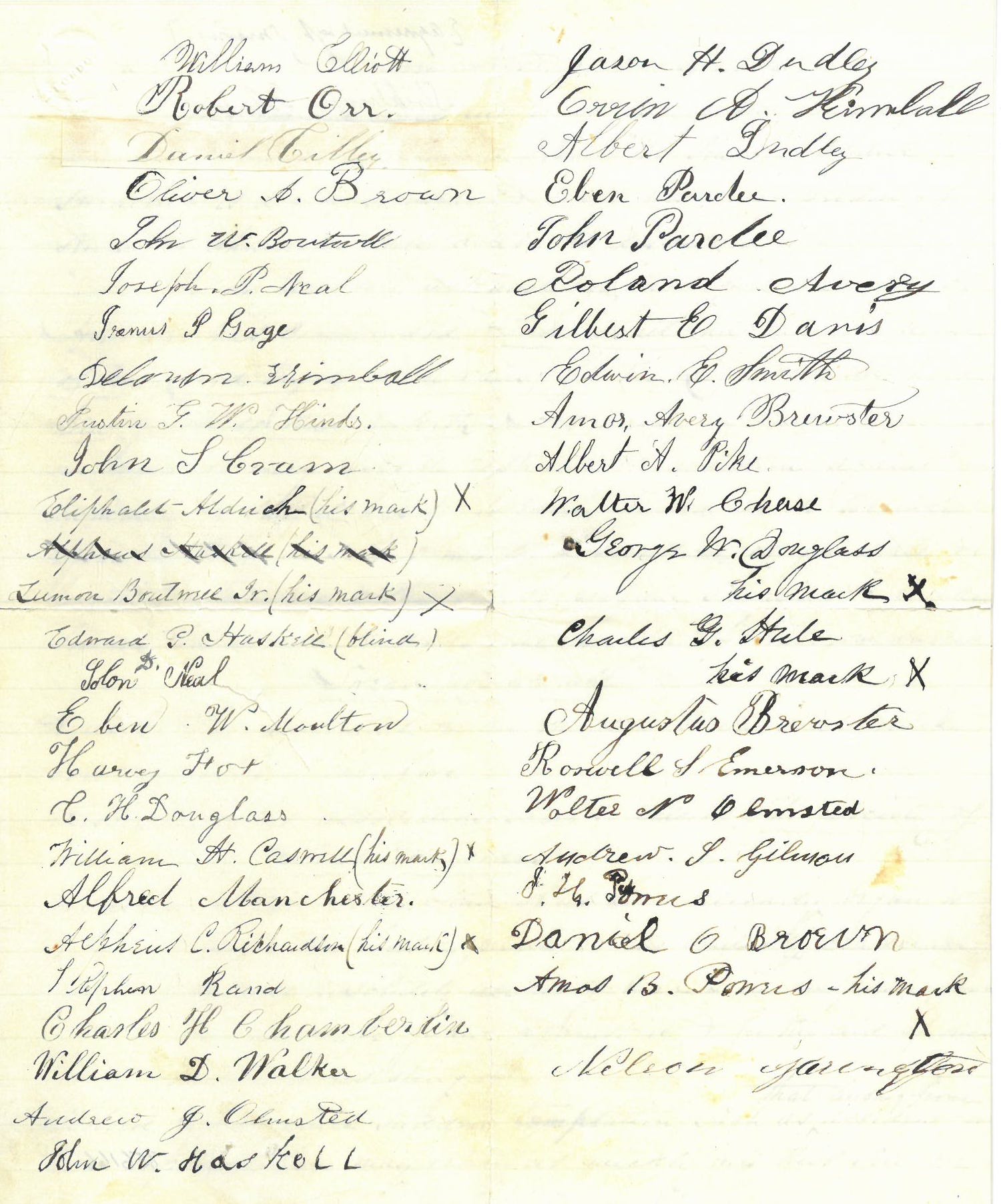
The members of the Society of Self-Watchers vowed to hold steady in their conviction with God’s help even when ridiculed. The agreement was signed by forty-six Hanover men.

Signatures of the members of the Society

To read their resolutions, come to Special Collections and ask for MSS 856166.

Friday, September 16, 2022

Representing Lust (and Chastity!)

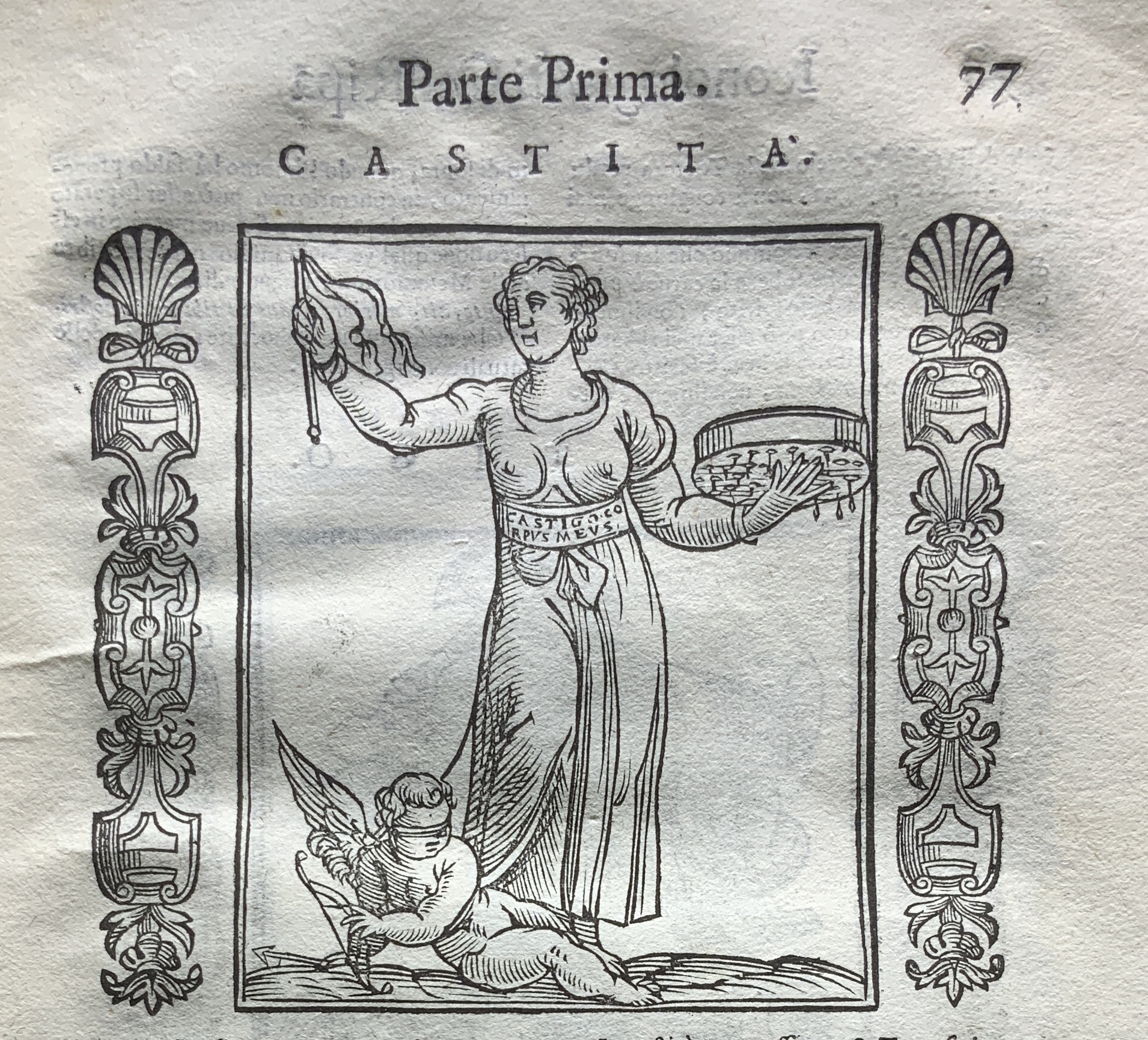
Woodcut image of ChastityThe use of emblems was popular during the Baroque time period in Italy and Europe in general, serving as a guide and source of inspiration for artists, poets, and sculptors when they were looking to creatively represent virtues, ideas, or even animals.

Cesare Ripa’s Noua Iconologia, printed in 1618, takes an encyclopedia-like format, alphabetically categorizing his emblems in multiple sections: Main Images (in 3 parts), More Notable Things, Animals, Colors and Metals, Gestures and the Human Body, Artificial Objects, Fish, and Plants. With each emblem description, Ripa also includes allegorical interpretations and references famous philosophers and writers of the time, whose interpretations of a particular object or virtue influenced his depiction of it.

Take the examples of Lust (Libidine) and Chastity (Castità). Ripa writes that the woman that symbolizes Woodcut image of Libidine Chastity in his emblem dresses in white to represent “the purity of the spirit, which maintains this virtue” (“Vestesi questa donna di bianco per rappresentare la purità dell'animo, che mantiene questa virtù.” (77).) and we see an association of colors with the value of chastity, but even more importantly, there is a suggestion that chastity leads to strength and truthfulness of character, as though someone who isn’t chaste is deceitful. Similarly, the emblem of Lust uses a particularly large amount of animal imagery, from beaks to panthers, all of which Ripa says symbolize lust, whose beauty “devours time, money, fame, body, and soul and spits it out becoming a slave to sin and the devil” (“Il che molto è simile alla Libidine, la quale con la bellezza ci lusinga, e tira, poi ci divora, perché ci consuma il tempo, il dannaro, la fama, il corpo, e l'anima istessa ci macchia, e ci avvilisce, facendola serva del peccato, e del demonio.” (312)). This, therefore, adds an element not just of deception, but of monstrosity and of sin, bringing in a religious element as well. Lust, according to Ripa, derives in women not even solely on a sexual level but also on the pursuit of fame and money.

All of this is to say that the use of emblems both had an impact on the time period’s interpretations of virtues, people, and things in the moment, as well as a longer lasting impact when the allegorical interpretation of these virtues are still seen in the present day depictions of values and morality.

To explore the woodcuts of Lust, Chastity, and many more, come to Special Collections and ask to see Rare N7740.R52 1618.

This post was originally written by Diana Alvarado '22 for Nancy Canepa's Italian 23 class, "17th and 18th Century Italian Literature".

Friday, March 12, 2021

The Love of Irish

As a part of celebrating Irish-American Heritage Month during March, we're taking this opportunity to highlight one of Dartmouth's most beloved sons of Éire. Sidney Joseph "Irish" Flanigan (seen here on the right next to classmate Lou Lewinsohn) was a member of the class of 1923, a social butterfly, and an inveterate jokester. While a student, he was a member of Phi Delta Theta, Green Key, Casque and Gauntlet, the debating team, the Dartmouth Players, and served as manager of the hockey team. His senior year on campus, he was chosen as the unofficial mayor of Hanover by the student body in a mock election, likely in part because of his campaign's pro-alcohol stance that good-naturedly thumbed its nose at Prohibition.

After graduation, Irish was nearly as active in Dartmouth matters as he had been during his undergraduate days. He served as his Class President, Assistant Class Agent, and Newsletter Editor for almost fifty years. He was also the President of the Alumni Council and the Dartmouth Alumnni Association of Westchester County and even did a stint as Secretary for the New York City Association. In 1953, he co-founded Aquinas House and later took a leave of absence from his career in insurance to fund-raise nationally for a building for the Catholic student center. Nearly a decade later, he was inducted into the Sovereign and Papal Order of the Knights of Malta, one of the highest awards that the Catholic Church can bestow upon its laity. He also received the Dartmouth Alumni Award around that time, the citation for which read, "Dartmouth is written on the heart of Irish Flanigan, just as he is close to the hearts of thousands of Dartmouth men."

A photograph of an older Flanigan sitting in a chair looking bemusedOne of the reasons for Flanigan's stature among his fellow alumni was his self-sacrificial philosophy of life. He once said to his classmates, "Regardless of one's station, it is given to all to be generous. But the word self must be shoved far into the background so that the heart will have room to enjoy the real happiness and pleasure that comes only in doing for others -- without thought of praise, favor, or reward." Irish Flanigan passed away in his sleep on September 22nd, 1973. In a move that his classmate Charles Zimmerman characterized as "typical" for Flanigan, he had spent a good part of that very day "extending kindness and good cheer" towards two friends who were laid up in the hospital.

Zimmerman went on to pay tribute to Flanigan in his obituary in the Dartmouth Alumni Magazine's Class Notes, saying "1923 and Dartmouth have lost an irreplaceable son, one who brought good cheer, good faith, good spirit, and goodness to everything and to every one he touched. All of us are better because of him."

To learn more about Sidney Joseph "Irish" Flanigan's amazing life, come to Rauner and ask for his alumni file.

Friday, May 15, 2020

Cromwell's Bible

There is nothing better for social distancing then a really good book. If you are like a lot of us, you are knee deep in Hilary Mantel's final installment of the Wolf Hall series, The Mirror & the Light. It lives up to the previous two novels in the series following Thomas Cromwell's rise and fall in the court of Henry VIII.

Throughout the third novel, Cromwell is overseeing the production of what came to be know as The Great Bible--a full English translation fit for the evolving Church of England. The book was being printed in Paris because they wanted the best quality work Europe had to offer, but political difficulties kept rearing up (a Protestant bible in France... not cool with the Inquisition). When it was nearly finished, Cromwell had all of the type and printed sheets brought to England to complete the printing.

Our copy is particularly nice because when it was bound someone put "Lord Crumwel" on the spine--you get the feeling, based on the various pronunciations of Cromwell's name in Wolf Hall, that it was a native French speaker--though I doubt it was a member of the Boleyn family!

The title page, probably designed by Hans Holbein, is amazing. The word comes from God, but Henry doles it out to the people--on his right to the head of the church to distribute to the clergy, and on this left, to Cromwell to send out to the laity.

Cromwell didn't last much longer after the publication was finished, but the book is alive and well in our collections. To see it, ask for Rare BS155 1539.

Wednesday, April 1, 2020

Early Readers

A primer with a page of text on a wooden frame.Until quite recently, one of the first texts that many children would have learned to read was the Lord's Prayer. A child learning to read in eighteenth-century England might have encountered the Lord's Prayer in a hornbook, a durable primer containing a single sheet of text backed with wood and covered with a thin, transparent sheet of animal horn or mica. This hornbook from our collection devotes nearly half its page to the text of the Lord's Prayer.

In the second quarter of the sixteenth century, a young girl in the French royal family also owned a pocket-sized copy of the Lord's Prayer. Her delicately illuminated book of hours has some unusual additions - the Lord's Prayer, Hail Mary, and Credo are all copied out in a large, legible hand on the first three pages of the volume. Every adult would have memorized these fundamental texts long ago, but a young girl just learning to read and write would certainly have appreciated this (admittedly lavish) cheat-sheet.

An open book with illuminated details. A page containing the Lord's Prayer in Latin.
Ask for Val 028.5 H783 to see the hornbook.  The miniature book of hours is Codex 003197.

Friday, December 7, 2018

The Aura of the Original

Human body surrounded by glow of "Insensible Perspiration" In Special Collections, we sometimes get a bit obsessive about "aura,"that mystical energy that surrounds authentic historical artifacts. It is utterly context specific, and created solely from our cultural expectations, but it is still real. People get a tremendous rush from seeing the original and interacting with it. It opens people's minds to new ways of knowing, excites their imaginations, and, we think, makes them more likely to learn from their encounters. It is one of the reasons why active learning works so damn well in Special Collections.

So, we were delighted today to find a new term to express that "aura" from Ebenezer Sibly's A Key to Physic and the Occult Sciences (London: Printed for the Author, 1800?): "The Insensible Perspiration." It is just so much better than the sensible kind!

To learn more about it (with the original book, mind you!) ask for Rare RS81.C96.

Friday, October 26, 2018

Translating Tamil

First page of a letter from Levi Spaulding to his nephew Lyman Spaulding, August 22, 1863.
In June of 1819, a young man named Levi Spaulding embarked on a trip to South Asia that would ultimately lead him to the island country of Ceylon, now known as Sri Lanka. The small nation had just been colonized by the British in 1818, and Spaulding's intent was to serve as a minister of God to its indigenous people. Spaulding had originally intended to be a farmer in Jaffrey, New Hampshire, where he was born in 1791, but his father's death in 1809 changed the trajectory of his life. Instead, he enrolled in Dartmouth College as a member of the class of 1815 and had a spiritual awakening there after several years of religious indifference. After graduating, he promptly attended Andover Theological Seminary and received his degree in 1818. Only a short year later, Spaulding was on a ship headed for India. He would return only once to his native country for a two-year furlough and spent his life ministering to the Tamil people of Sri Lanka and southern India. He died in Uduvil, a town at the north of the island, in 1873 at the ripe old age of 82.

The title page from Spaulding's Tamil translation of the New Testament (vol. 2).One of the most daunting initial challenges for Spaulding was a lack of suitable religious texts. When he wrote to his nephew in 1863 to describe his early days as a missionary, Spaulding mentioned that upon his arrival he discovered that there were only two grammars in the mission, no dictionaries, and no Christian texts. There weren't even enough English Bibles for the missionaries. Spaulding dedicated himself to translating various tracts, sermons, and other religious texts into Tamil, including Pilgrim's Progress. Spaulding recounted in his correspondence that he would often pick up new words during his conversations with the local community and then immediately pencil them on his shirt sleeves for later transcription. Eventually, the fruit of his labors was both a Tamil-English dictionary and a Tamil translation of the New Testament.

To see a volume of Spaulding's Tamil New Testament, come to Rauner and ask for Alumni S7393t v.2. To read his correspondence with his nephew, ask for MS 838563.1.