Showing posts with label 16th Century. Show all posts

Friday, April 10, 2026

Exhibit: "Reading Sentences: Prison Libraries and Literature"

Beyond punishment for social wrongs, imprisonment has long functioned to silence or remove voices from the public forum. As we have seen with figures from Cervantes to Martin Luther King Jr., however, prison can also give inmates copious time to articulate their thoughts and the fame or notoriety necessary to draw attention to them.

This exhibit examines both the literature consumed and produced by prisoners as well as the evolving depiction of the prison in popular culture. Its scope spans hundreds of years and thousands of miles, from the chivalric romances dreamed up by imprisoned knights (and aspiring knights) of the medieval and Renaissance eras to the cheap, sensational prison dramas peddled to the working classes and the reformist prison library catalogs whose titles sought to educate and equip inmates with secular knowledge and employable trade skills in late nineteenth- and early twentieth-century New England. It highlights the electrifying prison manifestos of several prominent civil rights leaders and concludes with contemporary artist and children’s books which grapple with the psychosocial impact of incarceration.

The exhibit was curated by Sophie Chadha, Edward Connery Lathem '51 Special Collections Fellow at Rauner Special Collections Library. The poster was designed by Chadha and Max Seidman, Exhibits and Graphic Arts Designer for Dartmouth Libraries. It will be on display in Rauner Special Collections Library's Class of 1965 Galleries from April 6 through June 19, 2026.

Friday, February 20, 2026

Mapping Ancient Rome

Map of ancient Rome showing walls and major landmarks
We just acquired a stunner of a book: the 1532 edition of Marco Fabio Clavo's Antiquae urbis Romae cum regionibus simulachrum [A Model of Ancient Rome and its Regions]. The book has a crazy history. The Renaissance piqued interest in ancient Rome in Europe and there was a desire to map the city as best they could. Raphael was particularly interested and may have played a part in the creation of the original plans for the book. It was first printed in 1527 right before Charles V's army went rogue and sacked Rome, destroying nearly the entire initial print run. Then the author died, the printer disappeared, and the author's nephew was left to try to pick up the pieces and get the book out. Five years later, our edition appeared.

Map of the Via Appia showing houses and landmarks
The book is a series of woodcuts that show the growth of ancient Rome from a small city with four hills into the famed walled city of seven hills.  In addition, each region is detailed, though certainly not in a way that would give you directions to Pliny's house. The images are more like stylized infographics, giving you a feel for how big each region was. My guess is that in 1532 they didn't have a very keen sense of historical Rome's actual appearance, so they just made representations that seemed reasonable. It would be fun to compare these maps with the representations we have now after 500 years of purposeful and accidental archeology have uncovered more and more of the ancient city.

To see the streets that Caesar and Cicero roamed (Romed?) ask for Rare N6920 .R347 1532.


Friday, December 19, 2025

New Additions to our Collections!

In addition to our current collections of phenomenal books and manuscripts, we are always collecting new amazing items that we know will be used eagerly by students in our classrooms. The breadth and depth of our teaching across the curriculum is represented in the following list of recent acquisitions, all of which were added to our shelves over the last three or four months. If you'd like to visit us to see any of them in person, place a request via the linked catalog record and then come to Rauner!

Codex 003545: A 17th-century manuscript scroll containing the Lotus Sutra, one of the most important texts of the Mahayana branch of Buddhism.

Incunabula 171: A single sheet from a 1483-84 almanac printed by Johannes Angelus, a prominent physician/astrologer/astronomer who practiced his trade in Vienna in the late 15th and early 16th centuries. This particular page provides advice on how to pair medical treatment with beneficial astrological signs  for the coming year.

Presses L876lokn: Book artist Angela Lorenz created this volume, titled Known no-bodies, in 2025. The work displays seven original watercolor paintings of "portrait-like figures, each with aspects of a face and a body with various fanciful modifications".

Rare CT3202 .B4 1804: Matilda Bethany's Biographical Dictionary of the celebrated women of every age and country was printed in 1804 and contains short biographies of famous women from antiquity to the present day, organized alphabetically.

Rare RM184.5 .K45 1753: A book printed in 1753 and written in Chinese with Japanese reading marks that explains the locations and relations of fourteen meridians and acupuncture points using woodcut illustrations.

Rare PA6801 .A2 1502: The 1502 Strasbourg printing of the works of Virgil, sometimes known as the "Grüninger Virgil" after the name of its printer. The work contains 137 original full-block woodcuts that were influential for artists and printers across Germany, Italy, and France for several centuries.

Rare G2355 .N577 1666b: Japan's first atlas published in Kanbun 6 (1666), consisting of 1 preface and 16 provincial maps. The accompanying text describes routes on the maps and includes such information as statistics for rice production and distances between various points by land and sea.

Friday, May 23, 2025

Dolphins, octopi, and bishop fish

illustration of an octopusFrench professor and scientist Guillaume Rondelet (1507-1566) dabbled in many areas, among them anatomy, medicine, botany, and zoology. We're going to focus on a subset of that last one today, because Rondelet legacy in our collections is that of ichthyology, the study of fish.

First published in 1554, our copy of Rondelet's masterwork is the 1558 translation, L'Histoire Entière des Poissons (The Complete History of Fish), which remained a standard reference work on the subject until the early 19th century. Not remotely limited to fish, the book includes cephalopods, crustaceans, marine mammals like dolphins, and even less fishy aquatic animals like beavers. And unless you're studying the history of science, the woodcuts are the real stars here. The illustrations are fantastic, and there are a lot of them.

fanciful illustration of a sea monster in the habit of a bishopWhile the "fish" of L'Histoire are all worth looking at, we'll draw your attention to one anomaly, categorized helpfully in the sea monsters section. The "sea monster in the habit of a bishop," now referred to simply as the bishop fish, was something of a hot news item in Rondelet's day. According to his description, the bishop fish has been caught and brought to the King of Poland in 1531, to whom he "made certain signs to show that he had a great desire to return to the sea." The bishop fish was brought back to the ocean, into which he promptly threw himself.

To look at L'Histoire, request it online (Rare Book QL41 .R7) and then come to Rauner to see it.

Saturday, May 17, 2025

Um, I have a lot going on that week...

Manuscript letter on vellum from Mary Tudor
Many people dream of a hand-delivered official summons from the Queen for a private appointment. Sounds pretty exciting, but each of the ten nobles summoned with this letter refused to attend on the appointed date. Some of them wouldn't even allow Lord Paget, Keeper of the Privy Seal, anywhere near them to deliver the invitation. You see, this particular letter was from Mary Tudor to a group of English nobles living in exile in 1556. They had fled their home county when Mary assumed the throne. All of them had helped either Henry VIII or Edward VI bring about the English Reformation, and many had received lands from Henry when he dissolved the monasteries as reward for their loyalty and support.

There is a reason Mary earned the nickname "Bloody Mary." During her short five-year reign she attempted to reverse the Reformation and restore property back to the Roman Catholic Church. This, naturally, involved killing a lot of people, as sensationally documented in Foxe's Actes and Monuments of the Latter and Perillous Dayes (more commonly called Foxe's Book of Martyrs). This formal invitation wasn't to the kind of party anyone wanted to attend.

The intended guests didn't have to wait much longer in exile. Mary died two years later and Elizabeth I assumed the throne and made it safe for these particular nobles to visit court again.

Seal from Mary Tudor letter

We are still cataloging the letter, but we will put a link here when it is ready. It pairs nicely with our 1563 first edition of Foxe's Book of Martyrs--just ask for Presses D334f.

Friday, November 22, 2024

Look What We Found!

Image of person wearing a mask to correct their vision
Sometimes we "acquire" a book simply by discovering it in our collections. Every week we receive dozens of catalogs and offers from rare book and manuscript dealers. We are pretty picky about what we buy. We need to know that a book or manuscript will get used--we are not really adherents of the "build it and they will come" model of collection development. We are more focused on what do people need now and how can we build the collections to support them. Anyway, we are frequently tempted by pricey books and wrack our brains to figure how the book can do enough work for us to justify the cost.

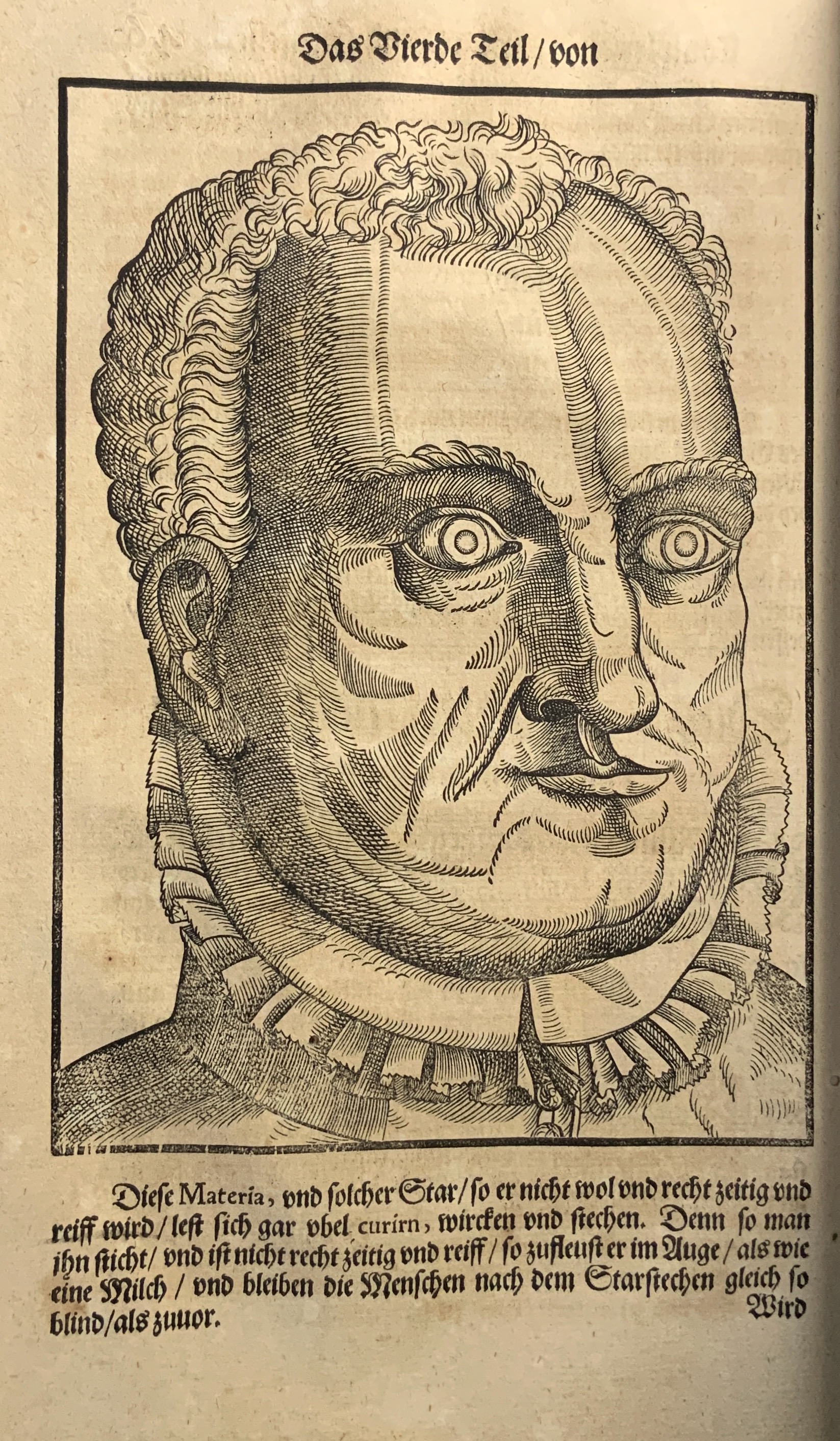
Image of man with startled eyes
A couple of weeks ago, a catalog came to us and we were ogling a very cool book: George Bartisch's Ophthalmodouleia, das ist Augendienst, the first work on ophthalmology from 1583. We could envision a lot of uses--we do a lot with the history of medicine--but the price was pretty steep so we were hesitant. Would the book do THAT much work for us? As we pondered, we checked the catalog, and, glory be, we already had a copy! Not only that, but all of its flaps still work and it still has its original metal clasps--so it is a dandy copy. Someone bought it for the library back in 1938 for a tiny fraction of what it costs today. A book unknown to us was sitting there all along just waiting to catch someone's eye. You can bet we will be using it now, and that it will find its way into Dartmouth classes.

Image of dissection of eye with all flaps closed
Image of dissection of eye with flaps open

 Come feast your eyes on it by asking for Rare RE41 .B3.


Friday, May 10, 2024

Theatre of the World

A two page spread showing a late 16th century map of the globe.What did the world look like in 1592? Abraham Ortelius's Theatrvm orbis terrarvum, or, Theater of the world attempts to answer that question. Cited as the first true modern atlas, Theatrvm was initially  published in 1570 in Antwerp, the richest city in the world at the time. Earlier compilations of maps did exist, but this work's combination of the best available maps with textual description lacked precedent.

Our edition is the 19th, with Latin text and a whopping 134 maps. Each map was printed from copper plates engraved by the Antwerp artist Frans Hogenberg and his assistants. While not reflective of global geography as we now know it -- there are, for instance, only five continents in Ortelius's world -- they are a massive artistic achievement, hand-colored and decorated with allusions to Classical and biblical events. We particularly recommend the maps of the Holy Land, Ancient Egypt, and Iceland (which has the best sea monsters).

The title-page for Theatrvm, showing four women representing the continents of Europe, Asia, Africa, and America, and the bust of a fifth woan represnting Terra Australis.Ultimately, this book is worth checking out for the title page alone. It features allegorical representations of the five known continents as women, and those images are just as fraught as the modern viewer might expect. We'll draw your eye to the smallest figure on the page -- only a bust of a woman where the other four have complete bodies. This is Terra Australis or Magellanica, the unknown but plenty theorized continent to the south. Europeans would not reach the (already inhabited) Australian continent until 1606, after which the idea of yet another unknown southern continent would persist until the discovery of Antarctica in the 19th century.

To take a look at Ortelius's world, ask for Rare Book G1006 .T5 1592.

Friday, March 29, 2024

Happy (Belated) Purim!

An image of an unrolled scroll with Hebrew text.Last weekend, Jews around the world gathered to celebrate the holiday of Purim, or the Festival of Lots. This joyous occasion, celebrated each year in the Hebrew month of Adar, celebrates the triumph of the Jewish community of ancient Persia against the threat of annihilation at the hands of the villain Haman. Jews traditionally celebrate Purim by dressing up in costumes, sharing baskets of treats and gifts with friends, eating delicious triangular hamantaschen cookies, putting on comedic plays (purimshpieln), and gathering in synagogue to listen to the Purim story read aloud from the Book of Esther. This is the story of how the beautiful Jewish Queen Esther and her cousin Mordechai foiled the plot of the wicked Haman, advisor to King Ahasuerus, who sought to exterminate the Jews. Unlike Torahs, which take the form of a double parchment scroll, the Purim story is traditionally written on a single parchment scroll called a megillah, which gives the Book of Esther its Hebrew name, Megillat Esther.

Rauner recently acquired a rare Megillat Esther, written in elegant Hebrew script on parchment. While it can be hard to determine the date and place of origin for Hebrew manuscripts, carbon dating tests performed by the dealer narrowed down the potential date range, and analysis of the Sephardic script and Italianate parchment indicate that it was most likely produced in Italy between 1500 and 1550. According to the dealer, this megillah is one of only 30 surviving copies of this text dating from 1400-1600.

An image of an unrolled scroll with Hebrew text.
Amazingly, the scroll that bears this infamous story of Jewish persecution was produced during another infamous moment of Jewish persecution: the advent of the Jewish ghetto in what is now Italy. The first Jewish ghetto was established in Venice by ducal decree in 1516, in the same time period and approximate location as our megillah. The Jews of Venice and, later, other Italian city-states, were required to live segregated from the gentile population, only permitted to leave the ghetto during the day before being locked in at night. I like to think that for the Italian Jewish community that produced and read this very megillah, the Purim story had special salience and significance - an inspiring story of Jewish survival.

To see our Megillat Esther, come to the reading room desk and ask for Codex 003513.

Friday, February 23, 2024

Perfection through Portraiture

The title page to the Illustrium Imagines.Can we become more virtuous just by looking at portraits of illustrious people? Yes, we can! This is the claim of 16th century portrait books like the Illustrium Imagines (Images of the Illustrious), published at Rome in 1517. The printer’s preface points out that the noble Romans had portraits of illustrious people “in the halls and even in the very doors” so that “by constant recollection of them, not only in thought but by sight, their minds were encouraged and supported to emulate their glory.” Portrait books offered readers an edifying gallery of portraits in the palm of their hands.

The portraits in the Illustrium Imagines are mostly based on coins – making it the earliest illustrated printed book about ancient coins. It is probably the work of Andrea Fulvio, an antiquarian and Latin teacher active in Rome.

The book’s layout is striking. Ornate woodcut frames surround and “support” coins depicting Roman emperors and members of their families. Brief biographical, historical, or antiquarian notices accompany each coin. Though mostly dedicated to Roman emperors, the Illustrium Imagines includes Byzantine and medieval rulers, but their likenesses are almost entirely imaginary and suggest that medieval coins, despite being nearer in time to Fulvio’s day, were less readily available to collectors.


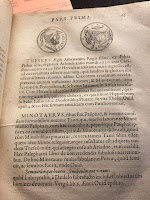
[The emperor Tiberius depicted in the Illustrium Imagines and a gold aureus issued in 16 CE (image courtesy of the American Numismatic Society).]

The portrait artist (both Ugo da Carpi and Giovanni Battista Palumba have been proposed) has crammed many details into the tiny portraits: craggy wrinkles, exquisitely coiffed hair, and fierce or benign gazes. The inscriptions around edge of the coins, like the coins themselves, are sometimes genuine.

The Illustrium Imagines was widely imitated. Johann Huttich’s Imperatorum et Caesarum Vitae cum Imaginibus ad Vivam Effigiem (Lives of the Emperors and Caesars with Lifelike Portraits, published in Strasbourg in 1534; an earlier edition was printed in 1525) copied many portraits from the Illustrium Imagines, including those of Emperor Galba and his wife. Fulvio's version is below on the left, and Huttich's on the right.

Fulvio's portraits of the emperor Galba and his wife.

But Huttich also corrected many of Fulvio’s errors, added coins to which he had access, and included blanks in cases where he had no coins at hand, such as the empty space shown below where the emperor Leo's image should be. Book owners could draw in their own if they had them.


In the second half of the 16th century, the formula of coin with text was still popular. The French printer Guillaume Rouillé published his Promptuarium Iconum Insigniorum (Treasury of Portraits of Distinguished People) in 1553 (often reprinted; our copy is from 1578). Less concerned with historical accuracy – there are coins depicting Theseus and the Minotaur, for example, as seen below on the left – Rouillé’s work includes historical and contemporary people of note, like modern kings and men of letters. The images below on the right are his renditions of Renaissance luminaries Erasmus and Guillaume Budé.

Rouillé's images of Theseus and the Minotaur      Rouillé's renditions of Renaissance luminaries Erasmus and Guillaume Budé

Fulvio’s and Huttich books held great value for those interested in ancient coins. Rouillé’s has more of a general appeal. But perhaps the most important reason for the success of their books, and Rouillé’s, is the human desire to see (or imagine) what illustrious people looked like. And, of course, to make ourselves more virtuous.

In his preface to the reader, Rouillé suggests that the edifying effect of gazing upon such illustrious people could even result in the reader himself being immortalized in print: “Conduct yourself in this way,” he writes, “so that through the exceptional praises of your virtues, your likeness too might be deemed worthy of a distinguished place in future editions of this book.”

To see the Fulvio, ask for Rare N7585 .F8 1517; the Huttich, RareDG203 .H8 1534; and the Rouillé, Bryant CJ5569 . R73.

Further reading:

Cunnally, John. Images of the Illustrious: The Numismatic Presence in the Renaissance (Princeton 1999).

Haskell, Francis. History and Its Images: Art and the Interpretation of the Past (New Haven 1993).

Madigan, Brian. Andrea Fulvio’s Illustrium imagines and the Beginnings of Classical Archaeology (Leiden 2022).

Pelc, Milan. Illustrium Imagines: Das Porträtbuch der Renaissance (Leiden 2002)

Stahl, Alan. “Numismatics in the Renaissance.” Princeton University Library Chronicle 69.2 (2008), 217-240.

Weiss, Roberto. “The Study of Ancient Numismatics during the Renaissance.” Numismatic Chronicle 7.7 (1968), 177-187.

Published for Daniel Abosso, Subject Librarian (Baker-Berry Library).

Friday, December 15, 2023

Captured!

Woodcut of author attempting to escape and being tortured
We have lots of various captivity narratives in our collection. They are usually sensationalized stories set in New England--stories of terror designed to frighten and titillate. There is almost always a racially charged dichotomy set up between the "savage" and the "civilized" reflecting the pervading fears of the white settlers. We just acquired a new one that is both very different and still frighteningly similar. In this second edition of Bartolomej Georgijević's De afflictione tam captivorum quam etiam sub Turcae tributo viuentium Christianorum (Worms: excudebat Gregorius Comiander, 1545), the captive is a Croatian captured and enslaved by the Ottoman Empire. The same tropes appear: a good Christian is captured by a threatening non-Christian other and forced into servitude. 

Interestingly, Georgijević was also a talented linguist and the slender volume contains a basic Latin to Turkish lexicon and a short Croatian-Latin dictionary. The book took off, as so many captivity narratives did, and served as a highly biased account of Turkish culture at a time when Europe was both fascinated and terrified of that which lurked just to the East.

To take a look (it has seven wonderful woodcuts), ask for Rare DR481 .G46 1545.

Friday, March 24, 2023

Happy New Year's Eve?!

Quaker document page 1Tomorrow is New Year's Day! Well, at least, it would be here in the former English colonies if not for an Act of Parliament in 1750 that firmly established January 1 as the start of the "New" New Year. This was a necessary law because of the widening discrepancy between the dates of the Julian calendar, which was only still used by England, and the Gregorian calendar, which had been in use by the rest of Europe since 1582. Fiercely Protestant at the time, England had rejected the Pope's calendrical fiat and stuck with the Old Style system.

Well, at least, partially; March 25th remained the first day of the legal year (akin to July 1 being the start of the fiscal year for some institutions like Dartmouth), but everyone generally accepted January 1 to be the start of the real New Year because of the need to synch up important celebratory dates with the rest of Europe. So, often, English documents from 1582 until 1750 used a double-dating system to note both Julian and Gregorian systems.

Moreover, by the 1750s, the two calendars were more than ten days out of sync with each other because of their use of different strategies to account for their system's inability to perfectly match the actual orbital cycle of the earth around the sun. 

Whew. Are you still with me? It's okay if not; all that's important for this post is that the British powers-Quaker document page 3that-be called a halt to the madness by instituting a multi-step changeover to the Gregorian system that was finished in 1752. Despite previous Protestant pushback against the Pope's preferred program, at least one group of dissenters saw the change as a chance to remind its followers about what they viewed as textual idolatry. In a broadside addressed to "The Quarterly and Monthly Meetings of Friends in Great-Britain, Ireland, and America", the group's standing representative body encourages its members to embrace the use of numbers instead of names for months and days so that they would no longer give "honor to the idols of the heathen."  The document then spells out the sources for all of those names. Although you're probably familiar with some of these attributions, some of them may be new to you. One detail that I had never really considered, but that makes perfect sense, is that Sept-ember, Oct-ober, Nov-ember, and Dec-ember are named after their previous chronological place in the Julian system (since February was the twelfth month of the year, not December!).

To read the entire document denouncing pagan months and days, come to Special Collections and ask for Presses F854f.

Friday, March 17, 2023

Llull's "Ladder of Understanding"

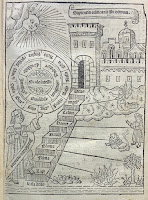
Woodcut of Llull's "Ladder of Understanding"This striking woodcut is found in the 1512 edition of Ramon Llull’s Liber de ascensu et descensu intellectus (Book on the Ascent and Descent of Understanding, written ca. 1305) that was printed in Valencia. It represents the “Ladder of Understanding” (scala intellectus) that Llull elaborates in this work. The particulars of Llull’s system are abstruse, but behind them lies the assumption that humans can, using their senses and intellect, understand the links between the created world and divine reality (Note: A full transcription and translation of the words found in this woodcut can be found at the bottom of this post).

The extraordinary Ramon Llull (c. 1232 - c. 1315) was born in Majorca. By his own account, he lived as a licentious troubadour before a series of visions convinced him to abandon his worldly life to serve God. Llull was particularly inspired to convert Muslims. He learned Arabic and deepened his knowledge of philosophy and other branches of knowledge.

It was on a mountain, the story goes, that God once again inspired him to write a book that would convert non-believers. “[Llull] came down from the mountain and … began to plan and write the book in question, calling it at first the Ars major, and later on the Ars generalis. Within the framework of this Art he then wrote many books … in which at great length he explained general principles by applying them to more specific things.” (Ramon Lull, A Contemporary Life, ed. And trans. Anthony Bonner (Barcelona / Woodbrige 2010).

This little book is one of the many expressions of Llull’s Art (largely logical in nature) – he wrote over one hundred works, including novels to alchemical works. His logical works, however, have sometimes earned him the status of pioneer in computational theory.

Description of the Woodcut:

There are three ladders depicted in the woodcut. The professor (bottom left), with a banderole that reads “Combined understanding,” has one foot placed upon the bottom step of the first ladder, and points to it with his right hand. With his left hand, he holds up the second and third ladders (the two concentric circles).

The first ladder:

Stepping from the bottom to the top, our intellect ascends (in understanding) first through stone, then fire, the plants, then animals, then man, then the heavens, the angels and, finally, God. The hierarchy is clear: the stone is most simple, and God is most complex.

The second and third ladders:

To understand the properties each of the steps on the first ladder, the professor holds up the second and third ladders (the two concentric circles), each subdivided into “steps” with words. 

It is perhaps easiest to understand these words as forming a conceptual rubric through which one can classify the properties belonging to a created thing. A stone, for example, might be classified as “cold, inert, passive,” and so on.  Using the conceptual rubric of the second and third ladders, one can range up and down the first ladder. Without using the proper concepts, Llull says, the intellect is ineffective in understanding. 

If we use the Llull’s Ladder of Understanding, we can enjoy serene contemplation in the Mansion that Wisdom Built for Herself (Sapientia edificavit sibi domum).

Llull’s conception of a chain linking the simple to the complex is not unique to him. See Great Chain of Being. To see our copy of Llull's Liber, come to Special Collections and ask to see Rare Book PA8360.L93 D4 1512.

This post was written by Daniel Abosso, Research & Learning Librarian for Humanities.


*****

Transcription and Translation for Woodcut:

Top banderole: Sapientia edificavit domum. Wisdom has built a home for herself. (Proverbs 9:1, paraphrased)

Bottom banderole (magister): Intellectus coniunctus. Complete understanding.

Scala i(n)tell(ectu)s — Ladder of understanding

Lap(is) - stone
Flam(m)a - fire
Planta - vegetable
Brutu(m) - animal
Homo - man
C[a]elum - heaven
Angelus - angel
Deus - god

Circular Diagram:

At center: Scal(a)e intellectus — Ladders of understanding

Outer circle (=second ladder), clockwise:

Ac(cide)ns - accident
S(ubs)t(an)tia - substance
Natura - nature
Actio - action
Passio - passivity (being acted upon)
Act(us) - actuality
Ens - being (existence)
Gen(us) - genus
Spe(cie)s - species
I(n)divi(duu)m - individual
(Com)positu(m) - compound
Simplex – simple

Inner circle (third ladder), clockwise:

Dubita(bi)le - Doubtable
Imagina(bi)le - capable of being apprehended by the mind
Sensibile - capable of being apprehended by the senses
Intellegi(bi)le - understandable
Credibile - believable

Friday, March 10, 2023

Call (Number for) the Midwife

Childbirth depicted in Ruff's De Conceptu
We have a lot of really amazing guides to midwifery in our collections. They are fascinating--all written by "expert" men for the use of women assisting other women in childbirth and tending to many of their other medical needs. There is a weird vibe to them: you always get the feeling the users of the books were better informed than the producers.

Reproductive system from Ruff's De Conceptu
Today we show off two of our favorites from the 16th century. The first is Jakob Rüff's De Conceptu et Generatione Homminis (Frankfurt, 1580). We love this one for the images. The reproductive system looks like a plant producing a fruit--that seems fitting with a lot of early metaphors for reproduction. But it also has a great image of a birth. You'll notice the mother is being attended by a midwife, and off to the side are two gentlemen studying the stars to determine the child's fate. Good thing it was nighttime!

Title page to Birth of Mankind
The second is one of those survivals that gives you tingles. It was owned by two different midwives. Susan Aylett laid claim to it on the title page, and Elizabeth Fiss used the back flyleaves of our copy of Thomas Raynalde's The Birth of Mankind (London, 1565) as a record of births. She has listed each in the name of the father not the mother, for example, "Thomas Lucas his wife of" followed by three hash marks. There is also a big fat inky thumbprint on in the margins of the "Prologue to the women readers." We're dying to know if that was just a sloppy mistake in the printing office or if Elizabeth or Susan or left more evidence of their lives behind in this book. 

Midwife's notes in back of Birth of Mankind

Thumbprint in Birth of Mankind
To see them, ask for Rare RG91 .R27 and Rare RG91 .R9.

Friday, August 19, 2022

Ancient and Modern Apparel

De gli habiti antichi et moderni di diverse parti del mondo (Ancient and Modern Apparel of Different Parts of the World) is a seminal work in the field of fashion history, though it perhaps reveals more about the biases of its author than it does about its purported subject. Written in the 1590s by Venetian author and woodcut printer Cesare Vecellio, the treatise contains hundreds of beautifully detailed images of clothing from throughout Afro-Eurasia. During the Baroque era, one's social class, gender, and place of origin could be easily divined based on appearance and clothing. Though this was beginning to change by Vecellio's time, it was still largely true that certain people predictably dressed in a certain way. Vecellio's book was an attempt at documenting these archetypal looks from throughout the world. The treatise is also considered to be an early example of anthropology or ethnography, as Vecellio often discusses the daily habits, routines, traditions, and customs of the people whose clothes he is describing. However, Vecellio is far from a reliable source. His descriptions of foreign cultures are often filled with speculation and stereotypes. He also spends the vast majority of his book describing European dress culture, with only a very small minority of the test devoted to Africa and Asia. (A later edition of the book would also include the Americas). So while Vecellio provides the modern reader with marvelous images and interesting tidbits about dress culture, his work is perhaps best read as a glimpse into the kaleidoscope of stereotypes and tropes through which a late sixteenth century Venetian saw the world. 

This post was originally written by Stephen Iovino '21 for Nancy Canepa's Italian 23 class, 17th and 18th Century Italian Literature. 

Friday, June 25, 2021

The Pope's Celebrity Chef

An image from Scappi's cookbook of a rotisserie deviceAs we head into summer, we are beginning to dream about hot dogs, corn on the cob, and other seasonal favorites. Although we personally are satisfied with our own backyard cooking arrangements, this 16th-century cooking contraption might potentially breed serious grill envy among some outdoor barbecue enthusiasts.⁠

This mechanical marvel is one of many kitchen gadgets pictured in the 1596 edition of Bartolomeo Scappi's Opera dell'Arte del Cucinare. Scappi was the first true international celebrity chef, a la Julia Childs or Anthony Bourdain. He cooked for several popes and numerous bishops, but he truly rose to fame in 1570 when his cookbook with over a thousand Renaissance recipes was published to great acclaim. One of his pronouncements that was likely very well received by his local audience was that Parmesan is the greatest of all cheeses.

We recently acquired this volume for use in the classroom at the request of two of our Italian Department faculty members; we're so excited at the prospect of having students back on site, hopefully sooner rather than later!⁠ To take a look at some of the other great images in this book, come to Rauner and ask for Rare TX711 .S283 1596.

Wednesday, September 16, 2020

From νόστος / nostos to nostalgia

The Ulysses Etchings of Robert Motherwell
Motherwell, Robert, David. Hayman,
and James Joyce.
San Francisco: Arion Press, 1988.
 
"Keep Ithaka always in your mind.
Arriving there is what you’re destined for.
But don’t hurry the journey at all.
Better if it lasts for years,
so you’re old by the time you reach the island,
wealthy with all you’ve gained on the way,
not expecting Ithaka to make you rich.

Ithaka gave you the marvelous journey.
Without her you wouldn't have set out.
She has nothing left to give you now.

And if you find her poor, Ithaka won’t have fooled you.
Wise as you will have become, so full of experience,
you’ll have understood by then what these Ithakas mean."
(Excerpt from "Ithaka" / C.P. Cavafy ; trans. E. Keeley)
 
James Joyce Wavewords : from Ulysses
James Joyce Wavewords: from Ulysses.
Hellmann, Margery S., and James Joyce.
Seattle, Wash: Windowpane Press, 1996.

 "I cannot rest from travel: I will drink
Life to the lees: All times I have enjoy'd
Greatly, have suffer'd greatly, both with those
That loved me, and alone, on shore, and when
Thro' scudding drifts the rainy Hyades
Vext the dim sea: I am become a name"

Excerpt from "Ulysses"
Alfred Tennyson.
Seven Poems and Two Translations
Hammersmith: Doves Press, 1902.

See also "Ulysses" Alfred Tennyson. Poems, London: E. Moxon, 1842

Circe from After Flaxman
The Odyssey of Homer
After Flaxman, John and William Blake
London: Longman, Hurst, Rees & Orme, 1805.

Ulyyses and  Diomedes are condemned to the Eigth Circle
Ulysses and Diomedes are condemned to the Eighth Circle.
Inspired from Dante Alighieri, Henry Francis Cary, and William Blake.
The Inferno from La Divina Commedia of Dante Alighieri
New York: Printed by Richard W. Ellis for Cheshire house, 1931.

Colophon to Vlyssea, 1524
Vlyssea
Homer. Batrachomyomachia. Hymni. XXXII.
Venetiis: [In aedibvs Aldi, et Andreae Asvlani soceri mense aprili], 1524

See also: Odysses


Friday, May 15, 2020

Cromwell's Bible

There is nothing better for social distancing then a really good book. If you are like a lot of us, you are knee deep in Hilary Mantel's final installment of the Wolf Hall series, The Mirror & the Light. It lives up to the previous two novels in the series following Thomas Cromwell's rise and fall in the court of Henry VIII.

Throughout the third novel, Cromwell is overseeing the production of what came to be know as The Great Bible--a full English translation fit for the evolving Church of England. The book was being printed in Paris because they wanted the best quality work Europe had to offer, but political difficulties kept rearing up (a Protestant bible in France... not cool with the Inquisition). When it was nearly finished, Cromwell had all of the type and printed sheets brought to England to complete the printing.

Our copy is particularly nice because when it was bound someone put "Lord Crumwel" on the spine--you get the feeling, based on the various pronunciations of Cromwell's name in Wolf Hall, that it was a native French speaker--though I doubt it was a member of the Boleyn family!

The title page, probably designed by Hans Holbein, is amazing. The word comes from God, but Henry doles it out to the people--on his right to the head of the church to distribute to the clergy, and on this left, to Cromwell to send out to the laity.

Cromwell didn't last much longer after the publication was finished, but the book is alive and well in our collections. To see it, ask for Rare BS155 1539.

Wednesday, April 1, 2020

Early Readers

A primer with a page of text on a wooden frame.Until quite recently, one of the first texts that many children would have learned to read was the Lord's Prayer. A child learning to read in eighteenth-century England might have encountered the Lord's Prayer in a hornbook, a durable primer containing a single sheet of text backed with wood and covered with a thin, transparent sheet of animal horn or mica. This hornbook from our collection devotes nearly half its page to the text of the Lord's Prayer.

In the second quarter of the sixteenth century, a young girl in the French royal family also owned a pocket-sized copy of the Lord's Prayer. Her delicately illuminated book of hours has some unusual additions - the Lord's Prayer, Hail Mary, and Credo are all copied out in a large, legible hand on the first three pages of the volume. Every adult would have memorized these fundamental texts long ago, but a young girl just learning to read and write would certainly have appreciated this (admittedly lavish) cheat-sheet.

An open book with illuminated details. A page containing the Lord's Prayer in Latin.
Ask for Val 028.5 H783 to see the hornbook.  The miniature book of hours is Codex 003197.

Tuesday, October 22, 2019

Portable Fuchs

Frontispiece to Fuchs's herbalIn 1542, Leonhard Fuchs published his great herbal. We have a copy of that first edition. It is a beast of a folio, richly illustrated and dense with text made for serious study. But it couldn't easily be carried into the field for easy reference, so seven years later, an octavo edition was printed in Lyon for portability.

We were just able to acquire a copy with hand-colored images throughout: De historia stirpium commentarii insignes (Lyon, 1549). One of the reasons we love this little edition is that it provides a wonderful contrast with the original edition in the classroom. Students can immediately see how form and function interact in a printed book.

Two-page spread showing hand-colored plants
As an aside, Fuchs is always fun to use because his herbal was placed on the index of forbidden books by the Catholic church--not because it contains any heresy, but because Fuchs had joined the Protestant Reformation.

Hand-colored flowers from Fuchs
To see the first edition, ask for Rare QK41.F7 1542. For the colored edition, request Rare QK41 .F7 1549.