Friday, July 8, 2022

Exhibit: Sharing the Computer

Looking around campus today, it is hard to believe, but there was once a time when Dartmouth didn’t have any computers. And when Dartmouth did first acquire a computer, like many institutions at the time, they faced obstacles sharing access with the Dartmouth community. It was the 1960s; computers were big and expensive, and hardly anyone knew how to use them. But when John McCarthy, a computer scientist at MIT, told Dartmouth math professor Thomas Kurtz, “you guys ought to do time-sharing,” Kurtz realized this could be the answer to Dartmouth’s problems.

Time-sharing worked by allowing multiple users to connect to a single, powerful computer via teletype terminals. The computer couldn’t actually run more than one program simultaneously but instead cycled through them very quickly. And while one person was typing, or thinking, or getting distracted at their own terminal, the computer wasn’t sitting there waiting for them: it was keeping busy running other people’s programs. This efficient arrangement allowed many, many more people to learn to use a computer for the first time, and eventually, the effects of the Dartmouth Time-Sharing System (DTSS) reached even beyond Dartmouth.

To learn more about Dartmouth's innovative impact on computer science, visit the current exhibition in the Class of 1965 Galleries at Rauner Library in Webster Hall. It was curated by Val Werner '21 and is open to the public from June 28th through September 2nd during our regular hours of operation.

Friday, July 1, 2022

All Wrong, but So Right

Engraving of fireworks at Versailles
This is silly. This book is 100 years too old, it was created to honor a monarch, it is from France, and it was owned by a member of the British court, "Henry Duke of Kent." So why pull it out on Independence Day? Well, fireworks!

Les plaisirs de l’Isle enchantée: Course de bague; collation ornée de machines; comedie, meslée de danse et de musique; ballet du palais d’Alcine, feu d’artifice: et autres festes galantes et magnifiques (Paris: Imprimerie Royale, 1673) is a pretty amazing book. Commissioned in 1673 to document a lavish celebration of Louis XIV at Versailles, it depicts food, parties, elaborate spectacles like papier-mache sea monsters in the pools, and even the staging of one of Moliere's plays. It has all the trappings of royal extravagance and excess, and has nothing to do with a colonial rebellion. We could say featuring it this week on the blog is some kind of subtle indictment of American complacency and decadence (a party is a party), or perhaps just another example of our willingness to appropriate anything, but really, we are just into the imagery and it put us in the mood for a Fourth of July barbecue and day in the park.

Engraving of fireworks at VersaillesEngraving of sea monsters at Versaille


Engraving of fireworks at VersaillesEngraving of banquet table at Versailles

To see the book (it is so worth your time), ask for PQ1840.P2 1673.

Thursday, June 23, 2022

I Musk Ox You A Question

On March 17, 1917, Canadian-Icelandic explorer Vilhjalmur Stefansson wrote hurriedly to Sir Robert Borden, the Prime Minister of Canada. In his letter, Stefansson enclosed a small sample of wool from a musk ox, which he believed that, "if cultivated, can make Canada, continental and insular, as productive of meat, tallow and wool as the grazing regions of Australia or the Argentine."

Stefansson is clearly excited about the potential that musk ox presents to his nation: he asks Borden to set aside a half-hour for him to regale the PM with the wonders of this creature. He lists the many ways in which the reindeer in particular is an inferior creature and then boldly asserts that musk ox "will replace sheep and cattle on some ranges where these are now profitable."

To touch some musk ox wool, or to compare its texture with samples of camel hair and cashmere, come to Special Collections and ask to see the Papers of Werner Von Bergen (MSS-94).

Friday, June 17, 2022

Elementary BASIC

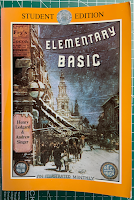
Photo of the cover of Elementary Basic.

Have you always wanted to learn BASIC? No? Well, would you want to learn BASIC if it were taught by Sherlock Holmes? If so, we have just the book for you!

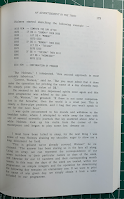
BASIC, the programming language invented at Dartmouth in the 1960s, revolutionized computing by making it easy for beginners to pick up programming for school, work, or fun. Over the following decades, methods of learning BASIC were in high demand, including at least one creative textbook. Elementary BASIC, by Henry Ledgard and Andrew Singer, resembles a typical Sherlock Holmes book, with a key difference: Sherlock is using BASIC to solve the crime. He explains it to Watson as he goes, giving examples in both BASIC and pseudo-code, such as this one for a conditional loop:

Photo of a sample page of Elementary BASIC.
Do the following:
    get another clue
    examine the clue
until MURDERER ≠ UNKNOWN

While it may seem silly, the book covers a lot of important programming concepts. It could even be useful today if BASIC were replaced with a more modern programming language, though Elementary Python doesn't have the same ring to it.

Now that you’ve been convinced to learn BASIC, come to Rauner and ask for MS-1144 Box 10, Thomas Kurtz’s collection of BASIC texts from around the world. On June 28th, we'll also be opening our summer exhibit on the Dartmouth Time-Sharing System, which BASIC was created for.

Friday, June 10, 2022

"Feeling Great Enjoying Everything"

Today we're taking a quick peek at the letters of Willard S. Smith, a New Hampshire man who served as an army chaplain during World War II. Written between August 1944 and February 1945 from positions in England and France, he describes life in the army, his thoughts on the war's progress, and the news he receives from home. His writing style is verbose and playful, and as such his letters are an absolute delight to read. In one, Willard outlines his seasonal calendar at home with "Nor will it be too long now before sap time, then mud time, then arbutus time, then graduation time, then haying time, then Murphy Cottage time, then (and always) lovin' time!"

There isn't a lot of biographical information out there on Willard, but we do know that he was in his forties  during World War II, with a wife and children back at home. He worked as a minister and was a practicing magician - some of his letters refer to putting on shows for local French children and to his correspondence with all his "magic friends." If his correspondence is anything to go by, he was an enormous personality and we recommend getting to know him better. Until then, we'll leave you with one of the first pieces of correspondence in the collection - a telegram that reads, in full: "Feeling great enjoying everything always remember dear keep smiling."

To read Willard's letters yourself, ask for MS-757.   

Friday, June 3, 2022

Dear (blank),

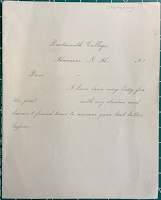
Photo of the first page of fill-in-the-blank letter stationery

For a student in the 1890s, keeping in touch with friends and family back home could be a chore. But the busy Dartmouth student could dash off his letters a bit quicker with some fill-in-the-blank stationery. We have a sample of such stationery here, in the second of our four Stationery vertical files.

The form covers all of the basic letter-home content:


Dartmouth College, Hanover, N.H., 189 (blank)

Dear (blank),—

I have been very busy for the past (blank) with my studies and haven’t found time to answer your last letter before.

I am much interested in (blank)

The weather has been (blank)

I see by the paper (blank)

I shall be home in (blank) weeks and

You said in your last letter that (blank)

There has nothing new happened here and it’s getting late so I shall close.

Your (blank)

The form makes some fair assumptions: this letter will be arriving later than expected, the writer is either busy with studies or willing to lie about being busy with studies, and if anything more interesting than the weather has happened in Hanover, the writer doesn’t care to share.

To see this and more stationery used by the Dartmouth community over the years, visit Rauner and ask for the Stationery vertical files.

Friday, May 27, 2022

An Ice-Free Arctic

Map from the front of Moxon's pamphletThe possibility of an efficient trade route from Europe to East Asia was an idea that gripped the imaginations of European explorers for centuries after Columbus's discovery of the American continent. In 1697, a member of the Royal Society and hydrographer to Charles II, published the second edition of a popular self-authored pamphlet that recommended a new approach to this puzzle.

In the aptly named "A Brief Discourse of a Passage by the North-Pole to Japan, China, Etc.," Moxon spends six pages to explain why he believes that pursuing a course through the Arctic is the most likely strategy to succeed. Moxon says that he has been "credibly informed by a steersman of a Dutch Greenland ship" that the North Pole is actually a warm and open sea. Based on this expert advice, Moxon goes on to say that he is convinced that the ice encountered by ships only appeared near land masses; if that narrow band of Arctic ice could be traversed, then it would be free and warm sailing across the top of the world and down to Japan.

Moxon's hypothesis was eagerly embraced by other reputable Northwest Passage enthusiasts, who further developed his idea to the point that in 1776, Captain Cook embarked on his third voyage to the Pacific with the goal of finding a way through the Arctic to the Atlantic. As you might already know, one of Cook's crewman on that trip was John Ledyard, a non-graduate of the class of 1776.

To skim Moxon's pamphlet and look at his map which shows what was known of the Arctic Circle at the time, come to Rauner and ask for Stefansson G640 .M69 1697.