Friday, June 3, 2022

Dear (blank),

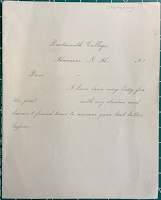
Photo of the first page of fill-in-the-blank letter stationery

For a student in the 1890s, keeping in touch with friends and family back home could be a chore. But the busy Dartmouth student could dash off his letters a bit quicker with some fill-in-the-blank stationery. We have a sample of such stationery here, in the second of our four Stationery vertical files.

The form covers all of the basic letter-home content:


Dartmouth College, Hanover, N.H., 189 (blank)

Dear (blank),—

I have been very busy for the past (blank) with my studies and haven’t found time to answer your last letter before.

I am much interested in (blank)

The weather has been (blank)

I see by the paper (blank)

I shall be home in (blank) weeks and

You said in your last letter that (blank)

There has nothing new happened here and it’s getting late so I shall close.

Your (blank)

The form makes some fair assumptions: this letter will be arriving later than expected, the writer is either busy with studies or willing to lie about being busy with studies, and if anything more interesting than the weather has happened in Hanover, the writer doesn’t care to share.

To see this and more stationery used by the Dartmouth community over the years, visit Rauner and ask for the Stationery vertical files.

Friday, May 27, 2022

An Ice-Free Arctic

Map from the front of Moxon's pamphletThe possibility of an efficient trade route from Europe to East Asia was an idea that gripped the imaginations of European explorers for centuries after Columbus's discovery of the American continent. In 1697, a member of the Royal Society and hydrographer to Charles II, published the second edition of a popular self-authored pamphlet that recommended a new approach to this puzzle.

In the aptly named "A Brief Discourse of a Passage by the North-Pole to Japan, China, Etc.," Moxon spends six pages to explain why he believes that pursuing a course through the Arctic is the most likely strategy to succeed. Moxon says that he has been "credibly informed by a steersman of a Dutch Greenland ship" that the North Pole is actually a warm and open sea. Based on this expert advice, Moxon goes on to say that he is convinced that the ice encountered by ships only appeared near land masses; if that narrow band of Arctic ice could be traversed, then it would be free and warm sailing across the top of the world and down to Japan.

Moxon's hypothesis was eagerly embraced by other reputable Northwest Passage enthusiasts, who further developed his idea to the point that in 1776, Captain Cook embarked on his third voyage to the Pacific with the goal of finding a way through the Arctic to the Atlantic. As you might already know, one of Cook's crewman on that trip was John Ledyard, a non-graduate of the class of 1776.

To skim Moxon's pamphlet and look at his map which shows what was known of the Arctic Circle at the time, come to Rauner and ask for Stefansson G640 .M69 1697.


Friday, May 20, 2022

Bringing Martin Luther King, Jr. to Dartmouth

A letter from Martin Luther King, Jr. to Gene Lyons about his recent visit to Dartmouth.
Martin Luther King III will be speaking on campus on May 23rd, so it’s a good time to reflect back to when his father spoke here, on the same date 60 years ago. Martin Luther King, Jr. lectured in Dartmouth Hall as part of the Great Issues Course, which brought in a variety of guest lecturers to speak on current world issues and was required for all seniors. On that day, King declared to his Dartmouth audience that segregation was “on its deathbed” and spoke on his methods for advancing racial justice. An overflow crowd gave King a standing ovation, and in a letter he wrote after the fact, he said he would “always remember the warm reception” he received.

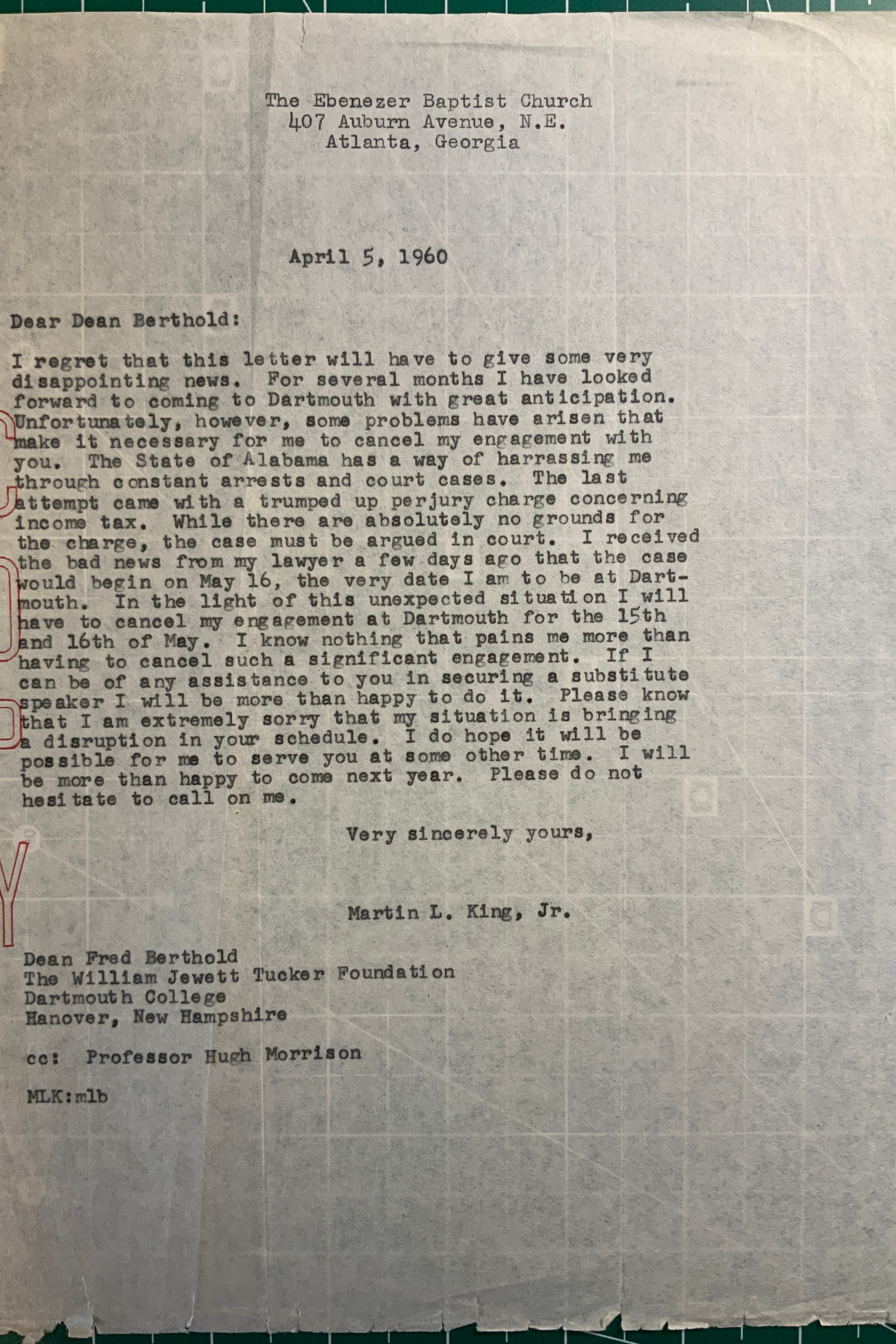
A letter from Martin Luther King, Jr. to Fred Berthold canceling his speaking engagement at Dartmouth.
Before 1962, Dartmouth had been trying for five years to get King to come to campus. The first time he was invited to speak in the Great Issues course, in 1957, he declined because his schedule was full. He was invited again and agreed to speak at Dartmouth in May of 1960; however, in April, he sent a profusely apologetic letter explaining that on the day of his speaking engagement, he would have to be in an Alabama court fighting a “trumped up perjury charge concerning income tax.” The next attempt was scheduled for May of 1961, but the day before King was first scheduled to speak, the Freedom Riders were brutally attacked in Montgomery, Alabama, and he left Hanover the next morning to address the emergency. After this last disappointment, Professor Gene Lyons wrote to King again and extended an open invitation, allowing him to visit any date in the next academic year when “the situation in the South might permit,” with as few as ten days’ notice. This time, King was able to make his lecture as planned, and the seniors of the class of 1962 had a chance to hear from one of the most celebrated civil rights leaders in history.

To read the correspondence about Martin Luther King, Jr.’s visit to campus, come to Rauner and ask for DA-12, box 1387. 

Monday, May 16, 2022

Hampered Housing

Front page of 7 Jan 1986 Dartmouth newspaper with article "Forty students in need of housing"
When the pandemic hit campus in early 2021, there was a lot of hysteria and confusion. For Dartmouth students, trying to figure out how the rest of the 2020-2021 school year would look like was difficult, especially regarding housing. Trying to secure safe on-campus housing was a nightmare for everyone, but especially for low-income, international, and homeless students: Dartmouth simply did not have enough physical housing for all its enrolled students.

As the Spring 2022 Historical Accountability Fellow, my research aims to find an explanation for why Dartmouth does not have enough physical housing for its students even though the administration knows that it has more total students than rooms available.

Dartmouth is unique among colleges and universities, in that it implements not only a quarter system, but also something called the “D-Plan”. The D-Plan allows for students to be unenrolled for a term and do anything that they want, whether that be an internship, fellowship, traveling, working, or simply taking a break from their studies. Based on my research, the D-Plan is an integral reason as to why Dartmouth does not have sufficient housing for all students.

Before the Fall of 1971, Dartmouth was a male-only school. Only three Ivy League colleges had gone co-ed as Dartmouth was transitioning from single-sex to co-education. After going co-ed, mainly due to alumni complaints, Dartmouth decided to admit the same number of male students as it would have admitted before co-education, so that no potential male students would lose a spot in favor of a female student. However, the college also enrolled an additional 150 students, all of them female. The first year of co-education, the Fall of 1971, was a difficult time for Dartmouth housing and residential staff, to say the least.

Not only did they have to change and modify requirements for the incoming freshman to adjust for the D-Plan, but they also had to modify room capacity to accommodate the extra students. Making singles into double and doubles into triples, Dartmouth housing had to scramble to make sure that all students enrolled in the 1971 fall term had a bed to sleep on, not to mention making renovations to older dorms, displacing male students to create single-sex female dorms, and accommodating students living in common rooms while waiting on a vacancy.

Dartmouth College would not reach a steady state, meaning that all classes enrolled were subjected to the D-Plan and no major housing crisis would ensue, until the 1975-1976 school year. From the Fall of 1975 until about the early 90s, Dartmouth had no major housing crisis. The D-Plan allowed for the administration to take in more students but not have to physically create more housing.

And although no major housing crisis (or construction) occurred from the late 70s to the early 90s, Dartmouth did not build any new dormitories despite knowing how fragile the balance was between enrolled students and available on-campus housing. The Lodge, originally a small motel called the Motor Lodge, was transformed to Dartmouth Housing in the early 70s. However, while the conversion of the Lodge and renovations to the Choate and River Clusters and other dorm clusters did indeed increase the number of total dorms, it did not amount to a significant increase in space. 

Only after a severe housing shortage in the Fall of 1994, where as many as 180 students were left without housing (after a record number of 3,845 students were enrolled for the term), did Dartmouth seem to believe that new construction was in order. Still, no new housing was available until 1996, with the completion of the Morton, Andres, McCulloch, and Zimmerman Halls, today known as the East Wheelock cluster.

Yet again in 2001, with the class of 2005, did Dartmouth have another housing crisis. New housing would not come until 2006, with the opening of opened the Fahey McLane and the McLaughlin Cluster. Another housing crisis occurred in the Fall of 2014, with the arrival of the abnormally large incoming class of 2018.

Evidently, there is a historical and cyclical discrepancy between how many Dartmouth students can be on-campus and enrolled per on a termly basis and how many beds Dartmouth has available for these students. My research aims to contextualize the housing crisis at Dartmouth to understand why and how Dartmouth has attempted to alleviate the strains on its housing system.

Posted for Rachel Perez '23, recipient of the Dartmouth Library's Historical Accountability Student Research Fellowship for the 2022 Spring term. The Historical Accountability Student Research Program provides funding for Dartmouth students to conduct research with primary sources on a topic related to issues of inclusivity and diversity in the college's past. For more information, visit the program's website.

Friday, May 13, 2022

A Curious Choice

Faded image of first page of Booker T. Washington letter to Dartmouth PresidentTucker.
On September 24th and 25th, 1901, Dartmouth threw a big gala event to celebrate the Webster Centennial. It was a big deal with dignitaries from all over the country descending on Dartmouth, speeches, parades, a recap of the last century of Dartmouth's history, a football game pitting alumni against students, a bonfire, and lots of cooing over how great Daniel Webster was. There was a also a special commencement to confer honorary degrees on a select group of people, among them Booker T. Washington.

Washington was a curious choice, perhaps inspired by then President Tucker's modern liberalism. You see, Daniel Webster is most famous as a great orator, fierce lawyer, and as a U.S. Senator who could get bill passed. Less talked about is his infamy for rousing the votes needed to pass the Fugitive Slave Act in 1850. That law forced federal officers to capture and return runaway enslaved people in Northern States and made it a crime to assist those enslaved persons whom had fled to the North. As you can imagine, the law was hated in the North, but Webster, seeking to preserve the Union, saw fit to give the speech that persuaded enough Senators to pass the bill. So here is Tucker, celebrating Webster's legacy by conferring an honorary doctorate on the most well-known civil rights leader in the United States who had been born into slavery. He must have known exactly what he was doing--a moment of symbolic resistance among the celebrations.

Second page of Washington letter featuring his signature

To see the letter Washington wrote to Tucker to accept the invitation to the Centennial, ask for MS 901557.1. The D has a great account of the festivities in the September 27th, 1901 issue on our reference shelves.

Friday, May 6, 2022

"Editorial Rutland"

Cover image from Frost's "New Hampshire"
Here at Rauner, we're fortunate to have one of the best, if not the best, collections of Robert Frost books and manuscripts anywhere in the world. In addition to his notebooks, correspondence, and calendars (among other things), we have first editions of all of his books of poetry, many of them duplicated many times over. Most of those editions are presentation copies, and Frost was fond of scribbling a message or a poem of his in the flyleaf along with his signature.

First page of Frost's letter to DuntonIn one of our copies of New Hampshire, instead of a poem or lengthy address, there is a letter from Frost to the book's owner, Edith Dunton, who lived in Rutland, Vermont. In his letter, Frost says that he hopes that the recipient will find this book of poems preferable to his previous works, which he notes "seem to have made no great hit in Rutland." He goes on to say that he had been told that "Editorial Rutland saw nothing in [his] work to compare with the work of some judge or other."

Despite Editorial Rutland's misgivings about Frost's work, New Hampshire would go on to win the 1924 Pulitzer Prize in Poetry and included such well-known favorites as "Stopping by Woods on a Snowy Evening" and "Fire and Ice."

To read Frost's letter for yourself, come to Rauner and ask to see Frost PS3511.R94 N4 1923.

Friday, April 29, 2022

Peddling Plaster of Paris

Bernardi smiling and holding his hat to the cameraWithin Dartmouth College's Photo Files Collection, we have several folders titled "Hanover People". Browsing through those folders, one discovers the faces of many of Hanover’s residents all the way back to the 19th century. There are images of men, young and old, babies, and women of all ages in crinolines, bustles and corsets. Many are identified by names written on the back of the photographs in pencil.

In addition to their name, a few have been annotated with the word "Characters". One such character was Americo Bernardi, a peddler who visited primarily college towns all over the nation to sell statuettes and other objects made of plaster of Paris. Bernardi applied for a license to sell his wares in Hanover on May 25, 1908, and for the next 25 years, Dartmouth College was one of his regular spots. The pictures in the Photo Files Collection show him peddling his masks and statues on the steps of Webster Hall around 1927 during one of Bernardi’s last visits to Dartmouth.

Bernardi selling figurines on the steps of Webster HallAccording to an entry in the Dartmouth Alumni Magazine of January 1933, Bernardi left the United States to return to his "Sunny Italy" because he was "feeling kind of homesick." Bernardi is also quoted as saying: “Now when I get home I will start drinking some of my ginger ale I told you about. I will try to save some for you when you come to visit me…Remember me to the President and also the Dean and Miss Bianchi; also, all my friends."

Bernardi, to whom students gave an insensitive sobriquet that was related to his heritage, also pops up in a 1926 notice in Banta’s Greek Exchange, an American magazine about college fraternities and sororities. There the writer comments on Bernadi’s remarkable memory: “If the name of a friend of college is mentioned, [Bernardi] will name his fraternity and hometown.” The notice also mentions his return to Borgo a Mozzano, Tuscany, in his native Italy because he “made his pile” and at the age of fifty wanted to enjoy life with his wife and six children.

To browse through photographs of Bernardi and other Hanover characters, visit Digital by Dartmouth Library's Dartmouth Photo Files Collection online and search for "Hanover people." You're also welcome to come to Special Collections and explore the original photographs in person.